
La demande de dosettes de recharge pour Nespresso s’est stabilisée à environ 14 800 recherches par mois aux États-Unis : signe qu’un changement sérieux dans les habitudes des consommateurs se déroule. Les utilisateurs complètent leurs propres capsules pour économiser de l’argent, accéder aux mélanges de boutiques et réduire l’utilisation du plastique. Ce guide se penche sur tous les formats : compatibilité machine pour les dosettes rechargeables, matériaux ayant la durée de conservation la plus longue, comment remplir correctement une dosette sans gâchis et économies réelles auxquelles vous pouvez vous attendre à différents niveaux d’utilisation.
📋 Référence rapide : Nespresso Pods rechargeables
| Spécification | Détail |
|---|---|
| Systèmes compatibles | OriginalLine (support complet) | Vertuo ️ ️ ️Très limité |
| Matériaux POD | Acier inoxydable, PP plastique, Aluminium |
| Quantité de remplissage | Espresso : 79g | Lungo/Double : 101g |
| Coût du bricolage par dosette | ~$0.23$0.43 (café uniquement) |
| Coût de la nacelle OEM Nespresso | $0.90$1.50 (officiel) | $0.35$0.70 (tiers) |
| Coût du kit de démarrage | ~$15$25 une fois | Pods d’équilibre ~2530 |
| Économies annuelles (1 pod/jour) | ~$183 contre OEM4T402 |
Que sont les pods de recharge pour Nespresso ? (Et pourquoi 14 800 personnes recherchent chaque mois)
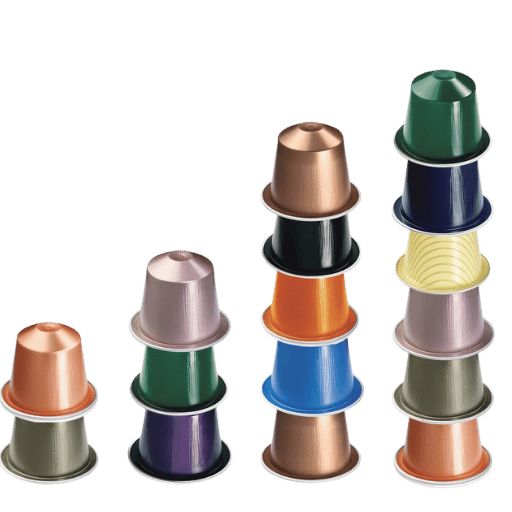
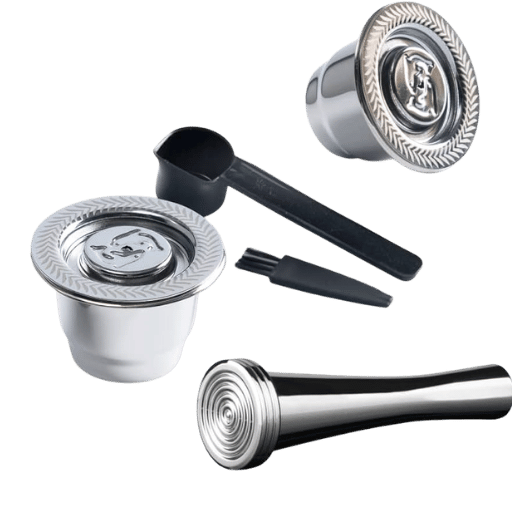
Rechargeables Nespresso Pods (Nespresso) Autrement appelés reusable Nespresso capsules sont des étuis vides destinés à être remplis avec précision de quoi sont fondamentalement faites les gousses Nespresso, « Mais à l’inverse : vous fournissez le café moulu de votre choix, puis vous scellez la dosette et la déposez dans votre machine, fonctionnant de la même manière qu’une dosette d’usine. ».
Trois formats principaux existent aujourd’hui sur le marché :
- Les dosettes rechargeables spécialement conçues pour ces unités arrivent sous la forme d’unités rechargeables fabriquées en acier inoxydable, en plastique PP ou en aluminium, spécialement créées pour être remplies et réutilisées encore et encore, avec des durées de vie allant de dizaines à des centaines d’utilisations.
- L’utilisation de pods OEM récupérés ce processus implique de trancher les pods d’usine à consommation ouverte, de les nettoyer soigneusement, puis de sceller à nouveau le dessus avec des autocollants en feuille d’aluminium. Cela s’accompagne d’une dépense financière initiale inférieure, mais cela a tendance à être une approche plus fastidieuse.
- Pods compatibles tiers : produits tels que Starbucks de Nespresso, Lavazza, Illy et les capsules préremplies OriginalLine compatibles avec le marché de Peet, qui coûtent moins cher que les pods Nespresso d’origine.
Les consommateurs passent aux dosettes rechargeables pour trois raisons impérieuses : une réduction du prix qui peut atteindre 79% par dosette, la liberté de brasser du café de spécialité ou des variétés de décaféiné qui ne sont pas disponibles dans la gamme Nespresso et un engagement à minimiser l’impact environnemental Le marché mondial des dosettes et capsules de café a été estimé à $25,9 milliards en 2022, avec un taux de croissance anticipé de 7,3% annuellement jusqu’en 2028 (Source : Groupe IMARC).
La croissance constante de ce secteur fait du créneau rechargeable un intérêt commercial considérable, puisque 56 milliards de dosettes de café finissent annuellement dans les décharges L’intérêt accru des recherches pour les dosettes réutilisables laisse penser que ce déséquilibre est susceptible de continuer à croître.
Les professionnels du commerce du café trouveront ici un terrain familier : les mécanismes impliqués dans les dosettes Nespresso rechargeables et la production de capsules commerciales compatibles Nespresso suivent les mêmes principes fondamentaux : forme et dimensions des capsules, gestion précise du poids et réalisation d’une étanchéité efficace. Le volume et l’automatisation sont ce qui sépare le remplissage de bricolage de la production commerciale, couvert en détail dans la section à l’échelle commerciale ci-dessous.
Nespresso OriginalLine vs Vertuo : Quelles machines fonctionnent avec les mottes rechargeables ?
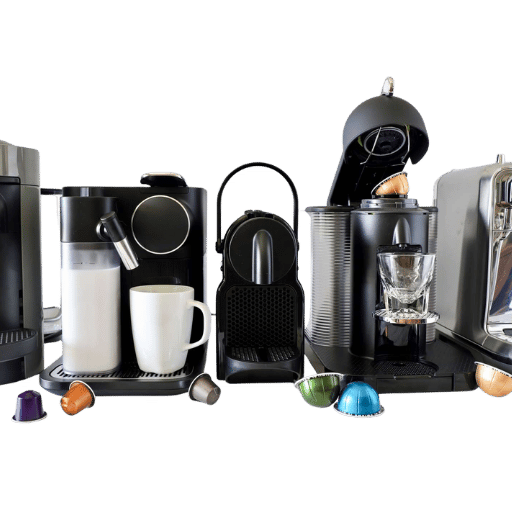
Votre machine Nespresso spécifique détermine à peu près toutes les options rechargeables disponibles Les systèmes OriginalLine et Vertuo fonctionnent très différemment : l’engagement des capsules, les mécanismes de verrouillage et le marché des dosettes rechargeables reflètent cette différence de manière frappante.
| Caractéristique | Ligne originale | Vertuo |
|---|---|---|
| Système d’extraction | Pompe à pression de 19 bars | Centrifugation (centrifugeuse + perfusion) |
| Mécanisme de verrouillage | Aucun ne convient uniquement | Analyse du code-barres DOM (code la température de l’eau, le régime, le volume) |
| Disponibilité rechargeable des pods | Large 20+ marques | Très limité 3 options 5 |
| compatible 3ème | Oui, les Starbucks, Lavazza, Illy, Peet’s | Très peu ; principalement OEM |
| Modèles OriginalLine | Essenza Mini, Citiz, Pixie, Inissia, U | Vertuo, Vertuo Suivant, Vertuo Pop |
Le plus gros obstacle est le système de codes-barres de la machine Vertuo ; chaque capsule a un code-barres circulaire DOM (Date de fabrication), qui permet à la machine d’identifier les paramètres précis pour faire le mélange spécifique de café contenu à l’intérieur des codes-barres non reconnus et Nespresso rejettera la capsule Il arrive aussi que Nespresso détient le brevet Vertuo, qui expire en 2030. Il empêche les fabricants tiers de dupliquer les capsules Vertuo. Dans l’ensemble, les choix sont assez limités pour le propriétaire d’une machine Vertuo qui veut éviter les consommables d’usine Cependant, certains kits de recharges Vertuo ont été développés pour adapter la capsule originale.
Existe-t-il des dosettes rechargeables pour les machines Nespresso ?
Oui : vous possédez une machine OriginalLine, vous pouvez trouver un excellent choix de dosettes rechargeables en acier inoxydable, aluminium, polypropylène de plus de 20 fabricants différents. Si vous possédez une machine Vertuo, votre choix sera alors considérablement limité à la fois par la capacité de lecture de codes-barres DOM de Nespresso et ses brevets sur la forme des capsules (jusqu’en 2030).Vous pourrez remplir votre café en utilisant des dosettes rechargeables Vertuo spécialisées qui s’insèrent à l’intérieur des capsules Original Nespresso, mais elles sont beaucoup plus rares que pour les systèmes OriginalLine.
Nous approfondissons la différence entre les capsules OriginalLine et les capsules Vertuo Guide des capsules Nespresso vs Dolce Gusto.
Types de Nespresso Pods rechargeables : matériaux, durabilité et lesquels choisir
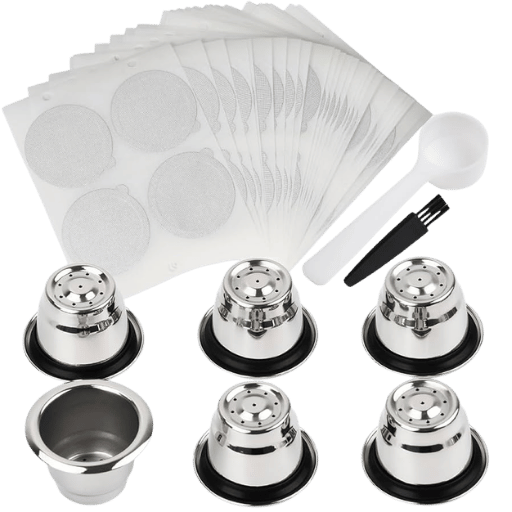
Nous avons classé les dosettes de café rechargeables spécialement conçues par leurs matériaux de construction : plastique, acier inoxydable et aluminium. Tous ont été testés par nous ou par un professionnel et résisteront aux hautes pressions (9 à 19 bars) et aux températures d’une machine OriginalLine Nespresso. Votre décision dépendra du nombre de cafés que vous préparez habituellement et de la quantité que vous souhaitez investir au début. Pour une explication des matériaux des capsules Nespresso rechargeables et de leur importance, consultez notre guide types de matériaux pour capsules Nespresso.
| Matériel | Coût/pod | Max réutilise | Nettoyage | Meilleur pour |
|---|---|---|---|---|
| Inox 304/316 | ~$1.50$3.00 | 100+ | Coffre-fort lave-vaisselle | Utilisateurs quotidiens, meilleure économie |
| PP Plastique | ~$0.30$0.80 | ~50 | Lavage à la main | Utilisateurs économiques, la plus grande variété |
| Aluminium | ~$0.50$1.20 | 3–10 | Moyen | Utilisation d’essai, sensation adjacente à l’OEM |
Best of the Best : Les capsules Nespresso rechargeables en acier sont généralement livrées en acier inoxydable de qualité alimentaire (304 ou 316) et occupent généralement le devant de la scène. “Les capsules de café réutilisables sont généralement fabriquées à partir de” en acier inoxydable, explique Natalie Hancock de Maverick Coffee Company. “Cela signifie qu’elles peuvent être soigneusement rincées entre les bières et être préparées pour votre prochaine tasse en quelques instants.” Elles offrent une rétention de chaleur fantastique et une température constante pour une extraction fiable Nous avons élaboré un guide complet de nos recommandations capsules Nespresso en aluminium si vous recherchez un look similaire aux capsules OEM.
Les capsules Nespresso rechargeables en plastique représentent la plus grande partie du volume du marché et offrent généralement un investissement initial inférieur. SealPod utilise du plastique PP (polypropylène) et dispose de nombreuses tailles de dosettes OriginalLine rechargeables pour répondre à une gamme de besoins, et même si certaines peuvent être utilisées jusqu’à 50 fois, beaucoup commenceront à montrer des signes d’usure beaucoup plus tôt.
Semblables aux OEM, les dosettes de café rechargeables en aluminium peuvent offrir une expérience esthétiquement similaire, mais elles nécessitent un nouveau couvercle en aluminium à chaque réutilisation ($0,02 par couvercle environ), ce qui en fait une solution hybride.
Insight technique : Les capsules Nespresso authentiques sont fabriquées avec un alliage d’aluminium de qualité alimentaire répondant à des normes dimensionnelles extrêmement précises (± 0,05 mm).À la haute pression dans une machine à café, de minuscules écarts dans la fabrication ou la qualité des capsules peuvent conduire à un contournement. Des capsules rechargeables fiables doivent maintenir ces normes, de sorte que les dosettes en plastique avec des tolérances de fabrication inférieures peuvent avoir des performances moins constantes.
Ceux qui s’approvisionnent en capsules vides et en couvercles d’étanchéité en aluminium peuvent trouver la sélection de l’AFPAK sur capsules vides et couvercles d’étanchéité.
Comment remplir les Nespresso Pods à la maison : étape par étape (avec des erreurs courantes)
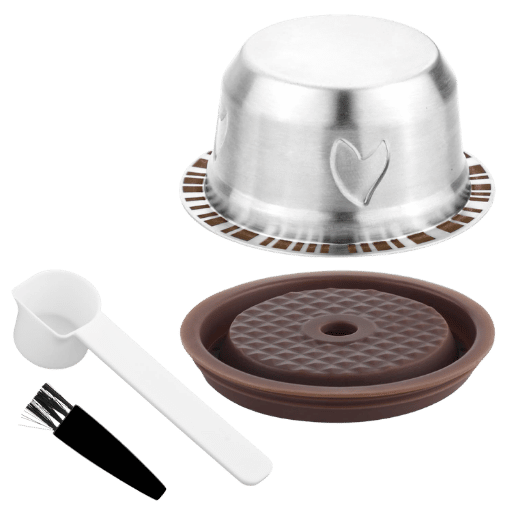
Puis-je remplir mes propres dosettes Nespresso ?
Sure ‘s simple pour OriginalLine avec un kit de recharge $15-25. Les dosettes de recharge Vertuo sont également une option en utilisant la coque de dosette d’usine d’origine puis en scellant avec du papier d’aluminium, mais ces résultats sont généralement plus incohérents par l’état du dosette et la préparation du code-barres autant que la cohérence de la mouture. Des mouture fines sont nécessaires pour les deux types de dosettes ou le résultat sera une extraction très faible et aqueuse quelle que soit la machine.
Quelle taille de mouture pour les dosettes Nespresso rechargeables ?
Moudre fine d’espresso (comme le sel de table).Certaines extractions plus longues (lungo) peuvent nécessiter une mouture fine légèrement plus grossière Évitez les mouture grossières (sous-extraction/faibles) et les fines turques (obturées).Un broyeur à bavures est idéal pour créer des marc de taille constante afin d’assurer une extraction uniforme dans le petit volume de la capsule.
Vous aurez besoin de gousses rechargeables, de haricots entiers frais moulus à la consistance appropriée, d’un porte-capsule et d’un kit d’inviolabilité (environ $15-25), de nouveaux couvercles en aluminium ou joints silicones et un petit pinceau.
- La mouture est critique Nous préférons une mouture fine à l’espresso pour 40 ml et une fine moyenne pour l’espresso de 110 ml Broyez les haricots frais et utilisez dans les 15 minutes suivant le broyage, car une grande partie de la saveur est perdue après cela.
- Grammes pesés, pas cuillères volumétriques. 7 g à 9 g pour l’espresso, 10 g-11 g pour le double. 13 g pour la grosse dosette de café Vertuo Utilisez une balance de cuisine qui mesure au dixième de gramme si possible, puisque certains cafés se emballent plus ou moins densément.
- Ne remplissez pas la dosette jusqu’au bord (brim) laissez un espace de 2 mm au-dessus du marc de café Le café se dilate sous la pression et la chaleur du processus d’extraction de l’eau Le remplissage de cet espace est l’erreur de débutant la plus courante qui fera voler le marc de café dans votre tasse.
- Appuyez légèrement avec le porte-capsule ou votre scoop-tamper. Nous voulons emballer légèrement afin qu’il n’y ait pas de tunneling et que le café ne soit pas surcomprimé et amer à cause du surtampage.
- Badigeonnez légèrement le marc de café égaré du bord extérieur de la capsule juste avant de placer le couvercle/le joint. Cela garantit que le couvercle entrera en contact, créera une étanchéité appropriée et évitera les fuites, une étape de cinq secondes.
- Appuyez fermement sur le nouveau couvercle en aluminium sur la capsule en travaillant à partir du centre, ou enclenchez solidement le capuchon en silicone Assurez-vous que les bords en aluminium sont pliés sous le rebord de la capsule pour les dosettes Vertuo si vous utilisez des capuchons en aluminium refermés. Agitez doucement la dosette 3 à 4 fois avant de la préparer pour desserrer le sol.
Alerte de remplissage excessif ! le remplissage excessif est la cause la plus fréquente de défaillance des dosettes de Nespreso Le café, forcé de sortir par les trous d’aiguille et de revenir dans l’extraction, souvent en raison d’un volume de sol excessif créant trop peu d’espace aérien Assurez-vous de laisser AU MOINS 2 mm d’espace au-dessus de votre marc de café avant de boucher votre dosette Les groundes dans votre tasse sont un signe pour toujours vérifier votre espace libre en premier !
Pour ceux qui recherchent l’expérience d’un expert, l’utilisateur vérifié Wayne, l’autorité sur le remplissage de plusieurs centaines de dosettes, a ceci à offrir : “Sur les haricots rôtis noirs sur un broyeur OXO Burr réglé à 2,2 sur espresso, je vais faire des 10 g en double shot L’astuce n’est pas de tasser trop fort, puis secouer doucement pour redistribuer le terrain pour s’assurer que le débit n’est pas entravé”.
Les plus grosses erreurs que j’ai commises et que je vois des autres sont : (1) Remplir et souffler à nouveau dans la tasse. (2) Broyer trop grossier créant une faiblesse. (3) Mauvaise étanchéité autour du bord avec Grounds s’échappant. (4) Sauter la brosse/le dessus propre hors de propos pour laisser le couvercle/le papier adhérer bien.
Scénario de la fête : le lot du dimanche de Maria
Maria, barista à domicile à Austin, remplit 3 dosettes chaque dimanche pour sa dose d’espresso du matin toute la semaine. En utilisant un ensemble $22 de capsules en acier inoxydable, ainsi que le rôti moyennement foncé de son magasin local, son coût en haricots par dosette s’avère être d’environ $0.31. Son seul ajustement après son premier mois : passer d’un grind moyen à un fin après deux tentatives a donné des bières fines et faibles.
Analyse des coûts : combien pouvez-vous réellement économiser avec des Nespresso Pods rechargeables ?
$0.23
Coût par module de bricolage
$1.10
Moyenne OEM Nespresso pod
~79%
Réduction des coûts vs OEM
Ce chiffre de 0,23 $ suppose du café moulu ordinaire de supermarché. Avec des grains de spécialité (environ 20 $/lb), comptez 0,43 $ – 0,50 $/dosette — cela reste une remise de 55 à 65 % par rapport à l’achat OEM. Un kit de démarrage (15 $-25 $) s’amortit généralement en 25 à 30 dosettes remplies.
| Gousses/jour | Dépense annuelle d’OEM | Coût annuel du bricolage | Économie annuelle | Kit recommandé |
|---|---|---|---|---|
| 1/jour | $329$548 | $84$157 | $172$391 | Kit plastique PP de base |
| 2/jour | $657$1,095 | $168$314 | $343$781 | Ensemble de 2 modules en acier inoxydable |
| 3+/jour | $985+ | $252+ | $550+ | Système inoxydable 5-pod |
| 30+/jour (entreprise) | $10 000+/an | — | Substantiel | Machine de remplissage commerciale |
Autres marques OriginalLine-compatibles Pour les consommateurs à la recherche d’un point médian entre OEM et bricolage manuel, vous pouvez envisager les capsules Starbucks by Nespresso, Lavazza Armonico, Illy Classico et Peet’s OriginalLine, toutes généralement vendues au détail à partir de $0.35 $0.70 par pod Les options de tiers Vertuo sont plus limitées ; la plupart des machines sont uniquement Npresso de conception Ceux qui recherchent des options écologiques voudront peut-être les envisager production commerciale de capsules PLA Nespresso écologiques.
Scénario de la personne : James et le problème de Vertuo
James, qui possède une machine Nespresso Vertuo à Chicago, a d’abord acheté trois marques différentes de dosettes de“ compatibles avec des” et a été accueilli par des messages de rejet sur sa machine Il est ensuite passé à la Nespresso OriginalLine de sa femme, et le remplissage de ses dosettes a fonctionné sans problème Il passe maintenant $28/mois sur les haricots spéciaux par rapport au $96/mois qu’il payait sur les dosettes Nespresso Vertuo et est $89 dans un commutateur de machine qui, selon lui, s’est payé en moins de six semaines.
Du bricolage à l’échelle commerciale : quand envisager une machine de remplissage de dosettes de café Nespresso
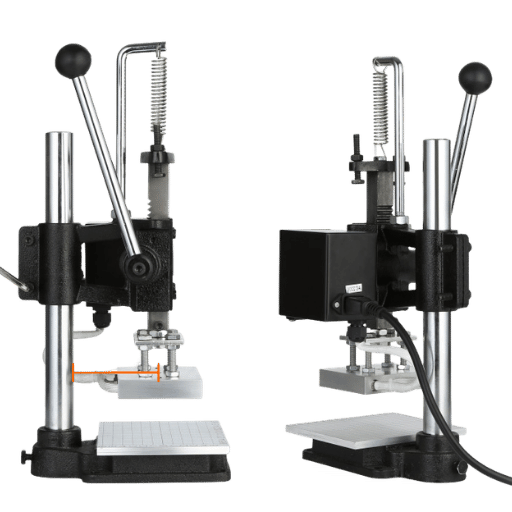
Remplir 1-5 dosettes par jour reste gérable à temps, N’importe quoi d’autre, et cela devient un problème Au-delà d’un certain seuil quotidien, cela devient un goulot d’étranglement plutôt qu’une solution, non seulement sous l’aspect du temps investi mais aussi de la cohérence de la qualité et de la durée de conservation.
Le remplissage de bricolage de signes a dépassé vos besoins :
- Remplissage de plus de 30 modules par jour = plus de 1 heure de travail manuel par jour
- Plaintes des clients ou du personnel concernant une résistance incohérente du café (l’écart de dosage en est la cause)
- Gousses développant une saveur rassis en quelques jours (pas de rinçage à l’azote = oxydation rapide après scellement)
- Incapable de répondre aux exigences de durée de conservation au détail (demandes commerciales de plus de 12 mois ; les modules de bricolage durent 1 à 2 semaines maximum)
- Rejets de qualité dépassant 5% de votre lot en raison de défaillances de scellés ou d’incohérences de remplissage
Les lacunes de précision de dose expliquent également cela Les dosettes Nespresso remplies à la main ont une variation de dose de 2 à 3 g entre les capsules, ce qui se traduit par une différence de 22 à 331 TP3 T dans la force d’infusion étant donné une cible de 9 g qui serait facilement perceptible pour tout buveur de café passionné Pendant ce temps, les machines automatisées de remplissage de capsules atteignent une tolérance <0,1 g, conduisant à des variations de résistance de la dosette à la dosette bien inférieures à 1%.
| Échelle de production | Vitesse (CPM) | Meilleur pour |
|---|---|---|
| Petite échelle | 400 CPM | Cafés spécialisés, startups, marques DTC |
| Mi-échelle | 1000200 CPM | Marques régionales de café, co-emballage |
| Haute vitesse | 4000600 CPM | Grands producteurs sous contrat OEM |
Scario de la salle de sport : mise à l’échelle du café de Singapour
Une marque de café de spécialité à Singapour remplie à la main 60 dosettes compatibles chaque jour pour leur café sur place ; après avoir rencontré des difficultés avec plus de 2 heures par jour consacrées au remplissage et des dosages incohérents provoquant des plaintes des clients, ils ont opté pour une machine de remplissage semi-automatique qui a réduit leur temps de remplissage des lots à 15 minutes, a réduit leur variation de dose de 2,8 g à seulement 0,09 g et a donné à leurs capsules rincées à l’azote une durée de conservation de 12 mois leur permettant de vendre du café en ligne.
Conceptions AFPAK machines commerciales de remplissage de capsules Nespresso sur la gamme de sortie 400 CPM 600, approvisionnant les entreprises dans plus de 40 pays En savoir plus dans notre Machines de remplissage et de scellage de capsules Nespresso guide, ou lire 6 facteurs clés pour choisir la bonne machine de remplissage Nespresso.
☕ Scaling votre production de capsules compatible Nespresso ? AFPAK propose des consultations gratuites pour les marques à n’importe quelle étape de sortie 1 000 pods/jour à 1 000 000. Contactez-nous à propos de notre machines commerciales de remplissage de capsules Nespresso.
Les pods rechargeables et l’environnement : 56 milliards de raisons de repenser votre habitude Nespresso
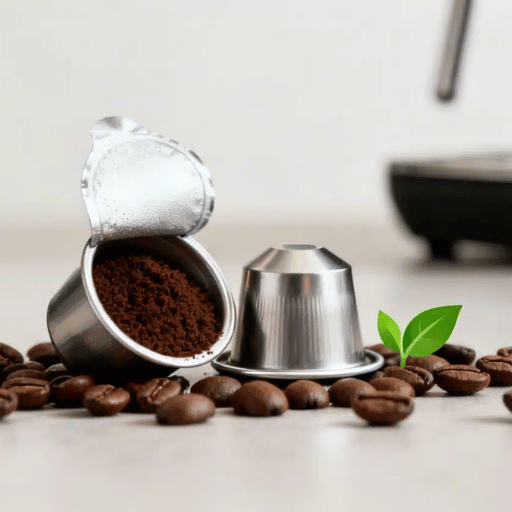
Au total, 56 milliards de dosettes et de capsules usagées sont déversées chaque année dans les sites d’enfouissement. La quasi-totalité du café que nous produisons dans le monde représente 95 pour cent. En termes de poids seul, avec 3 grammes par capsule vide, cela crée 168 millions de kg de déchets d’aluminium et de plastique qui augmentent de près de 7,3% chaque année.
56B
pods dans les décharges/an
106g
CO2-eq par Nespresso lungo
7.3%
CAGR, marché des dosettes de café
La propre évaluation du cycle de vie de Nespresso, réalisée par Quantis et évaluée par des pairs selon la norme ISO 14040/14044, indique qu’une capsule lungo en aluminium OriginalLine transporte 106 grammes d’équivalent CO tout au long du cycle de vie. Pour la dernière année, le taux de collecte de l’entreprise en Europe était de 30%. Pour toutes les capsules, cela implique que plus des deux tiers continuent de se retrouver à l’incinération/décharges.
Le simple fait de changer 100 dosettes jetables pour une dosette rechargeable en acier inoxydable élimine 300 grammes d’équivalent CO pour la production d’emballages seuls ainsi que les autres matériaux.
Du côté du marché, Natalie Hancock, copropriétaire de Maverick Coffee Company et productrice de capsules, écrit ceci à ce sujet.
“Nous pensons que certains des plus grands fournisseurs de capsules ne veulent pas exactement que quiconque sache qu’il existe des capsules réutilisables, ils veulent toujours obtenir leurs propres capsules one-shot dans les paniers d’achat des gens Et comme les consommateurs commencent à chercher des choix de capsules réutilisables, peut-être plus de gens découvriront les alternatives aux capsules one-shot”.
« Natalie Hancock, copropriétaire, Maverick Coffee Company (Royaume-Uni), via Perfect Daily Grind »
Cette tranche de dosettes rechargeables est minuscule par rapport à un marché total de 60 milliards de capsules par an. Pourtant, la tendance est indubitable. Alors que le marché se dirige vers un montant prévu de $39,9 milliards en 2028, les décisions de consommation en réponse à une préoccupation planétaire vont augmenter plus rapidement que les tendances du marché.
Même si les marques entrant dans la compatibilité Nespresso cherchent désormais à intégrer la durabilité dans un argument concurrentiel, et pas seulement dans un argument éthique ; le véritable impact environnemental des dosettes de café sont explorés plus en détail plus tard dans notre enquête.
FAQ Réflexions Pods pour Nespresso : Questions courantes Répondre
Puis-je remplir mes propres dosettes Nespresso ?
Oui 15 £ à 25 £ pour des recharges faciles Il suffit de broyer son propre café fin, de le mettre et de le sceller avec un peu de papier ou un couvercle en silicone réutilisable spécialisé pour l’utiliser dans sa machine à café exactement comme d’habitude.
Existe-t-il des dosettes rechargeables pour les machines Nespresso ?
Oui, il existe une variété dans OriginalLine avec plus de 20 fabricants fabriquant des dosettes de remplissage réutilisables en aluminium, acier ou polypropylène La sélection de capsules réutilisables pour les machines Vertuo est extrêmement restreinte en raison de la nature du système de codes-barres DOM et de la protection par brevet de Nespresso de sa conception de capsule Soyez certain que toute recharge que vous sélectionnez est compatible avec votre machine.
Puis-je utiliser des dosettes Aldi dans ma machine Nespresso ?
Les capsules OriginalLine, qui fonctionnent sur la gamme de machines Alcafe d’Aldi (compatible avec tous les modèles de machines OriginalLine Nespresso), sont également compatibles avec les machines Essenza Mini, Citiz, Pixie et Inissia, ainsi qu’avec celles construites avec une technologie similaire. Bien qu’elles soient incompatibles avec les machines Nespresso Vertuo (qui nécessitent une capsule Vertuo avec un code-barres circulaire), elles constituent une solution bien chère.
Les dosettes Nespresso rechargeables annulent-elles ma garantie ?
“Bien que Nespresso insiste sur le fait que l’utilisation de capsules tierces annulera la garantie de votre machine, en réalité, tant que les dosettes rechargeables sont correctement remplies et assemblées correctement, le risque pour la machine est en fait minime la cause principale de la défaillance est de la mouture du café d’une dosette mal scellée et débordante-plutôt que tout dommage direct Il est vrai que lorsque votre machine à café est sous garantie, et une réparation coûteuse est hors de question pour vous, en utilisant des capsules OEM aussi longtemps que dure la garantie fournira un peu de tranquillité d’esprit-et alors vous pouvez commencer à les remplir-et à partir d’un rapport décous les machines podTP-19 devraient régulièrement être utilisées.“
Quelle taille de mouture dois-je utiliser pour les dosettes Nespresso rechargeables ?
La meilleure mouture d’espresso pour la plupart des capsules d’espresso OriginalLine serait à peu près la texture du sel de table Les poumons utilisent des mouture légèrement plus fines que l’espresso standard Le mouture du café à une mouture trop fine, comme pour le café turc, sera trop fin et peut empêcher les trous d’aiguille de la capsule de fonctionner sous pression conduisant à une mauvaise extraction – et il est préférable d’utiliser des broyeurs à bavures par opposition à une mouture à lame car l’incohérence des particules dans un broyeur à lame peut produire des zones ‘ chaudes ’ et ‘ froides ’ lors de l’extraction du café.
Combien de fois puis-je réutiliser une nacelle Nespresso en acier inoxydable ?
Utilisez de l’acier inoxydable ou de l’acier inoxydable de haute qualité alimentaire (de préférence des alliages 304 ou 316) lorsque cela est possible car ce type d’acier inoxydable peut produire plus de 100 réutilisations, en supposant que ces dosettes soient propres et soignées après chaque utilisation, en effectuant des nettoyages en profondeur chaque semaine. Comme vous le verrez, une dosette en acier de qualité surpasse souvent n’importe quelle machine Nespresso. Les dosettes en plastique PP durent généralement entre 20 et 50 brasseries avant de pouvoir voir une usure et les dosettes rechargeables en aluminium ne donnent généralement qu’entre trois et dix brasseries.
À propos de cette analyse
AFPAK conçoit et fabrique des machines commerciales de remplissage et de scellage de capsules de café pour les formats K-Cup, Dolce Gusto compatibles Nespresso, produisant 40 à 600 capsules par minute, déployées dans plus de 40 pays Nos ingénieurs ont analysé les dimensions physiques, remplissent les exigences de précision et les spécifications de scellage de centaines de formats de capsules compatibles Nespresso sur les systèmes OriginalLine et Vertuo.
Divulgation de biais : AFPAK vend des machines commerciales de remplissage de capsules Nous avons un intérêt commercial dans les entreprises passant de la production manuelle à la production automatisée Cette perspective façonne la façon dont nous encadrons le seuil DIY-to-commercial dans cet article Notre analyse des options de pod rechargeable par le consommateur est basée sur des recherches vérifiées par des tiers et des données utilisateur AFPAK ne vend pas de pods rechargeables par le consommateur.


