
How long do coffee beans last is the question every coffee drinker eventually asks, and the honest answer depends on what “last” means to you: maximum flavor fades within days, but an unopened bag of fresh coffee beans packed with care can live for months. Whole bean coffee stays fresh much longer than ground or pre-ground coffee, and the single biggest factor after the roast date is the packaging – whether it has a one-way valve, nitrogen flush, or neither.
Especificações rápidas
| Peak flavor window | 4–14 days after roasting |
| Whole beans, opened | 2–4 weeks for best flavor |
| Whole beans, unopened (valve + N2 flush) | 6–12 months (controlled study to commercial claim) |
| Café moído, aberto | 1–2 weeks recommended; lab studies show acceptable quality anywhere from ~3 weeks to 3+ months depending on temperature and moisture |
| Feijão verde (não torrado) | 1–2+ years |
How Long Do Coffee Beans Actually Last?
Roasted coffee beans are best (peak flavor) four to fourteen days after roasting, hold that best flavor for two to four weeks once opened (though they stay drinkable well beyond that), and can be preserved unopened – with a one-way valve and nitrogen flush – for six months under lab measurement, or up to 12 months on many suppliers’ claims. Coffee doesn’t spoil on a set calendar day the way dairy does; it decays gradually as its aromatic compounds oxidize.
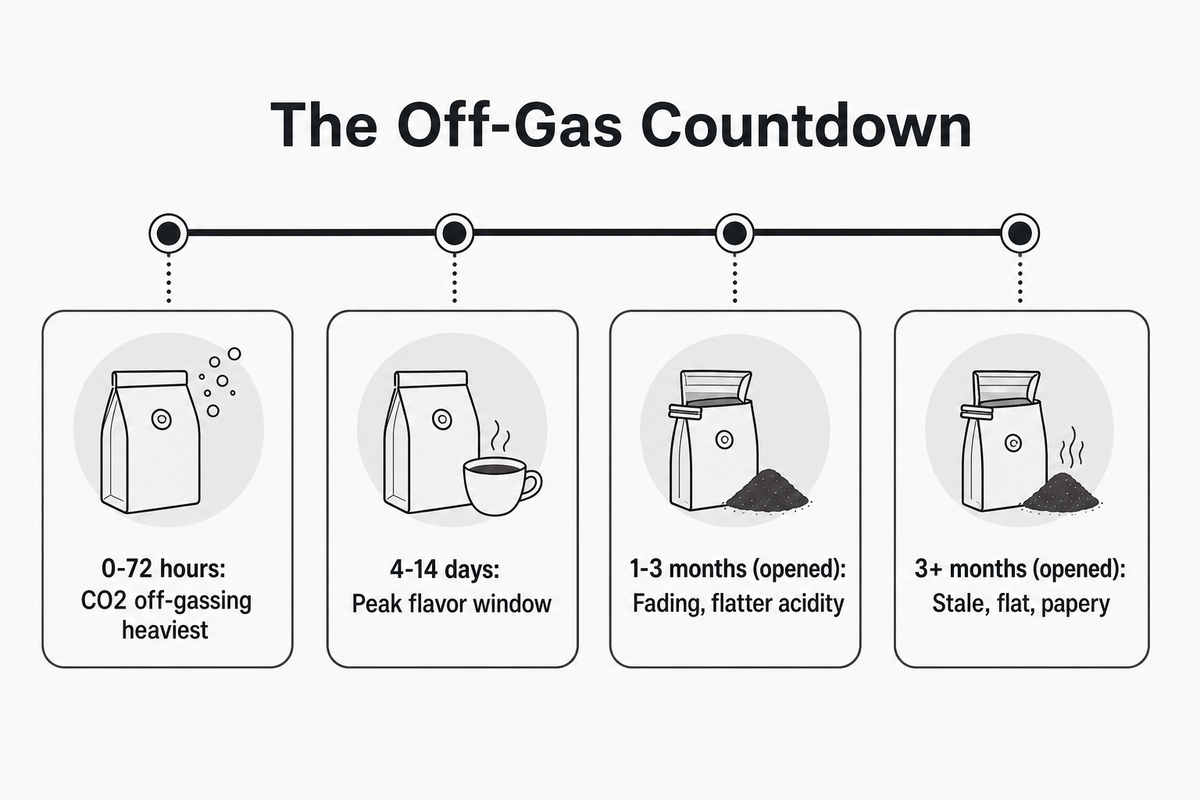
So “last” is an arbitrary measure, fluctuating from great to good to stale, and the number of days a specific bag of beans lasts depends on which end-point of that sliding scale – peak flavor, merely “good,” or technically “safe” – is being measured. What muddles the issue is confusion about which end-point is in question. A cupper assessing peak aroma, a consumer at home wondering whether to grind a bag of beans that have begun to stagnate, and a safety inspector investigating whether a beverage poses health risks are all answering different questions with very different answer-times. Most coffee drinkers really just want to know whether their coffee beans go bad the way milk does, or whether coffee goes bad in any meaningful sense at all; asking does coffee expire is really asking a different question than asking whether it’s still safe. Old coffee is safe to drink far longer than most people assume – coffee beans don’t spoil so much as they gradually go stale – and per FDA/USDA joint guidance on food date labeling, knowing the best way to store coffee beans matters more than any single date on the bag. Below, the version most useful to average readers maps time since roast to what’s really happening to the contents of the pack and what to do about it. Call it the Off-Gas Countdown: the freshness clock for any particular coffee starts the moment it leaves the roaster, not the moment it leaves the packaging.
| Time since roast | What’s happening | Flavor state | What to do |
|---|---|---|---|
| 0–72 hours | CO2 off-gassing is heaviest | Under-extracted if brewed too soon | Let dark roasts rest 2–4 days, light roasts 5–10 days |
| 4–14 days | CO2 release slows, aromatics peak | Peak flavor window | Brew now for the best cup |
| 15–30 days, opened | Oxidation accumulating with each opening | Still good, brightness mellowing | Fine for immersion brewing (French press, AeroPress) |
| 1–3 months, opened | Delicate aromatics degraded | Fading, flatter acidity | Use for cold brew, where weaker aromatics matter less |
| 2–4 weeks, unopened store bag | Slow oxygen ingress through a standard seal | Still near peak if bag stayed sealed | Open and use promptly once opened |
| 2–3 months, unopened vacuum-sealed | Oxygen largely excluded, CO2 trapped | Holding well if degassing finished before sealing | Confirm the bag was sealed after resting, not before |
| 6–12 months, unopened valve + N2 flush | Residual oxygen minimized, CO2 vents continuously | Commercially viable shelf life | Check for a roast date, not just a best-by date |
| 3+ months, opened | Oils surface, most volatiles lost | Stale, flat, papery | Repurpose (deodorizer, compost) rather than brew |
Look for a roast date printed on the package, not a best-before date – the FDA and USDA recommend “Best if Used By” as a voluntary quality marker, not a safety date. As a general packaging-industry convention (not a government requirement), that date is often set 6-12 months out from the packaging date, reflecting what nitrogen-flush and vacuum-seal formats can plausibly deliver. Either way, it doesn’t do much to indicate how long it has been since the beans were roasted.
How Long Does Coffee Last Once the Bag Is Open?
Once you open the bag, expect two to four weeks of good flavor from whole beans – one to two weeks if the coffee is already ground. The beans stay safe to drink well beyond that, but oxidation accumulates every time you open the container: by one to three months the delicate aromatics have degraded, and past three months most volatiles are gone and the cup turns flat and papery.
If you were to ask how long do coffee beans last, most people would probably really want to know either: is coffee going to spoil in a way I care about? Or: Have these particular coffee beans already begun to go stale? Coffee beans don’t spoil in a hard sense – they don’t transform into something hazardous to drink at some set calendar date. Coffee beans begin to decay more slowly: at first, the aromatics are lost, then the body, then the sweetness, and finally the beans become stale. And regardless of whether you keep your coffee beans in a bag on the counter, in a closed container, or in a can, the actual question that you’ll be asking yourself isn’t simply how long does coffee last, but is this bag of coffee still worth brewing today?
Why Coffee Beans Lose Freshness: The Chemistry, Briefly
Roasting wrings water out of the bean and traps a gas inside the cell structure – the same gas responsible for the hissing, bubbling “bloom” you’ll hear when you add hot water to freshly ground coffee. As soon as roasting finishes, that gas, carbon dioxide, begins escaping in a process called degassing, continuously for days or weeks.
Once most of the CO2 has made its exit, it’s replaced by oxygen, which slowly breaks down the oils and aromatics that give coffee its flavor through a process called oxidation, a mechanism academic shelf-life modeling of roasted coffee has quantified directly. Light, heat, and moisture all speed that same oxygen-driven breakdown of flavor compounds; all four are the enemies you’ll be guarding against with every storage tip in this guide. This is also where coffee begins to lose the qualities that make it worth drinking in the first place: aroma fades before body, and body fades before sweetness, so the beans begin to lose their best characteristics long before they become undrinkable. Green (unroasted) coffee beans skip that decline almost entirely. Because there’s no gas to be released and far less surface oil for oxygen to act on, green beans can sit around in a cool, dry warehouse for a year or longer and still make good beans for roasting, just as they do on home roasters’ shelves. Coffee’s freshness clock starts on its very first day out of the roaster.
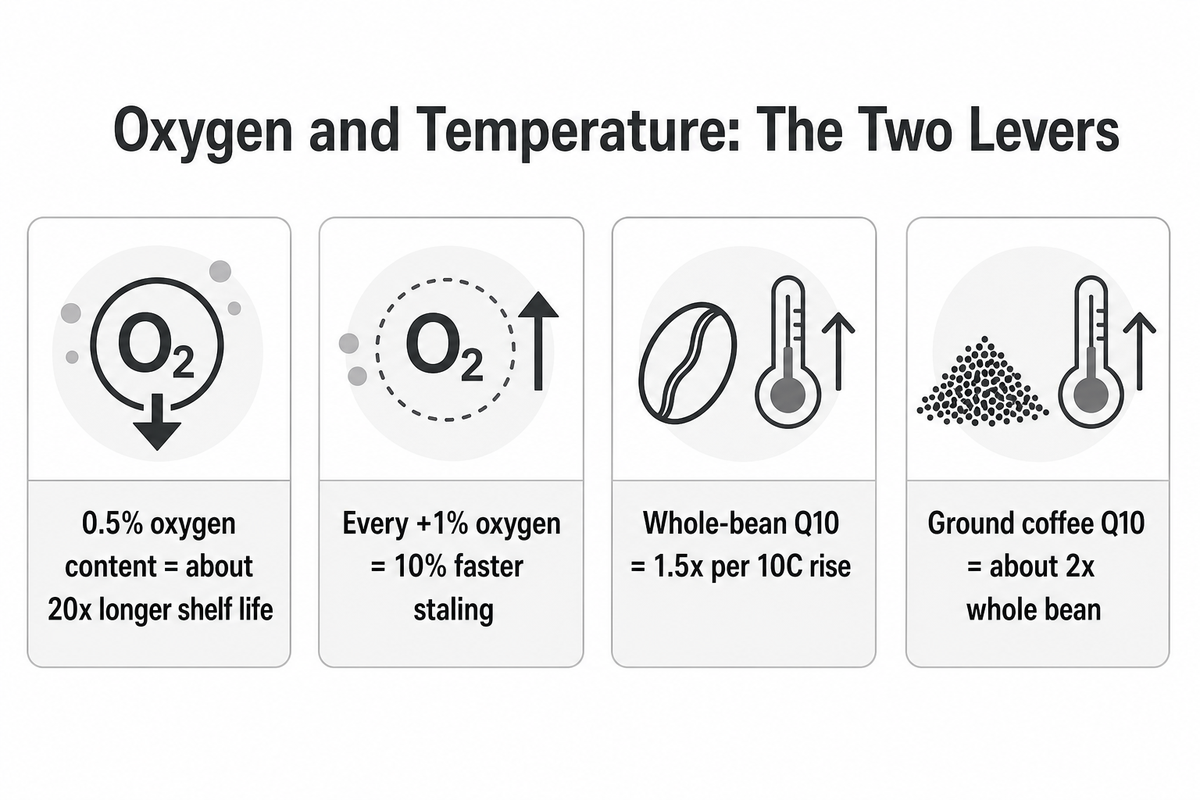
Oxygen exposure is less a component and more the component that determines the longevity of your coffee. The Specialty Coffee Association has cited research showing that 0.5% oxygen content in a coffee bag can extend the life of coffee by about 20 times compared to storing coffee in an open room. A separate study in that same literature review found coffee stales approximately 10% faster with every 1% more oxygen content in the bag – a different methodology measuring a different slice of the oxygen-staling relationship, so the two figures shouldn’t be multiplied together or expected to reconcile exactly; both point the same direction (less oxygen, slower staling) without claiming to be the same measurement. Of course, temperature compounds the effects: Labuza et al. (2001), as cited in the SCA literature review, found that whole-bean degassing has a Q10 of 1.5 – meaning it speeds up roughly 1.5-fold for every 10°C rise in ambient temperature. That same research found ground coffee’s Q10 runs about twice that of whole beans – not simply twice as fast at any fixed temperature, but accelerating twice as steeply as the room warms – another compelling case for grinding immediately before brewing.
“Coffee is what is known in the food science field as a shelf-stable product, which after roasting does not spoil due to enzymatic or microbial processes.”
— Specialty Coffee Association, literature review on coffee staling
Does Roast Level Affect How Long Coffee Beans Last?
Yes, roast level changes the timeline. Darker roasts develop more holes in their cellular structure from the extra roasting time, so they vent carbon dioxide faster and absorb oxygen more easily than lighter roasts, which hold their quality slightly longer under equivalent conditions. That’s why darker roasts need less rest (two to four days) before grinding than lighter roasts (five to ten days): the same porosity that speeds staling also speeds early venting.
The One-Way Degassing Valve, Explained
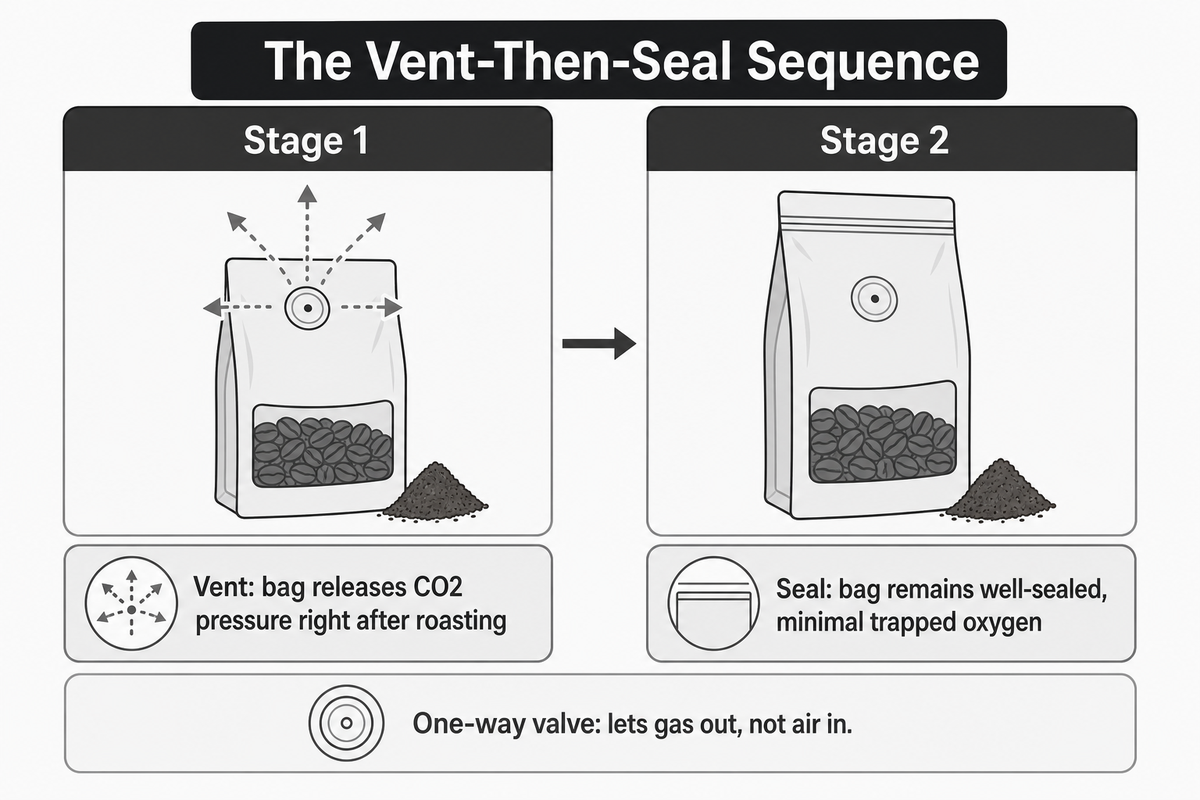
That little circular button commonly found on the outside of many coffee bags is actually a one-way degassing valve. It’s designed for the simple purpose of solving a bit of a timing dilemma: for days after being roasted, your coffee needs to release carbon dioxide gas – and yet, as soon as possible, you need to keep oxygen from reaching it. It achieves that by allowing gas out without letting air back in, a more pragmatic solution than having to choose between a sealed-up, risk-of-explosion bag and a prematurely-open-to-oxygen-damage one.
Think of it as The Vent-Then-Seal Sequence rather than a single feature: vent, then seal. Right after roasting, a bag needs to release pressure – be it through a one-way valve, or a brief period of open-air time before finally being sealed. Once most of that CO2 has been released, the bag needs to remain well-sealed, ideally with little oxygen trapped inside. A one-way valve – a check valve, in packaging terms – is simply the package construction that allows for both of those phases without fully de-sealing. AFPAK’s coffee bean bag packing equipment spec, where it lists the implementation of degassing valve application together with the nitrogen flush, notes that this is done “according to the coffee type, roasting process, bag structure and required shelf life.” That’s because there’s an interplay: how much CO2 is expelled and how quickly determines how the valve and the nitrogen flush should be calibrated and positioned.
A single one-way valve alone can’t guarantee a specific shelf life. Seal quality determines if it will even work: in a small published test of bags equipped with flexible valves (Walter et al. 2008, as cited in the SCA literature review – only six bags, so treat the numbers as directional, not definitive), fully sealed bags maintained over 40% CO2 content and 0% oxygen, whereas half had a seal leak which completely nullified the effects of the valve. Actual valve performance also depends on remaining headspace oxygen when the bag is sealed, the film’s intrinsic CO2 and water vapor transmission rates, and how many times the bag is subsequently opened. It’s one input into the packaging system, and can’t override the other elements – so seal-integrity testing on a production line deserves just as much attention as the valve specification itself.
Does Vacuum Sealing or Nitrogen Flushing Actually Help?
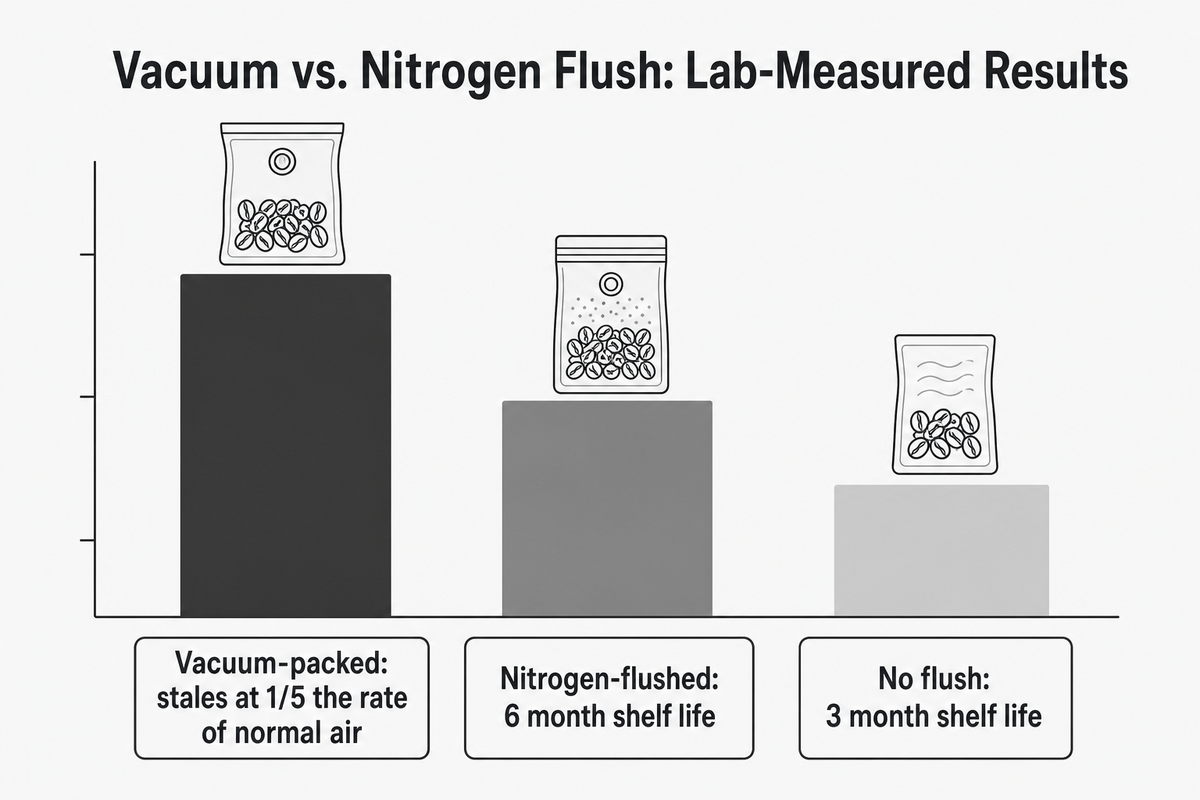
Yes, both methods help, and both work on the same principle: eliminating the oxygen that causes beans to oxidize. Vacuum packaging physically removes air from the bag; nitrogen flushing pushes air out by flooding the bag with an inert gas instead. Either approach measurably slows staling compared to a bag with ordinary air inside.
According to a review of published literature by the Specialty Coffee Association, vacuum-packaged coffee stales at one-fifth the rate of coffee left in normal air, while one sensory study found nitrogen-flushed coffee held a longer shelf life of 6 months, versus a mere 3 months for coffee packaged without flushing. Those lab-measured numbers are noticeably lower than the “up to 12 months” some commercial packaging suppliers advertise for combined valve-and-nitrogen systems, since laboratory research and commercial marketing tend to use different acceptability thresholds for shelf life – a gap a peer-reviewed comparison of coffee storage methods measured directly by tracking package headspace gas over time. For coffee drinkers comparing formats, the practical takeaway is that a well-executed vacuum or nitrogen-flush package keeps coffee fresh measurably longer than a plain resealable bag, even if it can’t match the boldest marketing claims.
- Household vacuum sealers are widely available for use by domestic consumers with coffee that’s already past the point of degassing.
- Nitrogen flushing is a staple in commercial coffee bag production systems, allowing for the creation of truly oxygen-free packages.
- Together with a one-way valve, the nitrogen-flushed bags will most often allow for longer sealed shelf life (up to 12 months) for a combined packaging option according to industry experts and various competitor reviews.
- Vacuum sealing coffee that’s still “degassing,” or expelling a natural build-up of gases created during the roasting process, could potentially lead to distorted extractions and damaged coffee beans due to over pressure and physical compression.
- Even the best bags can’t save coffee that has poor seal integrity, allows too much oxygen into the bag, or has already gone stale prior to packaging.
- Once opened both lose their advantage in days – it applies to the unopened/sealed state only.
Ground Coffee vs. Whole Bean: Which Lasts Longer?
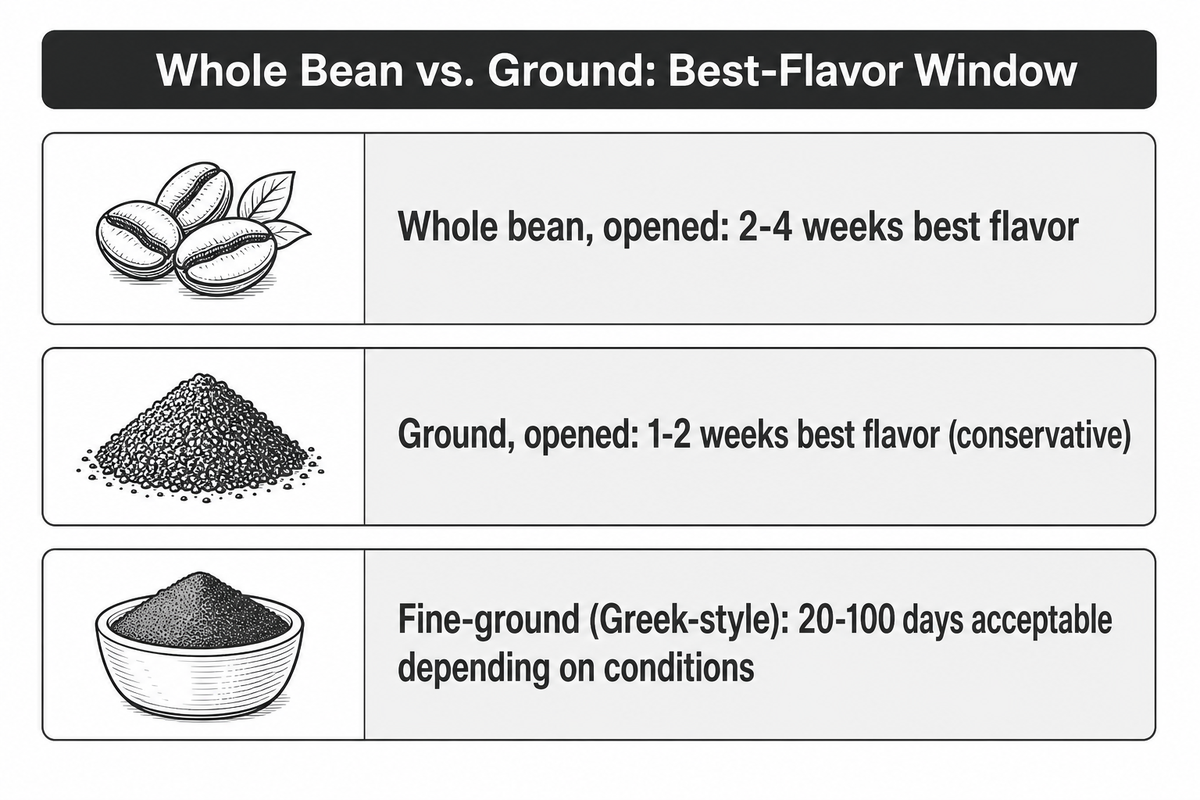
Whole coffee beans last longer than ground beans because grinding increases the surface area exposed to oxygen – whole bean coffee has relatively small, oil-sealed external surfaces compared to the myriad new surfaces exposed all at once when that same bean is ground. Ground coffee is best used within a week or two of opening, a target rather than an iron rule – and the finer the grind, the shorter that window: espresso grinds fade sooner than drip coffee grinds.
A controlled study on fine-ground (Greek-style) coffee quality loss during home storage, examining longevity under varying temperature and humidity, found that what’s still “acceptable,” though not the most flavorful cup, may last anywhere from about 20 days in hot, humid conditions to more than 100 days in a cool, dry pantry – and because a finer grind means more surface area exposed to oxygen, standard drip-grind coffee should hold up at least as long, if not longer, under the same conditions. That doesn’t make ground beans a long-term storage option; it’s a reminder that proper – and improper – storage conditions matter more than many coffee drinkers think, and learning to choose the right coffee format for how quickly you’ll use it beats any single storage trick.
| Formato | Relative surface area | Opened, best flavor | Opened, still drinkable |
|---|---|---|---|
| Feijão inteiro | Mais baixo | 2 semanas | 1–3 months, fading |
| Ground | Much higher | 1–2 weeks (conservative) | Up to ~3 months under cool, dry storage; closer to 3 weeks if warm and humid |
Does Whole Bean Coffee Stay Fresh Longer Than Ground?
Yes – every source we encountered agrees that whole beans stay fresh longer than ground. Given the mechanism – surface-area exposure – the implication is clear: buy whole beans if possible and grind just before use, since ground coffee’s freshness starts declining almost immediately after you open it, regardless of any best-by date.
Freshness almost immediately after roasting starts to shift, which is why buying local coffee in small batches and grinding just before brewing gives you fresher coffee than any storage trick can.
How to Store Coffee Beans at Home
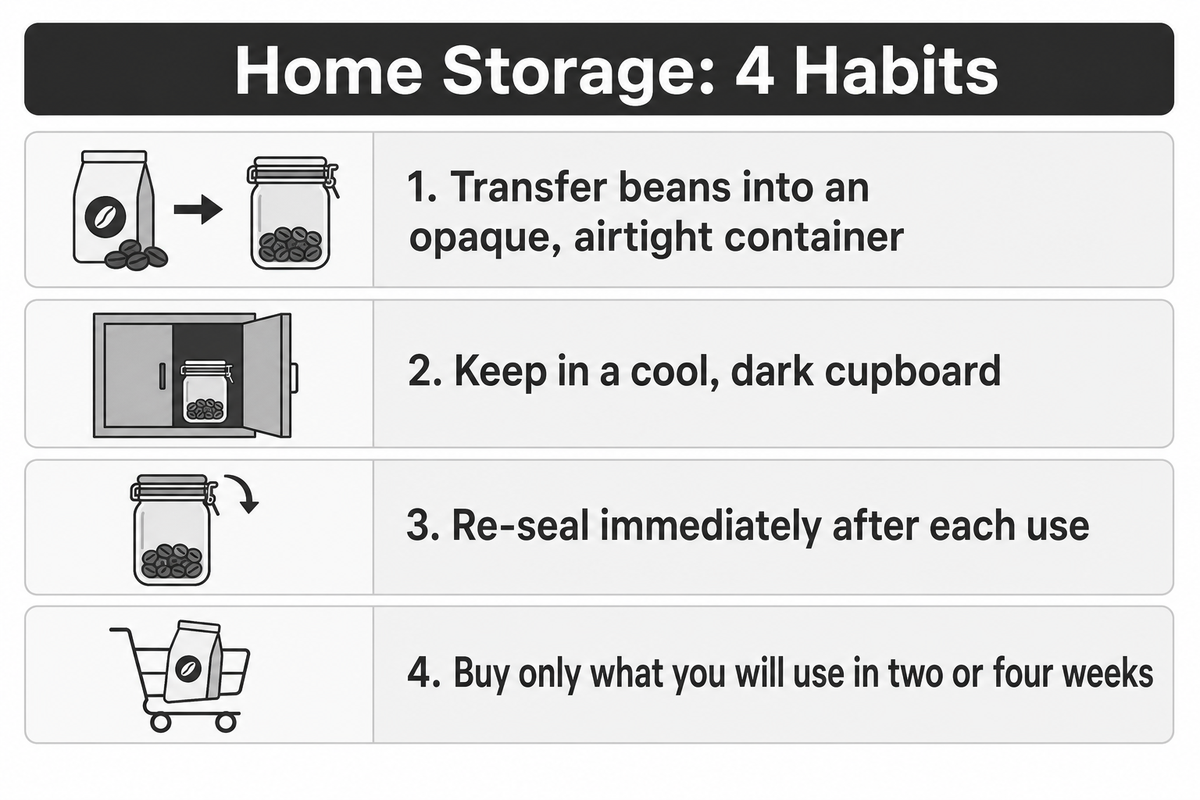
It wouldn’t take a secret recipe to arrive at the best advice for storing your beans, if only because all of them are surprisingly the same – it just rarely occurs to people to adopt all of them in their daily routine. Whatever the method, however, the principle of proper coffee storage can be easily summarized: just keep air, light, heat, and moisture out, the same four variables peer-reviewed storage research on green coffee tracks as drivers of quality loss. Good coffee bean storage at home is less about buying an ideal coffee canister and more about a habit you repeat every time you make coffee at home.
Storage Tips: The Best Way to Store Coffee Beans Day to Day
- Once the original bag is opened for regular use, transfer the beans into an opaque container designed to be airtight.
- A good bag of beans deserves a cool, dark place in your cupboard – anywhere but in a cabinet exposed to direct sunlight or on top of the stove.
- Don’t go digging for scoops and leaving the bag or canister open to the elements while you’re brewing a pot at home; re-seal everything immediately after removing each portion of beans.
- The best bet for even a dedicated coffee lover is to purchase no more than you’ll consume in two to four weeks – larger purchases can lead to more waste than the savings they represent, especially when stored improperly.
- Instead of storing bulky bags of beans openly on the counter to be accessed frequently, portion out the quantity you’ll need from your large, bulk purchase immediately into smaller airtight jars so you can access them easily and with minimal exposure to ambient air each time you prepare coffee.
- Don’t grind more than you’ll use for a single brewing pot at a time – portion the beans first, then grind, with the mill left set for your brew method; even properly stored, the grounds will degrade significantly faster than properly stored whole beans.
No, it’s not necessary to invest in any special equipment. Buying directly from an area coffee roaster – whose coffee bag itself is often ideal storage – and moving it into an airtight container that’s kept in a dark cupboard is likely to provide better results than any fancy, costly coffee system that isn’t being properly maintained. Properly stored coffee relies more on consistent habits than the cost of your equipment. The same logic applies to office coffee: move the beans out of the shared bag and into a shared airtight jar, and portion the beans into smaller batches if the office goes through coffee slowly, and you’ll extend the life of your coffee without buying anything new. How you store your coffee day to day matters more than what you store it in, and consistent habits are what separate coffee that tastes reliably good from coffee that’s a gamble every morning.
Whether the refrigerator beats the countertop comes up constantly, and the direct answer is no. Every time a coffee bag or container comes out of refrigerator-cool storage into warmer room air, condensation forms and clings to the beans, and coffee absorbs those nearby odors readily.
“Never freeze coffee” is the most prevalent and most misunderstood single rule of coffee. This so-called rule isn’t just overblown; it’s the inverse of truth. There’s a right way to freeze coffee beans to greatly inhibit oxidation and loss of aromatics: portion into single-use amounts and bag each portion twice before freezing, and then thaw without unbagging at room temperature. It isn’t the freezing that damages your coffee; it’s repeated freeze-thaw cycling, because every cycle brings condensation – just as taking beans in and out of the fridge does – and that condensation is what actually stales coffee.
Signs Your Coffee Beans Have Gone Stale (and Mistakes to Avoid)
How to Tell If Coffee Beans Are Past Their Prime
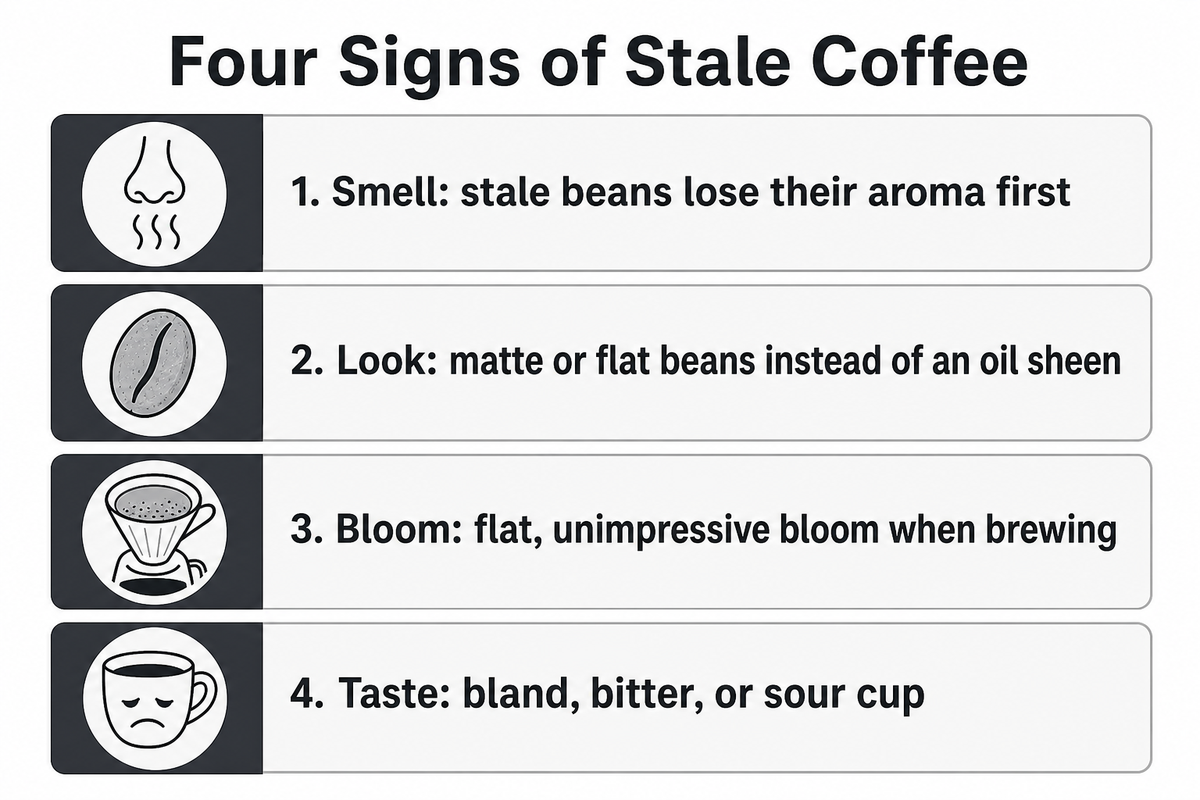
Four quick checks – call them the Four Tests of Fresh Coffee – tell you where a bag stands:
- Smell: a noticeable coffee aroma can be detected on well-stored beans while still in the bag; a whiff is often the fastest way to tell if your coffee beans have started to turn, since stale coffee beans lose that aroma before anything else changes.
- Look: A sheen of natural oils is generally apparent on fresh beans; coffee beans that are matte or flat looking have begun to lose oil due to oxidation.
- Bloom: the bubbly, expansive bloom that results when coffee is showered in hot water is an indication of high CO2 content and a freshness that’s generally still on the bright side; flat, unimpressive blooms signify the beans are past peak.
- Taste: poorly aged beans produce a rather bland, often bitter or sour cup with a lackluster sweet finish.
Two major problems can lead to premature staling: beans stored in a clear glass container (light, even when in a sealed container, can break down flavor compounds) and leaving a bag of beans open on the counter after purchase. That second habit means purchasing more coffee than can be consumed in the beans’ best window of time. Either one doesn’t involve the beans themselves but rather the storage vessel and buying cycle. Improper storage causes coffee to go stale far faster than time alone, and it’s a big part of why how long beans stay fresh varies so much between two people who bought the exact same bag. There are a few reliable ways to tell if coffee beans have gone past peak, starting with smell, and recognizing stale beans early saves your next pot from a disappointing cup.
When Does Coffee Go Bad vs. Simply Go Stale?
Coffee does not go bad the way dairy does. Stale beans lose aroma first, then body, then sweetness, but they stay safe to drink long after they stop tasting good. “Bad” in coffee usually means a cup you don’t enjoy rather than a cup that can hurt you – visible mold or a distinctly musty smell being the exception that does belong in the bin – and that changes what you should be checking for.
To differentiate fresh coffee from stale coffee instead of “faded” or diminished, you’ll need to ask different questions than you would typically pose when tasting coffee that’s freshly roasted. Per FDA/USDA food date-labeling guidance, coffee won’t hurt you even when it’s old and stale, even though it no longer tastes as good, so the Four Tests of Fresh Coffee only tell you whether the beans are still worth brewing, not whether they’ll do you any harm. This guide to grinding coffee beans properly won’t restore beans to their peak freshness – brewed coffee made from beans that have begun to go stale will still taste like badly stored beans, only finer – but it will help ensure an accurately adjusted preparation. If your coffee tastes uninspired regardless of grind adjustment, the beans themselves are the likely reason, not your technique, especially if the same brew method worked perfectly last week.
This is all to say: You need to view keeping your beans fresh more like a habit and less like a one-time purchase. Store any beans you aren’t using this week in a smaller airtight container and keep the container consistent. Keep your beans away from your stove; practice the exact same storage technique every time, not a rotating cast of containers and so on. There’s no such thing as the best coffee container, and no coffee gadget will magically preserve beans like the habit of regularly transferring them from a large bag to smaller containers. Even a good roaster’s beans will go stale as quickly as beans from anywhere if stored badly, because coffee – once out of its bag – doesn’t know or care where it was roasted. Knowing roughly how long beans are at their best, and choosing to keep beans in the conditions this guide covers, does more for cup quality than brand loyalty ever will.
Freshness just after roasting is the bar by which all other fresh coffees are measured – roughly when ground coffee stops being its freshest is when whole beans start to peak. Whether ground coffee or whole bean better fits your life comes down to how quickly you’ll consume your coffee: on an office’s shared kitchen setup or anywhere coffee will sit unused for several days before its jar is re-filled, fresh grinding wins on overall coffee bean freshness every time. Choosing ground versus whole bean will affect shelf life more than any single storage trick, and it’s also the only decision you have to make once. Really good coffee, roasted well and quickly transported to you, will always be fresher than a great coffee that’s languished since leaving the roaster.
Packaging Format Comparison: What Actually Controls Shelf Life
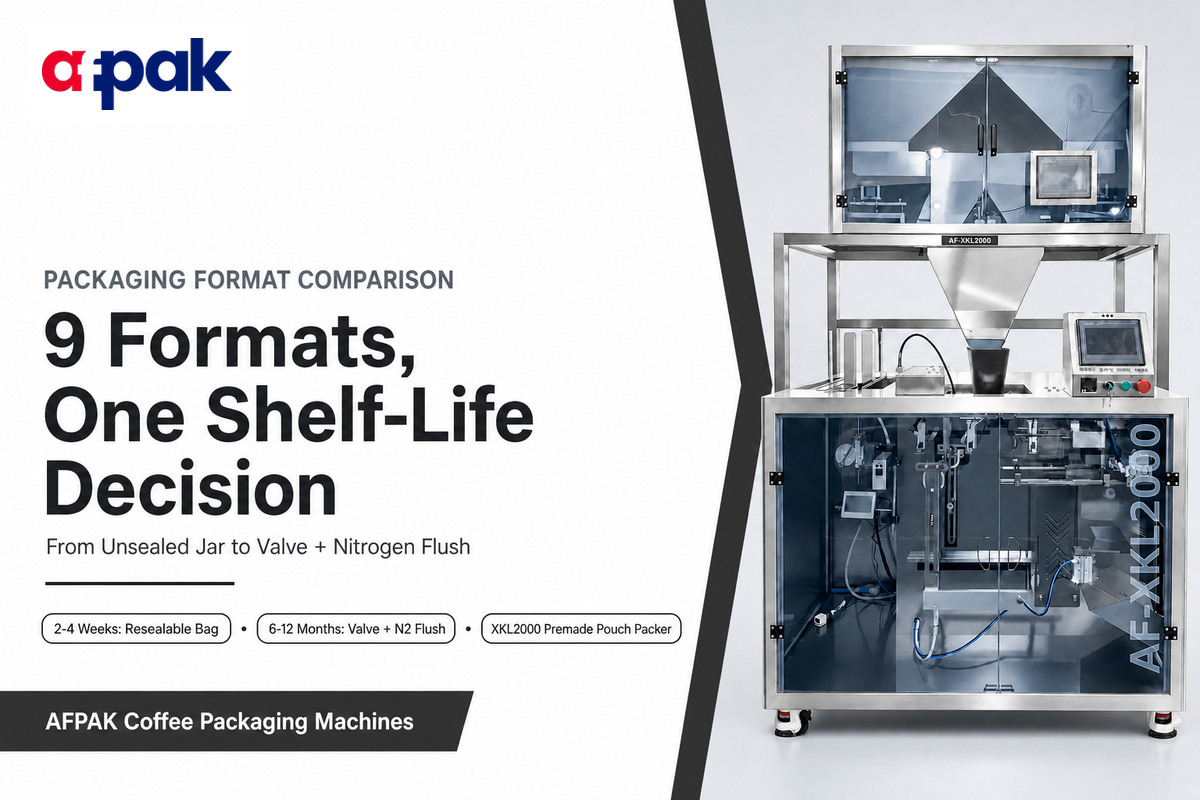
For a roaster or brand that packages beans and ground coffee for consumer sale, the decision about coffee bean (or ground coffee) packaging format will have more effect on the shelf-life claim advertised on their bag than the specific profile at which the coffee was roasted, or any storage advice offered on the bag itself. This chart lines up how these common formats work in principle, and what factors contribute to their respective shelf life, enabling a more informed decision than solely relying on what’s on a packaging supplier’s datasheet.
What Each Coffee Bean Packaging Format Actually Buys You
| Tipo Embalagem | Typical unopened shelf life | Melhor para | Limitações |
|---|---|---|---|
| Unsealed jar / open container | Not applicable — treat as opened immediately | Beans about to be used same-day | No barrier to oxygen, light, or moisture at all |
| Resealable bag, no valve | 2 semanas | Small-batch, fast-turnover retail | Can’t seal fresh-roasted beans without risking bag swell from CO2 |
| Bag with one-way valve, no N2 flush | 2–3 months | Standard specialty retail bags | Residual oxygen at fill time still limits ceiling |
| Bag with valve + nitrogen flush | 6–12 months (controlled study to commercial claim) | Brands needing a long, defensible shelf-life claim | Requires a packaging line configured for N2 flushing, not a retrofit |
| Vacuum-sealed bag (no valve) | 2–3 months | Fully degassed beans only | Must not be used on freshly roasted beans still off-gassing |
| Premade pouch, valve pre-installed | 6–12 months (controlled study to commercial claim) | Brands sourcing print-ready retail pouches rather than forming bags in-line | Pouch and valve compatibility must be confirmed with the pouch supplier |
| Opened bag, reclosed | 1–2 weeks for ground, 2–4 weeks for whole bean (peak flavor) | Any format, once opened | Peak-flavor window is shorter for ground than whole bean once opened, but total drinkable life still varies by format – whole beans and ground coffee can remain acceptable for 1–3+ months under good storage (see the format-specific rows above) |
| Freezer, portioned + double-bagged | Several months | Overstock a consumer won’t finish in weeks | Repeated freeze-thaw cycling defeats the benefit |
| Refrigerator | Not recommended at any format | Not recommended | Condensation on every opening accelerates staling regardless of pack type |
For any brand evaluating packaging equipment as per the chart above, the one-way valve and nitrogen-flushable options are configured as options on AFPAK’s AF-VFFS520-X 2-in-1 VFFS packaging machine that handles both fresh roasted beans and ground coffee, while the XKL2000 pre-made pouch packer is dedicated to the pre-made pouch with valve row for brands that source print-ready pouches off-line.
2026 Outlook: Format-Specific Queries Are Rising as Generic Freshness Searches Fall
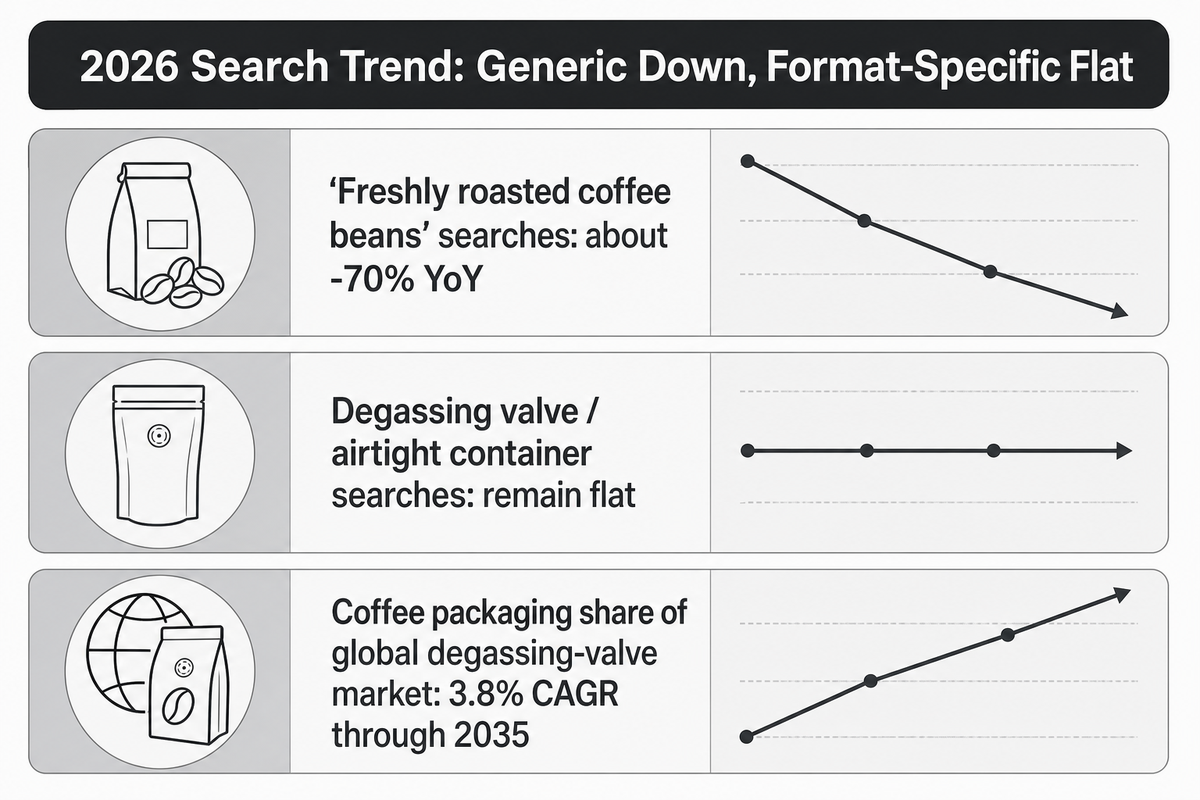
When looking at US Google search interest, searches for the generic phrase “freshly roasted coffee beans” have cratered over the past year (about -70% YOY, to mid-2026 per DataForSEO), but more specific and technically descriptive searches – “degassing valve,” “coffee bag valve,” and “airtight coffee container” – remain flat, and have for the past year as well. This trend speaks less to waning consumer demand for coffee freshness than to savvy consumers learning to search for the products that peer-reviewed storage-method research shows actually deliver measurable freshness gains. Independent market research from IndexBox puts the global degassing-valve market on a 3.8% CAGR growth path through 2035, and names coffee packaging as the largest and most dynamic end-use segment driving that growth – meaning the valve isn’t a niche AFPAK talking point, it’s the dominant real-world use case for this exact packaging technology, and a strong signal that buyers are already voting with their packaging specs.
In practical terms for a brand actively roasting, it simply becomes more incumbent on the brand to show its due diligence in terms of shelf life and its associated packaging format, before buyers place their first order.
Perguntas frequentes
P: Qual é a regra 15-15-15 para o café?
The 15-15-15 rule is informal brewing guidance, not a shelf-life standard – one common version says green (unroasted) beans stay good for about 15 months, roasted beans are best used within 15 days, and ground coffee should be brewed within 15 minutes of grinding.
Q: Are 10-year-old (or older) coffee beans still safe to drink?
Coffee is a shelf-stable food that doesn’t spoil through bacterial growth after roasting, so age alone doesn’t make it dangerous, but very old beans carry a real, separate risk that isn’t just about mold you can see.
Q: Can you freeze coffee beans?
Yes, if beans are portioned into single-use amounts, double-bagged, and thawed fully before opening; the real risk with freezing coffee is repeated freeze-thaw cycling, not the act of freezing itself.
Q: How long do coffee beans last before roasting?
Green, unroasted coffee beans hold their quality for 1 to 2 years or more when stored cool, dry, and dark, far longer than any roasted format.
Q: Should coffee beans be refrigerated?
No, refrigeration introduces condensation and food-odor absorption every time the container is opened, which accelerates staling in coffee beans rather than preventing it, so a cool pantry works better.
Sobre Esta Análise
This guide is based on peer-reviewed coffee-storage research, FDA and USDA guidance on food labeling, and AFPAK packaging machinery specifications and limitations cross-referenced with three independently published consumer coffee freshness guides. Numbers are reported as ranges wherever sources genuinely diverge rather than collapsed into one falsely precise figure. Reviewed by the AFPAK technical team.
Referências e fontes
- What is the Shelf Life of Roasted Coffee? A Literature Review on Coffee Staling Specialty Coffee Association (2012 review of the peer-reviewed and conference literature on coffee staling kinetics through that date; oxygen-sensitivity, temperature, and packaging-comparison figures in this guide are drawn from studies summarized in this review, not measured first-hand)
- Effects of different coffee storage methods on coffee freshness after opening of packages Food Packaging and Shelf Life / ScienceDirect (Smrke et al. 2022, DOI 10.1016/j.fpsl.2022.100893)
- Greek Coffee Quality Loss During Home Storage: Modeling the Effect of Temperature and Water Activity Journal of Food Science, PubMed/NIH
- The Storage of Green Coffee (Coffea arabica) PMC, National Institutes of Health
- Mycotoxins in Food Administração de Alimentos e Medicamentos dos EUA
- Modeling the Shelf Life of Roasted Coffee Journal of Agricultural and Food Chemistry (2006), author copy hosted at the University of Oregon (source for the oxidation kinetics cited in this guide)
- Degassing Valves Market Forecast Points Higher Toward 2035, Driven by Coffee Freshness Demands IndexBox (source for the degassing-valve market CAGR through 2035 and the coffee-packaging end-use segment claim)
- USDA-FDA Busca Informações Sobre Rotulagem de Data de Alimentação FDA/USDA joint announcement
- Reposo’s Impact: Shelf Life and Cellular Stability of Green Coffee Roast Magazine
- How Long Does Green Coffee Stay Fresh For? Moagem Diária Perfeita
- 2-in-1 Coffee Bean & Ground Coffee Packaging Machine AFPAK product spec page (source for the degassing-valve + nitrogen-flush selection quote and machine capabilities described in this guide)
- Máquina de embalagem automática de bolsa pré-fabricada XKL2000 para grãos de café AFPAK product spec page
Artigos Relacionados
- Nespresso Pods Cost vs. Manufacturing Cost the true margin math behind capsule packaging economics