
Last updated: November 2026
The best k cup coffee brands for 2026 are Keurig Dr Pepper (Green Mountain and Original Donut Shop), Starbucks, McCafé, and Smucker (Folgers, Dunkin’, and Café Bustelo) for everyday medium cups. Peet’s, Lavazza, and Death Wish lead bold dark profiles, while San Francisco Bay, Newman’s Own, and Eight O’Clock cover organic and budget picks.
Similar logos are all consumers see on bestseller charts, but most customers don’t recognize the four corporate groups who supply the greatest share of the aisles. Sister brands, who operate under the same corporate roasting plants or licensed distribution, may charge differing carton prices. Being aware of who owns, licenses, or roasts each pod prevents consumers from paying for the same thing twice, especially in the case of morning blends.
Just as important to flavor is the density of the grind. Not all pods are created equally, and when you stretch a light breakfast pod across a travel mug, most roasts taste flat and papery. Matching pod fill density to a 6-ounce or 8-ounce brew button fixes weak extraction right away.
Published by AFPAK, a coffee capsule filling and sealing equipment manufacturer. This is a buyer’s research guide to K-Cup coffee capsules, not a sensory test in disguise or a market share audit. AFPAK manufactures packaging machinery and is not one of the consumer coffee brands listed.
Best K cup coffee at a glance
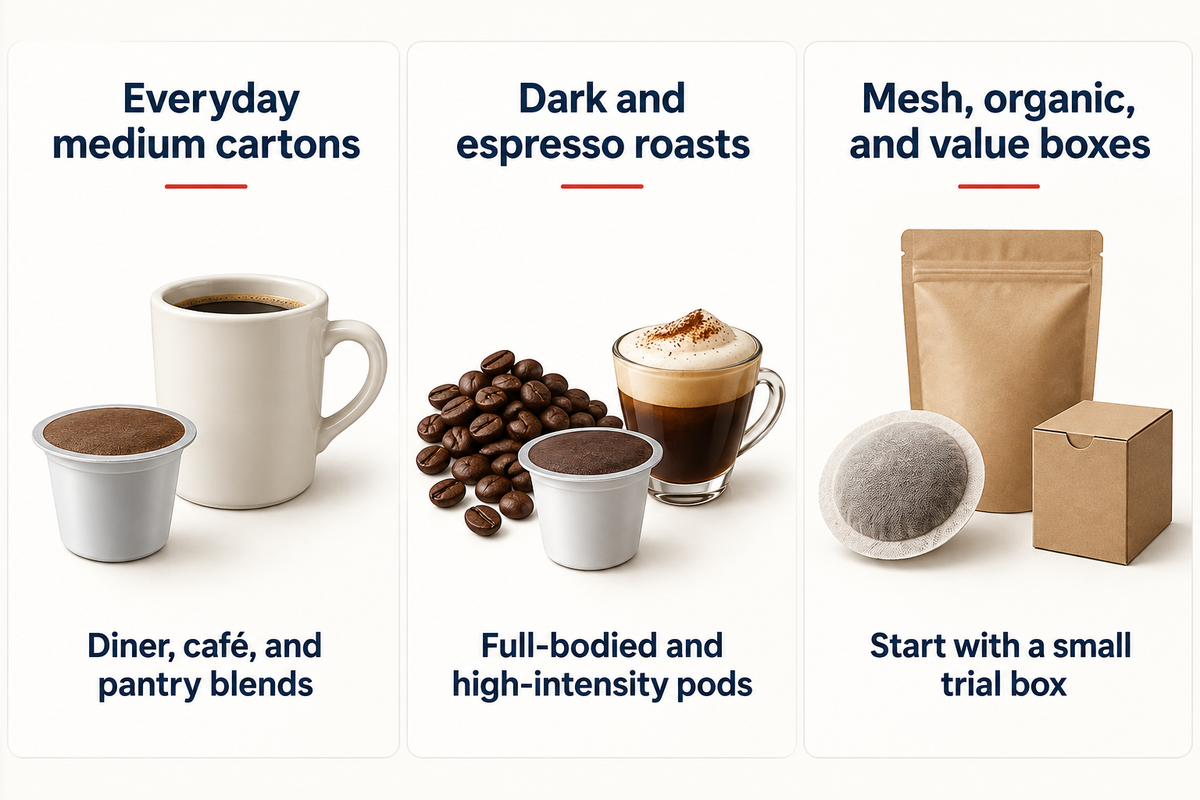
Every coffee lover brings different priorities to a kitchen counter or office breakroom. No single public auditor publishes nationwide unit-share rankings across all US retailers, though Green Mountain, Original Donut Shop, Starbucks, McCafé, and Dunkin’ consistently headline mainstream household shelves. Grouping ten distinct coffee brand groups by roast intensity, pod shell structure, and carton value lets you discover the best match quickly.
Numbered entries below are grouped by roast and pod category. Entry one pairs Green Mountain and Original Donut Shop under Keurig Dr Pepper, while entry four unites Folgers, retail Dunkin’, and Café Bustelo under Smucker. Separating trademark owners from licensed retail packers covers thirteen recognizable grocery labels without counting shared corporate operations twice.
- Best for everyday breakfast cups and extra-bold diner medium profiles: Keurig Dr Pepper (Green Mountain Coffee Roasters and The Original Donut Shop).
- Best for café-familiar blonde, medium, and dark profiles at home: Starbucks At Home (distributed in retail under Nestlé license).
- Best for smooth pure Arabica medium cartons on Amazon and supermarket shelves: McCafé At-Home (McDonald’s brand distributed in partnership with Keurig).
- Best for classic American diner coffee and multi-brand pantry cartons: Smucker retail coffee portfolio (Folgers, Dunkin’ At-Home, and Café Bustelo).
- Best for full-bodied dark roasts and Italian-style espresso pods: Peet’s Coffee, Luigi Lavazza S.p.A., and Death Wish Coffee Company.
- Best for commercially compostable mesh rings, charitable organic blends, and budget Arabica boxes: San Francisco Bay Coffee, Newman’s Own Organics, and Eight O’Clock Coffee.
How We Selected These K Cup Coffee Brands
We selected ten distinct coffee brand groups selling coffee for Keurig systems on Amazon and in U.S. retail. Selection was determined based on brand ownership and licensing structures, the variety of roast, carton sizes, and disclosures made by the brands on their packaging. Coffee machine and packaging equipment manufacturers, generic e-commerce directories, unbranded bulk resellers, and duplicate sub-lines under the same brand card were excluded. Company information was verified on official websites and public records in November 2026.
Grouping similar supermarket labels in their portfolio allows consumers to see relationships before they compare box prices.
| No. | Brand / Company | Headquarters | Founded | Signature K-Cup Pods | Best For | Pod & Roast Distinction | Buying Limitation | Official Website |
|---|---|---|---|---|---|---|---|---|
| 1 | Keurig Dr Pepper (Green Mountain & Donut Shop) | Burlington, MA & Frisco, TX, USA | — | Breakfast Blend, Nantucket, Donut Shop Regular | Everyday breakfast and extra-bold diner cups | Native MultiStream fit; #5 plastic shell | Curbside #5 pod acceptance differs by city | https://www.keurig.com/ |
| 2 | Starbucks Corporation (Starbucks At Home) | Seattle, WA, USA | 1971 (Pike Place store) | Pike Place Roast, Veranda Blend, Sumatra | Café-style blonde, medium, and dark pods | Three-tier roast spectrum; Nestlé retail license | Higher per-pod price than store brands | https://athome.starbucks.com/ |
| 3 | McDonald’s Corporation (McCafé At-Home) | — | 1954 (Ray Kroc system) | Premium Roast, Colombian, French Roast | Smooth pure Arabica grocery cartons | Keurig retail partnership; wide club stock | Core diner blends; no estate microlots | https://www.mcdonalds.com/us/en-us/mccafe-at-home.html |
| 4 | The J.M. Smucker Co. (Folgers & Dunkin’) | Orrville, OH, USA | — | Classic Roast, Black Silk, Dunkin’, Bustelo | Classic pantry cartons and Latin espresso | GFSI-benchmarked plants; Master Cuppers QC | Lighter blends taste mild past 8 oz | https://www.folgerscoffee.com/ |
| 5 | Peet’s Coffee | Emeryville, CA, USA | 1966 (Berkeley shop) | Major Dickason’s, Big Bang, French Roast | Full-bodied dark cups resisting dilution | Published 0–100 sensory ratings; organic line | Incompatible with L’OR Barista machines | https://www.peets.com/ |
| 6 | Luigi Lavazza S.p.A. (Lavazza) | Turin, Italy / New York, NY | 1895 | Espresso K-Cup, Classico, Gran Aroma, Perfetto | Italian-style medium and espresso pods | 10-point intensity scale; Tierra Organic | Low-pressure brew skips thick bar crema | https://www.lavazzausa.com/en |
| 7 | Death Wish Coffee Company | Saratoga Springs, NY, USA | 2012 | Dark Roast, Medium Roast, Power Surge | High-intensity organic Arabica-Robusta cups | USDA Organic & Fair Trade; 10–100ct packs | Too strong for low-caffeine drinkers | https://www.deathwishcoffee.com/ |
| 8 | San Francisco Bay Coffee (Rogers Family) | California, USA | — | Fog Chaser, French Roast, Rainforest OneCUP | Commercially compostable plant-ring mesh pods | US roasted Arabica; up to 120-count bags | Needs industrial composting; reseal foil bag | https://sfbaycoffee.com/ |
| 9 | Newman’s Own, Inc. (Newman’s Own Organics) | Westport, CT, USA | — | Special Blend, Special Decaf, French Roast | Organic Arabica pods funding charity | All profits to foundation; dual-origin blend | Compact SKU list without dessert flavors | https://newmansown.com/ |
| 10 | Eight O’Clock Coffee (Tata Consumer) | Woodcliff Lake, NJ, USA | 1919 brand; 2006 Tata | The Original, Colombian Peaks, Blonde Roast | Budget-friendly pure Arabica daily pods | Own-facility roasting; up to 94-count boxes | No organic or compostable shell lines | https://www.eightoclock.com/ |
You want to start with a 10-count, 12-count or 18-count trial box with an unfamiliar roaster. Testing a large pantry case before sampling a roaster on your 8-ounce button can really dull your mornings. Once one profile fits your palate, stepping up to 72-count or 94-count cartons lowers your cost per mug.
Mainstream medium roast K-Cups: Green Mountain, Donut Shop, Starbucks, McCafé, and Folgers
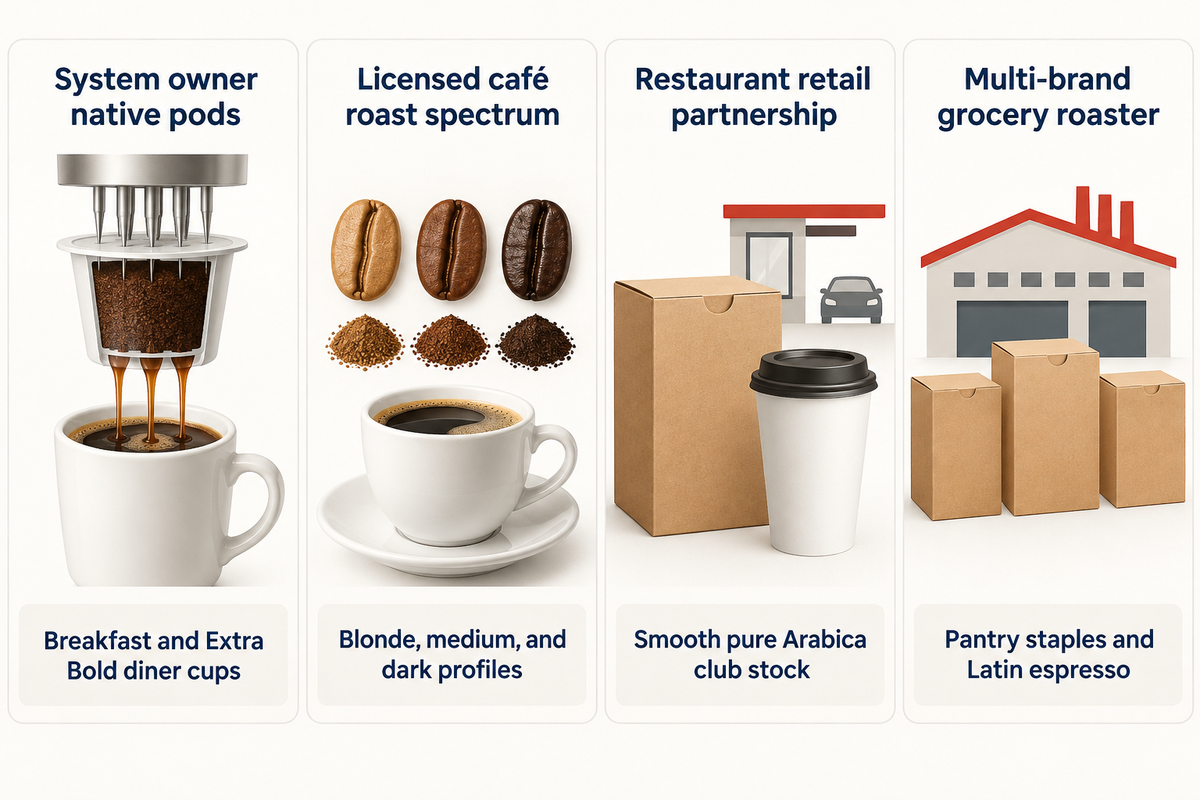
Supermarket shelves and office breakrooms rely heavily on balanced medium roast coffee that tastes clean black or with cream. Across online retailers, four corporate groups supply most mainstream household cartons sold in North America. Understanding how those four groups split native pod manufacturing and brand licensing helps buyers pick the right everyday box.
Many shoppers assume restaurant logos mean restaurant kitchens roast and seal their own retail capsules. In practice, global café chains partner with major beverage manufacturers to pack shelf-stable pods for grocery distribution. Reading both the front roast profile and the fine-print licensing line clarifies who stands behind your morning cup.
1. Keurig Dr Pepper (Green Mountain Coffee Roasters & The Original Donut Shop): Best for everyday breakfast blend and extra-bold diner medium roast K-Cup pods
Headquarters: Burlington, MA and Frisco, Texas, USA · Type: Beverage system owner and coffee roaster managing 150+ iconic brands across owned, licensed, and partner lines.
Official website: https://www.keurig.com/
Main products: Green Mountain Breakfast Blend, Nantucket Blend, and Dark Magic alongside The Original Donut Shop Regular and specialty K-Cup pods.
Certifications / notable work: According to Keurig’s official recyclability and corporate pages, the company transitioned its US pods to polypropylene (#5 plastic) in 2020, made a $10 million commitment to The Recycling Partnership’s Polypropylene Recycling Coalition, and runs mail-in K-Cycle recovery bags.
Owning the brewer ecosystem gives Keurig Dr Pepper direct control over capsule headspace, foil lidding, and MultiStream five-needle puncture geometry. Green Mountain Coffee serves drinkers who prefer crisp New England profiles, led by its bright Breakfast Blend coffee and medium Nantucket Blend. Sister label Original Donut Shop targets fans of punchier diner mugs by packing Extra Bold ground doses into its flagship Regular medium roast. Grouping both labels under one entry reflects shared corporate ownership while letting households compare light morning acidity against fuller diner body.
Buying limitation: Polypropylene #5 shells carry Keurig’s official check-locally notice because many municipal curbside bins don’t accept small plastic pods without mail-in K-Cycle recovery.
2. Starbucks Corporation (Starbucks At Home): Best for café-familiar blonde, medium, and dark roast K-Cup pods
Headquarters: Seattle, Washington, USA · Founded: 1971 (first Pike Place Market store in Seattle) · Type: Global specialty coffee roaster and café chain where Nestlé uses Starbucks trademarks under license for retail packaged coffee.
Official website: https://athome.starbucks.com/
Main products: Pike Place Roast, Veranda Blend Blonde, Sumatra, French Roast, Caffè Verona K-Cup pods, ground bags, and whole bean offerings.
Certifications / notable work: According to Starbucks At Home’s official brand history, the company grew from a single 1971 storefront in Seattle’s Pike Place Market into a three-tier Roast Spectrum spanning Blonde, Medium, and Dark Arabica profiles.
Consistent roast development makes Starbucks Pike Place Roast one of the best-known medium roast coffee pods in workplace kitchens. Drinkers who find traditional café dark roasts too smoky often prefer mellow Veranda Blend Blonde on an 8-ounce setting. Under the Global Coffee Alliance, Nestlé manages retail grocery distribution while keeping the café chain’s signature roast curves across disposable pods and bagged lines. Fans of earthy Indonesian body can also step up to Sumatra without switching pod systems.
Buying limitation: Retail café-branded boxes carry higher per-pod shelf prices than supermarket private labels or warehouse club cartons.
3. McDonald’s Corporation (McCafé At-Home): Best for smooth pure Arabica medium roast pods on Amazon and grocery shelves
Founded: 1954 (Ray Kroc McDonald’s system) · Type: Global restaurant brand owner offering licensed McCafé packaged coffee across US retail and Keurig channels.
Official website: https://www.mcdonalds.com/us/en-us/mccafe-at-home.html
Main products: Premium Roast, Breakfast Blend, Premium Roast Decaf, French Roast, Colombian, French Vanilla, and Mocha pods, bags, and cans.
Certifications / notable work: According to McDonald’s corporate history and McCafé At-Home pages, the brand draws on a network of more than 36,000 restaurants across over 100 countries and blends pure Arabica coffee distributed nationwide in partnership with Keurig.com.
Drive-thru regulars frequently pick McCafe Premium Roast when they want an uncomplicated, low-bitterness mug that tastes steady every weekday. Rather than operating separate retail pod factories, McDonald’s licenses its retail K-Cup manufacturing and grocery distribution with Keurig Green Mountain. Multi-count cartons stay widely stocked across Amazon, Walmart, Target, Kroger, and warehouse clubs, making restocks easy for families and small offices. Shoppers seeking slightly brighter fruit notes can also swap in the brand’s single-origin Colombian medium roast.
Buying limitation: Retail pods stick to approachable restaurant-style blends and sweet flavors rather than farm-traceable specialty microlots.
4. The J.M. Smucker Co. (Folgers & Dunkin’ At-Home): Best for classic American diner coffee and widely stocked pantry cartons
Headquarters: Orrville, Ohio, USA · Type: North American packaged food and retail coffee manufacturer managing Folgers, licensed at-home Dunkin, and Café Bustelo.
Official website: https://www.folgerscoffee.com/
Main products: Folgers Classic Roast, Black Silk, Colombian, Half Caff, and Buttery Caramel pods alongside retail Dunkin’ Original Blend and Café Bustelo Espresso Style lines.
Certifications / notable work: According to Smucker and Folgers craft pages, manufacturing plants operate under Global Food Safety Initiative (GFSI) benchmarked food-safety programs while sensory panels led by Master Cuppers calibrate Folgers batch roast consistency.
Few shoppers realize one Ohio food manufacturer sits behind three of America’s biggest grocery pod shelves. Smucker produces classic Folgers pantry staples, packs licensed Dunkin’ Original Blend medium roast cartons for retail aisles, and distributes bold Latin-style Café Bustelo pods. Darker Folgers Black Silk delivers smooth roast depth without harsh ashiness, whereas Dunkin’ Original Blend suits drinkers who stir milk into morning diner coffee. Grouping these three supermarket staples under one entry shows shoppers which morning cartons share Smucker’s Ohio retail coffee operations.
Buying limitation: Milder Folgers morning roasts use a gentle profile that can taste thin if brewed past an 8-ounce mug setting.
Dark roast, French roast, and espresso roast K-Cup coffee pods
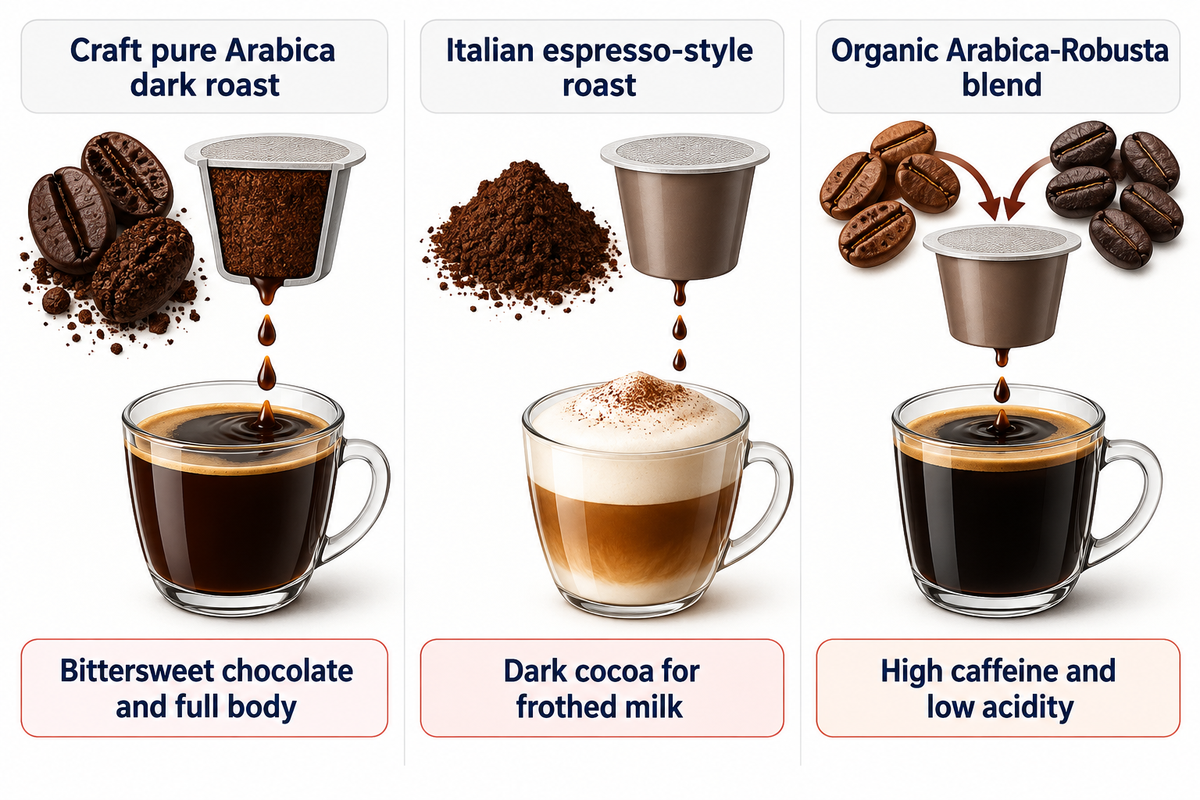
Bold cup lovers using low-pressure drip machines face short extraction times that prevent thick oils and caramelized sugars from fully dissolving. Dark roast coffee roasters use finer grinds, deeper development of the beans, or more intense Robustas to achieve a stronger cup.
Your mug preferences play a role in your choices of the California craft dark roasts, Italian espresso blends, and high-caffeine organic pods. Pure Arabica dark blends have a bittersweet chocolate and smoky profile. Arabica-Robusta blends have a thicker mouthfeel and a naturally high caffeine content.
5. Peet’s Coffee: Best for full-bodied dark roast K-Cup pods that resist dilution
Headquarters: Emeryville, CA, USA · Founded: 1966 (first Berkeley coffee shop by Alfred Peet) · Type: Specialty craft coffee roaster and retail coffeehouse company.
Official website: https://www.peets.com/
Main products: Major Dickason’s Blend, French Roast, Big Bang, Café Domingo, House Blend, Luminosa, and Decaf House Blend pods.
Certifications / notable work: According to Peet’s official K-Cup product pages, the company traces its dark-roast craft to Alfred Peet’s 1966 Berkeley storefront, publishes quantitative 0–100 sensory ratings such as 63 out of 100 on Big Bang, and offers USDA Organic pods via Organic Alma de la Tierra.
Craft dark roasting made Peet’s Coffee a West Coast benchmark decades before single-cup machines reached home counters. Flagship coffee Major Dickason’s Blend combines multi-origin Arabica lots for rich spice and full body that stays assertive even at 8 ounces. Medium-roast fans who still want depth often pick Big Bang, where washed Latin American and natural Ethiopian beans add citrus aroma without sourness. Numerical sensory meters on official product pages take the guesswork out of comparing cartons online.
Buying limitation: Official product notices state Peet’s K-Cup pods fit Keurig brewers only and aren’t compatible with L’OR Barista capsule machines.
6. Luigi Lavazza S.p.A. (Lavazza): Best for Italian-style medium and espresso roast K-Cup pods
Headquarters: Turin, Italy (US storefront operated by Lavazza North America Inc in New York, NY) · Founded: 1895 · Type: Heritage Italian coffee roaster and multi-system capsule producer owned by Luigi Lavazza SpA.
Official website: https://www.lavazzausa.com/en
Main products: Espresso Keurig K-Cup pods, Classico, Gran Aroma, Perfetto, Italian Roast, bagged beans, and Nespresso-compatible capsules.
Certifications / notable work: According to Lavazza’s US storefront, the Turin house has blended Italian espresso since 1895, prints a ten-point strength meter such as Intensity 5/10 on Espresso K-Cup cartons, and markets certified Organic coffee lines within its Tierra collection.
Four generations of Turin blending expertise help Lavazza translate northern Italian coffee aroma into North American single-cup machines. Perfetto and Espresso roast k-cup boxes lean into dark cocoa and velvety bittersweetness that pairs naturally with frothed milk. Drinkers preferring gentler floral and dried-fruit notes can step down to Classico or Gran Aroma medium blends without losing European character. Direct US online subscriptions and grocery multi-packs make restocking Classico or Perfetto straightforward.
Buying limitation: Low-pressure Keurig drip needles brew a concentrated black Americano-style mug rather than nine-bar Italian espresso bar crema.
7. Death Wish Coffee Company: Best for organic Arabica-Robusta high-intensity K-Cup pods
Headquarters: Saratoga Springs, NY, USA · Founded: 2012 · Type: High-strength organic roaster and direct-to-consumer brand blending arabica and robusta beans.
Official website: https://www.deathwishcoffee.com/
Main products: Dark Roast, Medium Roast, Power Surge, Pumpkin Chai, and Coconut Caramel Single-Serve Pods in 10, 20, 30, 50, and 100-count cartons.
Certifications / notable work: According to Death Wish Coffee’s official storefront and help center, its core roasts are USDA Organic and Fair Trade Certified using beans sourced from India, Peru, and South and Central America, with direct US fulfillment that includes APO/FPO military addresses.
Most supermarket pods stick strictly to mild washed Arabica, leaving shift workers and heavy-caffeine drinkers wanting stronger kick. Death Wish pairs organic Peru and Central American Arabica with high-caffeine Indian Robusta roasted slow to keep perceived acidity low. Dark cherry and dark chocolate notes come through cleanly on 6-ounce or Strong-button pulls without burnt charcoal aftertaste. Carton sizes scale from 10-count trial boxes up to 100-count pantry cases for committed daily drinkers.
Buying limitation: Elevated natural Robusta caffeine and heavy roast intensity don’t suit caffeine-sensitive drinkers, and international wholesale isn’t offered.
Organic, plant-ring mesh, and budget Arabica K Cups for Keurig coffee makers
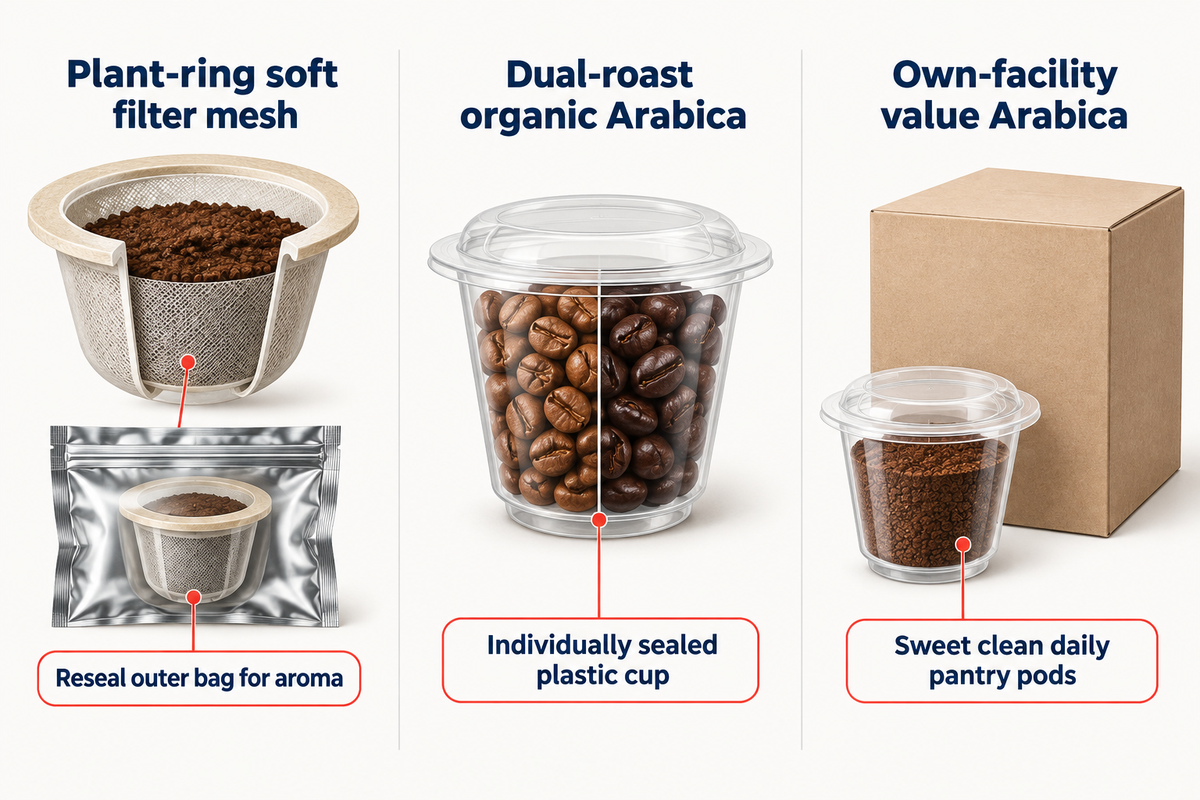
Not every household wants rigid plastic cups and overpriced national cartons. Many eco-conscious shoppers are interested in plant based filter designs and/or organic sourcing. High volume households prefer reliable pure Arabica k cups at a reasonable grocery cost. Three companies fulfill these demands without sacrificing brewer reliability.
Depending on the design, mesh pods breathe through filters and ship sealed in an outer bag. The rigid plastic cups are individually sealed.
8. San Francisco Bay Coffee (Rogers Family Company): Best for commercially compostable plant-ring mesh pods
Headquarters: California, USA · Type: Family-owned and operated US roaster under Rogers Family Company.
Official website: https://sfbaycoffee.com/
Main products: Fog Chaser, French Roast, Bay Bridge Blend, Donut Shop, and Organic Rainforest Blend OneCUP pods in 12, 36, 80, and 120-count packs.
Certifications / notable work: According to San Francisco Bay Coffee’s official product pages, its OneCUP pods are Roasted & Packaged In The USA using pure Arabica beans inside Certified Commercially Compostable plant-based rings and filters sold up to a 120 Count household carton.
Swapping rigid plastic walls for a plant-based collar and soft filter mesh gives OneCUP pods immediate aroma as soon as you open the outer bag. Flagship Fog Chaser balances medium-dark richness with smooth morning drinkability, while French Roast brings smoky Bay Area boldness. Because no solid plastic bottom traps brewed liquid, hot water flows freely across the coffee grounds during extraction. Families going through multiple mugs daily appreciate the 80-count and 120-count bulk cartons.
Buying limitation: Soft-bottom mesh OneCUP pods require industrial composting facilities rather than curbside blue recycling bins, and outer storage bags must stay tightly resealed after opening.
9. Newman’s Own, Inc. (Newman’s Own Organics): Best for USDA Organic Arabica medium-dark pods with charitable profit commitment
Headquarters: Westport, CT, USA · Type: Purpose-driven food and coffee company dedicating profits to Newman’s Own Foundation.
Official website: https://newmansown.com/
Main products: Newman’s Special Blend, Special Decaf, and French Roast pods in 12, 18, 32, and 48-count boxes plus bagged coffee.
Certifications / notable work: According to Newman’s Own official product and mission pages, the company directs 100% of profits to help children facing adversity while blending Central American medium-roast and Indonesian dark-roast Organic Arabica Coffee in its flagship pods.
Blending two roast depths inside one capsule solves a common household compromise between medium-roast brightness and dark-roast body. Central American beans contribute clean sweetness while darker Indonesian lots add rounded weight that holds up nicely to milk or oat creamer. Every box purchased supports youth nutrition and education grants without asking shoppers to pay boutique roastery markups. Special Decaf also gives evening drinkers an organic decaffeinated option that still tastes like real roasted coffee.
Buying limitation: Pod variety stays focused on Special Blend, Special Decaf, and French Roast rather than light single-origin lots or sweet dessert flavors.
10. Eight O’Clock Coffee Company (Tata Consumer Products): Best for budget-friendly 100% Arabica everyday K-Cup pods
Headquarters: Woodcliff Lake, NJ, USA (Tata Consumer Products US office) · Founded: 1919 (Eight O’Clock trademark by A&P); 2006 (joined Tata family) · Type: Heritage American Arabica roaster operating within Tata Consumer Products.
Official website: https://www.eightoclock.com/
Main products: The Original, 100% Colombian Peaks, Dark Italian Espresso, Blonde Roast, and Caramel pods from 10-count cartons up to 94-count value packs.
Certifications / notable work: According to Eight O’Clock’s official brand story, the brand celebrates over a century since A&P introduced the trademark in 1919 and roasts 100% Arabica beans at its own facility under master roasters.
Value-minded shoppers often worry low-priced supermarket cartons hide bitter filler beans or stale contract stock. Roasting pure Arabica in its own US facility lets Eight O’Clock keep The Original medium roast sweet, clean, and wallet-friendly across large value packs. Drinkers wanting richer winey notes frequently pick Colombian Peaks for a dependable solid cup on weekday mornings. Large 94-count club cartons make everyday pantry restocking simple without trading down to anonymous private labels.
Buying limitation: Lineup focuses on conventional commercial Arabica blends in standard plastic shells rather than certified organic or compostable formats.
How notable peer roasters and warehouse store brands compare outside this top-10 list
Restricting the main table to 10 coffee brand groups left several recognizable specialty roasters and retailer store labels out of the numbered cards. Excluding these reflects a sense of balance to the category rather than poor cup quality. Shoppers comparing broader shelves on Amazon, Costco, or Target regularly see seven additional names worth knowing:
- Caribou Coffee offers bright, approachable Midwestern medium roasts such as Daybreak Morning Blend, Caribou Blend, and other pods that are a good choice for many smooth morning mugs.
- Black Rifle Coffee Company offers dark roast single serve coffee pods for drinkers preferring punchy, smooth profiles like Just Black and Silencer Smooth.
- Kahawa 1893 sources East African Arabica for their Safari Blend and Serengeti pods along with other offerings sold at major US retailers.
- illy is a source for Arabica Italian coffee shoppers looking for silky Classico and Intenso capsules.
- Victor Allen’s Coffee supplies wide-count budget variety packs and seasonal flavors across supermarket endcaps.
- Warehouse cartons of 120 pods from Kirkland Signature at Costco, including Kirkland Pacific Bold, and Member’s Mark at Sam’s Club deliver cartons built for lower office cost per mug.
- Happy Belly, formerly Solimo, covers affordable online pantry subscriptions across coffee breakfast blend, medium, dark, and French Vanilla boxes.
How to choose K-Cup coffee pods with the 4 Criteria K Cup Pod Buyer Filter
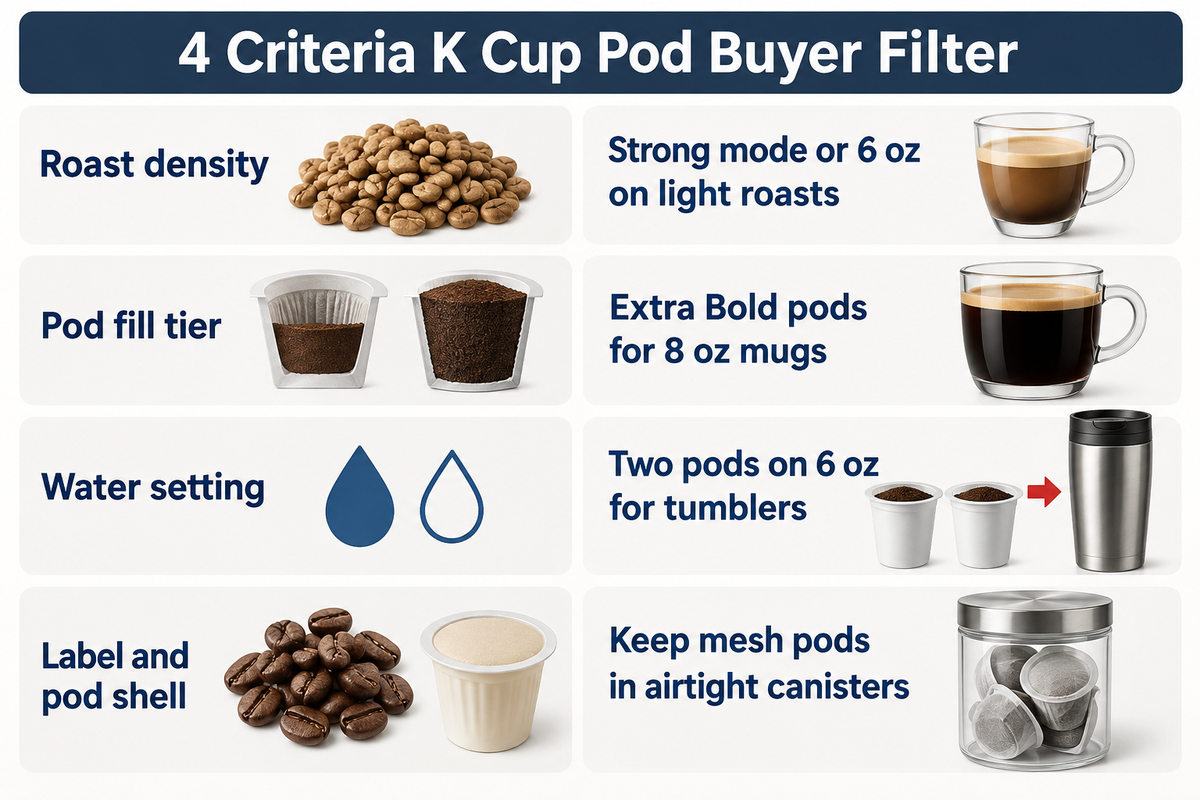
The best coffee pods are easier to pick once you stop equating capsules to scoops of coffee grounds. Using our 4 Criteria K Cup Pod Buyer Filter, you can avoid weak blend coffee. Checking bean density and pod fill, water ounces, and ingredients keeps weak pods out of your pantry.
While buying a multi-box case online or at a warehouse club, check four things in the seller’s listing. See the roast level, allergen, and ingredient disclosures on the back of the carton. Look for compatibility marks for MultiStream or Keurig 2.0 lids and the printed best-by window to ensure you don’t buy stale or incompatible boxes.
| Filter Step | What to Check | Why It Changes Your Mug | Practical Action |
|---|---|---|---|
| 1. Roast density | Light, medium, or dark bean cell porosity | Dense light beans dissolve slower in short cycles | Use Strong mode or 6 oz on light roasts |
| 2. Pod fill tier | Standard fill versus Extra Bold deep filter | Higher ground coffee mass raises dissolved solids | Pick Extra Bold pods for 8 oz mugs |
| 3. Water setting | 6–8 oz cup button versus 10–12 oz mug button | Extra water dilutes a fixed single-cup coffee bed | Brew two pods on 6 oz for travel tumblers |
| 4. Label & shell | Pure Arabica versus specialty dairy; #5 PP versus mesh | Separates zero-sugar aroma pods from sweetened lattes | Store open-mesh pods inside airtight canisters |
The integrity of oxygen barriers impacts the freshness of pre-ground capsules. Nitrogen foil cups slow staling. Filter rings, on the other hand, rely on the outer bag seal. Our storage guide on how long pre-ground coffee stays aromatic provides more information on the time frame for each capsule in the bag.
Which K-Cup pods taste bold in light, medium, and dark roasts without turning watery?
Green Mountain Breakfast Blend on a 6-ounce button leads light roasts, while Original Donut Shop Regular Extra Bold and Peet’s Big Bang lead medium roasts. Pick Peet’s Major Dickason’s Blend or Death Wish Dark Roast at 6 or 8 ounces for bold dark cups.
Roast-type extraction behaves differently in a rapid, single-cup cycle. Light roast coffee retains a tighter cellular structure, so soluble compounds take longer to extract. Selecting a smaller cup button like 6 ounces reduces water dilution, while pressing Strong slows water pulses to lengthen contact time across dense light grounds so citrus and toast notes shine.
Medium roast drinkers who take their coffee black often get the richest taste of coffee from Extra Bold diner blends. When a blend is a medium roast packed with finer grind particles, an 8-ounce pull delivers rounded coffee flavor without thin edges. Dark and espresso roast fans benefit from porous bean walls in French Roast or Italian profiles from Peet’s, Lavazza, and Death Wish. Those darker roast single serve coffee pods release heavy cocoa oils fast enough to anchor milk drinks.
How many grams of coffee are in a standard vs Extra Bold K-Cup, and which oz setting works best?
As a general format range rather than an audited SKU spec, standard K-Cup pods hold roughly 9 to 10 grams of ground coffee while Extra Bold pods pack roughly 11 to 13 grams. Brew standard pods at 6 or 8 ounces, and avoid diluting one pod across 10 or 12 ounces.
Rigid capsule geometry physically limits how much coffee a manufacturer can dose prior to the coffee bed expanding when it comes in contact with hot water. Leaving expansion room above the paper cone in a standard capsule prevents the top water-inlet needle from becoming blocked. Extra Bold blend k-cups, for example, have a modified filter pleat, which allows a denser dose of keurig k-cup coffee without the foil seal bursting.
For premium coffee from your Keurig, brew each pod at 6 or 8 ounces instead of 10 or 12. Pushing 10 or 12 fluid ounces through fixed keurig pods washes pale, woody late-stage solubles into your mug. Brewing a fresh single pod at 6 ounces gives you a good cup of regular coffee without papery bitterness.
Homeowners who love coffee ground fresh each morning can swap in a reusable pod basket filled with medium-fine Arabica coffee beans. Older aftermarket baskets may not clear the lid of a newer keurig machine using five MultiStream needles. Keurig’s My K-Cup Universal Reusable Coffee Filter fits most home units.
Do flavored coffee K-Cups like caramel or vanilla contain sugar or dairy?
Standard aroma-infused flavored coffee K-Cups like caramel, hazelnut, or French vanilla don’t contain any sugar, sweeteners, or dairy creamer. Only one-step or two-step specialty latte, cappuccino, mocha, and cocoa pods contain sweetened dairy or non-dairy creamer.
Roasters create unsweetened caramel or nutty profiles by misting warm roasted beans with aromatic flavor oils right after cooling. Because no syrups or milk solids enter flavored black coffee like Folgers Buttery Caramel or Eight O’Clock Caramel, these pods brew clean. Drinkers sensitive to synthetic aftertaste can compare natural-flavor ingredient panels from brands like Green Mountain.
Always flip the carton when front artwork shows whipped foam or chocolate drizzle. Café-style mocha and vanilla latte boxes contain soluble coffee with sugar and milk solids. Run a plain hot-water rinse cycle to clean your coffee maker exit needle.
Where to buy K-Cup coffee pods: bulk per-pod cost and US pod recycling realities
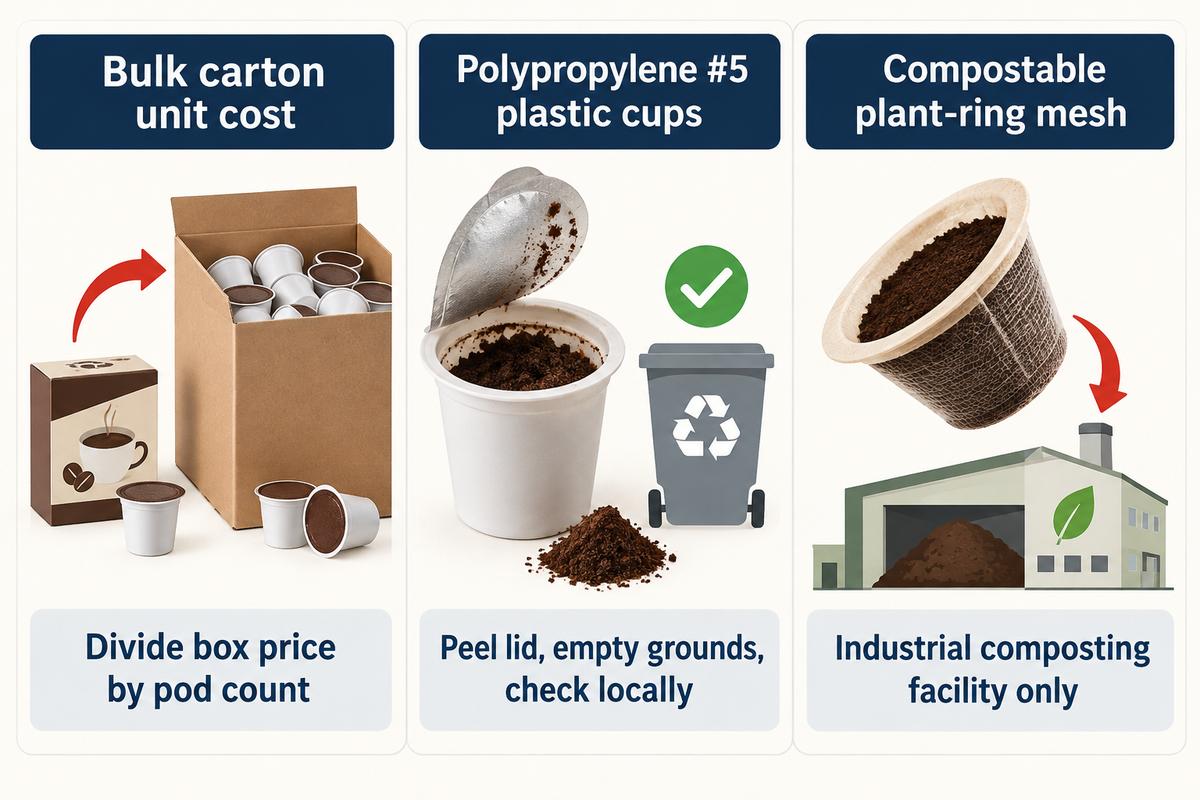
Smart pantry buying boils down to two checks that front labels rarely highlight: the unit price per capsule and the municipal waste acceptance. Supermarket endcaps, warehouse clubs, brand subscriptions, and online multi-packs structure carton counts differently across our ten brand groups. Keeping track of how pack sizes scale from 10-count sleeves to 120-count cases helps track household spending.
We also have to read environmental claims on capsule boxes. Plastic resin codes and compostability badges all follow strict municipal and industrial sorting rules which differ from how aluminum can recycling works.
How much do bulk 72-count to 100-count K-Cup boxes save per pod vs 12-count grocery packs?
Retail dollar prices per pod vary day to day and from store to store, meaning a national cent-per-pod figure doesn’t exist. Stepping up from 10-count or 12-count grocery sleeves to 72-count or 100-count bulk boxes lowers same-brand unit cost. Always divide total delivered box price by exact pod count rather than comparing store private labels against licensed café boxes.
Entry grocery sleeves vary between 10-count and 12-count boxes depending on the roaster, which changes per-cup cost even at similar shelf prices. Across these ten coffee brands, Death Wish scales boxes from 10, 20, 30, and 50 up to 100 count. Eight O’Clock steps from 10, 22, 32, and 44 up to 94-count cartons, while San Francisco Bay packs 12, 36, 80, and 120-count bags.
Make your bulk purchases of capsules to match a two to three month household drinking pace, so the aroma of quality coffee doesn’t fade. Sealed k-cup coffee pods retain freshness longer than meshed rings. Read our article on storage of coffee capsules to understand the effects of heat and humidity on sealed capsules.
Are #5 polypropylene K-Cup pods recyclable curbside compared with compostable mesh pods?
No, #5 polypropylene K-Cup pods aren’t accepted in many US municipal curbside bins and can be recycled curbside only where local sorting plants explicitly accept small #5 cups after you peel lids and empty wet grounds. By contrast, certified commercially compostable mesh pods like San Francisco Bay OneCUP require industrial composting facilities rather than curbside blue recycling bins or cool backyard piles.
Disclosures show why the rules around blue-bin recycling vary by municipality. According to Keurig’s official recyclability page, Keurig transitioned their US pods to polypropylene (#5 plastic) in 2020 and committed $10 million to The Recycling Partnership’s Polypropylene Recycling Coalition. Packaging states “Check Locally, Not Recycled in Many Communities” and mail-in K-Cycle recovery bags are offered. On September 10, 2024, the U.S. Securities and Exchange Commission (Press Release 2024-122) announced a $1.5 million civil penalty for the company’s FY2019 and FY2020 annual report statements. Keurig failed to disclose that two of the largest US recycling companies had contacted them to express they wouldn’t accept the pods for curbside recycling.
Plant-based mesh designs create a unique waste stream. The OneCUP rings used in the San Francisco Bay pods are certified commercially compostable and shouldn’t be placed in plastic recycling bins. Roasters interested in learning more can check out our engineering guide on capsule shell and lidding film material compatibility.
Frequently asked questions
What is the best coffee to use in a Keurig?
Green Mountain Breakfast Blend, The Original Donut Shop Regular, and McCafé Premium Roast are dependable choices for everyday medium cups at home or in busy offices. Drinkers wanting richer dark body should pick Peet’s Major Dickason’s Blend or Lavazza Perfetto for fuller crema-free strength. Organic shoppers can choose Newman’s Own Special Blend or Death Wish Dark Roast brewed on a 6-ounce or 8-ounce mug setting.
Which coffee pods are best tasting for people who hate weak pod coffee?
Peet’s Major Dickason’s Blend, The Original Donut Shop Regular Extra Bold, Starbucks Sumatra, and Death Wish Dark Roast are the best tasting picks for drinkers tired of watery mugs. Brew these best k-cups like any Keurig k-cup pods on your 6-ounce or 8-ounce cup button with Strong mode active, avoiding diluted 12-ounce pulls that wash out body.
Are Green Mountain Coffee Roasters and The Original Donut Shop made by the same company?
Yes, both Green Mountain Coffee Roasters and The Original Donut Shop are owned coffee brands within Keurig Dr Pepper’s North American beverage portfolio rather than competing independent roasters. Green Mountain focuses on regional profiles such as Breakfast Blend, Nantucket Blend, and Dark Magic. Sister brand Original Donut Shop centers on extra-bold diner medium cups and sweet specialty flavors.
Does K-Cup coffee contain instant coffee or real ground beans?
Standard black K-Cup pods contain real roasted and ground coffee sealed over a paper filter, not soluble instant crystals. Only one-step or two-step specialty latte and cocoa pods add sweetened creamer powders.
What did Keurig’s official recycling disclosures and the September 2024 SEC settlement establish?
Keurig switched US K-Cup shells to #5 polypropylene in 2020 alongside a $10 million Polypropylene Recycling Coalition commitment and prints “Check locally, not recycled in many communities” on boxes. On September 10, 2024, the US Securities and Exchange Commission imposed a $1.5 million civil penalty over FY2019 and FY2020 annual reports. Two major US recycling companies had expressed concerns and indicated they wouldn’t accept pods curbside.
Can I use a reusable pod filter in a Keurig coffee maker?
Yes, Keurig’s My K-Cup Universal Reusable Coffee Filter fits most home Keurig coffee makers for medium-fine ground beans, including newer five-needle MultiStream lids.
Which other K-Cup coffee brands are worth considering beyond this top-10 shortlist?
Several notable roasters and store labels serve specific niches outside our ten featured brand groups. Caribou Coffee and Kahawa 1893 suit bright mild roast morning mugs, while Black Rifle Coffee and illy serve bold dark or Italian espresso fans. Budget warehouse buyers also compare Kirkland Signature at Costco, Member’s Mark at Sam’s Club, and Amazon Happy Belly cartons when prioritizing low office cost per cup of coffee.
Packaging roasted coffee into commercial K-Cup pods
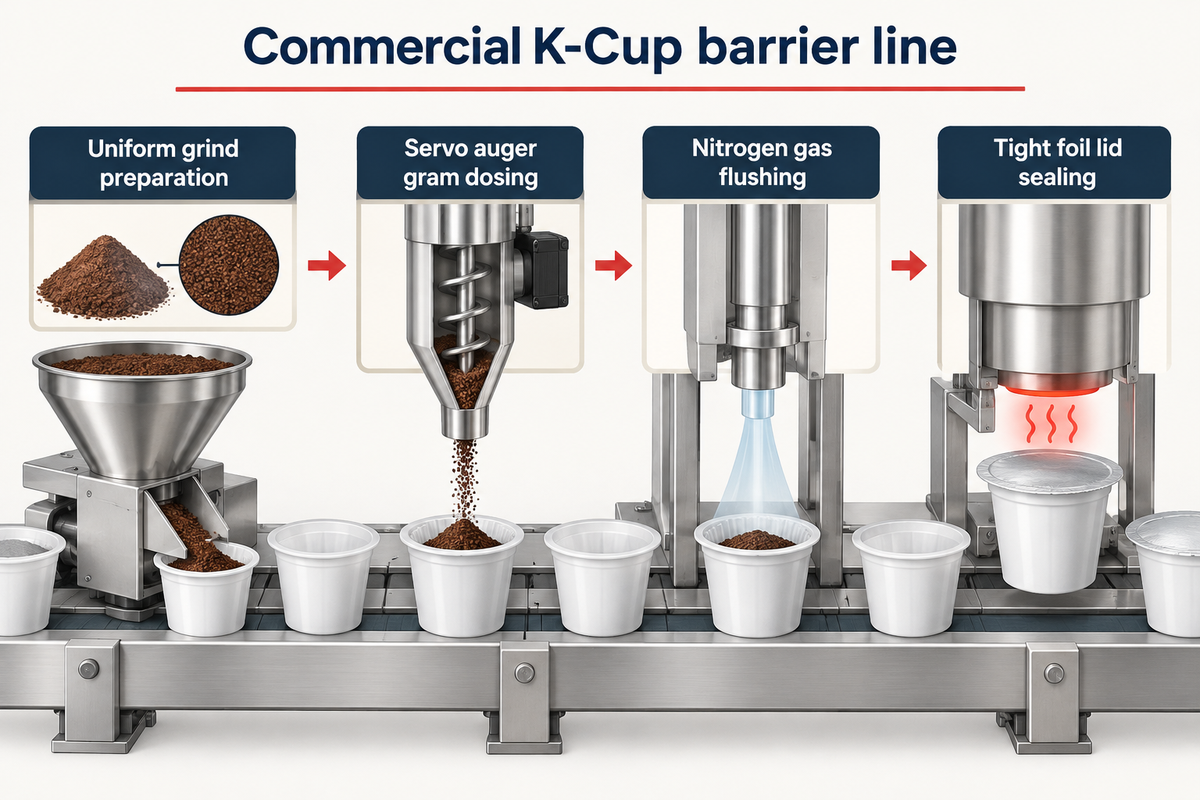
Interested in how roasters keep ground Arabica fresh in sealed capsules? Look to the commercial filling line behind every retail box. Specialty roasters and private-label coffee teams moving from co-packing into in-house pod production rely on uniform grind size, accurate gram dosing, nitrogen flushing, and tight foil lid sealing.
In commercial roasteries, AFPAK’s rotary and inline K-Cup filling machines and Nespresso capsule filling and sealing equipment can fill 50 to 600 cups per minute. Servo auger dosing and nitrogen flushing support single-serve coffee lines and AFPAK has no commercial ties to the retail brands reviewed previously.
References & Sources
- SEC Press Release 2024-122: SEC Charges Keurig With Making Inaccurate Statements Regarding Recyclability of K-Cup Beverage Pods (Sept. 10, 2024) U.S. Securities and Exchange Commission


