
Updated October 2026
Coffee capsule packaging material compatibility refers to the working together of capsule body, lid, and sealing layer to perform functions such as filling, sealing, storage and brewing. A replacement has to fit the tooling, form the intended seal and protect the coffee. The material name alone leaves several decisions such as the sealant, surface, and the production process open.
- Match: capsule rim surface, lid sealing layer and machine contact geometry.
- Control: material revisions, coffee recipe and production conditions.
- Measure separately: seal strength, leaks, gas transmission and brewing performance.
- Compare commercially: cost per 1,000 accepted capsules.
Coffee capsule packaging material compatibility requires a matched rim surface, lid sealant and production process. Maintain the approved pair for routine production. Trial changes to the sealing surface, geometry, or the complete pack, before replacing the supply.
- Aluminum lidding can seal to a plastic body when its sealing layer is designed for that surface.
- A body that fits the brewer may still need different feeding or sealing tooling.
- A lower material price can produce a higher cost per accepted capsule.
Coffee Capsule Packaging Material Compatibility at a Glance
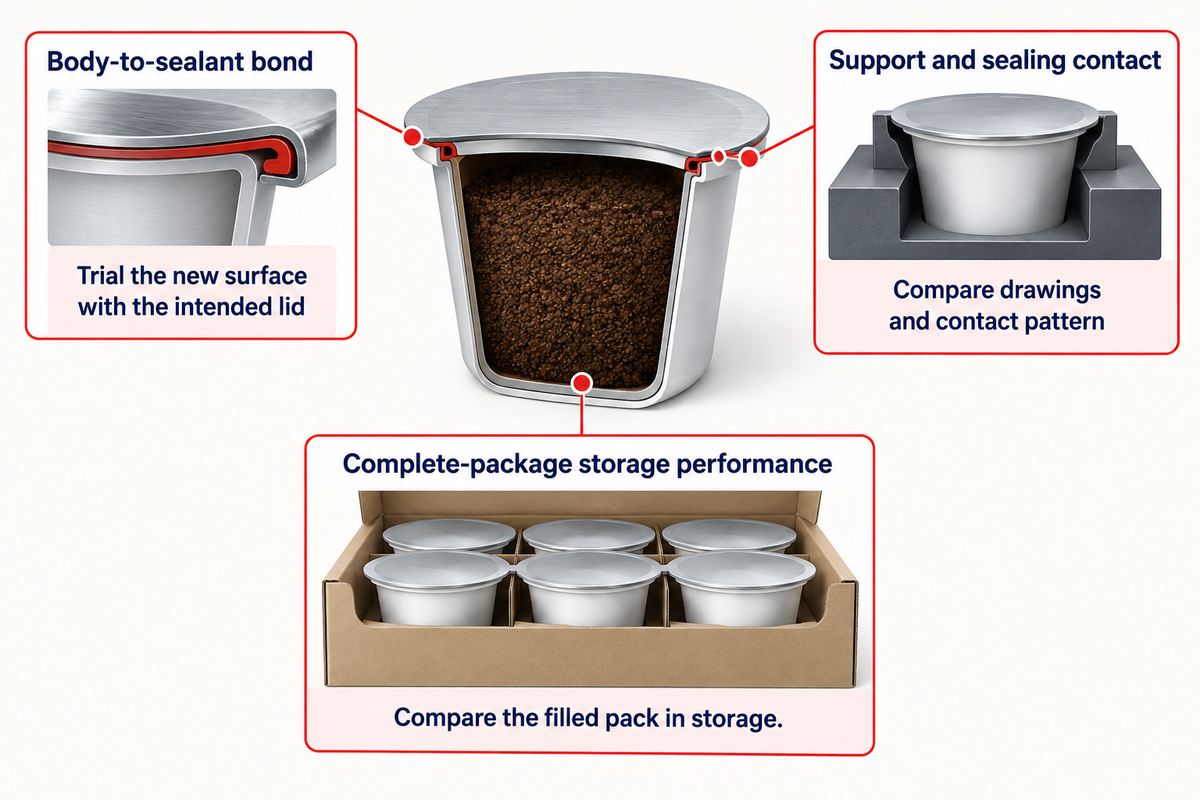
A matched package starts with the surfaces that touch. The lid’s sealing layer meets the capsule flange; the body meets the filler’s supports and brewer’s chamber; the closed pack meets storage conditions. Treating each of those interfaces separately helps in replacement decisions as opposed to making a choice of “plastic or aluminum.”
3-Interface Substitution Map
The 3-Interface Substitution Map links each material change to its sealing, machine contact or finished package consequence.
Use the current approved capsule bodies and sealing lids as the reference pair. A change to printing may leave the sealing face unchanged. A new coating on an otherwise identical rim changes the bond itself. These two purchases require different trials.
| Changed item | Interface affected | Next decision |
|---|---|---|
| Rim coating or surface treatment | Body-to-sealant bond | Trial the new surface with the intended lid before retaining the old recipe. |
| Body resin or layer structure | Heat response, stiffness and barrier | Evaluate feeding, flange support, sealing and finished-pack protection. |
| Flange dimensions or flatness | Support and sealing contact | Compare the controlled drawings and contact pattern before ordering change parts. |
| Lid sealant | Bond formation | Develop settings for the new body-and-lid pair. |
| Lid thickness or laminate | Heat transfer and opening behavior | Evaluate sealing, separation and brewing with the complete structure. |
| Pre-cut lids to roll film | Feeding, registration and cutting | Include film handling and cutting equipment in the change scope. |
| Filter or inner membrane | Internal flow and retention | Run filling and brewing checks for the selected capsule construction. |
| Barrier layer or overwrap | Complete-package storage performance | Compare the filled pack under the intended storage conditions. |
| Line speed | Available contact and handling time | Repeat the production trial at the required sustained rate. |
| Coffee grind or dose | Rim cleanliness and brewing flow | Separate the coffee change from the packaging comparison. |
Retain a replacement only within the existing approval when both the controlled specification and the agreed change procedure allow for it. Otherwise, find the changed interface and perform the relevant comparison. This approach allows for the preservation of an approved baseline and gives production a defined task.
Aluminum Coffee Capsules vs Plastic and Compostable Designs
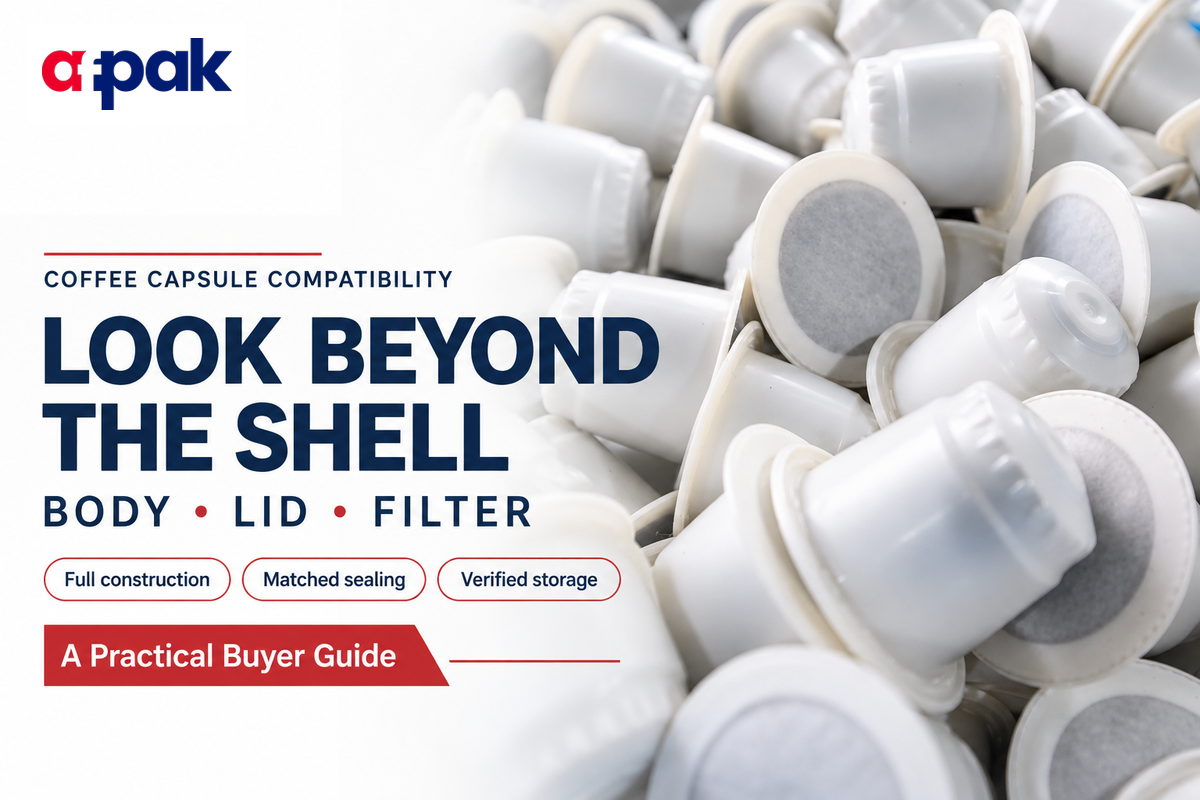
Aluminum coffee capsules, plastic pods and compostable coffee capsules are three families of construction. Pick the candidate that best matches the brewer format, storage route and production requirement as a complete package. The choice includes barriers, coatings, filters and the visible package. Changing that shell can change more than its purchase price.
Rigid coffee pods use a formed body and closure while soft coffee pod packaging has a different structure. In rigid capsules, a multilayer body and a monolayer body may look similar. An aluminum lid can have a polymer sealing layer. A compostable capsule can have different layers with different functions.
| Construction or component | Relevant feature | Selection consequence |
|---|---|---|
| Coated aluminum body | Flange surface and coating | Match the lid to the sealing surface, not bare-metal assumptions. |
| Single-polymer plastic body | Resin grade and molded geometry | Retain both material and dimensional requirements. |
| Barrier plastic body | Barrier and structural layers | Identify which layer reaches the sealing flange. |
| Compostable body | Specified compound and complete assembly | Select the corresponding lid, filter and disposal route together. |
| Aluminum lidding | Lacquer, coextrusion or laminated sealing layer | Use the designated seal-side construction. |
| Fiber-based multilayer lid | Sealing, barrier and flow functions | Keep the full laminate identity when comparing alternatives. |
| Filter | Retention, flow and attachment | Check the intended coffee and brewing arrangement. |
| Inner membrane | Capsule-specific internal structure | Include it where the selected format requires it. |
| Outer barrier pack | Protection around the finished capsules | Compare shelf-life results for the same complete pack. |
Compostable materials don’t impose one production-speed ceiling. In a July 2025 Packaging World report, Metropolis Coffee used Compostable Solutions bodies and Jura-Tech lidding on an IMA four-lane machine running at 240 capsules/min. This is a specific case of production, and not a matched-speed comparison against aluminum pods or an AFPAK specification.
For a roaster already making high-quality coffee products on an approved pair, keep that pair as the reference during alternative packaging trials. A different coffee, a new capsule material and a new machine recipe changed together make the cause of any improvement or loss difficult to identify.
Lidding Foil: Match the Sealant to the Capsule Rim
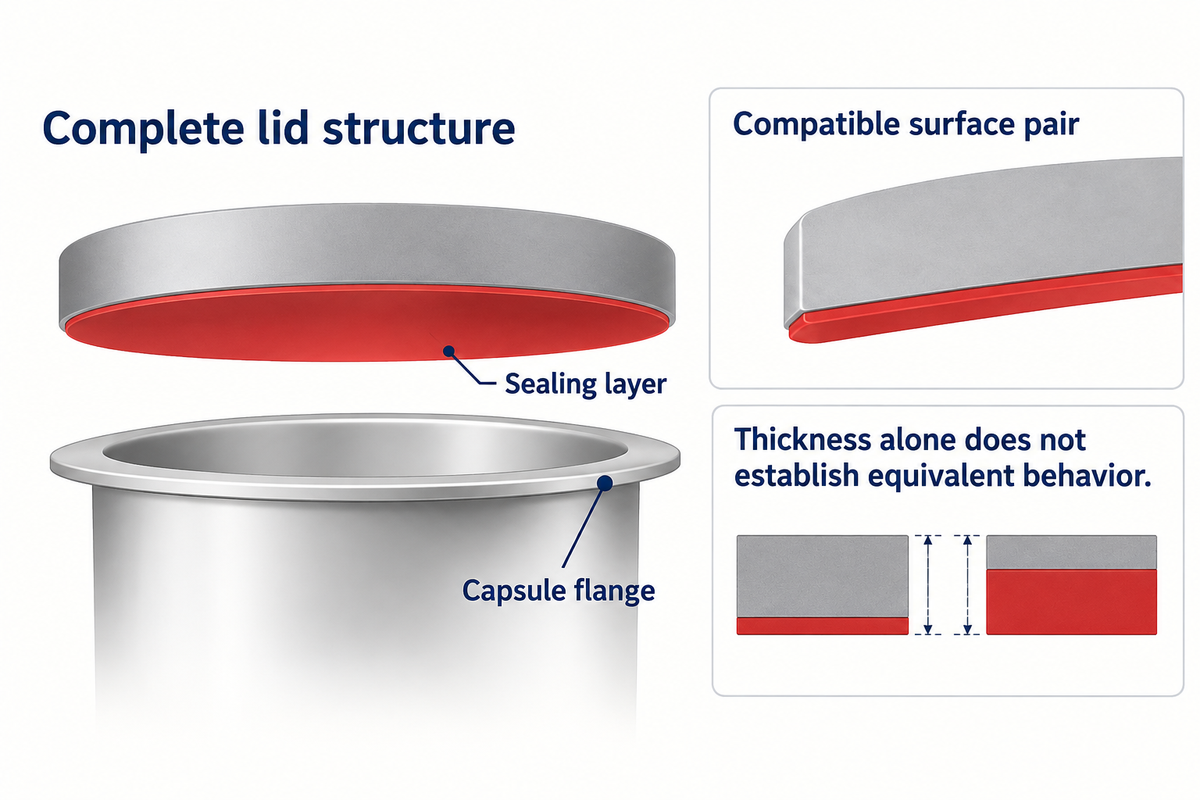
The layer interfacing with the capsule’s contact surface must provide sealing. The outer substrate carries other duties, including handling and barrier performance. The complete lid structure, its sealing side and intended substrate must be considered. A roll with the same appearance, but a different coating, would be a different sealing candidate.
ASTM F2029-16(2021) describes how the sealing layer, overall construction and thickness influence laboratory heat sealability. Its scope includes webs of the same or dissimilar materials. The practical choice is therefore a compatible surface pair, rather than a rule that the body and lid must have identical bulk materials.
Think of a buyer who gets two quotations for identical diameter foils with the same printed artwork. The lower price quote is for a different sealing lacquer. Keeping the old temperature because the two lids look alike would leave the changed bond unexamined. Production should compare the proposed lid on the approved body first, then assess any other planned substitution separately. Approval follows a matched pair and its operating conditions.
How thick should the lid be?
Use the gauge or basis weight specified for the complete lid construction and intended opening mechanism. Equal thickness of the two laminates doesn’t give equal sealing or brewing behavior. Different layers of the laminate (i.e. foil, coating, fiber and others) have different performances, and thus retaining the approved structure is the first choice when only price is changing.
As for the Metropolis case, Jura-Tech’s three-layer lid provided sealing and barrier as well as filtering functions at a reported basis weight range of 115 – 130 g/m². Basis weight is expressed in mass per area, and can’t be related to lid thickness without knowing the construction and densities of the layers. Thus, a substitution needs to provide the functionality and not just be in the basis weight range reported for that case.
Coffee Capsule Diameter and Tooling Fit
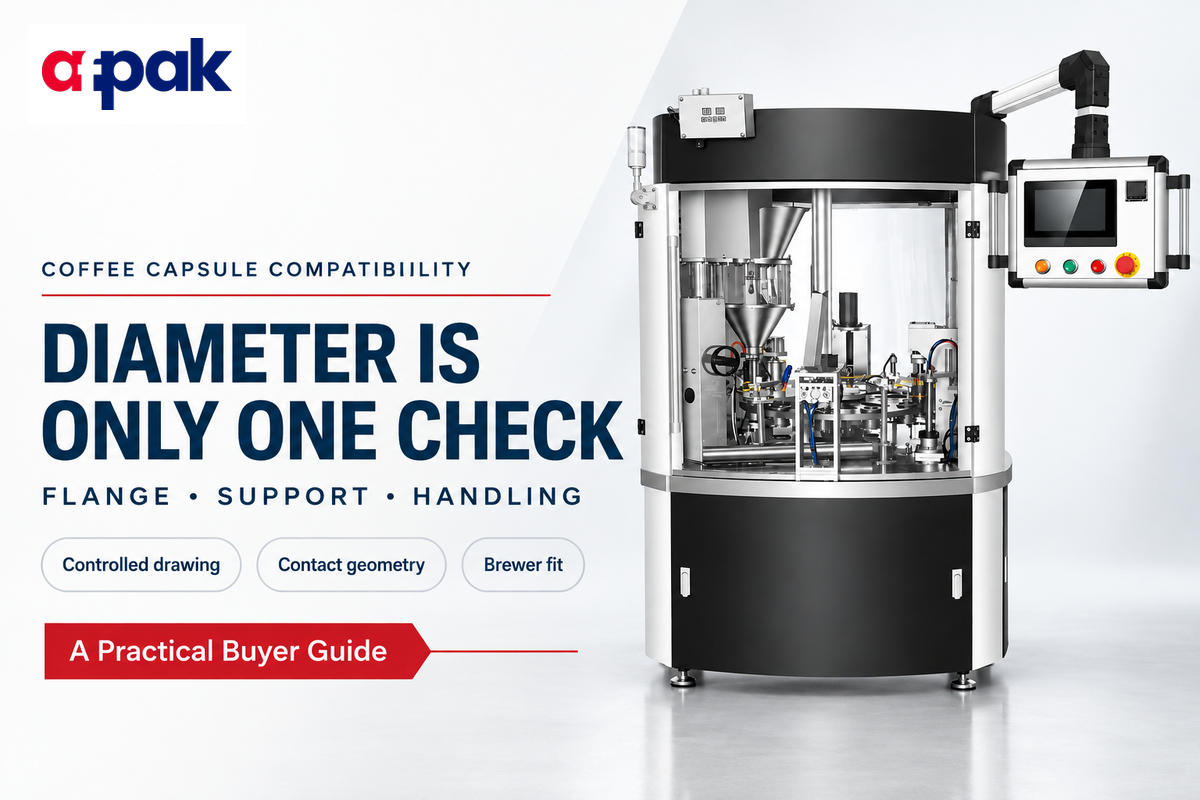
Coffee capsule diameter is one aspect of machine compatibility. Other aspects include flange shape, height, flatness, nesting behavior and stiffness. How a body is fed and sits under a sealing head is determined by these. Keep the contact geometry on the drawing. Change tooling when the proposed construction needs different support or handling, rather than assuming every material change requires a complete tooling set.
ISO 20457:2026 addresses tolerances for plastic molded parts, including material behavior, molding shrinkage and warpage. Its published framework helps explain why metal-part tolerance assumptions do not transfer directly to molded plastics. The capsule’s functional fit and its supports require a project drawing.
AFPAK’s Nespresso format tooling is selected along with the capsule and the lid material. On appropriate inner and top film arrangements, both film interfaces are to be included in the trial. A Nespresso compatibility label doesn’t represent different capsule packaging lines.
Capsules must also brew coffee consistently in the intended espresso machine. Packaging World explains a paperboard gasket incorporated into the Metropolis capsule body to attain the intended capsule to machine seal. Correct lid bonding and correct brewer seating are separate design issues, even though they both influence the drink reaching the cup.
Coffee Capsule Sealing: Validate a Production Window
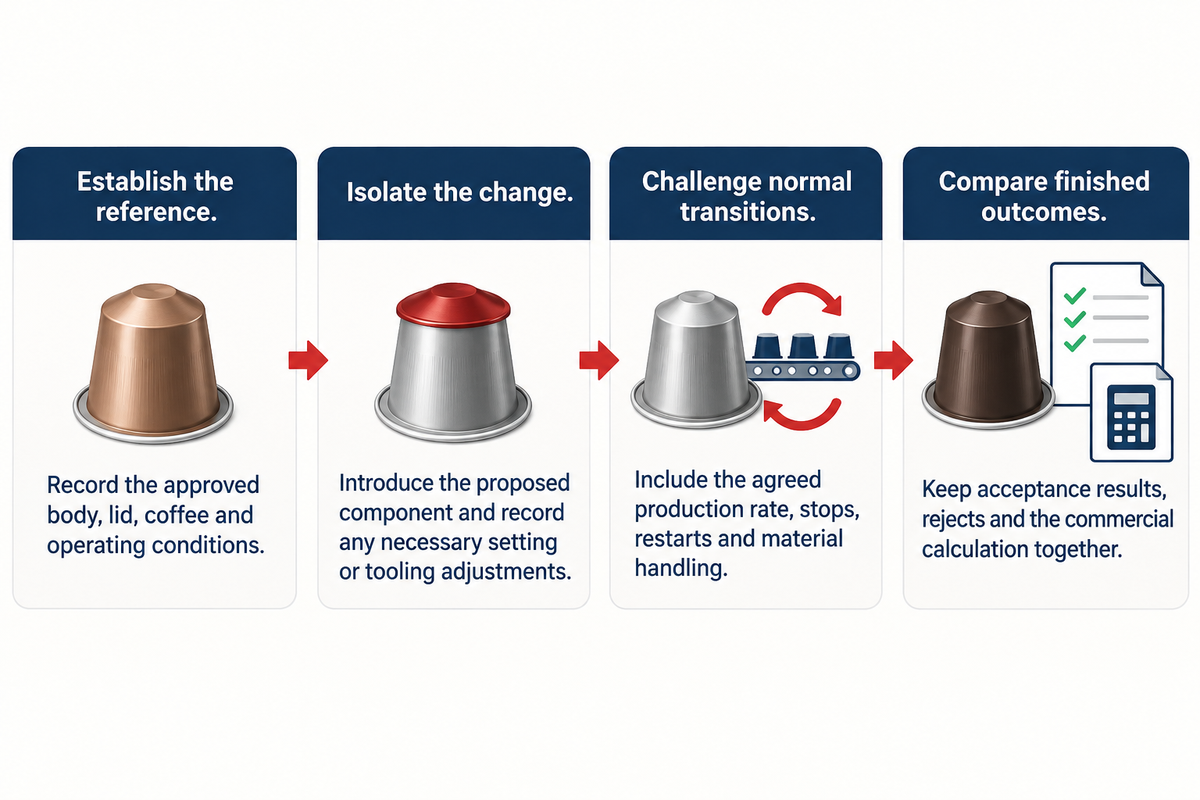
During coffee capsule trials, the approved and proposed material pairs should be compared under defined process conditions. Record temperature, dwell time and contact force or pressure with the tooling and line speed. It’s more useful to determine the operating window that achieves the agreed outcomes, e.g. start up and restart behavior, over one successful seal.
ASTM F2029 uses laboratory heat-seal curves as a starting point for manufacturing settings. Production sealers vary in contact area, scale and speed of processing. Those differences explain the need to adapt a lab result to the conditions of the working line.
How do we proof-test compatibility before the big run?
First run the current pair and then the proposed pair with the same coffee and documented settings. Compare results such as feeding, coffee powder on the rim, seal behavior, accepted output, and brewing results. Keep the material revisions and sample identities attached to the observations so production can distinguish a material effect from a changed coffee or machine condition.
- Establish the reference. Record the approved body, lid, coffee and operating conditions.
- Isolate the change. Introduce the proposed component and record any necessary setting or tooling adjustments.
- Challenge normal transitions. Include the agreed production rate, stops, restarts and material handling.
- Compare finished outcomes. Keep acceptance results, rejects and the commercial calculation together.
Routine batch sampling and receipt should occur within incoming capsule material qualification. If an established pair develops a fault, use the sealing fault investigation to check the process before blaming a new raw material.
A 2020 Scientific Reports study of 43 capsule products found that a higher share of fines below 100 µm was associated with longer extraction at similar median particle size. Separate the same batch of coffee for the material trials and record its particle distribution. Otherwise, a changed coffee bed may mask a packaging comparison.
Coffee Capsule Shelf Life: Verify the Finished Pack
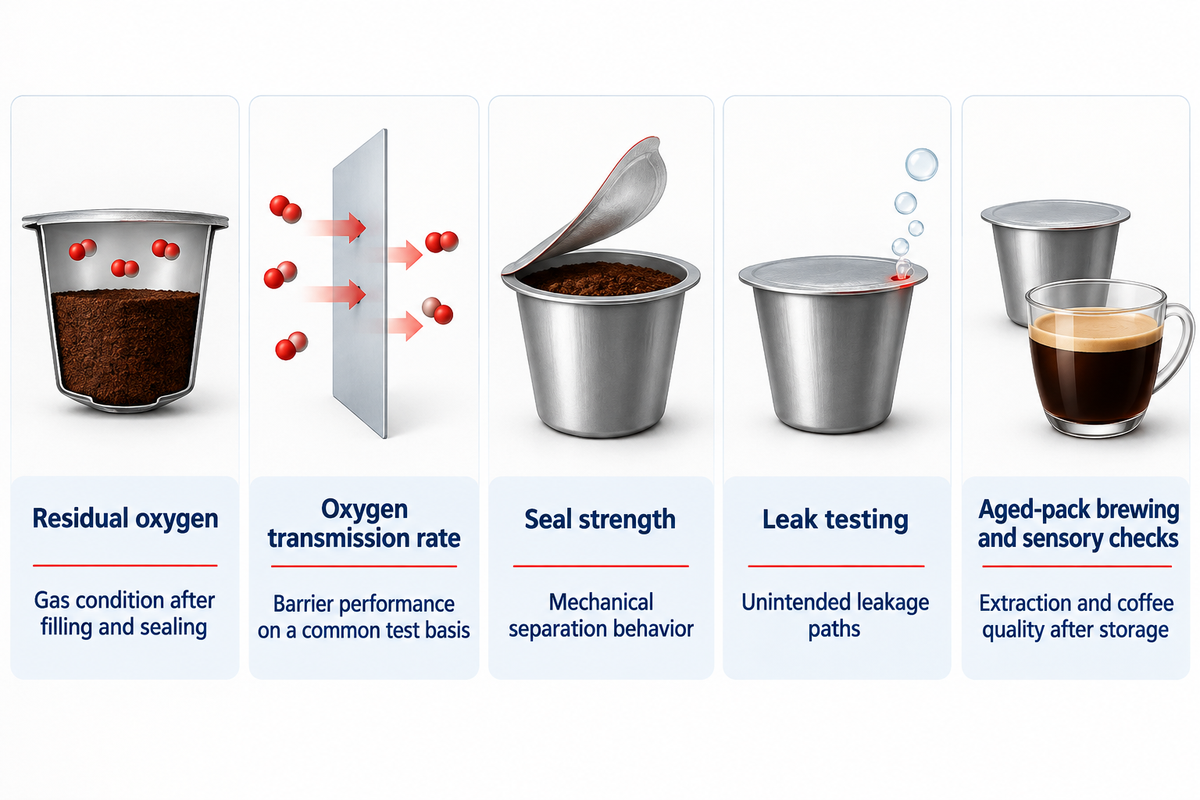
Coffee freshness tracks the filled and sealed package through storage. Initial headspace oxygen, gas transmission, leakage and seal strength describe different properties. Choose the measurement that answers the suspected failure, then compare samples under the same conditions. Freshly ground coffee, nitrogen flushing and a high-barrier body still require a closure that performs its intended function.
| Measurement | Report basis | Decision it supports |
|---|---|---|
| Residual oxygen | Percentage, sampling time and headspace | Assess the gas condition after filling and sealing. |
| Oxygen transmission rate | Units, specimen, temperature and humidity | Compare oxygen barrier performance on a common test basis. |
| Seal strength | Specimen, fixture, angle, force and failure mode | Assess mechanical separation behavior. |
| Leak testing | Method, sensitivity and test conditions | Detect unintended leakage paths. |
| Aged-pack brewing and sensory checks | Coffee, pack, storage interval and brewer | Assess extraction and coffee quality after storage. |
Seal-strength methods also vary. ASTM F2824-10(2025) covers removal of the entire flexible peelable lid from a rigid or semi-rigid round container. It specifies a 45° pull angle; other angles can be used when documented and validated. Whole-lid separation and leakage remain different measurements, and the method must suit the closure being tested.
“This test also assumes that the one-inch section tested is representative of the entire seal, which may not be the case.”
Basile and colleagues’ 2024 study of alternative multilayer film compared external flexible packaging around paper pods and plastic capsules. The capsules, packed at 10 per bag, were stored at 25 °C and 40 °C for 180 days. The measured lipid and volatile results concern the coffee stored in those outer packs, rather than a replacement capsule body or lid.
When you package coffee for distribution, compare complete packs for coffee aroma and staling. If an overwrap is removed, its oxygen barrier disappears from that pack design. Keep coffee fresh by evaluating the new route of storage and assembly, rather than maintaining the previous shelf life for a pack that has been altered.
Empty Coffee Pods: Compare Cost per Accepted Capsule
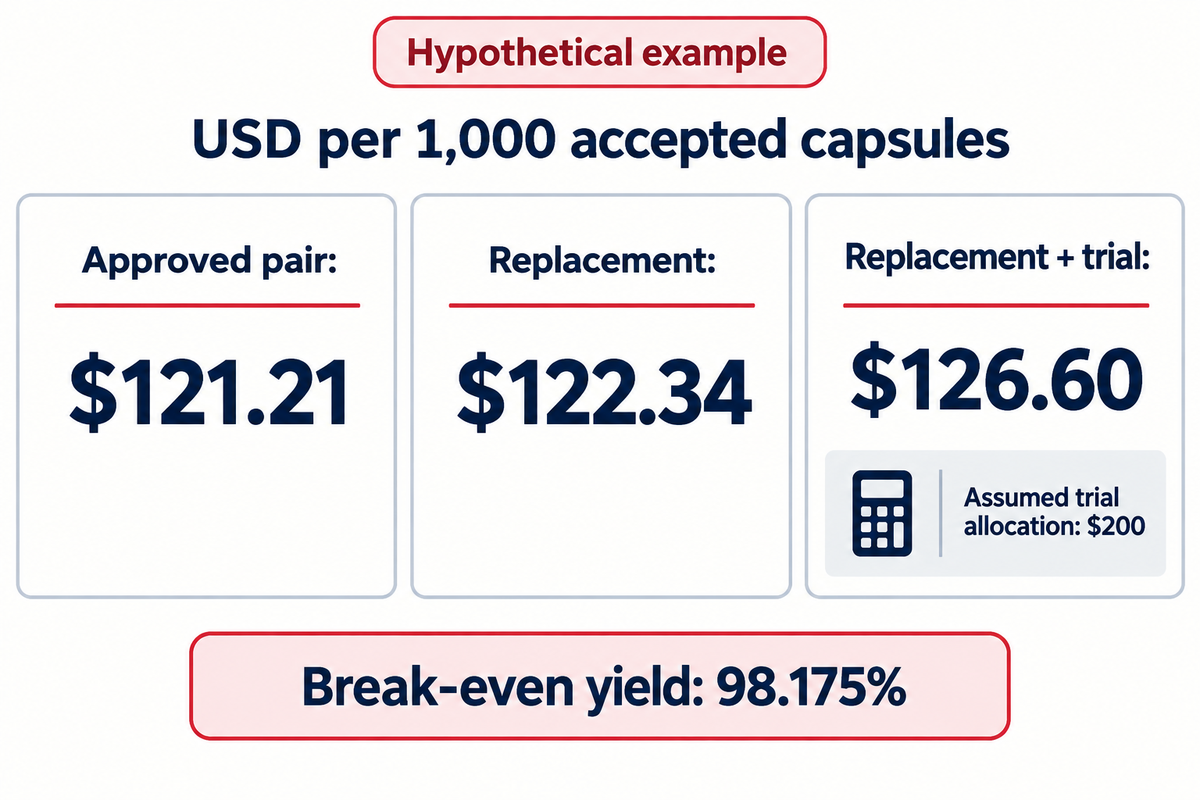
Empty coffee pods should be analyzed with respect to accepted output, because rejected capsules eat packaging, coffee, and line time. A lower shell-and-lid price can negate its advantage when yield falls. Make sure the same cost components are in both options and apportion trial or tooling costs over an estimated production volume before making the purchase decision.
Accepted-Capsule Cost Crossover
The Accepted Capsule Cost Crossover is the break-even yield where a replacement’s cost per accepted capsule equals the approved pair’s cost.
Assumed inputs: 50,000 started capsules, with the same coffee, conversion cost and production rate in both options. Every started capsule incurs the listed variable costs. The replacement body-and-lid pair costs $0.005 less, but its accepted yield falls from 99% to 94%.
| Cost or output measure | Approved pair | Replacement pair |
|---|---|---|
| Body and lid per start | $0.070 | $0.065 |
| Coffee per start | $0.030 | $0.030 |
| Conversion per start | $0.020 | $0.020 |
| Variable cost per start | $0.120 | $0.115 |
| Started quantity | 50,000 capsules | 50,000 capsules |
| Accepted yield | 99% | 94% |
| Accepted quantity | 49,500 capsules | 47,000 capsules |
| Total variable cost | $6,000 | $5,750 |
| Variable cost per 1,000 accepted | $121.21 | $122.34 |
| One-time trial allocation | $0 | $200 |
| Cost per 1,000 accepted, including trial | $121.21 | $126.60 |
To find cost per accepted capsule, use the formula (N × c + F) ÷ (N × y), where N is starts, c is variable cost per start, F is the allocated one-time cost and y is accepted yield, as a decimal. The rejected material is already included in N × c, so its purchase cost shouldn’t be added to N × c again, as this would be double counting.
For the replacement to match the baseline with its $200 trial allocation, the required yield is 0.99 × ($0.115 + $200 ÷ 50,000) ÷ $0.120 = 0.98175, or 98.175%. At 94%, the proposed saving doesn’t cover the loss in accepted output. Production and purchasing therefore have a measurable target for the next trial.
The calculation has to be adjusted if the replacement slows the line, requires an overwrap, or produces excess inspection. In her seal-integrity review, Claire Koelsch Sand describes increasing leak-detection sampling after a material change. These costs should be included in the comparison, and not be hidden within equivalent material. Minimum order quantities can also affect the quantity over which qualification costs are spread. A small first order can carry a different unit burden from repeat capsule production.
Coffee Capsule Filling Machine Trials: What to Send AFPAK
Send capsule drawings or samples, lid material and coffee details, along with required output and final pack, to AFPAK. Those inputs connect a material choice to a coffee capsule filling machine configuration. Keep the body supplier, lid supplier, and the machine builder in the same proposed change, to ensure that the quotation addresses all interfaces.
Coffee producers can reproduce these fields for packaging suppliers and the line builder:
- Capsule identity: format, material construction, drawing revision and samples.
- Lid identity: Full structure, seal side, gauge or basis weight, and pre-cut or rolled presentation.
- Coffee: type, target filling weight, grind distribution, and relevant handling characteristics.
- Output: Required accepted capsules per minute and the planned production schedule.
- Finished Pack: capsule count, carton or overwrap, storage route and shelf-life target.
- Trial scope: agreed test methods, acceptance limits, change parts and who’s responsible for adjustments.
- Market requirements: destination country, intended food contact use and specific disposal claim.
Confirm the tools and materials tests included in the quote, who supplies the samples, and what happens in case of a failed test. Ask for the results against the agreed criteria. AFPAK’s published process evaluates the customer’s capsule, lid and coffee before the final setup is selected.
For food packaging, the component and intended use framework of the FDA includes several authorization routes. A food contact notification is one route and is specific to its manufacturer, substance and conditions of use. The relevant requirements apply to the complete construction and intended contact conditions, including brewing where applicable.
A capsule oligomers study of polybutylene terephthalate (PBT) and polypropylene (PP) capsules by the JRC, using water and a food simulant, evaluated migration. Assessing migration is different from sealing. That study evaluates the materials and conditions tested; it isn’t a health assessment of every capsule or of aluminum-capsules.
Recyclable Coffee Capsules and Material Change Control
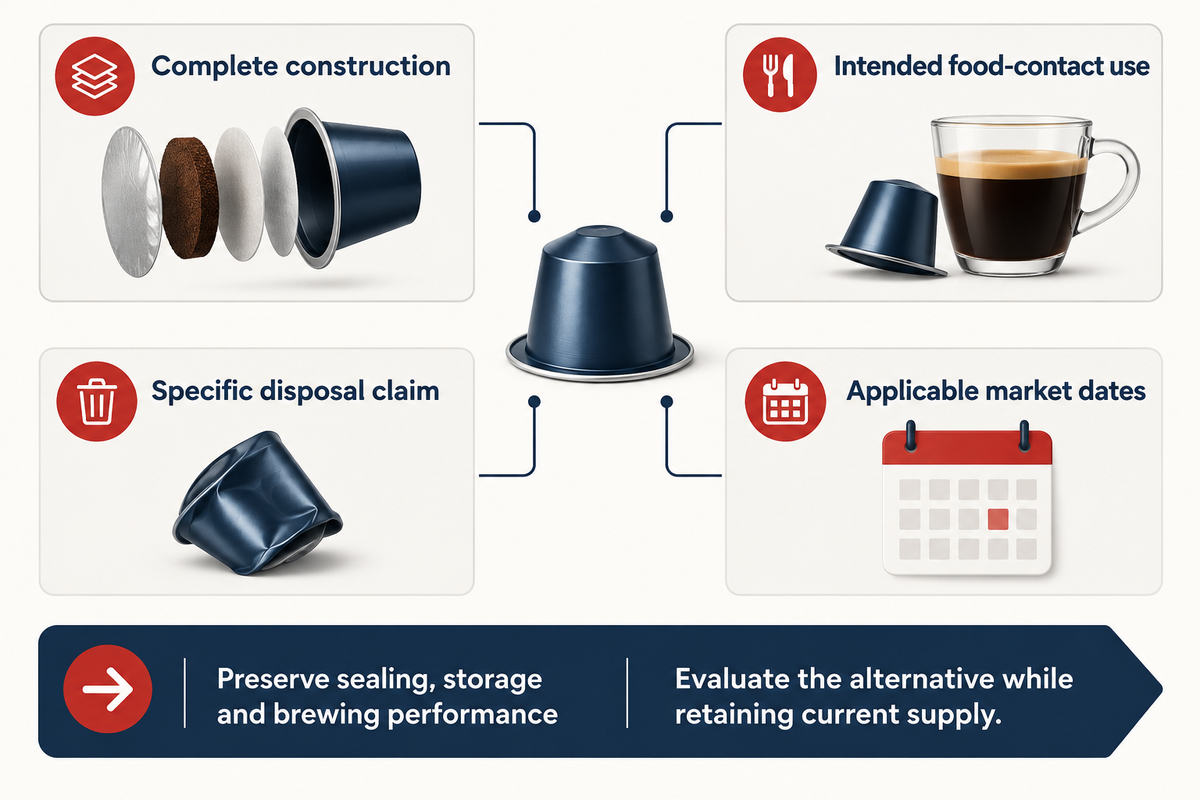
Recyclable coffee capsules and compostable packaging require a disposal route that’s matched to the finished construction. Sustainable coffee packaging decisions also have to preserve sealing, storage and brewing performance. Budget materials development work alongside other project work (i.e. artwork and sourcing), as alterations to a barrier, adhesive or gasket may affect the package and environmental claim.
For U.S. marketing, the Federal Trade Commission’s compostable-claims guidance calls for evidence covering all materials in a compostable product or package. Claims need qualification when home composting is unsuitable or if appropriate facilities aren’t widely available. “biodegradable coffee capsule” and industrial compostability aren’t interchangeable claims.
European export projects now have a dated planning trigger. The European Commission’s August 2026 announcement states that the Packaging and Packaging Waste Regulation begins phased application on 12 August 2026, with other measures following later. Keep the destination market requirements and their applicable dates for each revision of the material, rather than using a single date for all requirements.
The focus for technical development in the coffee industry is already on complete assemblies. In Global Coffee Report’s 2024 interview, IMA’s Nicola Panzani described tests of capsules, filters and top lids and the IMA/NatureWorks work on PLA-based components. Their technology belongs to those companies. It illustrates why trends in coffee packaging should be defined for specific materials and processes.
For coffee brands considering new pods, run the existing supply chain while the alternative is evaluated. Sustainable packaging should reduce the intended environmental impact without an unplanned compromise in product protection or accepted output. A construction that meets the cost crossover and technical criteria has a clear purchase case.
FAQ
What are the key requirements for coffee packaging?
Coffee packaging must protect the product and work through production, distribution and intended use.
Are all coffee pods compatible?
Coffee pods are not interchangeable across all brewing systems.
Is there a difference between coffee pods and capsules?
A soft pod encloses coffee in a filter structure; a capsule uses a formed container and closure.
Can one machine run different Nespresso-compatible capsule materials?
A machine can be configured for approved material combinations, with the required tooling and sealing adjustments.
Are Compostable Coffee Pods Actually Compostable?
Compostable pods need a supported claim for the stated composting conditions and the complete claimed assembly.
Can an existing lid be used after a capsule material change?
Retain the lid only when it works with the new sealing surface and agreed production conditions.
Does a lower capsule price mean a lower production cost?
A lower capsule price saves money only when the complete cost per accepted capsule falls.
Approve the body, lid and process as a matched construction. Compare material offers per 1,000 accepted capsules, with the changed interfaces and trial costs included.
Plan the material trial with AFPAK
Send your drawing of capsule, lid structure, coffee details and desired output to discuss production line configuration. Define the scope of the material pair, tooling and trial, in conjunction with AFPAK, and your packaging solutions and equipment quotation will address the same production requirement.
This guide combines published technical sources with a buyer decision method. The cost example uses assumed inputs. Named production cases and material technologies belong to their respective companies. They’re separate from AFPAK’s project-specific equipment offering.
References & Sources
- Compostable Capsules for Nespresso Original Line Systems Pat Reynolds, Packaging World, 2025.
- ASTM F2029-16(2021): Laboratory Heat Seals ASTM International, public scope and significance.
- ISO 20457:2026: Plastics Moulded Parts International Organization for Standardization, public overview.
- Extraction of Single Serve Coffee Capsules Scientific Reports, 2020.
- ASTM F2824-10(2025): Round Containers with Peelable Lids ASTM International, public scope and significance.
- Testing the Integrity of Package Seals Claire Koelsch Sand, Food Technology, 2019.
- Coffee Pods and Capsules Packaged in an Alternative Multilayer Film Basile et al., Foods, 2024.
- Regulatory Status of Food Contact Material Components U.S. Food and Drug Administration.
- Analysis of PBT and PET Cyclic Oligomers European Commission Joint Research Centre, repository record 2020.
- 16 CFR § 260.7: Compostable Claims Federal Trade Commission guidance, reproduced by Cornell Legal Information Institute.
- New EU Packaging Rules Start to Apply European Commission, 11 August 2026.
- IMA on Creating Sustainable Capsule Packaging Solutions Global Coffee Report, 2024.