
The wrong K cup sealing machine is a $50,000 error most roasters commit only once. It is much less often the machine itself! Few seal failures result from shoddy equipment-about 70% of them are caused by an improperly calibrated $12,000 not a cheap $12,000.
⚡ K Cup Sealing Machine — Quick Reference
| Parameter | Typical Range |
|---|---|
| Production Speed | 15–600 CPM (cups per minute, model-dependent) |
| Filling Accuracy | ±0.1 g (servo auger) to ±0.3 g (volumetric) |
| Sealing Temperature | 160–200°C (aluminum foil); 120–145°C (compostable PLA) |
| Residual Oxygen (N₂ flush) | <1% |
| Changeover Time | 15–30 minutes (cup size / foil type) |
| Foil Compatibility | Aluminum / PE-coated film / Compostable PLA |
| Power Supply | 110V / 220V (50 or 60 Hz) |
What Is a K Cup Sealing Machine and How Does It Work?
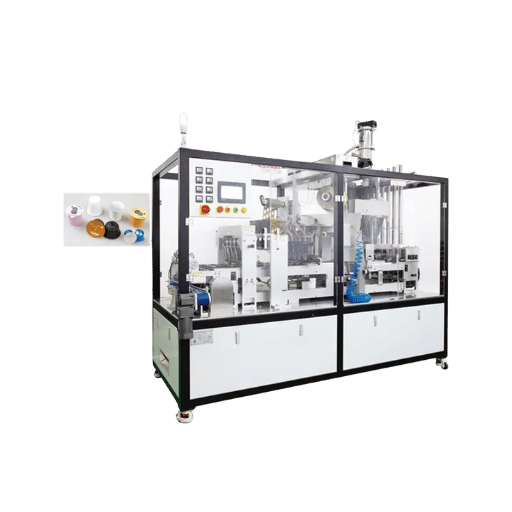
A K cup sealing machine is a semi/automatic machine which places and seals a die cut foil lid for filled K cup using roller heat and pressure ensuring a hermetical seal to preserve aroma & prevent oxygen contact. For automatic machines, filling & sealing are performed in a continuous operation- the machine automatically places cups, doses coffee, flushes nitrogen through the cup & bonds the foil to the cup tab.
The core process has four stages:
- Cup loading. Empty K cups – with mesh filter already installed – are dropped into indexed mold stations. Manual and semi-automatic machines require the operator to load cups one at a time.Rotary and inline automatic machines have an overhead hopper with cup-drop wheel that feeds the mold plate continuously.
- Coffee filling. Servodriven auger filler provides controlled dosing of the ground coffee (usually 9-12 g per cup). Higher-specification machines include a tamping station that lightly compresses the coffee bed, reducing headspace and improving foil contact at the rim.Inline weighing—in which a rejected cup is diverted before sealing—is incorporated into some models.
- Nitrogen flushing. On equipped machines, inert nitrogen pushes oxygen out of the cup headspace just prior to sealing. Specify a residual oxygen target and verify it under agreed production conditions. Shelf life depends on the coffee, package barrier, seal integrity and storage conditions and must be validated for the finished product. Confirm in the quotation whether nitrogen flushing is included or optional; price alone does not establish the configuration.
- Heat sealing. A heated die depresses a foil lid pre-cut in a 160-200 C bevelled edge against the rim of the cup, totaling 0.8-1.0 seconds dwell time. Heating initiates the lid bonding layer; pressure is maintained at 1.7 bar-7.4 bar for optimum full edge contact of the lid to the cup.The seal when properly set withstands 3meter drop test and 12 months ambient storage.
⚙ ENGINEERING NOTE — DWELL TIME VS. TEMPERATURE
At 175 C, dwell for just 0.6 sec gives a marginal seal. The same dwell held for 1.0 sec gives a seal stronger than the cup rim tensile strength. When performing seals calibration, if weak seals are found, increase dwell time before touching time – the majority of PLC controllers have 0.1 sec resolution.
Temperature is the headline spec, dwell time is where the seal is actually made.
For a complete look at the full capsule production line — cup handling, dosing, and downstream packaging — see our complete coffee capsule filling machine guide.
What Is the Difference Between a K Cup Filling Machine and a Sealing Machine?
The volumetric coffee filler measures out and deposits the pre-weighed beans into an empty cup. The sealer fuses the foil top. In a commercial operation, they are one and the same machine—hence the interchangeable terminology used by manufacturers. The packaged cup sealer is just that—one function, the foil-gluing. It must be fed unfilled cups. If you look at vendor pricing for your K cup filling and sealing machine, the inclusive formation equipment is described as one integrated machine.
K Cup Sealing Machine Types: Manual, Semi-Automatic, and Fully Automatic
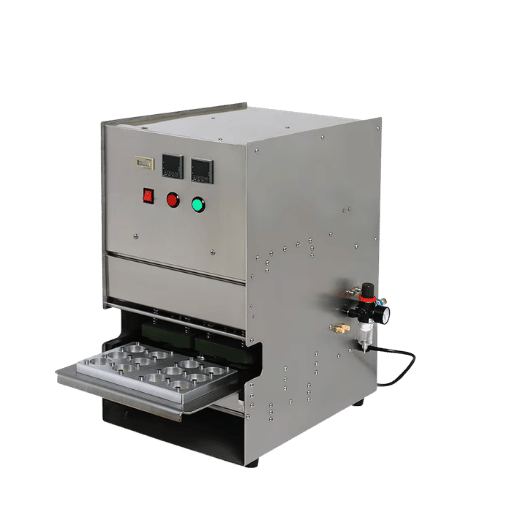
The deciding factor in machine selection is production capacity — cups per day. Overspending on capacity you won’t use, or running well over 100% for too long and causing premature machine failure could both be costly mistakes.
| Type | Output | Price Range | Best For |
|---|---|---|---|
| Manual cup sealer | 30–60 cups/hr | $200–$2,000 | Café-scale sampling, gifting, product testing |
| Semi-automatic tabletop | 500–2,000 cups/day | $5,000–$15,000 | Micro roasters, DTC subscription startups |
| Automatic rotary (entry–mid) | 40–120 CPM | $15,000–$100,000 | Small–mid roasters, private label production |
| High-speed rotary / inline | 200–600 CPM | $100,000–$500,000+ | Industrial co-packers, national brands |
High-end rotary versus inline format. For the largest production runs, rotary machines have a circular indexing plate with twelve mold stations—small, mechanically stable, and ideal for single-SKU output. To switch format, the twelve corresponding mold plates are swapped out, a job that takes 15-25 minutes. Inline (or “linear”) machines have a conveyor that runs in a straight line, and they’ll have over 44 mold plates per format—requiring a heavier, longer machine body with additional stations for flavor injections, secondary weighing, or multi-step sealing patterns. For roasters filling one or two K cup SKUs at a consistent volume, rotary generally requires less upkeep; for co-packers jumping between different pod formats every day, inline can have benefits worth the extra changeover labor.
Compare the specifications on our K cup filling and sealing Machines page, where we detail rotary and inline models across output ranges.
📦 REAL-WORLD EXAMPLE
A roaster comparing third-party co-packing with an in-house filling and sealing line should calculate payback using confirmed equipment and operating costs, monthly saleable output, co-packing charges and expected margins. A generic payback period cannot establish the return for a particular business. Nitrogen flushing and shelf-life claims require finished-product validation and should not be assumed to guarantee a retail sales window.
5 Key Features That Separate High-Quality K Cup Sealers From Budget Machines
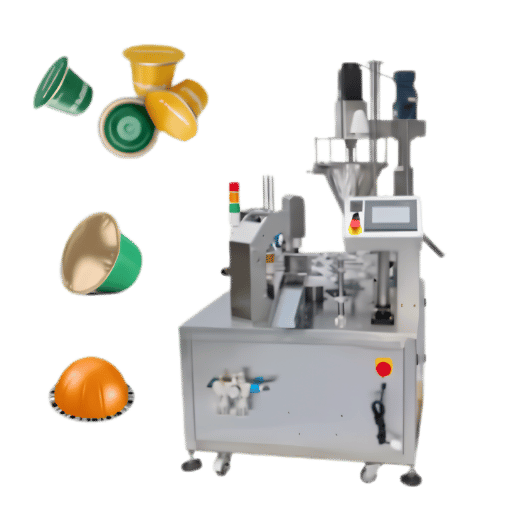
Nitrogen flushing may be included as standard equipment or offered as an optional add-on. A flushing nozzle alone does not establish the residual oxygen level in a sealed cup. Before issuing a Purchase Order, be sure to confirm these five figures IN WRITING:
- Servo-driven auger filler — filling accuracy ±0.1 g
Volumetric cup dosing (a much less sophisticated machine) has accuracy to within 0.3-0.5 grams, and it drifts as grind particle size varies. Servo-driven augers will hold within 0.1 grams, no matter the size of the coffee particle. Be aware: on dark roasts high in oil content, dosing consistency is only so reliable as long as your machine operator halves the unit “speed” from the maximum. You can be best served operating at 30-35 CPM, not the maximum rated. - Nitrogen flushing with documented residual O₂ <1%
Ask vendors for an actual residual oxygen test result — not a spec sheet claim. The gap between <1% O₂ (verified) and “nitrogen flush system included” translates directly to shelf life: 14 months vs. 5 months in practice. For a deeper look at how nitrogen flushing affects capsule chemistry, see our guide on extending coffee capsule shelf life. - Adjustable temperature + pressure — 160–200°C and 0.3–0.8 MPa range
Fixed-temp-makings force you into just one foil type. Many systems with adjustable profile-up to run aluminum foil at 175C and switch to a compostable PLA at 130C without any hardware changes. With compostables now accounting for 11–15% of the market as of early 2026–and increasing–this flexibility is increasingly a production requirement and less a premium feature. - Changeover time ≤30 minutes (cup size / foil type)
For rotary machines a cup format changeover is replacing 12 mold plates – can be done in 15-25min with an experienced operator. On linear machines the same process involves 44+ plates and will often take 30-60mins. Changeover time is directly linked to effective Daily Capacity, when running multiple SKUs.Always check the actual plate count before buying, not just the headline changeover time in a marketing message.
- PLC control + touchscreen HMI with automatic rejection
Lower-cost machinery involves simple mechanical timers, adjustments of individual parameters, and manual entry of machine production recipes. Certified industrial K cup sealing machines are equipped with PLC controllers that record production recipes, counts of reject items by failure type, and protest inline weighing rejects when actual fill weight exceeds tolerances. Touch screen HMI interfaces not only reduce human training, but avoid undocumented machine modifications common to generic grade equipment used to produce multiple non-uniform recipes.All food-contact components — auger filler, cup mold, sealing die — should be food-grade stainless steel; verify this is documented in the machine’s compliance certificate before factory acceptance.
🔍 THE 70% RULE
From field service responses, about 70% of K cup seal failures are due to incorrect temperature calibration, not mechanical failure, not foil quality, not tolerances on cup dimension. The message here: a $12,000 machine properly calibrated will best any failed $40,000 with incorrect heat profile. Feature 5 – PLC with inline rejection—is there to prevent a calibration upset becoming a recall.
⚙ PRO TIP: DEGASSING WINDOW
Fresh roasted coffee off-gasses CO for 24-72 hours after roast. K cups filled hours after roasting can develop enough gas pressure to push grounds into and onto the rim of the cup leading to contamination of the seal zone before the foil’s even over it. Never run a batch in less than 24-48 hours of degassing – this is just about the single most common point of failure that new machine operators mistake for parts issues when it is in fact a batch incompatibility.
What Filling Accuracy Should I Expect From a K Cup Sealing Machine?
On a servo auger filler 0.1 g per cup for stable operating conditions. On volumetric cup dosing 0.3-0.5 g, drift increases as grind particle size does. For retail K cups for a 10 g fill, that is a 0.5% error vs. a 5% error – very large at 100,000+ cups/month.
Insist on a factory acceptance test (FAT) report showing fill weights through a 500-cup run before accepting machine delivery.
Foil Lid Compatibility: Aluminum, PE Film, and Compostable Options
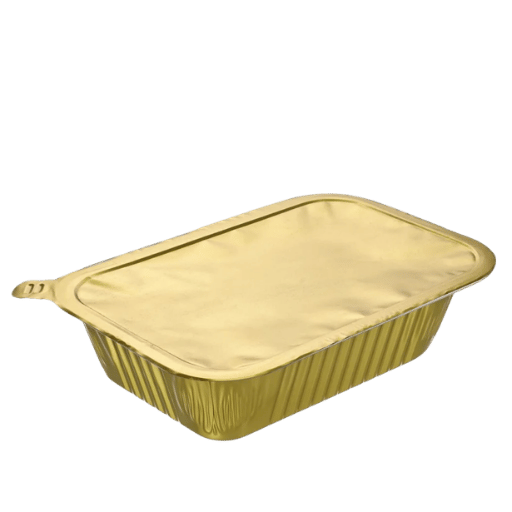
Aluminum foil is still the industry standard for K cup sealing for one reason: oxygen transmission rate is near zero, which is why nitrogen flushed aluminum-sealed K cups reliably hold 12-18 months shelf life. Aluminum is no longer the sole choice of lid material, however, and the gap is narrowing faster than most machine buyers realize.
| Lid Type | Seal Temp | Shelf Life | Sustainability | Key Notes |
|---|---|---|---|---|
| Aluminum foil | 160–180°C | 12–18 months | Recyclable (separately) | Industry standard; best oxygen barrier |
| PE-coated paper | 140–160°C | 6–9 months | Partial | Lower oxygen barrier; shorter shelf life |
| Compostable PLA | 120–145°C | 3–6 months | BPI certified (ASTM D6400) | Requires lower temp range; machine must support |
Every machine manufacturer will tell you this upfront. First: commercially compostable PLA lids take 30-40C less heat (lower operating temperature) to seal than aluminum. If your foil income sealing profile is set for a 180C hot plate, the PLA lid will burn or the bond will not develop – make sure the temp range runs below 145C before committing to pallet quantities of compostable lid stock. Second: “compostable” is not a pass/fail blanket certification. The BPI (ASTM D6400) standard compost in commercial processing averages a temp of 58C over 90 days. Home processable isn’t the same level of heat or time, verify your standard before touting sustainable packaging on new product labels.
For a comparison across K-cup, Nespresso, and Dolce Gusto pod formats and their respective packaging requirements, see our capsule format comparison guide.
📦 REAL-WORLD EXAMPLE
A co-packer transitioned to a full load of compostable PLA lids at an aluminum sealing profile of 170C before the lids turned brittle and began unsealing. During the troubleshooting process, the retrofit was remedied by reducing the sealing temperature to 130C, bumping pressure back 0.15 MPa. Parts acquisition was not necessary after the foil vendor verified thermal calibration data, and 15 minutes in the Machine Data Log/PLC.
K Cup Sealing Machine Price: What to Budget at Every Production Scale
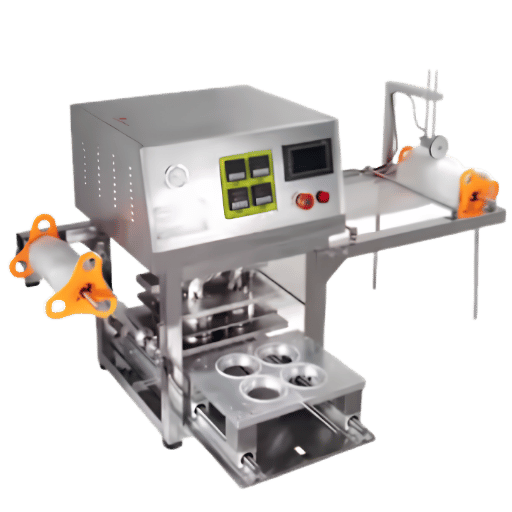
The pricing for K cup sealing machines correlates strongly with production throughput. Ultimately, the tier can also reflect relative placement of the equipment in the overall production line, the sophistication of its mechanics, and the total lifespan of the product – not just the brand name.
| Budget | Machine Type | Output | Best For |
|---|---|---|---|
| $200–$2,000 | Manual cup sealer | 30–60 cups/hr | Sampling, gifting, café-scale production |
| $5,000–$15,000 | Semi-automatic tabletop | 500–2,000 cups/day | Micro roasters, DTC subscription startups |
| $15,000–$100,000 | Automatic rotary | 40–120 CPM | Small–mid roasters, private label |
| $100,000–$500,000+ | Industrial rotary / inline | 200–600 CPM | Industrial co-packers, national brands |
Cost is not the defining factor. Total cost of ownership over five years at each of several brand name equipment tiers could be broken down as: initial purchase of machine (30-45% of 5 year total), foil material at $0.015-0.08 per pod multiplied by expected annual run volume, maintenance at $500–$2,000/year on standard machines, electricity at 1.5-4.5kW on average, and time operators spend watching the equipment. Ultimately, the machine can be the smallest expense.
For small roasters evaluating the K cup investment specifically, see our guide on K cup packaging strategy for small brands. For current AFPAK model specs and configurations, see AFPAK K cup machine models.
💡 TIP: TOTAL COST OF OWNERSHIP
Request a TCO estimate over five years from any prospective vendor. This should include the cost of the kit in the foil source supply chain, spare parts from the factory, and local service coverage. A 6-9 month lead time on spare parts can increase actual incurred maintenance cost by the cost of OEE losses. The one time savings between the two choices of equipment usually fails to materialize when you look at overall spend.
K Cup Sealing Machine Problems: 3 Common Seal Failures and How to Fix Them
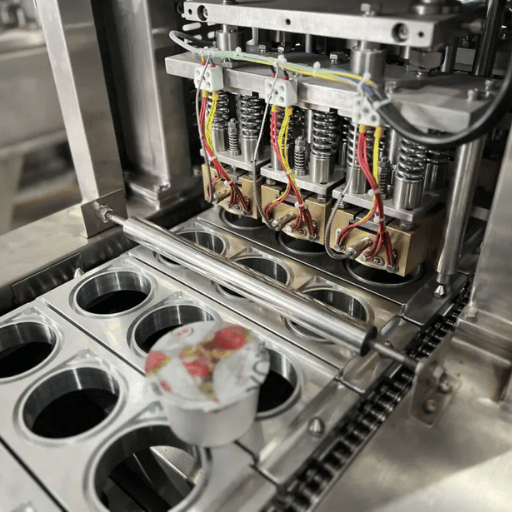
Most of K cup seal failures are resolved in less than an hour of the machine being offline. If a failure persists beyond that time frame, the cause is almost always misdiagnosed. Blame the machine for the material or calibration problem it’s actually having. Replace your components one by one, starting at the temperature and working down.
Why Is My K Cup Sealing Machine Leaving Gaps or Leaking?
Three primary seal failure reasons: setting heat below the foil’s bonding window, static bonding grains or types of grounds, oils or sick coffee particles contaminating the rim. Work through those three problem areas before assuming the machine is mechanically kaput.
PROBLEM 1: The seal is not complete, the foil rises at the corners or edges;
Cause: Sealing temperature too low relative to the bonding activation temperature for the foil, or dwell time below 0.8s. The most common single failure mode and often wrongly blamed on either the foil quality or a machine fault.
Fix: Raise T in increments of 5C (Run 5 cups at each step). Confirm dwell time has been set to 0.8 s by using the PLC. Do not raise pressure as the immediate response (more pressure does very little for the thermal deficit and even more for risk of wrinkles in an already-near-borderline seal).
PROBLEM 2: Wrinkled/crease sign seal – foil at rim is folded
Cause: seal pressure excessive, contamination of cup rim or degassing by CO of freshly roasted coffee. Coffee roasted under 24 hours, exhibits active degassing – blanking coffee into a warm, freshly roasted pack may push grounds onto cup rim encasing clean foil, preventing firm contact. The companion scenario: static electricity arising from low humidity or rapid processing of high oil dark roasts causes small coffee particles to be electrostatically attracted to cup rims – preventing contact.
Prevents: 24-48hr post-roast degassing time before production runs. Lower seal pressure 0.05MPa steps. Machine chassis grounded for static potential, since static problems may exist with other roast types.
If static persists across many coffee samples, add an ionizing air bar above fill station.
⚠ PROBLEM 3: Inconsistent seals across a production batch
Cause: Drift in thermocouple calibration. The sealing dies go from ambient to 175 C many times an hour. Over months of operation, the thermocouple offset builds up – the HMI reads 175 C, but the die is actually 160 C or 190 C.
Set Point: Verify thermocouples once a quarter by comparing them against a contact thermometer. The actual die surface temperature will be compared to the read-out on the HMI during the cold start, steady state, and after running for two hours consecutively. Each thermocouple will be replaced at scheduled intervals as part of the preventive maintenance program rather than after failure.
📦 REAL-WORLD EXAMPLE
The other Midwest roaster, processing 60,000 cups per month, developed intermittent seal integrity over six months. Initially, the reject rate was 1-2%. After six months, it increased to 8%.
The problem was caused by the failure of a copper sealing head with a 0.3 mm low spot. The low spot resulted in a micro-gap at the same position on every rotation of the cup rim. The price to replace this part was $180 plus the cost of one hour of machine downtime.
The failure to correctly diagnose this problem resulted in multiple temperature and pressure modifications over six months, additional rework labor, and three customer complaints.
K Cup Packaging Market Trends: What’s Changing in 2025–2028
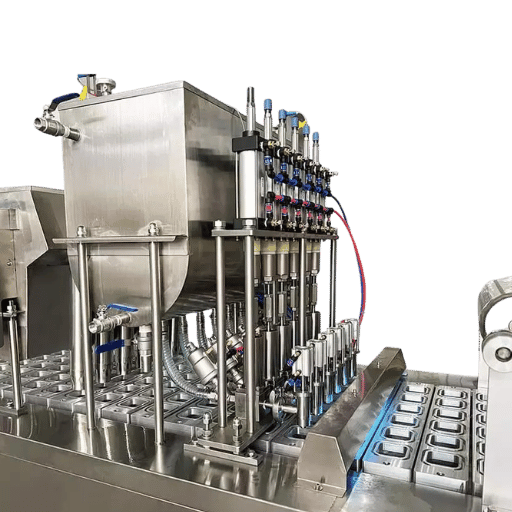
📊 MARKET SNAPSHOT — 2025–2028
- US coffee pods market: $5.26B (2024) → $7.62B (2030), CAGR 6.2%
- Compostable pods: 11-15% of product mix (early 2026), growing at 6.7-10.5% compound annual growth rate
- Private label single-serve: ~18% market share; 32% of private-label manufacturers expanding into this format
- Aluminum packaging: CAGR 6.82 % up to 2031 fastest-growing lid material subdivision
Compostable is mainstream, not niche. As of early 2026, with 11-15% market share, compostable K cup compatibility has become a standard not a premium feature. EU Single-Use Plastics Directive enforcement and increased US regional regulation of non-recyclable pods are hastening the change. Resale of machines without flexible temp profiles – specifically without seal bonding below 145C – is becoming more difficult in 2ndhand markets. Keep this in mind when selecting a machine if you plan to scale beyond 2027.
Private label is where the volume is. With private-label representing approximately 18% of single-serve market share and a third of private-label players expanding into the format, your key buying constituency is smaller, nimbler roasters and regional co-packers. The latter require reliable output and rapid changeover more than raw CPM speed.
Multi-format is becoming a competitive moat. The fastest-growing roasters run multi-format lines – K-Cup with Nespresso or Dolce Gusto formats – with a single machine footprint. Machines with 30-minute batch changeover and compostable compatibility can enable multi-format contracts. If that’s part of your roadmap, see our overview of Nespresso filling machines and the capsule format comparison guide.
Frequently Asked Questions
Is a K cup sealing machine worth the investment for small coffee roasters?
For over 50,000 cups/month, the breakeven period generally favors an in-house filling system versus co-packing in less than two years. The precise break-even period can be calculated based on your current co-packing fee rate ($0.08-0.15/ cup), target volume, and whether a nitrogen-flushed shelf life is necessary. When less than 30,000 cups/month consider a semi-automatic tabletop machine as a lower entry investment risk. If higher volumes are anticipated, see the case for automatic rotary machines through total cost of ownership analysis.
What is the difference between a K cup filling machine and a K cup sealing machine?
A filling machine fills (or doses) ground coffee into a pod. A sealing machine applies the foil lid. Multi-stage commercial units combine the two functions in one machine – which is why I often refer to “filling” and “sealing” as interchangeable terms in my listings. Independent sealer units can only bond foil to pre-filled cups – termed “K Cup sealing machines”. What I mean is an all-in-one machine capable of filling grounds and sealing them.
How long does it take to changeover a K cup sealing machine to a different cup size?
On rotary machines, it takes 15-25 mins to swap out 12 mold plates and program the PLC fill profile if you have a trained operator. On inline/linear equipment, it can take 30-60 mins due to the large inventory of mold plates needed per format (44+..). PLC profile memory allows fill parameter loading in under 5 minutes, though, the physical plate swap process takes significantly longer.
Can a K cup sealing machine handle compostable or eco-friendly foil lids?
Yes, but only if your machine can handle a lower seal temperature. PLA compostable lids should be bonded at 120-145C – approximately 30-40C under normal foil profiles. Machines calibrated for aluminum foil with a fixed temperature setting will either burn through or not seal with this shift in temperature profile. To prevent this, verify your machine’s ability to reach temperatures below 145C and that it can store alternate profiles in the PLC system.
What filling accuracy should I expect from a K cup sealing machine?
Screw auger fillers with servo or stepper motor drives reach 0.1 g per cup under steady-state conditions—this is the commercial benchmark for retail K cup production. Volumetric cup dosing utilising lower-priced machines reach 0.3-0.5 g, albeit with accuracy that drifts depending on varying grind particle size. Demand a factory acceptance test (FAT) report for field weight tests of 500+ cup production before accepting machine delivery.
How does nitrogen flushing in a K cup sealer extend coffee shelf life?
Coffee roasts also oxidize when exposed to air- they go stale within days of grinding at ~21% oxygen in most ambient air. Nitrogen flushing displaces oxygen in the K-Cup headspace before the foil lid is sealed; measure residual oxygen on finished capsules under agreed test conditions. Shelf life depends on the coffee, oxygen barrier, seal integrity and storage conditions; a specific 12-18-month claim requires finished-product validation. The sealed package must preserve that low-O state throughout shelf life and that is why foil oxygen barrier specification, and not just sealing method, becomes just as critical a specification.
Related Articles
- Complete Coffee Capsule Filling Machine Guide
- K Cup Filling and Sealing Machines: Models and Specs
- Extending Coffee Capsule Shelf Life
- K Cup Packaging Strategy for Small Coffee Brands
- Nespresso Filling Machines
Interested in ordering a K cup sealing machine for production testing?
AFPAK directly supports over 500 clients in 40 countries from first inquiry through installation: your best partner at the beginning…
Production undershot? Production overshot? AFPAK machines are built at the customer’s factory to provide a factory acceptance test (FAT) report that specifies fill weights performed over a 500+ cup production run at steady-state operation.
Copyright 2011 AFPAK: All rights reserved
Author: AFPAK Engineering Group-AFFP professionals who can help you (800) 451 8441, {info@afpak.com} Market sizes and CAGR are from third-party sources (Grand View Research & Verified Market Research) Specifications are from AFPAK facilities and crosschecking published data. Production scenarios are simulated composites from actual field data, as the case may be.


