


How to Choose the Right Dolce Gusto Filling Machine
Machine Selection Guide
Selecting a machine only by its maximum speed can result in excessive investment
or insufficient production capacity. The correct configuration should be based on
your daily demand, working hours, capsule structure, filling material and downstream
packaging requirements.
Plan the Machine Capacity Around Your Daily Output
The table below uses one eight-hour shift and an estimated 80% production utilization
rate for planning purposes. It allows for normal production activities such as material
replenishment, film replacement, cleaning and short production stops.
| Machine Configuration | Nominal Speed | Estimated Output per 8-Hour Shift | Recommended Application |
|---|---|---|---|
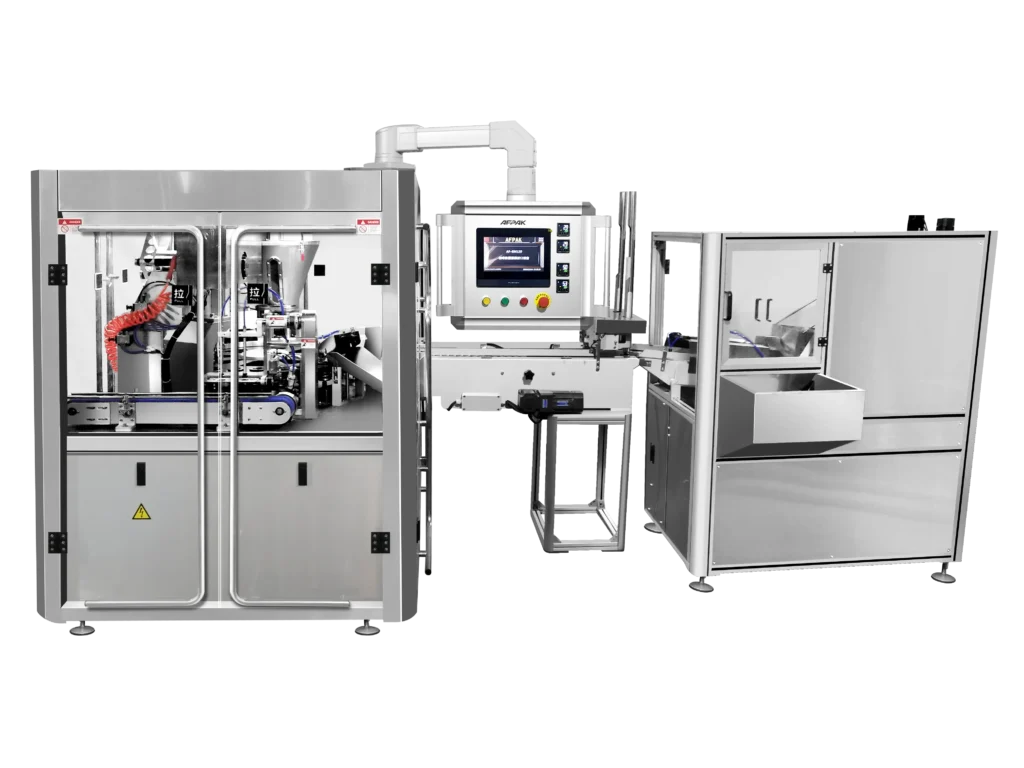
| AF-RN1S | 40–50 capsules/min | 15,000–19,000 capsules | Growing brands and flexible multi-format production |
| AF-RN120 | Up to 100 capsules/min | Up to 38,000 capsules | Higher output with limited factory space |
| 3-Station Rotary | Up to 150 capsules/min | Up to 57,000 capsules | Compact, medium-to-high-output production |
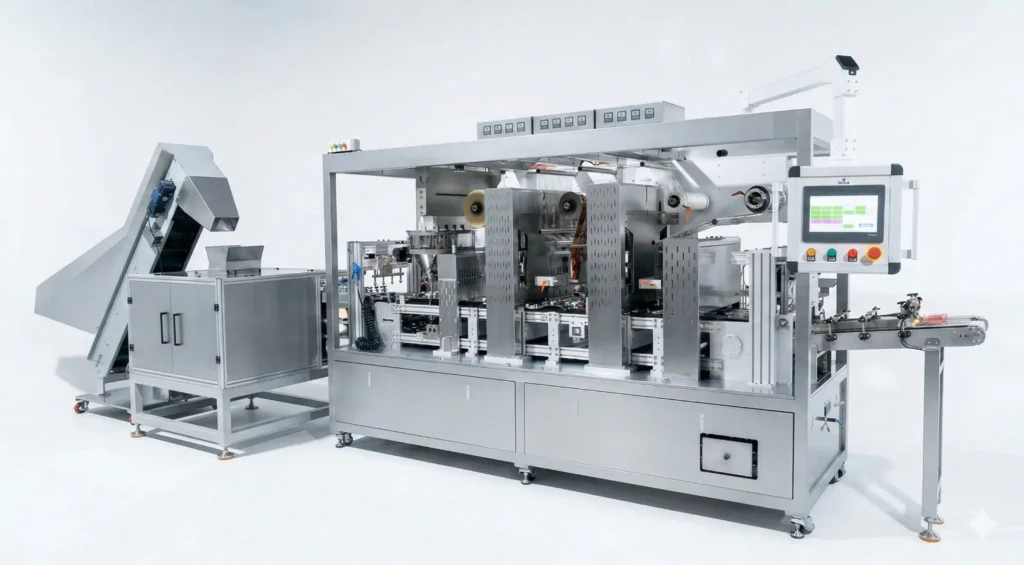
| AF-H2 | 80–100 capsules/min | 30,000–38,000 capsules | Medium-scale continuous production |
| AF-H4 | 160–200 capsules/min | 61,000–76,000 capsules | High-output coffee capsule factories |
| AF-H6 | 240–300 capsules/min | 92,000–115,000 capsules | Large private-label and industrial producers |
| AF-H8 | 320–400 capsules/min | 122,000–153,000 capsules | Large-scale automated production |
| AF-H10 | 400–500 capsules/min | 153,000–192,000 capsules | Industrial production and complete packaging lines |
Planning note: These figures are estimates rather than guaranteed
production output. Actual output depends on the powder, filling weight, capsule
structure, sealing process, material replenishment, changeovers and optional
inspection equipment.
Rotary or Linear: Which Structure Should You Choose?
Choose a Rotary Machine When:
- Your available factory space is limited.
- Flexible production is more important than maximum output.
- You plan to produce several compatible capsule formats.
- Your current demand is below large industrial production volumes.
- Fast mould changeover is required.
- You want to start with a compact system that can be expanded later.
Choose a Linear Machine When:
- Stable, high-speed output is your main priority.
- Automatic bulk capsule sorting and feeding are required.
- You need additional inspection or rejection stations.
- The machine will connect directly to a pouch packer or cartoner.
- You need multiple filling lanes for future capacity expansion.
- Your factory has sufficient space for a longer production layout.
AFPAK can evaluate your required daily output and available factory space before
recommending a rotary or linear configuration.
Understand the Capsule Structure Before Choosing the Machine
Dolce Gusto-compatible capsules can use different internal structures depending
on the beverage recipe, capsule design and required brewing performance. The
filling machine must be configured around the actual capsule and sealing materials.
A complete capsule may include:
- An empty plastic capsule
- An internal perforated membrane
- Ground coffee or soluble beverage powder
- A top sealing foil
Inner-Film Sealing
The internal film is positioned and sealed after the coffee product is filled.
This configuration may be required for specific capsule structures, beverage
recipes and brewing results.
The membrane feeding, cutting, positioning and sealing stations must be matched
to the capsule dimensions and film material.
Top-Film Sealing
After product filling and capsule-rim cleaning, the top foil is positioned and
heat-sealed to close the capsule.
Sealing temperature, pressure and dwell time are adjusted according to the
capsule and lid materials.
Available Sealing Configurations
- Inner film plus top film
- Top-film-only sealing
- Pre-cut aluminum lids
- Roll-film cutting and sealing
- Different film materials and sealing patterns
The capsule, internal membrane and top foil should be tested together before the
final machine configuration is confirmed.
Products the Machine Can Fill
Dolce Gusto-compatible capsules are used for more than ground coffee. AFPAK filling
systems can be configured for a wide range of beverage powders and product
characteristics.
- Ground coffee
- Instant coffee
- Milk powder
- Cocoa powder
- Matcha powder
- Tea powder
- Flavoured latte mixtures
- Protein and nutrition powders
- Other soluble beverage products
Different materials may require different augers, hopper designs, agitation systems,
feeding devices and operating parameters.
| Product Characteristic | Potential Production Challenge | Recommended Consideration |
|---|---|---|
| Oily ground coffee | Bridging, uneven feeding or powder sticking | Improved hopper agitation and product-specific auger testing |
| Fine milk powder | Dust generation and capsule-rim contamination | Dust management and enhanced rim-cleaning system |
| Cocoa and mixed powders | Density variation and inconsistent material flow | Stronger agitation and recipe-specific filling parameters |
| Multiple beverage recipes | Long cleaning and changeover time | Separate auger sets and stored production recipes |
AFPAK recommends testing the customer’s actual product before confirming filling
accuracy and stable production speed.
How a Dolce Gusto Capsule Production Line Works
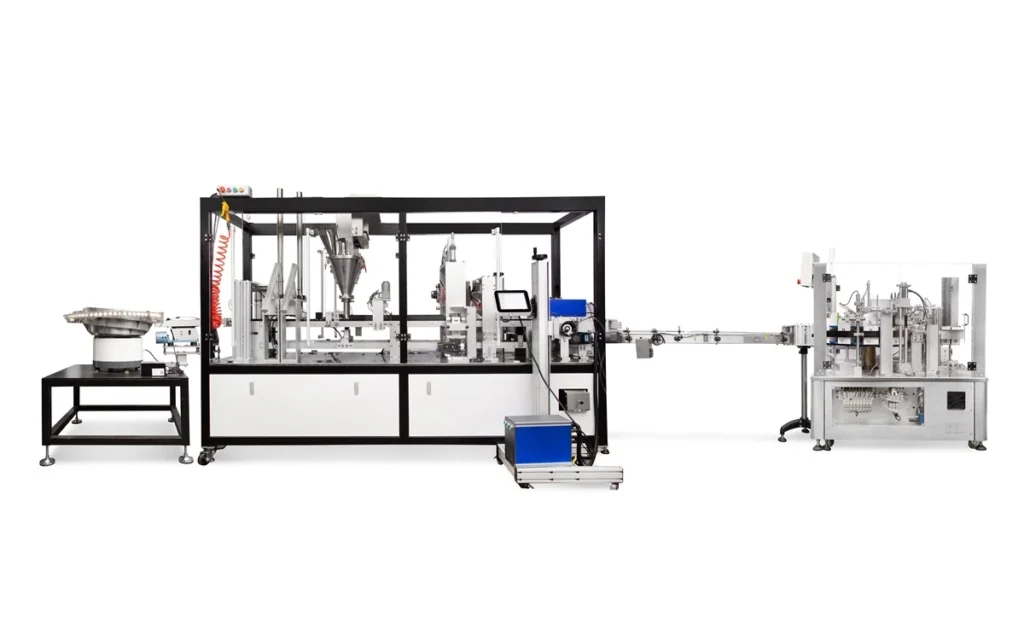
A fully automatic Dolce Gusto-compatible capsule production line can include the
following stages:
-
Capsule Sorting and Feeding
Bulk empty capsules are automatically oriented and delivered to each production
lane, reducing manual capsule placement. -
Capsule Detection
Sensors check whether each capsule is present and correctly positioned before
filling or sealing. -
Inner-Film Cutting and Sealing
When required, the internal membrane is cut from roll stock, positioned and
heat-sealed inside the capsule. -
Servo-Controlled Filling
The auger filling system doses the selected product into each capsule according
to the stored filling parameters. -
Nitrogen Flushing
Nitrogen can be introduced at multiple stations to reduce oxygen exposure before
the capsule is completely sealed. -
Capsule-Rim Cleaning
Residual powder is removed from the capsule flange to help create a more
consistent top seal. -
Top-Film Placement and Sealing
Pre-cut lids or roll film are positioned and sealed using controlled temperature,
pressure and dwell time. -
Inspection and Rejection
Optional checkweighing and vision systems identify and reject non-conforming
capsules. -
Counting and Arranging
Finished capsules are counted, accumulated or arranged according to the selected
pouch or carton format. -
Pouching or Cartoning
Capsules are automatically packed into retail pouches or cartons, with optional
date coding and final inspection.
Filling Accuracy, Sealing Quality and Freshness Control
Servo-Controlled Filling
The servo-driven auger allows the filling dose and operating speed to be adjusted
through the touchscreen. Product-specific parameters can be saved as separate
production recipes.
Filling accuracy should be evaluated using:
- The customer’s actual powder
- The required production speed
- The specified filling weight
- Multiple consecutive test samples
- A clearly defined acceptable tolerance
Capsule-Rim Cleaning
Powder remaining on the capsule flange can cause weak or inconsistent sealing.
A dedicated rim-cleaning station helps keep the sealing surface clear before the
top foil is applied.
Controlled Heat Sealing
Sealing quality is influenced by:
- Capsule material and dimensional tolerance
- Film structure and sealing layer
- Sealing temperature
- Sealing pressure
- Dwell time
- Cleanliness of the capsule flange
Customer-supplied capsules and films can be used for seal appearance, adhesion
and leakage testing before shipment.
Multi-Stage Nitrogen Flushing
Nitrogen can be introduced from the capsule-loading area through the final sealing
station. This helps reduce oxygen exposure before the capsule is closed.
Final residual oxygen and shelf life should be validated using the customer’s
actual coffee, capsule materials, production speed and storage conditions.
Optional Quality-Control Systems
For customers requiring higher production consistency and traceability, the filling
and packaging line can include additional inspection systems.
Inline Checkweighing
Each capsule is weighed after filling or sealing. Capsules outside the selected
tolerance are automatically rejected.
Filling-Weight Feedback
Weight data can be sent back to the filling system to compensate for gradual
changes in powder density or material flow.
Vision Inspection
The camera system can be configured to inspect:
- Capsule presence
- Lid presence and position
- Printing direction
- Seal appearance
- Capsule deformation
- Date-code presence
Automatic Rejection
Non-conforming capsules are separated from accepted production without stopping
the normal machine cycle.
Production Data
Depending on the configuration, the HMI can record production quantities,
alarms, rejected products and machine operating status.
Safety Protection
Safety doors, emergency stops, pressure monitoring and intelligent detection
help protect operators and reduce incorrect machine operation.
Why Test Your Materials Before Machine Production?
Two powders with the same target filling weight can behave very differently inside
a filling system. Coffee roast level, grinding size, oil content, moisture, density
and storage conditions can all influence dosing stability.
Before final machine production, AFPAK recommends providing:
- At least 500–1,000 empty capsules
- Inner membranes
- Top sealing films
- Sufficient product for continuous testing
- Target filling weight
- Acceptable weight tolerance
- Required production speed
- Finished capsule samples, if available
Material testing helps confirm the auger design, hopper configuration, sealing
parameters, nitrogen-flushing arrangement and achievable production speed.
From Capsule Filling to Retail-Ready Packaging
A filling and sealing machine produces completed capsules, but many factories also
require an integrated secondary packaging system. AFPAK can connect the capsule
machine with pouch packing, cartoning and other end-of-line equipment.
Pouch Packaging
Finished capsules can be counted and packed into premade or roll-film pouches.
The number of capsules per pouch can be customized according to the retail
packaging requirement.
Carton Packaging
Capsules can be randomly loaded or arranged into retail cartons. Available
functions include carton erecting, capsule loading, closing, hot-melt gluing
and date coding.
Future Line Expansion
Customers can start with a standalone filling machine and reserve interfaces
for future inspection, pouching, cartoning, case packing or palletizing systems.
Available Downstream Equipment
- Capsule counting and accumulation
- Capsule arranging systems
- Premade pouch packing machines
- Roll-film pouch packing machines
- Automatic cartoning machines
- Date and batch coding systems
- Case packing and palletizing systems
Project Support from Sample Testing to Production
A successful Dolce Gusto-compatible capsule project requires more than selecting
a machine model. AFPAK can support the project from initial evaluation through
production startup.
- Product and production-capacity evaluation
- Capsule, inner membrane and top-film review
- Recommended machine configuration
- Factory layout and utility planning
- Material filling and sealing tests
- Machine design and production
- Factory acceptance testing
- Complete-machine packing and shipment
- Installation and operator training
- Remote technical support and spare-parts service
Dolce Gusto Production Line Project in Spain
AFPAK supplied an H2 Dolce Gusto-compatible filling and sealing production line
for a customer in Spain. The project included machine configuration, production
preparation, training and technical support.
The project demonstrates how a two-lane filling and sealing system can be adapted
to the customer’s capsule structure, filling materials and factory requirements.
Get a Machine Configuration for Your Project
Tell us what you plan to fill, how many capsules you need to produce and how the
finished capsules will be packed. AFPAK will recommend a suitable configuration
based on your actual production requirements.
Please provide:
- Capsule type or drawing
- Product to be filled
- Target filling weight
- Required capsules per minute or per day
- Inner-film and top-film requirements
- Final pouch or carton format
- Factory voltage and available space
- Destination country


