
Updated October 2026
Test the sealed capsule for oxygen transmission, check residual oxygen after filling, and check for leaks. That’s a good starting point to verify coffee capsule oxygen barrier. A low reading for the oxygen level after sealing gives information about the gas in that sample; a controlled OT test gives information about how oxygen diffuses through the packaging.
Food packaging preserves coffee by controlling exposure during its intended distribution period. Coffee pods and capsules need the test specimen identified before a buyer can compare reports.
Quick Specs: Choose the Measurement
- Package transmission: oxygen volume per package per day, with the pressure basis stated.
- Film transmission: oxygen volume per square metre per day at stated conditions.
- Residual oxygen: concentration in the capsule headspace at a defined time after sealing.
- Seal and leak checks: separation force and package integrity, reported as separate results.
- Coffee can consume incoming oxygen, so a stable headspace result can hide transmission.
- Test the body, lid and assembled seal together as an oxygen path; film testing measures only the film specimen.
- Keep instrument repeats separate from independent capsules and production batches.
Coffee Capsule Oxygen Barrier Verification Starts with Four Measurements
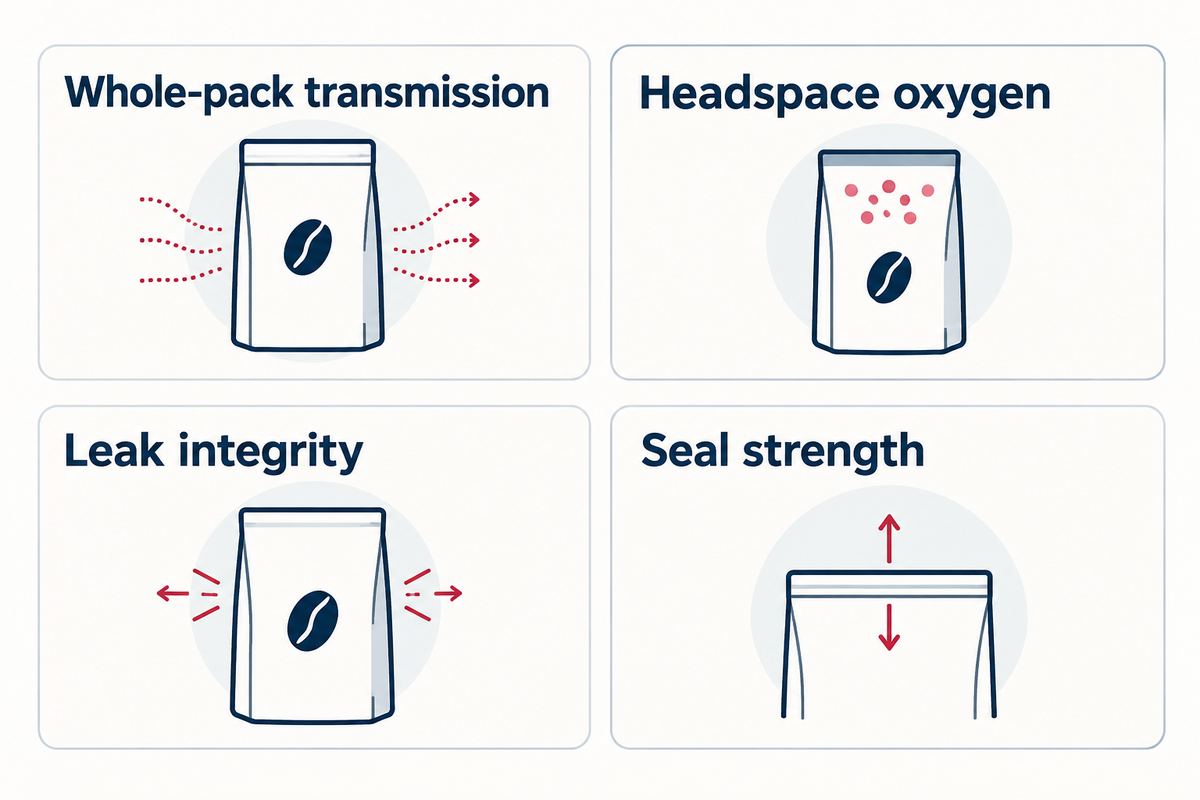
Use transmission testing to verify the oxygen barrier, headspace analysis to check the packaged atmosphere, leak testing to assess integrity, and seal-strength testing to assess separation force. Each test addresses a different production or purchasing concern. A good capsule report provides those results and records the individual test conditions and units.
What is the oxygen transmission rate?
Oxygen transmission rate is the rate of oxygen diffusion through a defined specimen at specified conditions. Film results commonly include exposed area; finished-pack results use the package as the specimen. Pressure-normalized values add another denominator. Keep that in mind when comparing the barrier properties of coffee packaging.
Steady state oxygen transmission into a dry package under ASTM F1307-20 can be compared to package performance through other tests. For ground coffee, flavour preservation involves both product and container: include roast, initial oxygen and storage exposure in the validation record.
| Measurement | Typical reporting basis | Decision it supports |
|---|---|---|
| Whole-pack transmission | cm³/package/day; pressure basis stated | Compare assembled constructions under matched conditions |
| Film transmission | cm³/m²/day; pressure basis stated | Screen lid or barrier-layer material |
| Headspace oxygen | % oxygen, sampling time and pressure basis | Investigate initial atmosphere and change during storage |
| Leak integrity | Validated method response and acceptance criterion | Separate an integrity fault from normal material permeation |
| Seal strength | Force, specimen width and failure mode | Compare sealing consistency and opening behaviour |
For uneven lid peeling, request force and failure-mode data under ASTM F88/F88M-23; for an unexpected oxygen rise in sealed capsule samples, add an integrity measurement. Base your discussion with the supplier on the failing requirement. A stronger peel result in itself would not define the route of oxygen entry.
Why Test the Whole Capsule Before the Body and Lid?
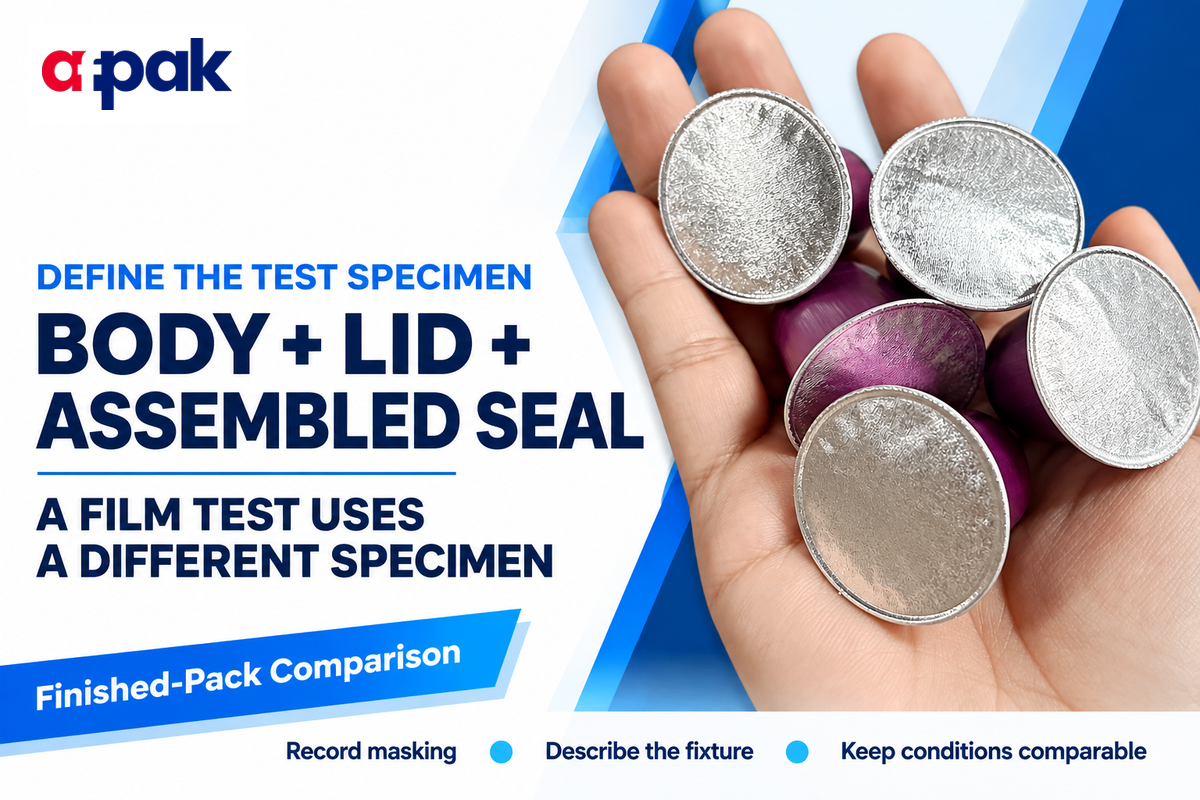
Consider the finished package when the buyer’s question is on the assembled capsule. Then isolate the body or lid to investigate a weak result. The adapter, exposed surfaces and sealing interface determine which oxygen path the instrument measures. Record them before comparing a rigid capsule with a flat-film certificate.
“the method is applicable to packages that in normal use will enclose a dry environment.”
A masked rim, an exposed body, and a body-and-lid assembly are different specimens. Record the adhesive, blank correction and exposed surfaces in the lab order. An impervious standard helps differentiate the mounting method from the capsule’s barrier performance.
The pod and capsule geometries need their own fixture description. For different packaging, show which surfaces are masked and which remain exposed.
For humid whole-package testing, specify the complete-package procedure and humidity on each side with the laboratory. ASTM D3985-24 covers films and sheeting; ASTM F1927-20 addresses barrier materials at controlled relative humidity. Applying the latter to a lid film does not define a humid whole-package method.
For a multilayer plastic body, identify the polypropylene grade and the barrier layer individually. PP capsules with an EVOH layer differ from uncoated polypropylene capsules; the layer position and formed wall matter. Other things being equal, pay attention to the interface of coating and seal with aluminum capsules. The body-and-lid compatibility guide provides guidelines for material matching.
Where injection molding is utilized, identify the tooling cavity with the body lot. A good barrier measured on a flat material still needs assessment after forming and assembly.
A change from polyethylene terephthalate to another carrier in multilayer films should be documented in the specimen description. For flexible packaging surrounding capsules, keep the result of the outer bag separate from the capsule.
How Can Residual Oxygen Be Measured in Small Headspaces Without Distortion?
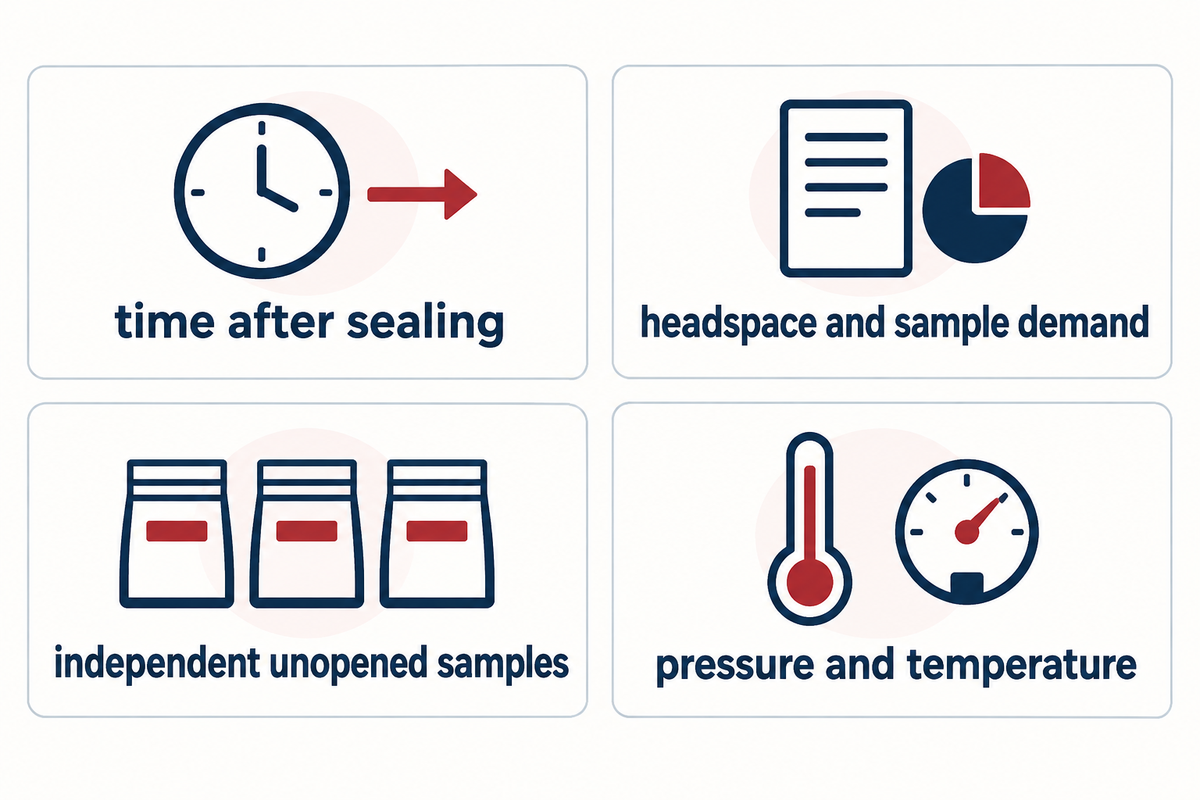
Match the sampling arrangement to the analyzer and available gas volume; fix the access procedure and time after sealing. Extractive instruments withdraw gas; optical arrangements can measure without withdrawing it, but some still puncture the capsule. For successive storage readings, use an arrangement validated for the package and keep its access point from becoming a new route for oxygen to enter.
How do you accurately measure residual oxygen in a sealed coffee capsule?
Prior to the measurement, use a calibrated method with suitable range and uncertainty, then fix the access procedure and time after sealing. Record the real headspace and sample demand for an extractive measurement. A needle puncture makes that specimen destructive for later comparisons with other intact packages, even if an optical probe extracts no gas.
Fluorescent decay analysis in ASTM F2714-08(2021) needs an internal sensing element and a suitably transparent or translucent optical pathway, including a window. Opaque capsules need a compatible sensing arrangement. Standard sensor stickers can’t be read through aluminum.
MOCON’s OpTech brochure describes transparent-package sensors, an opaque-package accessory and an invasive needle for limited headspace. Select the accessory and procedure, not just the “optical” label. Keep punctured units separate from unopened capsule samples reserved for aging.
Roasted coffee products change the atmosphere after sealing. F2714 notes that product oxygen uptake or outgassing affects headspace-based permeation estimates. A 2020 capsule study measured internal pressure and oxygen content separately. Record absolute pressure and temperature when converting concentration into a gas quantity; carbon dioxide release can change the composition and pressure basis.
Keep the coffee grounds and dose unchanged when comparing sampling arrangements. Coffee freshness studies also need a sensory endpoint, so agree the tasting assessment alongside the oxygen record.
Let’s say a roaster considers two coffee blends in the same capsule. The team notes similar oxygen concentration a week after sealing and suggests approving both products from that result. Quality staff instead retain independent unopened samples for each interval and record roast-to-pack time, dose and headspace. An empty-package transmission comparison then isolates the container, while filled-pack aging tracks the coffee. The resultant condition of the packaging informs the purchasing decision. If the controlled packaging result is acceptable, the common packaging construction can be used and the different coffee response can be investigated separately. It isn’t possible to independently measure the effect of storage if puncture damage is left uncontrolled.
What Do Rates and Concentrations Mean in the Rate-to-Pack Oxygen Budget?
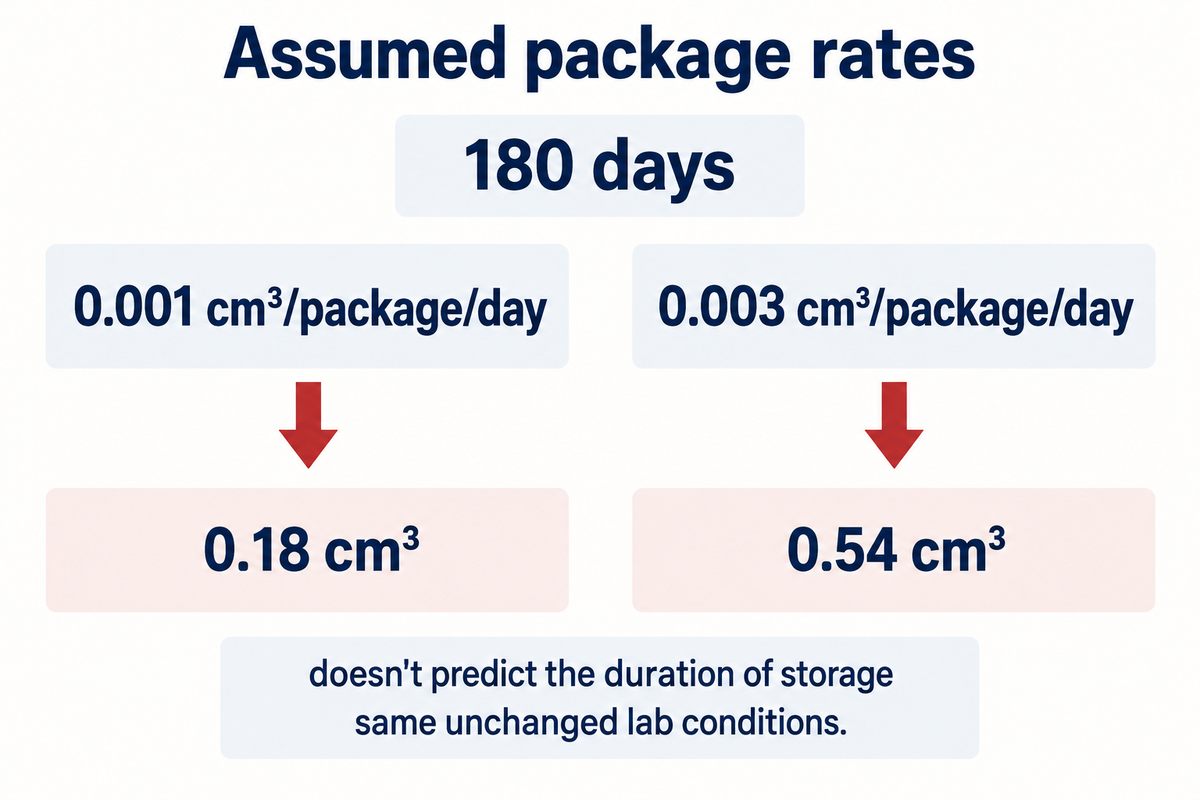
The Rate-to-Pack Oxygen Budget allows you to convert a stated package transmission rate to a volume of a gas over a defined, unchanged test period.
Use it to compare rates on the same basis, then return to product testing for shelf life. But multiplying a laboratory rate by time is a bounded calculation. It doesn’t take into account changes in the oxygen pressure, coffee consumption, temperature excursions, or a developing leak.
How to calculate oxygen transmission rate?
A laboratory determines transmission rate from oxygen movement over time, with its fixture, exposed area where applicable, and pressure basis. For a reported unnormalized package rate, transmitted volume equals the rate multiplied by the time. An area-normalized film value requires the defining area. An atmosphere-normalized value retains the difference in the partial pressures of oxygen.
Take the example of two finished-pack reports giving 0.001 and 0.003 cm³/package/day under the same unchanged lab conditions. These assumed rates are already package rates without an atmosphere denominator. Over 180 days, the volumes would be 0.001 × 180 = 0.18 cm³ and 0.003 × 180 = 0.54 cm³ per package. This is compared with the transmitted oxygen at the test conditions; it doesn’t predict the duration of storage.
| Item | Assumed package A | Assumed package B |
|---|---|---|
| Rate at matched test conditions | 0.001 cm³/package/day | 0.003 cm³/package/day |
| Volume after 1 day | 0.001 cm³/package | 0.003 cm³/package |
| Volume after 30 days | 0.030 cm³/package | 0.090 cm³/package |
| Volume after 60 days | 0.060 cm³/package | 0.180 cm³/package |
| Volume after 90 days | 0.090 cm³/package | 0.270 cm³/package |
| Volume after 120 days | 0.120 cm³/package | 0.360 cm³/package |
| Volume after 150 days | 0.150 cm³/package | 0.450 cm³/package |
| Volume after 180 days | 0.180 cm³/package | 0.540 cm³/package |
| What stays fixed | Reported rate, temperature, humidity and pressure conditions; no leak or changing product interaction modeled | |
For this separate calculation, consider 6 mL of gas at 1% oxygen. This contains 6 × 0.01 = 0.06 mL of gaseous oxygen with pressure and temperature kept the same. This is the oxygen in the defined gas space, disregarding oxygen bound to the coffee. To convert the gas volume to a reference state, use the corresponding pressures and temperatures.
Keep the pressure denominator in cc/pack/day/atm when interpreting transmission in Rey and Pétry’s May 2025 complementary-method study. Based on their filled-capsule interpretation, the study considers coffee oxygen consumption. Their study setup is different from the assumed and unnormalized package rates presented in the table.
What Makes a Matched-Condition Capsule Test Comparable?
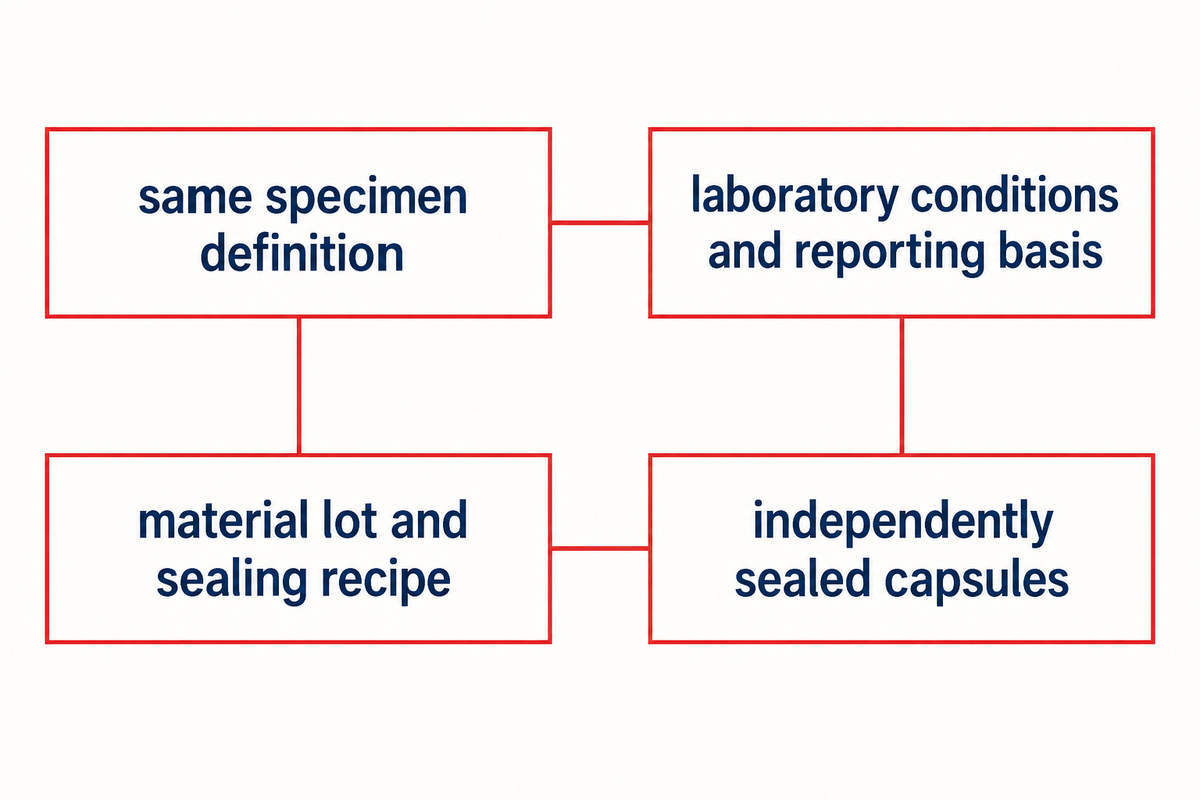
Compare constructions with the same specimen definition, laboratory conditions and reporting basis. Separate the empty-package transmission work from the filled-product aging study. Quality Staff should agree acceptance criteria prior to laboratory runs and Production should record the actual material lot and sealing recipe used for every capsule group.
| Control | Filled example entry | Who records it |
|---|---|---|
| Construction comparison | Body A versus body B; same nominated lid specification | Procurement and quality |
| Material identity | Separate body and lid lots; coating and formed-wall specification attached | Procurement |
| Laboratory environment | Proposed 23 °C and 50% RH; laboratory confirms suitability and both-side conditions | Laboratory |
| Transmission specimen | Empty assembled capsule; fixture drawing shows exposed body, rim and lid | Laboratory |
| Mounting control | Blank fixture and impermeable reference checked with each setup | Laboratory |
| Production sample groups | Start, steady run and restart retained as separate groups | Production |
| Headspace timing | Same nominated delay after sealing; independent units for destructive readings | Quality |
| Replication | Three independent units per initial comparison group proposed; additional count agreed from decision risk | Quality and laboratory |
| Stored-product study | Same coffee, dose and nominated storage interval; separate oxygen, moisture and sensory records | Quality |
| Report and decision | Individual results, uncertainty, unit basis and predefined criterion; investigate group differences before release | Quality owner |
Proposed entry 23 °C/50% RH is a starting condition, not a universally accepted specification for coffee. A laboratory should evaluate hot or humid conditions, if applicable, and report the result. The laboratory should report oxygen concentration for the driving side and the internal or sweep gas conditions; a single humidity number can’t be universally applied to an unspecified condition.
Count production batches, independently sealed capsules and repeated sensor readings separately. NIST’s guidance on binary performance tests discusses sample size, acceptance criteria, and decision risk. Three pieces need not represent three independent production batches; repeating one sensor reading improves information about that reading without adding an independently sealed capsule.
Maintain roast and grind for the first construction comparison. The physical properties of coffee change the filled-pack problem: fresh coffee, ground roasted coffee and roasted coffee beans don’t have identical gas space and handling. Trace the green coffee origin and roast record when preparing the blend. A change in arabica coffee content should begin a new product group rather than disappearing in a pooled average.
Use the incoming-lot release procedure for supplier identity and traceability. This test protocol continues from where the identity is established and evaluates the nominated finished construction.
For a supplier offering a hermetic barrier, enter the agreed integrity criterion next to the claim in the test order. Keep the transmission criterion in its own field.
Diagnose Oxygen Failures Before Changing the Filling Line
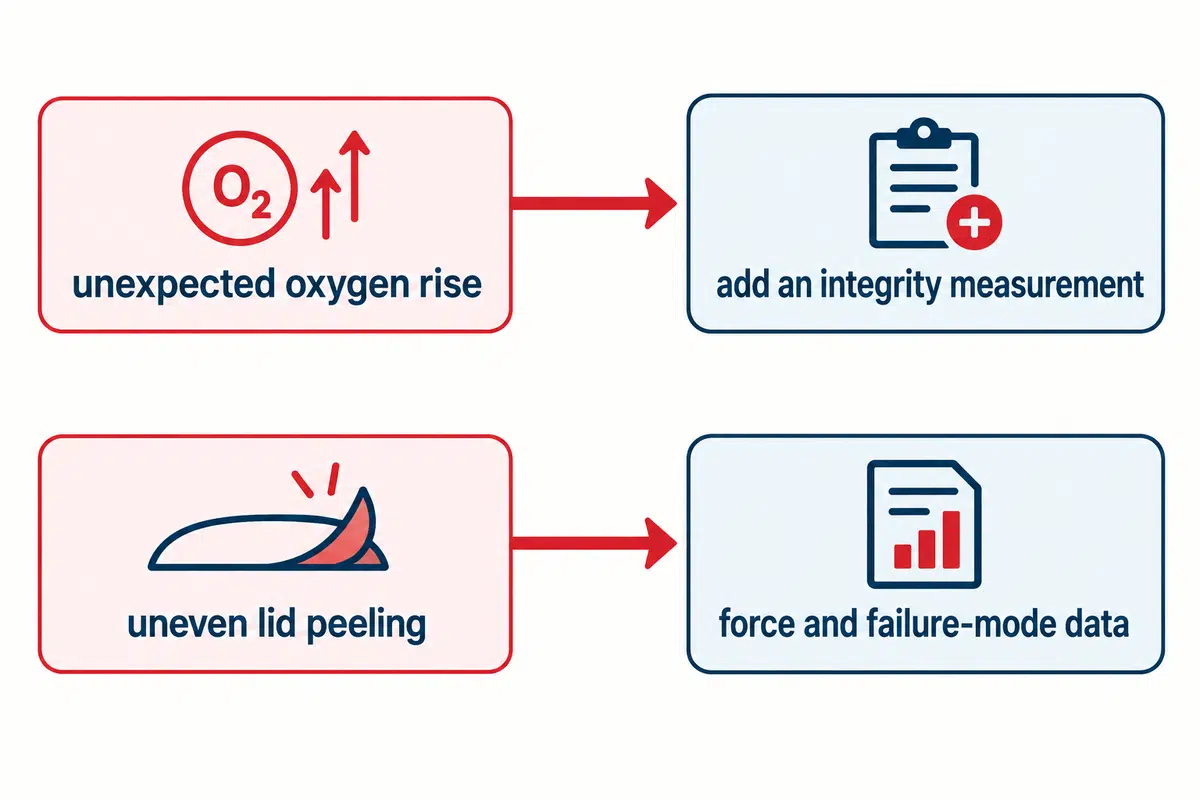
Select a measurement that separates plausible causes of the observed failure. High initial O2 suggests a different investigation from a delayed rise in an intact capsule. Keep package transmission, leak response and process timing in mind. Use the next-test column to separate an integrity fault from a change in material transmission or the filling sequence.
| Observed symptom | Next measurement | Action after the comparison |
|---|---|---|
| High oxygen immediately after sealing | Fixed-delay readings across flushing and sealing positions | Production checks gas delivery, exposure time and transfer to sealing |
| Oxygen rises during storage | Intact-package leak test plus empty-package transmission | Quality separates integrity faults from a construction-level rate |
| Strong peel, poor oxygen result | Validated leak test and inspection of the full seal path | Inspect channels, contamination and local defects |
| Body-only result good, complete pack poor | Lid/interface comparison with documented fixture exposure | Investigate the path added by the assembled closure |
| Results change after a needle reading | Independent unopened controls | Separate sampling damage from storage behaviour |
| Low oxygen but stale flavour | Moisture, sensory study and product-handling records | Check quality pathways beyond headspace oxygen |
| Different readings across a production run | Separate start, steady-run and restart sample groups | Investigate operating conditions before pooling results |
| Supplier reports disagree | Compare specimen, units, temperature, RH and pressure basis | Order a matched-condition comparison |
| Only one batch has poor results | Repeat with independently identified body, lid and coffee lots | Localize the changed input before substituting the complete system |
Use capsule-suitable chambers, system-specific validations, controls, and acceptance response for vacuum-decay leak detection under ASTM F2338-24. Published hole-detection sensitivity is specific to the package systems used to assess it; relying on another container’s assessment in a capsule report would mislead the buyer on the specification.
Does 99.9% Nitrogen Guarantee Less Than 0.1% Oxygen in a Sealed Capsule?
No. “Supply-gas purity” refers to the nitrogen used to purge the pack at the fill/seal station. “Residual oxygen” refers to the amount of oxygen in the pack post sealing. Air already in the coffee bed, incomplete displacement and exposure before sealing affect the final atmosphere. Measure residual oxygen inside finished units at the agreed delay instead of converting the nitrogen label into a package guarantee.
- Retain unopened controls.
- Separate units from repeated readings.
- Record the time after sealing.
- Reuse punctured samples for intact aging.
- Pool different gas-pressure bases.
- Approve a material from gas purity alone.
If there’s higher-than-expected oxygen in the first capsules following a shut down, the owner will request a capsule body change while production workers will suspect transfer to the sealing station. Quality will retain samples from restart and compare them to steady state samples from the same material. An integrity test and fixed delay headspace check will help decide the next course of action. If the comparison of the empty package transmission stays the same, Finance can defer a material change and Production can investigate the restart process. A broad average across the shift will dilute the difference in the groups being studied and make both investments difficult to evaluate.
Buy Testing and Prepare an AFPAK Trial
Order the laboratory work and the filling machine trial as separate, but related activities. The laboratory defines its specimen, fixture and report. Provide the same capsule construction and product requirement specifications for both laboratory testing and the filling machine trial. Ensure that a convenient lab sample doesn’t replace the pack you intend to manufacture.
As of 19 October 2026, Measurlabs’s finished-package oxygen transmission service was listed in USD at $845 per sample (excluding VAT) with a $105 service fee per order, three pieces, two replicate measurements and a typical six-week lead time after receipt. Specify the listed currency and custom capsule mounting in the purchase order.
Virginia Tech’s Sustainable Packaging Materials Lab offers third-party testing by quote, including oxygen permeability and headspace tests as well as seal/leak equipment. Request a scope identifying complete capsule work, film-coupon work and other samples required for the setup.
A format name used in the single-serve coffee market is too broad for the laboratory order. Attach the actual capsule drawing and lid specification for the nominated construction.
Example request to adapt before ordering testing:
| Parameter | Recommended range | Why it matters | How to verify |
|---|---|---|---|
| Specimen | Two nominated constructions; complete capsule and separate lid coupons | Aligns the report with the purchase | Approve sample photographs and fixture drawing |
| Conditions | Proposed 23 °C/50% RH, then an agreed storage stress if needed | Controls the comparison basis | Record both-side conditions in the report |
| Units | Package and area rates separated; atm denominator retained if used | Prevents an invalid ranking | Review a sample report before commissioning |
| Samples | Setup pieces, independent test units and spare controls quoted separately | Separates preparation from replication | Agree the physical count and analytical repeats |
| Line trial | Nominated dose, output and seal recipe; start/steady/restart groups | Tests the intended operating window | Use the same identified bodies, lids and coffee |
| Commercial scope | Fixture, conditioning, testing, report and repeat work priced separately | Makes the budget comparable | Confirm currency, tax, freight and completion trigger |
Suppose a procurement team must evaluate two different constructions prior to reserving a production slot. The less expensive quote is for a flat film, while the other longer quote includes mounting a finished package. The quality team needs the assembled seal, and the finance team compares the scope against the headline price. The team approves a fixture drawing, schedules sample manufacture and shipping, and coordinates with the lab to time sample shipment for the laboratory period. A machine trial can record the operating recipe and prepare samples for the trial, but the result is contingent upon the laboratory and their schedule. Keeping the two activities distinct ensures that an order for the machine doesn’t also guarantee the shelf-life.
For compact formats, discuss the Nespresso-format filling and sealing setup with the nominated lid and coffee powder. Other capsule systems require their own tooling and sampling arrangement. Start the broader discussion through AFPAK’s coffee capsule production line trial planning, with your required output and test protocol attached.
Industry Outlook: Retest New Coatings, Plastic and Compostable Constructions
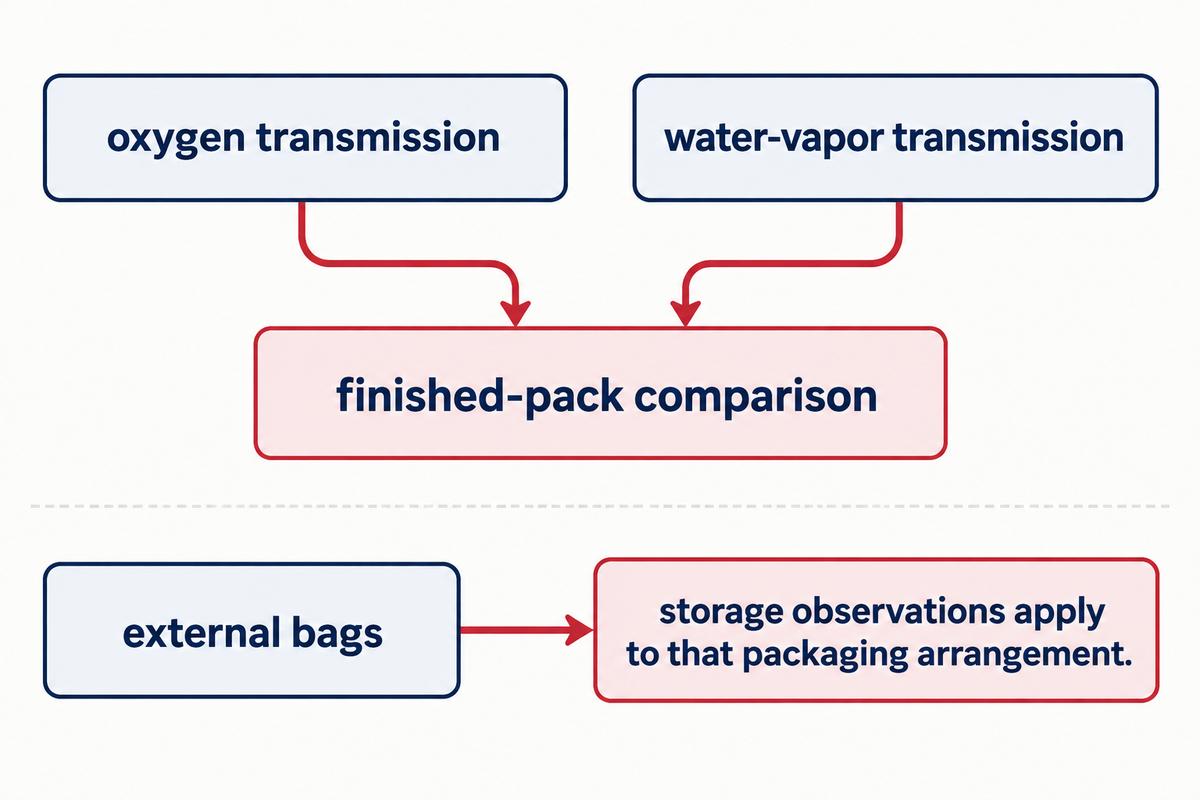
The test article is changed by a new barrier layer or a new capsule construction, so a finished-pack comparison is required before approving the change. Compostable coffee capsules require an oxygen specification and storage assessment, as do all formats. A sustainability label describes a different requirement from the preservation performance of the assembled capsule.
In Packaging Europe’s September 2025 report, OxBarrier’s licensing program targets compostable single-serve capsules. It indicates technology development. Compare candidate samples under the intended conditions, rather than assigning a barrier performance to every bioplastic.
In the packaging industry, proposed fiber-based capsule technologies include the composite and silane treatment described in WO2025061642A1, published in March 2025 with Nestlé entities listed as assignees. Compare the nominated finished specimen with your current construction before substituting it for another material or one of the bioplastics under consideration.
When considering oxygen permeability and shelf life of coffee, assess water-vapor transmission alongside oxygen transmission because a coating can change moisture response as well as oxygen barrier properties. Recyclability and end-of-life claims require their own assessment. Changing to a bioplastic or removing one layer of the assembly doesn’t establish environmental impact of the complete supply chain.
Assess the newly revealed individual capsule when a design removes its outer bag. The 2024 Foods study of alternative multilayer films evaluated external bags containing pods or groups of ten capsules; its storage observations apply to that packaging arrangement.
For coffee brands selling a single-serve product, keep the actual beverage and route in the approval plan. Espresso coffee stored for a retail channel and a different coffee beverage stored via another route may require different validation conditions. Define a good capsule in the food and beverage packaging order, with the required level of transmission and integrity. Coffee producers should rerun the relevant tests if the body, lid, coating or sealing interface changes.
Frequently Asked Questions
How Often Should an Oxygen Analyzer Be Calibrated?
Use the manufacturer’s calibration schedule; add performance checks after maintenance and measurement changes.
Use suitable reference gases or the specified sensor procedure, and keep verification records with sample results. Low-range residual-oxygen decisions need appropriate range and uncertainty. Verify needle access, sample volume and capsule fixture separately from instrument calibration. Record the method, reference and instrument configuration with each check so later results can be compared on the same basis.
How Soon After Sealing Should Residual Oxygen Be Measured?
Use a defined, repeatable delay after sealing, then separate those initial readings from later storage measurements.
Choose the delay in the test plan and apply it to each comparison group. Record the elapsed time, rather than combining readings made immediately at the line with samples measured after transport to a laboratory. Coffee gas release and oxygen consumption continue after sealing. Use independent unopened units at later intervals when the measurement requires puncturing the pack.
Is Less Than 1% Residual Oxygen Necessary for Every Coffee Capsule?
No. Set a project-specific residual-oxygen criterion from the product, package and validated storage objective.
State whether the limit is a gas volume fraction, the time after sealing and the acceptable measurement uncertainty. Then relate it to results from the actual filled product. Different roast, dose and gas space can change interpretation. A tighter initial target can be useful for a particular project, but its number must remain connected to the agreed method and product study.
Do aluminium capsules expire?
Follow the coffee producer’s date and storage instructions; the aluminium shell alone does not determine the coffee’s storage life.
Preservation depends on the complete sealed pack and product. Assess the actual construction and sensory performance over the intended distribution period.
Does oxygen testing replace moisture transmission testing?
No. Oxygen and water vapor are separate transmission measurements, and both can affect stored coffee quality.
Include moisture exposure and product measurements when evaluating a new construction. Virginia Tech’s laboratory lists separate equipment for these properties. Compare the relevant humidity conditions and follow the filled-product study with sensory assessment.
Can barrier testing prove recyclability?
No. Barrier testing measures gas transmission; recyclability requires an assessment appropriate to the complete packaging construction and collection system.
Assess the body, lid and coating together for the intended collection route.
Does an empty-capsule result transfer to a filled capsule?
Use the empty result to characterize the package; evaluate the filled product separately because coffee changes the internal atmosphere.
Keep the package identity, pressure basis and storage conditions connected across the two studies.
What Does a Filling Trial Need from Your Capsule Test?
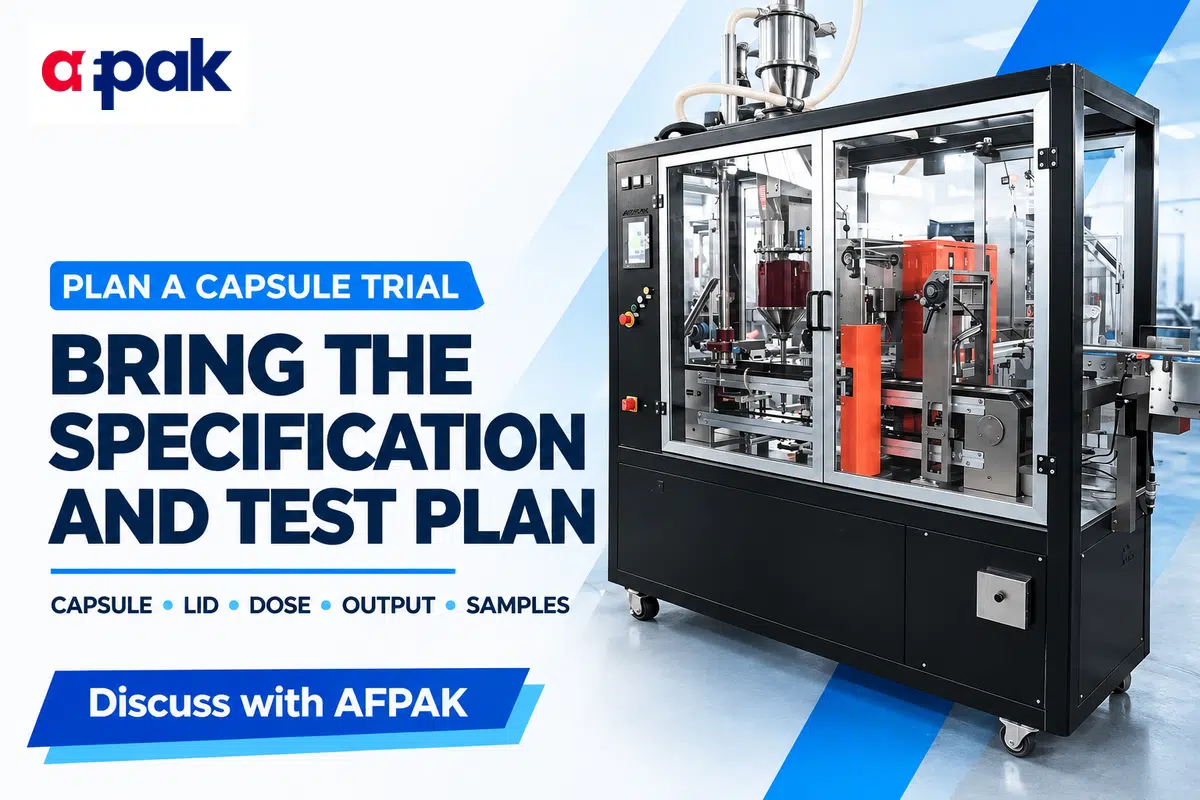
Send AFPAK the capsule and lid specifications, nominated coffee dose, required output and proposed sampling groups. Discuss the production-line configuration for a capsule trial around those requirements, and commission the external laboratory work with its agreed fixture and reporting conditions.
The worked gas-volume comparison and pilot scenarios are planning examples based on stated assumptions and not on the basis of AFPAK customer tests.
References & Sources
- ASTM International: F1307-20, oxygen transmission through dry packages
- ASTM International: F88/F88M-23, seal strength
- ASTM International: D3985-24, plastic film and sheeting
- ASTM International: F1927-20, controlled-humidity barrier materials
- ASTM International: F2714-08(2021), fluorescent-decay headspace analysis
- Eiermann and colleagues, 2020: capsule properties and extraction dynamics
- Rey and Pétry, 2025: complementary oxygen-barrier measurement methodologies
- National Institute of Standards and Technology: Technical Note 2045
- ASTM International: F2338-24, vacuum-decay leak detection
- Virginia Tech: Sustainable Packaging Materials Lab facilities
- Packaging Europe, September 2025: OxBarrier technology licensing
- WIPO publication WO2025061642A1: fiber-based composite materials
- Basile and colleagues, Foods 2024: alternative outer multilayer film study


