
UFO Drip Coffee Packaging Machine Buyer’s Guide (2026)
UFO drip coffee is a premium single-serve coffee format designed for manual brewing directly over a cup. The term “UFO” refers to its round, cup-style structure—typically with a diameter of around 95 mm—that sits securely on the rim of a mug during brewing.
Compared with traditional drip coffee bags, UFO drip coffee allows a larger coffee dose (usually 15–19 g), more stable extraction, and a cleaner brewing experience, making it increasingly popular among specialty coffee brands, export markets, and premium retail channels worldwide.
Choosing a UFO drip coffee packaging machine is not a “speed-only” decision.
It’s about repeatability, uptime, and cost per good unit—especially once you move beyond trial runs.
UFO drip coffee looks premium on the shelf, but it adds complexity on the factory floor:
- more parts
- tighter tolerance
- more feeding systems
- higher expectations on presentation and sealing quality
This guide is written for coffee brands, OEM/ODM factories, and investors who want a clean path from pilot to full production.
1) UFO Drip Coffee Product Structure (Your Machine Must Match the BOM)
A UFO drip coffee cup is a multi-piece structure. It typically includes:
- bottom paper ring
- filter paper cup (cut + formed)
- top paper ring
- card lid (logo lid)
- PET lid (transparent cap)
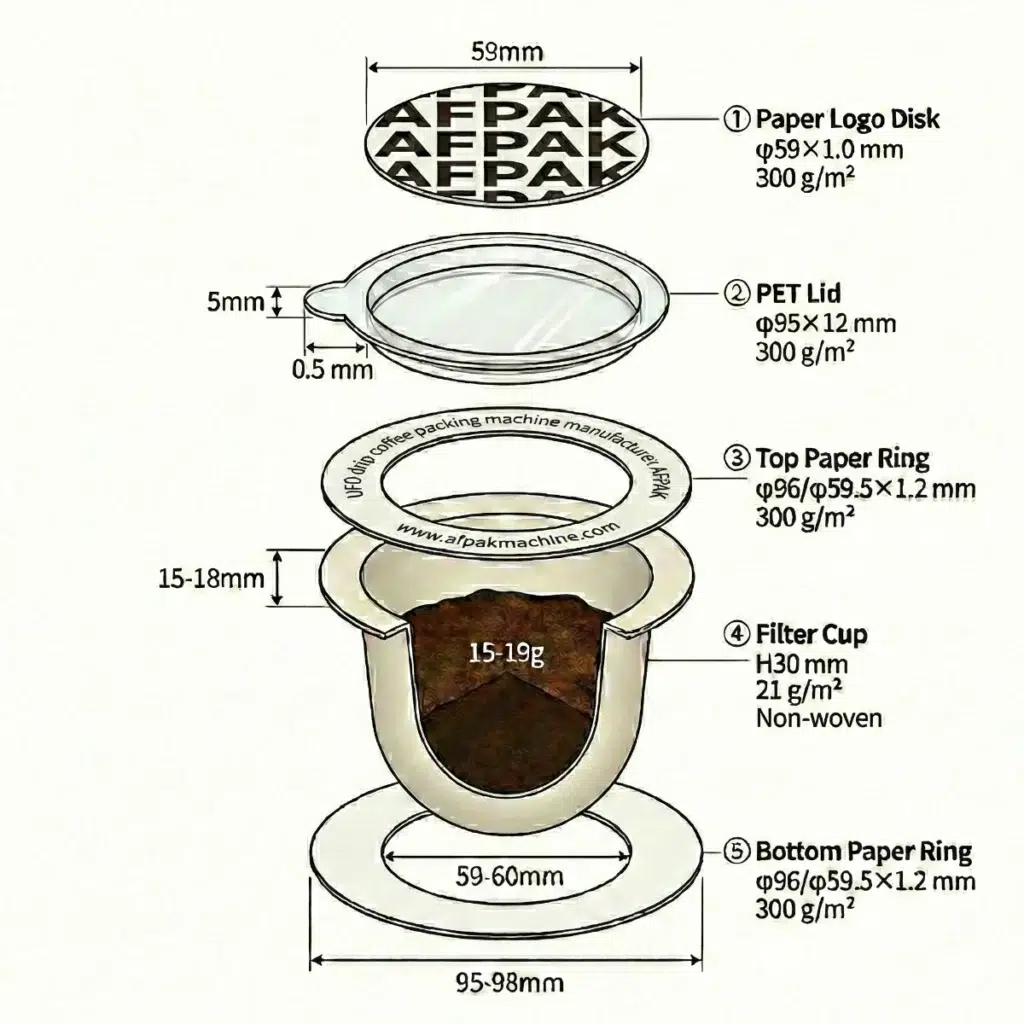
This “assembly logic” is exactly why UFO packaging equipment is different from a standard drip bag machine. If structure control is unstable, the product won’t feel premium—no matter how good the coffee is.
2) Define Your Production Target: Output Is “Good Units per Hour,” Not CPM on Paper
Most factories don’t lose money because their machine is slow.
They lose money because sealing yield drifts, powder contaminates sealing areas, changeover eats the shift, and downtime shows up at the worst time.
Before selecting equipment, define:
- daily output target
- number of shifts
- acceptable defect rate
- how often you change SKUs
Operational benchmark (AFPAK reference): our UFO packaging machines are designed to support 24-hour continuous operation with >99% qualified rate under stable materials and standard operating conditions.
3) Two Main UFO Production Routes: Ready-Made Cup Filling vs Forming + Filling + Sealing
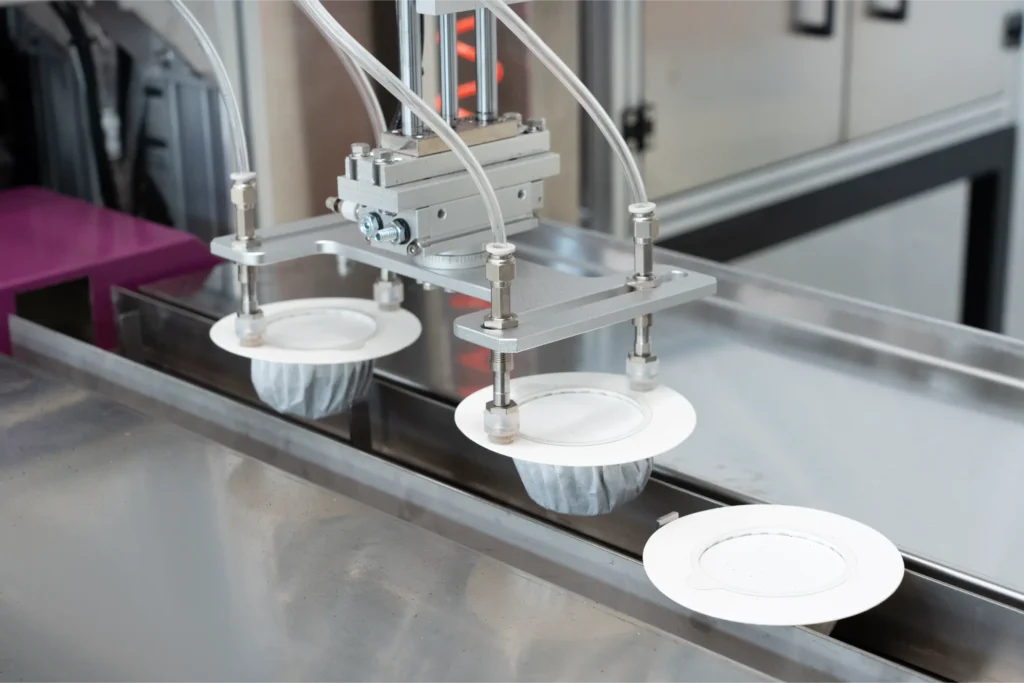
There are two proven routes for UFO packaging:
Route A — Ready-Made UFO Cup Filling (Fastest Launch)
This route fills pre-made empty UFO cups.
Typical workflow includes:
- ready-made pod feeding
- servo auger filling
- powder suction cleaning
- plastic cap sorting & feeding
- top lid loading
Best for:
- brands launching premium UFO lines
- factories that want lower engineering complexity
- teams that don’t want to manage component forming early
Route B — UFO Forming + Filling + Sealing (Best Long-Term Unit Cost)
This route forms the UFO structure from components and fills coffee in one sequence, including:
- bottom ring loading
- filter paper cutting & sealing
- top ring placement
- ultrasonic sealing
- servo auger filling
- powder suction
- plastic cap sorting & feeding
- lid loading
Best for:
- OEM/ODM factories
- high-volume projects
- buyers who want BOM control and unit-cost leverage at scale
4) Lane Count Selection: 1-Lane vs 2-Lane vs 4-Lane (How Scaling Actually Works)
Scaling UFO production is mostly about parallelization:
- 2-lane output ≈ 2× single-lane
- 4-lane output ≈ 4× single-lane
| Lane Count | Output Logic | Best For |
|---|---|---|
| 1 lane | baseline | testing market, new brands, limited shifts |
| 2 lanes | ~2× | growth stage, stable orders |
| 4 lanes | ~4× | OEM factories, export supply, multi-shift production |
5) Price Reference: UFO Machines by Lane Count (Practical Buyer Ranges)
Below pricing is structured for decision-making. Exact pricing depends on options, materials, feeding system design, and inspection requirements.
A) [Ready-Made UFO Cup Filling Machine] (Pre-made UFO cups)
| Lane Count | Output | Price Reference (USD) |
|---|---|---|
| 1 lane | 1× | $30,000+ |
| 2 lanes | 2× | $45,000+ |
| 4 lanes | 4× | $65,000+ |
B) UFO Forming + Filling + Sealing Machine (Build cups in-house)
| Lane Count | Output | Price Reference (USD) |
|---|---|---|
| 1 lane | 1× | $39,000+ |
| 2 lanes | 2× | $54,000+ |
| 4 lanes | 4× | $74,000+ |
C) Outer Bag Packaging Machine (Nitrogen Flushing Option)
For premium shelf life and export readiness, add an outer bag system:
- bag forming from reel
- pod feeding
- nitrogen flushing
- sealing
Price reference: $22,000+ :
A reference spec shows:
- pack speed: 40–70 bags/min
- voltage: 1-phase AC 220V
- power: 2.0 kW
6) UFO vs Standard Drip Bag: What Buyers Must Understand Before Choosing Equipment
Standard drip bag products are simpler:
- fewer structural parts
- easier forming
- fewer feeding stations
- typically lower machine cost for the same speed class
If your market is “value and daily consumption,” standard drip bag is often the first step.
If your market is “premium gift, boutique coffee, higher dose,” UFO is usually the upgrade path.
7) Standard Drip Bag Coffee Packaging Machine
If you plan to offer traditional drip bag coffee as well, this category is widely used.
What it can produce
- inner bag only
- or inner + outer bag packaging
Output & dosing
- 30–50 bags/min
- capacity 30–40 bags/min
- filling weight range 5–12g
- accuracy ±0.2g
Bag size & sealing
- inner bag size: W 90mm × L 90mm
- outer bag size: W 100mm × L 120mm
- sealing type: three sides sealing
Utilities
- power supply: 220V / 50Hz / 3.7kW
- air consumption: 0.6 m³/min, 0.8MPa
Price reference
USD $18,000+ / set
8) UFO vs Standard Drip Bag: Side-by-Side Comparison Table
| Category | UFO Drip Coffee (Cup Style) | Standard Drip Bag Coffee |
|---|---|---|
| Core positioning | Premium single-serve | Mass-market / daily drip |
| Structure complexity | Higher (multi-piece assembly) | Lower (film forming + sealing) |
| Typical coffee dose | 15–19g (premium dose) | 5–12g common range |
| Typical output approach | Lanes (1/2/4) | Single platform, speed variants |
| Key KPI | qualified rate + assembly stability | sealing stability + dosing accuracy |
| Operational benchmark | 24h continuous, >99% qualified (AFPAK reference) | varies by spec and format |
| Typical equipment investment | ~$31k–$74k+ (by lanes) | ~$18k entry reference |
9) Market Reality: Why Japanese Standard Drip Bag Machines Often Cost $80,000+
For traditional drip bag machines, Japanese equipment is commonly quoted at USD $80,000+ (market reference).
Pricing is often driven by:
- long-term stability for multi-shift production
- higher finishing standards
- higher automation level
- stronger process repeatability expectations
Meanwhile, many China-made machines start lower, but the price can increase quickly depending on:
- bag formats supported (inner only, inner + outer, special shapes)
- speed class and automation level
- dosing system (auger vs weighing systems)
- inspection requirements
- materials and sealing specifications
10) Which UFO Machine Should You Buy? (Clear Recommendations)
Recommendation #1 (Most Brands): Ready-Made UFO Filling — 1 Lane → 2 Lanes Upgrade
Choose this if:
- your #1 goal is launch speed
- you’re building demand first
- you’re comfortable sourcing ready-made empty UFO cups
Start with 1 lane, expand to 2 lanes once monthly volume is stable.
Recommendation #2 (OEM / Scale): Forming + Filling + Sealing — 2 Lanes or 4 Lanes
Choose this if:
- you want BOM control and lower unit cost
- you run daily production
- you want less dependency on cup suppliers
Recommendation #3 (Shelf-life Focus): Add Outer Bag + Nitrogen From Day One
Choose this if:
- you export
- you target premium retail
- you sell into warm climates
11) Buyer’s Checklist (What Serious Buyers Confirm Before Paying a Deposit)
Product & coffee specs
- target coffee load (15–19g)
- grind profile (fine % impacts stability)
- required shelf life and storage temperature
- nitrogen requirement for outer bag
Factory conditions
- power readiness (single-phase vs 3-phase)
- compressed air capacity
- operator training plan
- cleaning SOP (coffee powder is unforgiving)
Acceptance standards (put these in writing)
- weight tolerance
- seal strength requirements
- defect rate targets
- continuous operation test duration
- qualified rate definition (what counts as “qualified”)
12) Factors Affecting the Cost of UFO Packaging Machines
A single number does not define the price of a UFO drip coffee packaging machine.
In real projects, machine cost is the result of product design, functional requirements, capacity planning, and component selection working together.
Below are the four main factors that directly affect the final machine price and delivery timeline.
1) UFO Cup Size and Dimensions
While the 95mm diameter UFO cup has become a widely accepted industry standard, UFO packaging machines are often designed to support custom cup sizes based on brand or market requirements.
Customizing a machine for a non-standard cup size typically involves:
- mechanical structure adjustment
- tooling redesign
- feeding and positioning optimization
- additional testing and validation
As a result:
- machine design and manufacturing lead time is usually extended by 3–5 weeks
- engineering workload increases
- overall machine cost may rise accordingly
Buyer note:
If your product can follow the standard 95mm UFO format, both cost and delivery time are easier to control. Custom dimensions should be justified by clear market or branding needs.
2) Functional Requirements and Optional Configurations
Machine cost increases significantly with added functionality. Typical configuration choices include:
- Ready-made UFO cup filling vs in-line cup forming + filling + sealing
- optional aroma dosing or flavor injection
- online weight checking or inspection systems
- date coding / batch printing
- different bag sizes and bag design requirements
- integration with downstream equipment such as cartoning or case packing machines
Each function affects:
- mechanical complexity
- control logic
- synchronization between stations
- commissioning time
Buyer note:
These requirements should be discussed in detail with the supplier during the quotation stage. Incomplete early communication is one of the most common reasons for unexpected price changes later.
3) Required Production Capacity (Lane Configuration)
UFO packaging machines are commonly available in 1-lane, 2-lane, and 4-lane configurations.
As a general rule:
- 2 lanes ≈ 2× output of 1 lane
- 4 lanes ≈ 4× output of 1 lane
However, higher lane counts mean:
- more parallel forming and filling stations
- more complex synchronization
- higher demand on material consistency
- increased mechanical and electrical system load
As capacity increases, machine price rises accordingly—not only because of speed, but because of system complexity and stability requirements.
Buyer note:
It’s often more cost-effective to choose the correct lane count early than to under-size and upgrade too soon.
4) Electrical Configuration and Component Selection
Electrical components play a critical role in long-term machine reliability. Key elements include:
- PLC system
- touch screen (HMI)
- servo motors and drives
- sensors and safety components
For long-term stability and global service support, many buyers prefer established brands such as:
- Schneider
- OMRON
- Siemens
Choosing higher-grade electrical components usually:
- increases initial machine cost
- reduces downtime risk
- improves spare parts availability
- lowers total cost of ownership over the machine’s life cycle
Buyer note:
A lower upfront price achieved by cutting electrical configuration quality often leads to higher maintenance cost and production instability later.
Summary
The real cost of a UFO packaging machine is shaped by:
- cup size standardization vs customization
- functional scope of the line
- required production capacity
- electrical configuration level
Understanding these factors early allows buyers to align machine investment with actual production goals—rather than reacting to cost changes after the project has already started.
13) Cost Driver Checklist (What to Confirm Before Requesting a Quote)
Before requesting a quotation for a UFO drip coffee packaging machine, buyers should clearly define the points below.
Most pricing gaps and project delays come from missing or unclear information at this stage.
A. UFO Cup & Product Specifications
- Target UFO cup diameter (standard 95mm or custom size)
- Cup height and structure details (ring thickness, lid type)
- Coffee dose range (e.g. 15–19g)
- Filter paper specification and supplier (gsm, permeability)
- Whether multiple cup sizes are required on one machine
B. Production Process Route
- Ready-made UFO cup filling
or - In-line forming + filling + sealing
- Expected flexibility for future product changes
C. Functional Requirements
- Aroma or flavor dosing (yes / no)
- Online weight checking (sampling or 100%)
- Date coding or batch printing
- Vision inspection or defect detection
- Powder suction and cleaning requirements
D. Packaging Format & Downstream Integration
- Inner cup only or inner + outer bag
- Outer bag size range and design changes
- Nitrogen flushing requirement
- Connection to cartoning or case packing equipment (now or future)
E. Capacity Planning
- Target output per hour / per shift
- Lane configuration (1 / 2 / 4 lanes)
- Number of shifts per day
- Expected continuous operation time (e.g. 24h production)
F. Electrical & Utility Preferences
- Preferred PLC / HMI / servo brands
- Power supply conditions (single-phase or three-phase)
- Compressed air availability and capacity
- Factory space and layout constraints
Buyer tip:
Providing this information upfront allows suppliers to quote accurately and design a machine that matches real production needs—rather than revising pricing after engineering starts.
14) How Cost Drivers Map to 1-Lane / 2-Lane / 4-Lane Configurations
The four main cost drivers—cup size, function scope, capacity, and electrical configuration—affect each lane configuration differently.
Below is a practical reference to help buyers align machine selection with production reality.
1-Lane Configuration (Entry / Pilot Production)
Best for:
- new product launches
- market testing
- limited daily output
- minimal SKU changes
Typical cost drivers:
- standard 95mm UFO cup preferred
- ready-made cup filling or basic forming
- limited optional functions
- standard electrical configuration
Key advantage:
Lowest investment and fastest delivery.
Risk if misused:
Can become a bottleneck once orders stabilize.
2-Lane Configuration (Growth Stage / Stable Orders)
Best for:
- brands with consistent monthly demand
- OEMs moving from pilot to scale
- factories running daily shifts
Typical cost drivers:
- standard or semi-custom cup dimensions
- more optional functions added (inspection, printing)
- higher synchronization requirements
- stronger demand on electrical stability
Key advantage:
Balanced investment vs output, good long-term flexibility.
Buyer insight:
Many projects find 2-lane to be the “sweet spot” for cost control and scalability.
4-Lane Configuration (OEM Scale / Multi-Shift Production)
Best for:
- OEM/ODM factories
- export-oriented production
- multi-shift or 24-hour continuous operation
Typical cost drivers:
- strict cup dimensional consistency
- full forming + filling + sealing route
- advanced inspection and monitoring
- premium electrical component selection
Key advantage:
Lowest cost per good unit at scale.
Buyer caution:
Material consistency, operator training, and maintenance discipline become critical.
4-lane systems amplify both strengths and weaknesses in a factory.
Practical Decision Rule
- If volume is uncertain → start with 1 lane
- If demand is stable → 2 lanes is usually optimal
- If production is continuous and predictable → 4 lanes delivers the best unit economics
Correct lane selection early reduces redesign, avoids rushed upgrades, and protects total investment.
15) Sample Quotation Scenarios (Practical Reference for Buyers)
To help buyers better understand how different requirements translate into machine configuration and budget, the following examples are based on typical real-world UFO drip coffee projects.
These scenarios are not binding quotations, but they reflect how cost drivers interact in actual equipment selection.
Scenario 1: Standard Market Launch (Most Common Choice)
Project background
- New UFO drip coffee product
- Focus on fast market entry
- Stable quality, limited SKU changes
- No special structural customization
Product & process assumptions
- Standard UFO cup diameter: 95mm
- Coffee dose: 15–18g
- Ready-made empty UFO cups
- Inner cup + outer bag packaging
- Nitrogen flushing required
- No online weight checker
- No aroma dosing
- Date coding included
Recommended configuration
- 2-lane ready-made UFO cup filling machine
- Outer bag packaging machine with nitrogen flushing
Budget reference
- UFO filling machine (2 lanes): USD 45,000+
- Outer bag packaging machine: USD 22,000
- Estimated line investment: ~USD 67,000+
Why this setup works
- Fast commissioning
- Lower engineering risk
- Suitable for scaling from brand launch to stable monthly output
- Balanced cost vs production capacity
Scenario 2: Cost-Controlled OEM Production (Long-Term Volume Focus)
Project background
- OEM/ODM factory
- Stable orders and daily production
- Strong focus on cost per unit
- Internal technical team available
Product & process assumptions
- Standard UFO cup diameter: 95mm
- Coffee dose: 16–19g
- In-line forming + filling + sealing
- Inner cup + outer bag packaging
- Nitrogen flushing required
- Optional date coding
- No aroma dosing
- Sampling-based weight inspection
Recommended configuration
- 2-lane forming + filling + sealing UFO machine
- Outer bag packaging machine with nitrogen flushing
Budget reference
- Forming + filling + sealing machine (2 lanes): USD 54,000+
- Outer bag packaging machine: USD 22,000
- Estimated line investment: ~USD 76,000+
Why this setup works
- Lower long-term unit cost
- Full control over UFO structure BOM
- Better scalability for OEM contracts
- Suitable for continuous daily operation
Scenario 3: Large-Scale Export Production (24/7 Operation)
Project background
- Export-oriented production
- Multi-shift or 24-hour continuous operation
- High consistency and low defect tolerance
- Long-term supply contracts
Product & process assumptions
- Standard UFO cup diameter: 95mm
- Coffee dose: 18–19g
- In-line forming + filling + sealing
- Inner cup + outer bag packaging
- Nitrogen flushing required
- Online weight monitoring
- Production date printing
- Preparation for downstream cartoning
Recommended configuration
- 4-lane forming + filling + sealing UFO machine
- Outer bag packaging machine with nitrogen flushing
Budget reference
- Forming + filling + sealing machine (4 lanes): USD 74,000+
- Outer bag packaging machine: USD 22,000
- Estimated line investment: ~USD 96,000+
Why this setup works
- Lowest cost per good unit at scale
- Supports 24-hour continuous operation
- Designed for high qualified rate (>99%) under stable conditions
- Future-ready for automation upgrades
Scenario 4: Custom Cup Size & Advanced Features (Special Projects)
Project background
- Differentiated product design
- Non-standard UFO cup dimensions
- Brand-driven structural customization
- Higher engineering involvement accepted
Product & process assumptions
- Custom UFO cup size (non-95mm)
- Coffee dose customized
- In-line forming + filling + sealing
- Multiple optional functions (inspection, printing)
- Inner + outer bag packaging
- Nitrogen flushing required
Key impact on project
- Machine design lead time extended by ~1 month
- Engineering and tooling cost increased
- Final price depends heavily on customization scope
Buyer note
Custom projects should always be discussed in detail before quotation.
Early confirmation of dimensions and functions is critical to control cost and delivery time.
Final Buyer Insight
Machine pricing only makes sense when viewed together with:
- product structure
- functional scope
- lane configuration
- long-term production plan
The most successful projects are not those with the lowest initial price, but those where machine capability matches production reality from day one.
FAQ (Buyer Questions That Actually Matter)
1) Can the machine really run 24 hours continuously?
Yes—when materials are stable and standard operating procedures are followed.
AFPAK machines are engineered for 24-hour continuous operation, and in stable production conditions the qualified rate can exceed 99% (AFPAK reference).
2) Should I buy 1 lane, 2 lanes, or 4 lanes?
If you’re launching: 1 lane.
If you already have stable orders: 2 lanes.
If you run multi-shifts at OEM scale: 4 lanes.
3) What’s the difference between ready-made filling and forming + filling + sealing?
Ready-made filling minimizes process variables and speeds up market entry.
Forming + filling + sealing offers deeper BOM control and stronger long-term unit economics at volume.
4) Do I need an outer bag?
This is necessary! If you target premium shelf life, export distribution, or warm climates, outer bag packaging—often with nitrogen flushing—is strongly recommended.
5) Why does drip bag machine pricing vary so widely?
Because “drip bag machine” can mean different bag formats, different speeds, different dosing systems, and different inspection levels. Bag format and packaging speed alone can push pricing upward significantly.
FAQ:Is nitrogen flushing required?
Yes! Nitrogen flushing is widely used in food packaging to displace oxygen and improve shelf stability.
Author

Jeffree
Packaging Machinery Specialist | 15 Years Experience | AFPAK
Jeffree has spent 15 years building and supporting coffee packaging production lines, from drip bags and outer bag systems to premium single-serve formats. His focus is practical: stable output, clean sealing, and a production system that scales without quality drift.
For a fast recommendation, send:
1) target monthly volume
2) coffee dose (15–19g)
3) ready-made cups vs forming in-house
4) whether you require nitrogen-flushed outer bags


