anf717@gmail.com

アレナンフ

+86-1561 8866 167

859-813-2814 (米国/カナダのみ)


無料見積もりを入手

Aluminium Coffee Capsule Production: Materials, Machines, and Manufacturing Guide

How Aluminium Coffee Capsules Are Made: Materials, Machines, and the Full Manufacturing Process Aluminium coffee

How Aluminium Coffee Capsules Are Made: Materials, Machines, and the Full Manufacturing Process

Aluminium coffee capsules are increasingly taking a share of the world’s capsule market, which. fell to an estimated USD 32.62 billion in 2025, according to Mordor intelligence. For roasters and private label brands and beverage businesses getting into capsules, it is essential to know the ingredients, manufacturing process, and machines – the raw materials, the process, and the machine – since these factors determine the final product’s quality, shelf life, commodity regulations, and unit economics. This guide reveals the entire process of producing aluminium coffee capsules, from the choice of alloy to filling, sealing, and recycling.

Quick Specs

Primary Alloy 8011-O / 8079-O aluminium
Foil Thickness (Body) 0.07–0.12 mm (70–120 μm)
Empty Capsule Weight ~1.0–1.2 g
Coffee Dose per Capsule 5.5–7 g (format-dependent)
Residual Oxygen (N₂ Flush) <2% (target <1%)
Production Speed Range 50–300 capsules/min (model-dependent)
密封された保存期間 9–12 months (vs 3–6 months plastic)
Regulatory Compliance FDA 21 CFR §175.300 / EU (EC) No 1935/2004

Why Aluminium Is the Preferred Material for Coffee Capsules

Why Aluminium Is the Preferred Material for Coffee Capsules

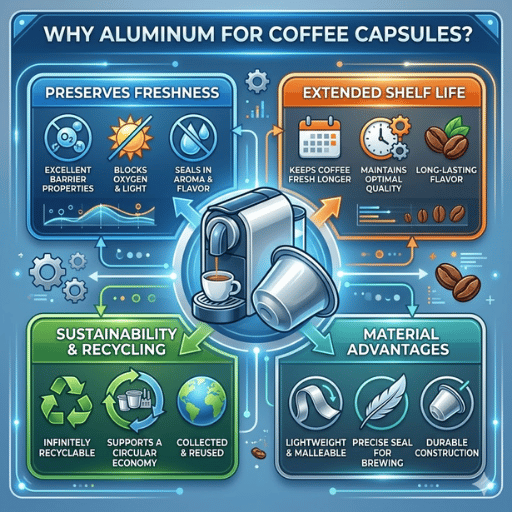
Aluminium, unlike plastic, provides an absolute barrier to light, oxygen and moisture, three potential causes of degradation of ground coffee after roasting. This is the key property that differentiates aluminium capsules from plastics and is the principal reason that all the main producers including Nespresso, manufacturing approximately 14 billion capsules a year, have selected it decades ago and not changed.

In a practical way this translates into aluminium having a shelf life of 9-12 months after sealing, vs 3-6 months for standard plastic capsules. Which is significant for any roaster or private label brand selling through retail outlets with uncertain shelf life. Aluminium is also suited to withstanding the temperature and pressure of espresso brewing (generally 90-95C at 9-19 bar) without distortion and imparting bitterness or other offn flavors into the drink.

Apart from the performance benefits, aluminium has a sustainability factor that will increasingly influence consumers’ buying decisions in the future. The International Aluminium Institute has indicated that some 75 per cent of all aluminium ever made is circulating today as the metal can be recycled endlessly with no degradation of its structure or barrier properties. For brands directly targeting these conscious consumers, that is an obvious selling point.

9–12 mo
Aluminium Shelf Life
100%
Light/O₂/Moisture Barrier
75%
All Alu Ever Produced Still in Use

Aluminium Alloy Specifications and Capsule Material Composition

Aluminium Alloy Specifications and Capsule Material Composition

However, not all aluminium alloys are appropriate for the can forming process. Industry standard alloys are 8011-O or 8079-O temper, which have the necessary formability (deep drawing without micro cracking) of the softer tempers to maintain hermeticity.

8011 vs 3003: Choosing the Right Alloy

For most nespresso capsule and holder formats the 8011 alloy with iron and silicon additions delivers the required high plasticity and corrosion resistance on purity of 99%. 8011 is the expected norm across the industry for most ali alu capsule ships. If the capsule or container shape is more complex, requiring multi-cavity, and must undergo elevated mechanical loads during transportation, a 3003 alloy with manganese additions will be required allowing for higher tensile strength and greater elongation.

財産 8011-O 3003-O
Primary Additives Fe + Si Mn (1.0–1.5%)
Tensile Strength 100–130 MPa 110–150 MPa
Elongation ≥12% ≥15%
Primary Use Standard capsule cups + lid foil Complex shapes, deep-drawn trays
Typical Thickness 0.07–0.12 mm (body), 0.03–0.04 mm (lid) 0.10–0.15 mm

For comparison, a typical Nespresso Original capsule has top outer diameter=37 mm, base diameter=24 mm, and height=29 mm with a wall thickness in the order of 110 m (0.11 mm) and an empty weight in the order of 1.0 g.

Interior Coating and Food Safety

Capsules are coated internally with an epoxy or BPA-non-intent (BPA-NI) lacquer barrier to prohibit direct contact between the aluminum surface and the roasted ground coffee bean or brewed product, with indications that the coating must meet compliance requirements of the Food and Drug Administration (FDA 21 CFR 175.300) 50 ppm overall migration of non-volatiles in coating to food and the European Union legislation (EC) No 1935/2004 overall migration should not exceed 10 mg/dm, with comply documentation supplied by contractors. This interpretation must be tested on each production run.

📐 エンジニアリングノート

Capsule wall thickness 0.07-0.12mm is maintained at a ± 0.02mm tolerance at the capsule rim to hold a hermetic seal while under hermetic heat-sealing pressure. Distribution of wall thickness at various stages during deep drawing is optimized so the capsule is able to sustain an extraction pressure of 9 to 19 bar without failure. Foil thickness of the capsule lid 0.03-0.04mm must be pierceable by the machine needle while still maintaining oxygen barrier properties.

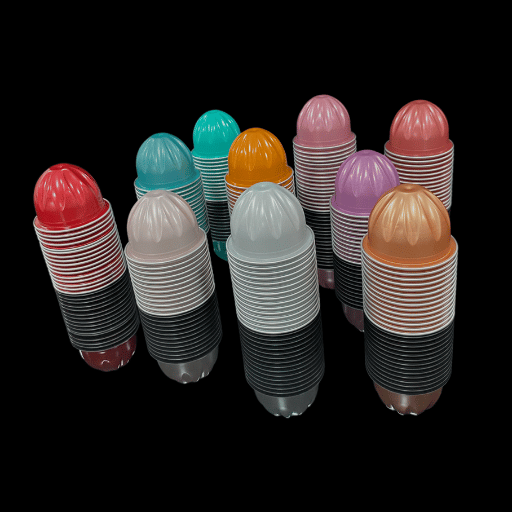
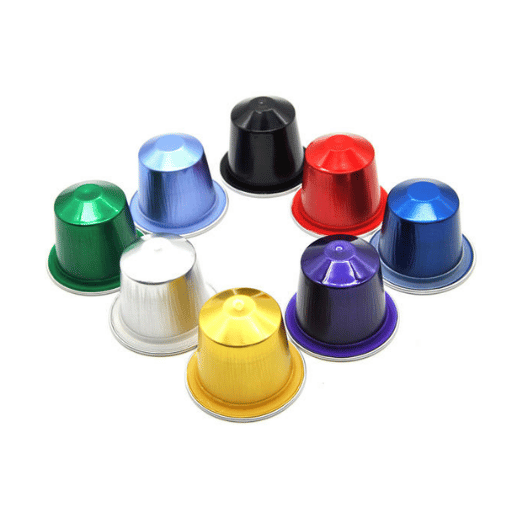
External design may be printed with bespoke branding using approved food-safe inks. Capsule surfaces can be anodized or lacquered across a range of colours, providing private label manufacturers the ability to personalize product branding without any additional tooling costs.

The Coffee Capsule Manufacturing Process: From Bean to Sealed Pod

The Coffee Capsule Manufacturing Process From Bean to Sealed Pod

Coffee capsule manufacturing follows a standard production chain, integrating capsule formation, coffee preparation, and automated filling and hermetic sealing into a continuous, uninterrupted sequence. All formats are processed in the same plant (Nespresso, K-Cup, Dolce Gusto, Lavazza compatible).

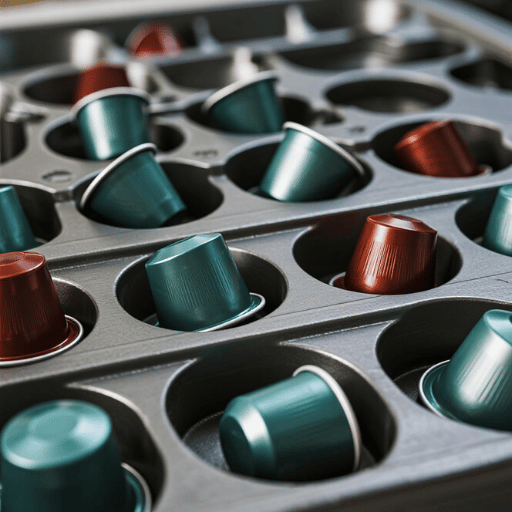
  1. Aluminium Sheet Stamping – Blank 8011-O aluminium coil is fed at high-speed (>600 up to 1,200 cycles/min) into a transfer press that prints and deep draws each capsule cup, holding rim tolerances to 0.02mm.
  2. Interior Lacquer Coating – Cup is coated with food-safe lacquer by a downstream coating station, which forms an oxygen barrier.
  3. Coffee Roasting and Milling – Beans are traditionally roasted to a medium-dark colour to increase solubility during extraction, then sent through an industrial 3-stage roller mill (breaking, intermediate grinding and ultra-fine final grinding) to produce consistent grain size for each capsule.
  4. Capsule Sanitizing – Papery, dimpled capsules are blown through with dust-free compressed air, then multiple capsules consecutively pass through an UV sterilizing chamber to fulfill food-grade hygiene standards.
  5. Auger Filler – Doser feeds in 5.5-7g of cold ground coffee from a single constant-level hopper to each capsule with ±0.2 grams level accuracy.
  6. Nitrogen flushing – between dosing and hermetic sealing stages, multiple ports of nitrogen injection inside the capsule displace residual oxygen to targeted levels of <2%, high purity lines reaching under 1% oxygen, with a shelf life of 9-12 months.
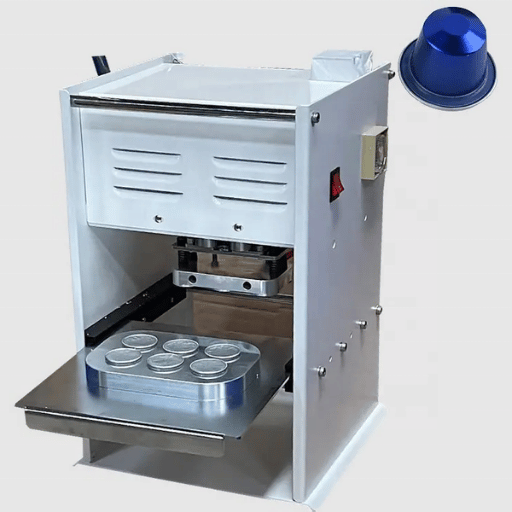
  7. Lid Cutting and hermetic sealing – lid foil is cut to size and hermetic seal heat applied to top of capsule, in turn preventing ingress of light, humidity and oxygen at the point of consumption.
  8. Quality control & Inspection – Sealed capsules are subject to inspection, with submersion-based measurement of residual OTR and C0 levels for adherence to seal integrity standards. Rejected capsules are discarded.
  9. 箱詰め & Palletizing – Final capsules are placed into cartons and palletized for shipment. A typical コーヒーカプセル生産ライン can take anywhere from 30 to 60 days from order to first shipment.
💡 ヒントの場合

The nitrogen flushing step is where many small roasters can lose shelf life. Automation with only a single nitrogen port at the sealing station achieve residual oxygen levels of 3 to 5 percent, while machines with multiple nitrogen ports from dosing station through to sealing inline have residual oxygen levels below 1 percent time and time again. When comparing コーヒーカプセルメーカー always ask for residual oxygen data not just the specification.

Coffee Capsule Filling and Sealing Machines: Types and Specifications

There are two main types of capsule filler and sealer – linear and rotary – the primary factor influencing your selection should be your monthly volume and growth plans.

仕様 Linear Machine Rotary Machine
スピード 50–100 capsules/min 100–300 capsules/min
Hourly Output 1,800–6,000 cph 6,000–24,000 cph
Lane / Station Count 1–4 lanes 6–12 stations
充填精度 ±0.2g ±0.2g
N₂ Flushing Ports 1–2 stations 3–5 stations (dosing → sealing)
に最適です Roasters <500K capsules/month Brands >500K capsules/month
Food-Contact Material 304ステンレス鋼 304ステンレス鋼
Format Compatibility Nespresso, K-Cup, Lavazza Nespresso, K-Cup, Dolce Gusto, Lavazza, custom

Both styles of machine utilise the same fundamental technology of auger filler dosing, nitrogen flushing and heat sealing. Where they differ is throughput and the manner in which the capsules are transported from station to station. Linear machines move capsules in lanes via a straight path while rotary use a rotating circular turret position capsules around the various station locations at high speeds and using less floor space – an innovation that has revolutionised production.

For forming of capsule cups (prior to filling), some manufacturers have moulded encapsulating presses integrated with filler and sealer designs. C-Series compact presses (45-80 ton, 1-5 cavity) are suitable for boutique roasters wanting to fill single origin capsules, while high volume presses (63-80 ton, up to 6 cavity) are suited to bulk scale producers. All provide the dimensional accuracy critical for proper compatibly with existing brewing equipment.

coffee capsule filler and sealer should be evaluated not only on maximum speed, but on minimum changeover times, feeding reliability and cleaning downtime.

How to Choose the Right Coffee Capsule Packaging Machine

How to Choose the Right Coffee Capsule Packaging Machine

Choosing a coffee capsule packaging machine is a capital investment which will define your production capacity, product mix and unit economics for years to come. When selecting a package machine avoid under capacity planning (as your volume grows you are forced to invest in multiple lines) or overlooking the importance of a well-made inert gas system – both are costly mistakes. This checklist highlights the seven critical areas to consider.


  • 生産量 — Calculate your current monthly capsule demand and project 2-year growth. If you expect to cross 500,000 capsules/month within 18 months, start with a rotary machine. Buying linear now and replacing it in two years doubles your capital outlay.

  • Capsule Format Compatibility — Confirm the machine handles your target format (Nespresso, K-Cup, Dolce Gusto, or custom). If you plan to offer multiple formats, prioritize machines with rapid mold changeover — some models switch formats in under 30 minutes, others require hours.

  • Material Handling — Aluminium, plastic, and compostable capsules each behave differently in feeding and sealing. A machine calibrated for aluminium may need adjustment for a compostable capsule filling machine workflow. Verify material compatibility before purchase.

  • Nitrogen Flushing Capability — Ask for residual oxygen data from actual production runs, not just brochure specs. Target below 2 percent for aluminium capsules, below 1 percent for premium lines.

  • 充填精度 — Confirm ±0.2 g accuracy. Inconsistent dosing leads to flavor variation that damages brand reputation more than any other quality issue.

  • 切り替え時間 — If you produce multiple SKUs (different blends, grind sizes, or capsule formats), changeover time directly impacts your effective daily output. Machines designed for quick changeover pay for themselves in reduced downtime.

  • After-Sales Support — Evaluate spare parts availability, response time for technical support, and whether the manufacturer offers on-site training. A machine that runs 20 percent faster but takes two weeks to get replacement parts is slower in practice.
⚠️ よくある間違い

Selecting on high speed alone. First, that is a short burst metric of the ability of a machine to run at its maximum speed under ideal circumstances. Second, because the machine’s real-world maximum throughput under production circumstances including capsule feeding, batch changeover, cleaning runs and quality assurance is typically between 15 and 25 percent below the overspec’d maximum capacity. When choosing a coffee capsule filler always seek depressed throughput data and ideally arrange for a reference site visit of a producer with comparable volume.

Aluminium vs Plastic Coffee Capsules: A Manufacturing Comparison

Aluminium vs Plastic Coffee Capsules A Manufacturing Comparison

Choosing between aluminium and plastic capsules impacts every facet of your supply chain – from the cost of raw materials to at home perceived value and end-of-life waste processing. While the material choice ultimately is often presented as an eco question, the manufacturing and performance differences to better inform production decisions are in many ways just as critical.

✔ Aluminium Advantages

  • 100% barrier against light, oxygen, moisture
  • 9–12 month shelf life (sealed)
  • Infinitely recyclable without quality loss
  • Premium brand perception among consumers
  • Withstands 90–95°C brewing without deformation

⚠ Aluminium Limitations

  • Higher per-unit material cost (~$0.03–0.05 vs $0.01–0.02 plastic)
  • Requires specialized forming presses
  • Thinner walls need careful handling in feeding systems
  • Recycling infrastructure still uneven across regions
寸法 Aluminium Plastic (PP/PBT)
酸素バリア 100% (inherent metal property) Partial (requires multi-layer or EVOH insert)
Shelf Life (sealed) 9–12 months 3~6ヶ月
Material Cost per Unit $0.03–0.05 $0.01–0.02
Recyclability Infinitely recyclable (no quality loss) Limited cycles, downcycling common
Brewing Temp Tolerance Stable at 90–95°C, 9–19 bar May deform above 90°C under pressure
Environmental Impact (end-of-life) Recyclable in standard aluminum stream 30,000+ capsules reach UK landfills monthly

Compostable capsule materials are a third alternative but still hampered by infrastructure restrictions. Commercial composting facilities that could handle capsules are not available in all geographies, cost per capsule exceeds that of aluminum and plastic, and barrier qualities are less than aluminium’s – resulting in a shorter shelf life. For most new entrants in capsule manufacturing, aluminium remains the default choice for its combination of performance and recyclability.

Sustainability and Recycling in Aluminium Capsule Production

Sustainability and Recycling in Aluminium Capsule Production

Aluminium can be recycled forever without losing barrier or mechanical characteristics-a benefit no plastic or compostable material can offer. As such, aluminium capsule production is arguably better suited for circular economy principles, although recycling infrastructure still needs to mature in many areas.

Nespresso, who is the largest aluminium capsule producer, has published granular sustainability data to track performance at an industry level. In Nespresso’s sustainability report, all Original capsules are now manufactured with 80 percent recycled aluminium, while 88 percent of their Vertuo capsules are manufactured with 85 percent recycled material- provided by Novelis through a dedicated recycled aluminium supply chain announced in 2020.

Global capsule recovery stood at 35 percent in 2024, and Nespresso has published a plan to reach 50 percent by 2025, and 60 percent by 2030. To achieve these goals, they have supported the installation of over 100 Eddy current separators in public collection centers around the world, dating back to 2009. 65 machines were added in France, after Nespresso proved the technology’s superior performance in test plants. Nespresso opened its capsule recycling program to other capsule companies in 2019—such industry-wide cooperation rather than competition is the only way to build a universal, global recycling infrastructure for the industry.

For private label producers and new market entrants, aluminium capsules reduce the sustainability objections consumers raise about single-serve coffee — particularly when sourced from post-consumer recycled aluminium, turning what could be an environmental liability into a positive brand story.

よくある質問

How Aluminium Coffee Capsules Are Made Materials, Machines, and the Full Manufacturing Process

Are Nespresso capsules made of aluminum?

回答を見る
Yes. All Nespresso Original capsules are manufactured from aluminium-3042 alloy, with a food-grade interior lacquer coating. They are 80 percent recycled material since 2020, supplied through a dedicated recycled aluminium supply chain announced in 2020. The larger capsule format Vertuo still contains 85 percent recycled aluminium. Both capsule lines are targeted for take-back through Nespresso’s dedicated recycling program operational in 71 countries worldwide.

Is it safe to drink coffee from aluminum pods?

回答を見る
Yes, provision as long as food-contact standards are maintained. Aluminium coffee capsules headed for commercial use receive an interior lacquer that prevents direct metal contact with coffee. The lacquer must comply with FDA 21 CFR 175.300 (50 ppm migration limit for non-volatiles) and EU Regulation (EC) No 1935/2004 (overall migration below 10 mg/dm). A peer-reviewed article in the Journal of Food Composition and Analysis (PMC 7331030) measured aluminum levels in coffee brewed from capsules and found all objects within acceptable limits. The interior coating must be proven to meet migration limits through lab testing before production.

How are coffee capsules manufactured and filled?

回答を見る
Capsule manufacture involves 9 steps: aluminium stamping, interior coat, coffee grind, capsule sterilisation, auger fill, nitrogen flush, lid seal, quality control and cartoning. The capsules and machine assembly is fully automated using production lines.

What is the difference between aluminium and plastic coffee capsules?

回答を見る
Barrier performance, shelf life, and recyclability are the main points of difference. Aluminium provides complete barrier to oxygen, light and moisture, resulting in a 9 to 12month sealed shelf life (vs 3 to 6 months for plastics). 100 percent recyclable without quality deterioration, aluminium capsules can be re-melted and back into use repeatedly, plastic capsules are downcycled or landfilled, with a monthly UK waste stream of over 30,000 plastic capsules. Cost is the obvious trade-off, with aluminium capsules costing an average of approx. $0.03-0.05 each versus approx. $0.01-0.02 for plastics.

How fast can a coffee capsule filling machine produce?

回答を見る
Line speeds vary according to machine design: linear fill and seal machines produce 50-100 per minute (1800-6000/hr), rotary machines up to 300 per minute (6000-24000/hr). Longer term average throughput is between 60 and 75 percent of rated maximum during an 8 hour shift, accounting for feeding, run up/down and changeover times.

Can aluminium coffee capsules be recycled?

回答を見る
Yes. Aluminium is infinitely recyclable, since it can be melted down as virgin grade without damage or degradation. As mention, Nespresso has launched capsule collection programs across 71 countries, with a global recovery rate of 35 percent in 2024, 60 percent targeted by 2030, from over 100 Eddy current separators that have been installed at public sorting stations in the last 15 years.

Interested in starting or expanding your aluminium coffee capsule manufacturing capacity?


Talk to AFPAK About Your Production Line →

Our Perspective on This Guide

This data is from AFPAK’s 14 years experience in manufacture of filling and packing equipment for the coffee capsule market, including linear and rotary format machinery for Nespresso, K-Cup and Dolce Gusto capsules. The properties referred to are reference specifications used during daily commissioning of production lines, from sourcing 8011-O foil through to nitrogen shell validation and automated fill weight recording.

参考文献 & 情報源

  1. Coffee Pods and Capsules Industry Forecast – Mordor Intelligence
  2. International Aluminium Recycling Data – International Aluminium Institute
  3. 21 CFR 175.300 – Resinous and Polymeric Coatings – U.S. Food and Drug Administration
  4. Regulation (EC) No 1935/2004 on Materials and Articles Intended to Come into Contact with Foodstuffs – European Parliament
  5. Coffee – Migration of Aluminium with Food – US NIH/NLM
  6. Capsule Recycling and Circular Economy – Nespresso Sustainability
  7. Supply and Recycling of Recycled Content Aluminium Packard – Novelis Inc.

関連記事

お問い合わせ

以下のフォームにご記入いただくか、メールで直接お問い合わせください お問い合わせ@afpak.co.

お問い合わせフォーム