anf717@gmail.com

アレナンフ

+86-1561 8866 167

859-813-2814 (米国/カナダのみ)


無料見積もりを入手

RTD Matcha Latte Packaging: Cans vs Bottles vs Cups (2026)

RTD matcha latte packaging is where a bright jade green idea lives to survive the

RTD matcha latte packaging is where a bright jade green idea lives to survive the shelf or dies on it. The fastest rising of all the currently available beverage launches, ready-to-drink (RTD) matcha doesn’t play the part of an ambient-friendly liquid the way it looks electric green in a sample cup. When you choose the wrong can, bottle, cup or dispenser cap, your matcha can brown, separate and abandon the specific caffeine+L-theanine “calm energy” you want to deliver long before the best by date.

In short, RTD matcha latte packaging involves solving two engineering hurdles at once: (1) oxidation, which fades color and flavour; and (2) sedimentation of insoluble matcha particles. Your chosen package, filling technology and fill process determine how well you overcome both, and together they set an ambient shelf life that runs roughly 6 to 18 months.

Key takeaways
  • Because oat or dairy RTD matcha latte drinks are low pH ( > 4.6) these aren’t candidates for hot fill; require UHT/Aseptic filling, heat processing (retort) or a cold chain for packaging.
  • Because the problem is light-generated fading, the most colourful RTD matcha latte outcomes are usually associated with opaque cans.
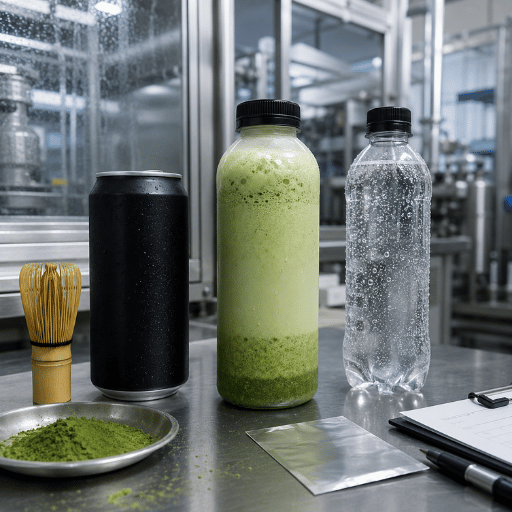
  • Because matcha is a 5 to 10 µm insoluble powder, it won’t stay suspended on its own and never truly dissolves, it has to be stabilized and homogenized or it settles.
  • With respect to format and 6-18 months average ambient shelf life ranges it’s important to know there’s a huge variation: hot fill, clear glass results in 6 months versus ambient a filled aluminium can/aseptic package will result in a 12-18 month shelf life range.
  • The “functional” antioxidant proposition offers the shortest period before colour and nutrient begins to decline because catechins degrade when they’re subjected to air, light, and heat over time.

Quick Specs: RTD Matcha Latte Formats

Typical fill dose ~1.5–2 g matcha per 250 mL (varies by target intensity)
Acid class line pH 4.6 — below = acidified (hot-fillable); above = low-acid (retort/aseptic/chill)
Color metric CIELAB L*a*b* (a* tracks green; b* tracks yellowing)
Shelf-life band ~6 months (glass hot-fill) to 12–18 months (aluminum can / aseptic)
Two hurdles Oxidation (color/flavor) + sedimentation (suspension)

This guide leans on green tea and general beverage science, because controlled data on finished RTD matcha latte products, milk and oat matrices especially, is scarce. Treat the figures below as engineering guidance to validate on your own formula, not as prescriptive values.

Why RTD Matcha Is Harder to Package Than Coffee or Soda

Why RTD Matcha Is Harder to Package Than Coffee or Soda

This type of drink is notoriously difficult to package than a soft drink or a coffee as it’s fighting on two fronts simultaneously. This is because a cola is already filtered, acidic, liquid whereas coffee is already in essence an extract (though with its own set of oxidative challenges). It’s not that there’s anything especially problematic with a beverage drink; it’s more that matcha, at the heart of a lot of current-day, functional beverage claims, requires much more challenging processes to keep it at its best – for example it’s a suspended whole leaf extract.

Every RTD matcha latte has two hurdles to clear. First, oxidation: the chlorophyll and catechins that give matcha its intense colour are especially prone to light, air and thermal degradation. According to a peer-reviewed review of matcha composition, that elevated chlorophyll content is exactly what makes matcha so vibrant, and so unstable. Second, because matcha doesn’t dissolve, you get sedimentation and a settling problem.

The Two-Hurdle Test for RTD Matcha

Do your packaging plan a favor: Before you spec any single component, score it by asking it: (1) Does my plan prevent oxygen and light permeation? And (2) Does it suspend insoluble matcha in formulation? The formats featured below-you’re sure to find your favorite-succeed on one question while stumbling on the other. Your goal is to identify the problem your formula suffers from, then select the format that help mitigate it, not simply the packaging with the cutest cap.

Served hot or iced, an RTD matcha latte is sold as a functional drink, a calmer alternative to coffee and energy drinks, built on caffeine plus L-theanine rather than a sugar rush. That’s why a premium, ceremonial-grade matcha powder you whisk at home can still end up a disappointing canned drink. brew cycles, fill temperatures, headspace oxygen all bombard that powder while it’s still in its package before you even open it. Flub the packing system, and you ship a costlier brown tea.

Cans, Bottles, Cups, and Caps: The 8-Factor RTD Matcha Packaging Scorecard

Cans, Bottles, Cups, and Caps: The 8-Factor RTD Matcha Packaging Scorecard

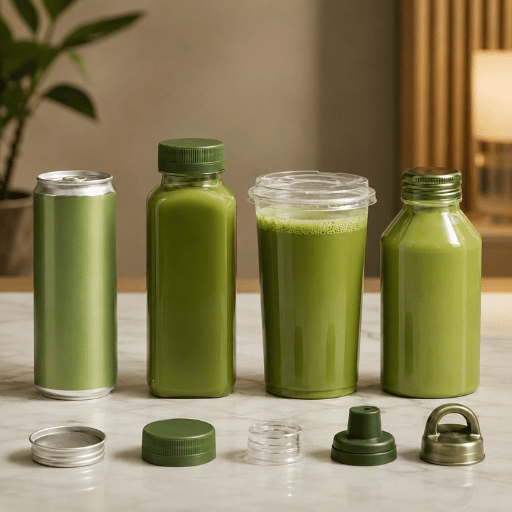
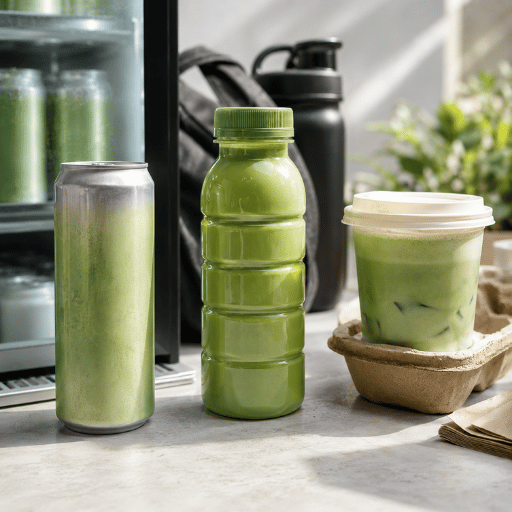
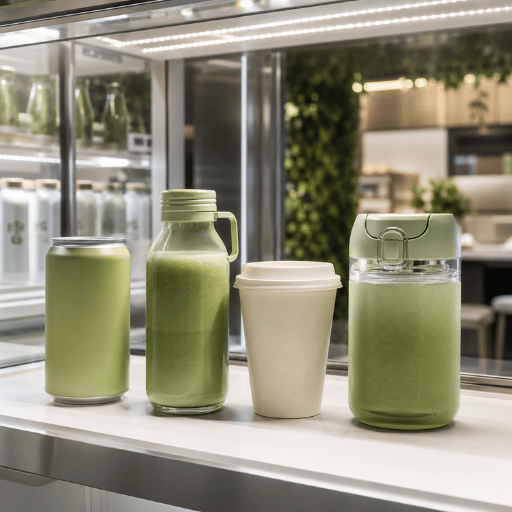
RTD’s Top Four matcha latte: aluminum cans, PET or glass bottles, pre-molded cups, and ‘fresh-mix’ powder-in-cap closures – all split cleanly when you make your score at what it really counts: light, oxygen, how they “act up in suspension,” what it will fill with, and how long it’ll last in the cupboard. So below is the decision tool none of the consumer mags ever create.

8-Factor RTD Matcha Packaging Scorecard, by container category — why aluminum cans win on color but cups and caps win on flexibility.
要素 Aluminum can PET bottle Glass bottle Cup / dispenser cap
Light barrier Total (opaque) Poor (clear) Poor if clear; good if amber Varies; cap keeps powder dark
O₂ barrier (wall) Effectively zero ingress Low–moderate (plain PET lets some O₂ through) Very low (good barrier) Cup film varies; powder stays dry
Suspension help None (needs stabilizer) None (needs stabilizer) None (needs stabilizer) Caps sidestep it (mix at use)
Fill fit Hot-fill (acidified), aseptic, N₂ flush Hot-fill, aseptic, cold-fill Hot-fill, retort Cold/clean fill of liquid; dry dose in cap
Typical size 200–355 mL single-serve 250 mL–1.4 L 250–330 mL premium Single-serve
Ambient shelf life 12–18 months 6–12 months ~6 months (hot-fill) Long (dry powder) + short once mixed
Capex tier Mid–high (seamer + N₂) Mid High (heavier line) Low–mid (cup/cap former-filler)
Best for Ambient mass retail, color retention Multi-serve, oat/almond lattes Premium chilled, shelf appeal Freshness purists, foodservice, on-the-go

Oxygen barrier ranking from packaging oxygen-transmission engineering data (plain PET: low-to-moderate barrier; aluminum and glass: high barriers); Shelf-Life Bands- These are generally derived from accepted ranges. These range of shelf lives can vary for formulation and are best validated with shelf-life studies.

Think of the scorecard as a landscape of compromises, not a horse race. The can win for protection, but can’t do a lick for the suspension and commands a single-serve shape. Dispenser cap wins as it can dodge sedimentation, oxidation both – by separating the matcha to the point of use – but it’s a more complicated cap to assemble and “it’s up to you to mix.” Everything else lies some where on the curve in between.

Oxidation and Color: The Jade-to-Khaki Window

Oxidation and Color: The Jade-to-Khaki Window

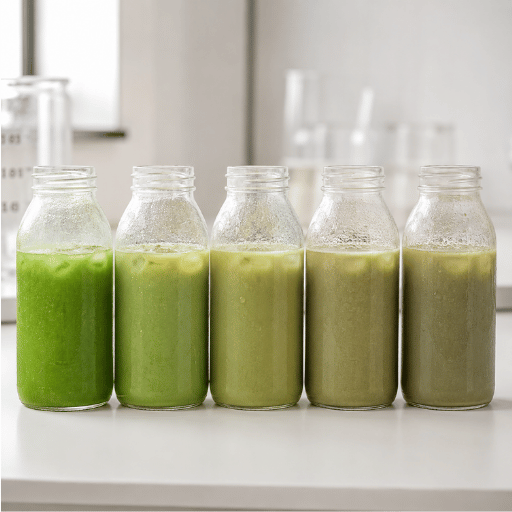
Matcha loses its colour because the same compounds that turn it green, chlorophyll and catechins, start reacting with oxygen, light and heat the instant water mix with the powder. Peer-reviewed work on green tea confirms that catechin degradation shows up as a visible color shift, moving a solution from clear toward brown; in a matcha latte that reads as jade fading to khaki.

Will matcha lose its color after pasteurization, UHT, or hot-fill?

Yes-heat is one of the biggest accelerators, and the hotter the temperature or the longer you process it the more green you swap away. A study of catechin degradation kinetics in green tea powder found temperature to be the dominant factor, even more so than humidity. In a liquid the effect is matrix-specific rather than universal: catechins can stay relatively stable in plain cool water, yet the majority can be lost within weeks once you add light, oxygen, heat and an oat or milk base, as degradation studies of EGCG in tea solutions show, a detail that matter commercially – as the “high-antioxidant” statement on the front of a can is only as valid the day you fill the can and depreciates thereafter.

📐 エンジニアリングノート

Measure color with CIELAB L*a*b*, not photos. Negative a* will become stronger green, a rising b* indicates browning. Collect measurements for raw powder, fresh mix, post heat and periodically over shelf life. Set maximum acceptable delta E for release. The number one thing you can control to maximize shelf stability is dissolved oxygen. Eliminate DO in liquid stream prior to fill head and headspace during the packaging event using a nitrogen purge before sealing.

This is the make or break of package format. Opaque aluminum may appear perfectly inert because it entirely blocks incoming light and doesn’t permit oxygen diffusion in any significant amount through the wall, but there are additional sources of ingress. As beverage oxygen-control guidance makes clear, oxygen ingress happens at several points in the process, dissolved in the liquid before fill, in the headspace at the filler, and during the capping or seaming step. That’s why nitrogen protection during filling and sealing does as much for matcha stability in an aluminum can as the packaging material itself.

Sedimentation and Suspension: Keeping Matcha From Settling

Sedimentation and Suspension: Keeping Matcha From Settling

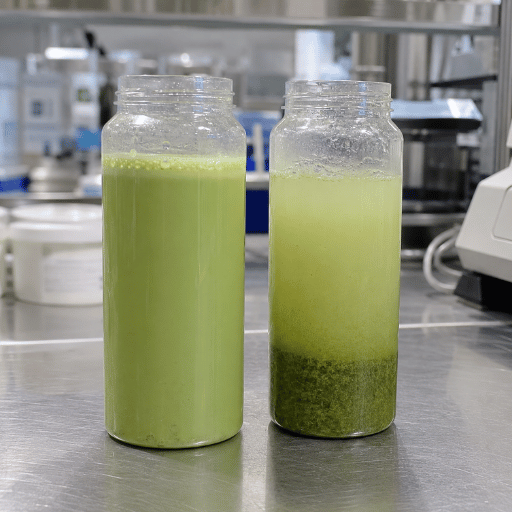
Matcha is what settles when suspended not dissolved, similar to how coffee precipitates in the bottom of your coffee mug if left to sit on the counter for long periods of time. Matcha is a suspension of very fine particles in water, fine-milled ceremonial grades sit on the order of 5–10 μm, coarser culinary grades run larger, and they simply fall to the bottom of the package unless the system is actively managed to hold them up. There’s no such thing as a “soluble matcha” for use in beverages; the solution isn’t to find one but to manage the suspension.

Does matcha fully dissolve in a canned drink?

No. As stated above matcha isn’t a soluble powder but an insoluble whole tea leaf powder that behaves as a suspension in both water and milk or plant based systems, necessitating the use of suspension ingredients or a homogenization process to keep the particulate matter from settling. Some patented RTD tea formulations use cellulose microfibrils to suspend tea solids in a ready-to-drink matcha latte、 と gellan gum has documented use in matcha-containing beverages. Clean-label formulators often reach instead for sunflower lecithin or acacia gum, then run the batch through high-shear mixing or homogenization.

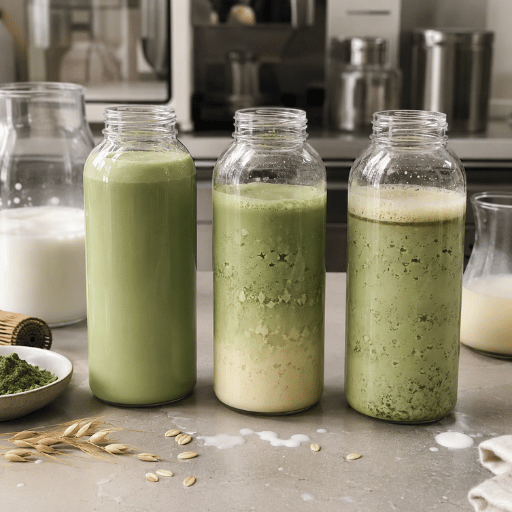
From people that have attempted to launched this type of product, the most common visual failures are a ring in the neck of the bottle, sediment at the bottom of the container and separation within plant based systems, especially milk. The countermeasures are equally concrete: tighten the particle size, dose the stabilizer to your specific base, keep the tank agitated during the fill so the last unit matches the first, and remember that an opaque can hides minor sediment that a clear bottle would put on display.

Dairy and Oat-Milk Bases: The Curdling and Separation Problem

Dairy and Oat-Milk Bases: The Curdling and Separation Problem

However, what this is about is one of the more insidious effects of changing a matcha tea to a matcha latte is to also introduce a base system – like a milk, plant-based milk or dairy free coffee – with inherent stability issues. The industry’s premier ready-to-drink matcha lattes will favor plant-based milks, including oat and almond milks as consumer demand pushes plant-based products to their forefront; unfortunately plant-based protein also contains inherent instability when challenged with heat and pH change.

“White flakes in an iced matcha latte are curdling, the milk reacted with something acidic. It’s safe, it just looks wrong.”

Consumer report paraphrased from a food-safety community thread

That basic observation is, in itself, the engineering sweet spot (trap). Acidify a transparent matcha tea to hot-fill levels – no problem, safe too. Do that to a milky latte, and you’ll curdle the protein; the very acidification that makes a tea shelf-safe under the 21 CFR acidified-foods rules kills a latte. Plant-based alternatives are stabilised with lecithin or gellan and adapted to gentler filling; many oat and almond matcha lattes are sold in opaque or multi-format packaging, simply because the same reasoning apply. These aren’t independent design decisions -base, format, and fill -choose one and you’re mostly choosing the others.

Hot-Fill, Cold-Fill, Aseptic, or HPP? The Hot-Fill Color Penalty

Hot-Fill, Cold-Fill, Aseptic, or HPP? The Hot-Fill Color Penalty

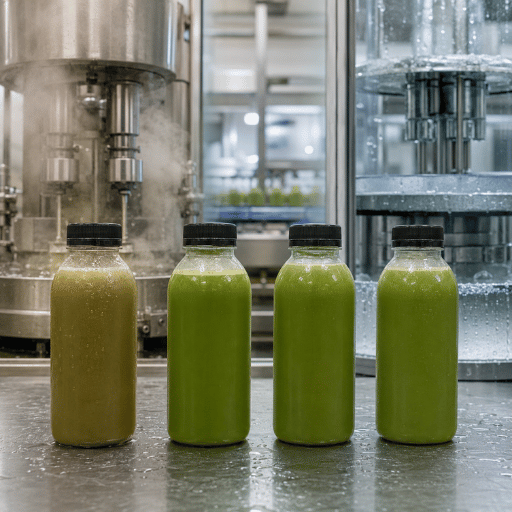
Selecting the fill process RTD matcha implies a trade between color and taste and the long-term stability-a trade to be made as regulated by food-law rather than customer preference. Under both the U.S. 21 CFR acidified-foods rulesFDA low-acid canned food (LACF) guidance, any non-alcoholic drink with a finished equilibrium pH above 4.6 and water activity above 0.85 is low-acid, which forces a full thermal process (retort, about 121 °C), a UHT/aseptic system, or refrigeration below 4 °C.

Fill-process routing for RTD matcha latte — the hot-fill color penalty buys ambient shelf life.
Process Heat load Color/flavor cost Distribution Fits matcha when…
Cold-fill + preservative Lowest Lowest Ambient/chilled Acidified clear tea; label tolerates preservatives
Hot-fill (~85 °C+) 高い Notable (the penalty) Ambient ~6 months Acidified (pH < 4.6) clear matcha tea
UHT / aseptic High but brief 適度 Ambient 12–18 months Low-acid milky latte; can or aseptic carton
HPP (high-pressure) None (cold) Lowest — best color Chilled 30–45 days Premium fresh matcha; cold chain available
Retort 最高 最高 Ambient, long Low-acid, color is secondary

Heat to shelf life numbers taken from beverage formulation reference and acid definition per FDA / 21CFR .

Worked example. So you’re making a sweetened oat-milk matcha latte chilled for sale. you want the green to be as bright as can be. Oat base has put you pH4.6 so you can’t use cold-fill/hot-fill-for-ambient and still be truly latte, that takes you to low-acid. So, the bright colour path is HPP (in the order of 600MPa, at cold temperatures), into cold-filled cup or bottle, accept the shelf-life limitation of 30-45 days with 4C cold-chain to follow the package from warehouse to counter. Alternative: ambient-filling; then, HPP goes out, it’s onto UHT into an aluminium can (with N2 flush) where you compromise a bit of the green to gain shelf-life of 12-18 months, and cease to convince yourself that hot-fill is going to work, for that same drink.

⚠️ A second compliance layer most brands miss

What about regulatory-other than process safety (21 CFR 113/114)? Are your food-contact components “authorized”? Your can liner, PET and rPET resin, cup films, colorants, closure, and even coating are all food-contact substances with their own migration and authorization criteria. Before locking up a format, check your component supplier for the Food Contact Notification (FCN) information, especially for acidic or fatty milk or oat applications where they’ll migrate in to your format.

Dispenser Caps and Fresh-Mix Formats: Engineering Around the Problem

Dispenser Caps and Fresh-Mix Formats: Engineering Around the Problem

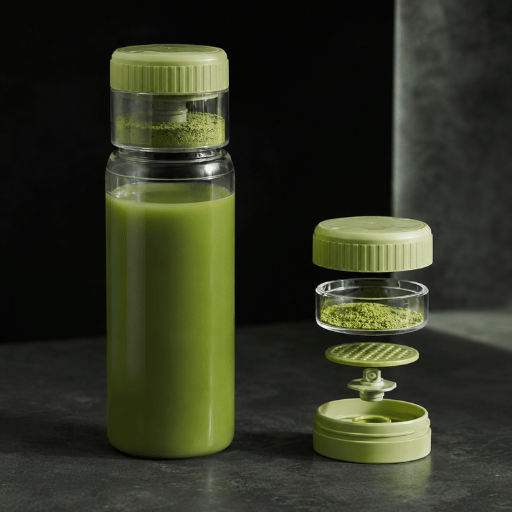
These can be the best route if you prioritize oxidation and sedimentation, because they bypass both by allowing matcha to reside as a dry powder until the instant of drink. Whether a push or a twist-off device, such a dispenser hold a precisely portioned dose of dry matcha above the liquid base (water or a plant-based milk), and the two don’t combine until you open the container. The notion work similar to how the nitro cold brew widget is applied, engineer it into the package and make it do for the freshest not a settled substance – a cool, dark, completely dry contained space to stop any oxidization in storage.

The honest caveat is this is mostly still a vendor- and patent-driven category and that there isn’t much independent, peer-reviewed validation for matcha alone — judge suppliers on dosing accuracy and seal integrity, not marketing. The engineering for an effective matcha dispenser cap is the same as what makes any single-serve format approach credible: dosing accuracy. Because matcha is dosed by tight weight rather than volume, your filling system has to place the same gram weight into each package every cycle, the kind of high-accuracy dosing built into custom filling and capping machines. If your fresh-mix matcha concept relies on the cap, get specs on your equipment’s dosing tolerances.

Which RTD Matcha Packaging Should You Choose?

Which RTD Matcha Packaging Should You Choose?

Select the format based on your primary binding constraint – start with distribution, follow with desired colour, and finish with budget constraints. This matrix turn the engineering behind packaging into a choice co-packers will understand:

If-then format selector for an RTD matcha latte.
If your priority is… Choose Because
Ambient mass retail + green retention Aluminum can, UHT/aseptic, N₂ flush Total light block + 12–18 mo + low headspace O₂
Premium chilled, brightest color Cup or bottle, HPP, cold chain No heat penalty; best L*a*b* retention
Clear acidified matcha tea, ambient, low capex PET/glass, hot-fill pH < 4.6 allows hot-fill; accept color penalty
Freshness purists / foodservice Dispenser cap / fresh-mix cup Powder stays dry — no oxidation or sediment in storage
Multi-serve oat/almond latte PET bottle (amber/opaque), aseptic Low-acid safe path + family format

Note that “best matcha for drinking” isn’t on the matrix. You’ll care about its flavour profile (grade/origin) but other packaging decision factors come first: its acid class under FDA low-acid rules, where you intend to keep it cold, and how much green colour you’re willing to sacrifice. Your most-delicious matcha still turns brown in the wrong package.

Producing and Filling RTD Matcha at Scale

Producing and Filling RTD Matcha at Scale

The actual matcha-manufacture part is simple: you can either build your own matcha line and take control of everything, or turn it over to a co-packer for white-label or private-label matcha drink production. You can test and be in the market quicker with an outside partner while distributing the capital investment, but will line up with other brand producers, surrender some control over the formula, and won’t control the fate of your often-delicate product. If your brand values control, scale for margin, and flexibility at scale, an internal line may make sense – but requires substantial initial capital outlay. The same logic scales from a single premium matcha beverage to a broader, scalable RTD product line, where consistent packaging design and matcha-supplier control are what keep every batch on-brand.

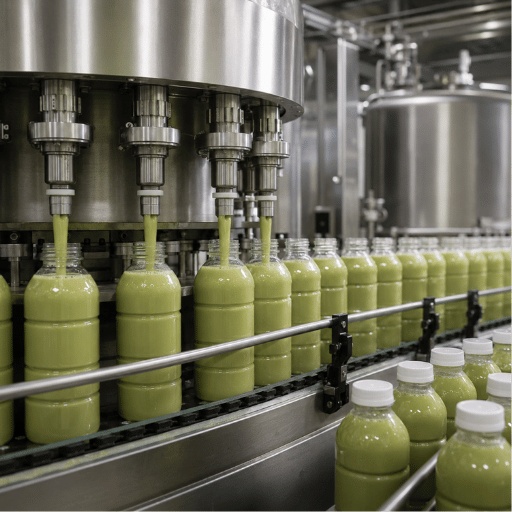
However, regardless of your approach to ownership/contract manufacturing, the required equipment for matcha manufacture remains largely the same. Two basic hurdles need clearing: you’ll need accurate, weight-based dosing equipment because matcha is filled on grams, not volume. Nitrogen filling also needed to remove head-space oxygen and prevent browning is also a necessity, followed by a filler matched to your format, whether that’s a liquid can filling machine for canned matcha drinks, a cup filling and sealing machine, or a cup forming-filling-sealing line.

📐 Engineering Note — equipment checklist

Four numbers you absolutely must cover when briefed the equipment-builder on your matcha concept before anything else: matcha dose accuracy requirements (target close to 0.1g), a filler with integrated nitrogen injection, an output rate that matches your anticipated batch sizes, and a reasonable level of change-over flexibility in order to run more than one matcha type on the line. AFPAK builds can and cup filling lines around exactly these principles, high-accuracy dosing, nitrogen protection and adaptable single- and multi-format systems, and can also fill milk-powder latte bases on its Dolce Gusto-style milk-powder filling equipment for dry-latte concepts.

Two related AFPAK guides go deeper on the freshness side: how nitrogen and barrier choices extend shelf life, and the broader cans and cup packaging solutions range for beverage producers.

Where RTD Matcha Packaging Is Heading

Where RTD Matcha Packaging Is Heading

The format decision is getting more consequential, not less, for two reasons that have little to do with headline market size. First, a real matcha supply crunch arrived in 2025, Japanese matcha and ceremonial-grade shortages and price hikes rippled across the category and into the wider coffee industry as health-conscious, grab-and-go drinkers crossed over. That means every gram lost to oxidation in your can costs more, so grade, dosing and format discipline now have a real commercial payback — and because most milky lattes fall under FDA low-acid canned food rules, the shift is pushing brands toward aseptic cans and cartons rather than hot-fill bottles. Second, demand is moving decisively toward single-serve, on-the-go formats, cans and cups over multi-serve bottles, mirroring the same Millennial and Gen Z behavior that already made canned RTD cold brew coffee the dominant way younger consumers drink coffee, and is now the clear trajectory for matcha.

Just to give context market trackers view the overall matcha space as on high single digit growth trajectory into the early part of 2030s, but that’s considered just noise – the tactical signal into 2026 for a launch is this: If selecting equipment this year, skew toward single-serve can and cup lines equipped with nitrogen protection, for there lies both the where demand is headed and the economics of cost-of-waste. The winners in the brand will be those which preserve an ever more preciously guarded ingredient rather than those with the glossiest lid. As the category broadens from unsweetened matcha to sweetened, hot-and-cold and other RTD formats, the brands that treat a high-quality, powdered matcha as a shelf-stable wellness asset – not just a flavour – are the ones whose RTD matcha beverage keeps its promise from the fill line to the shelf.

よくある質問

Q: What is the best matcha grade for RTD beverages?

回答を見る
To maximize flavor impact in ready-to-drink production, there’s generally no question whether culinary or dedicated beverage-grade matcha is a better bet than ceremonial. ceremonial matcha is grown and treated to whisk nicely at mild temperatures, while a filling line’s brew cycle, heat and oxygen expose those characteristics to degradation. In essence, you pay a high premium for a refinement that the filling and packaging process obliterates. Select matcha grade on its merits in a particular matrix and process, not on the reputation of the label.

Q: How do you stop matcha from separating in a can or bottle?

回答を見る
matcha you can’t break down, you can only stabilize. Couple with a smaller particle size and a hydrocolloid like gellan, cellulose or acacia gum and homogenise to get even dispersion and agitate your batch throughout your fill and they will come out the same from 1 to end to last. Opaque also has an advantage in disguising any tiny sediment you might have otherwise seen in clear.

Q: Does hot-fill or pasteurization ruin matcha’s green color?

回答を見る
Heat does not degrade color immediately but drives it away and more heat/time comes with more green-stuff price (the “hot fill color penalty”). For the catechins/chlorophyll, temperature is far more of a deciding factor and a short hot UHT burst near 135C would be less severe on color than holding hot fill near 85C for an extended time, even more so than ~600MPa cold HPP. If color is of utmost important to you, take it as cold as your acid class and channels permit.

Q: How long can an RTD matcha latte last on the shelf?

回答を見る
Depends on your format, and your own proven shelf life testing but roughly on bands run around 6 months for glass hot-fill, 12-18 months for aluminum can or aseptic carton, and ~ 30-45 days for an HPP refrigerated product. Far the fill process determines the band more than any preservative – always test directly.

Q: Can a small brand start with cups or cans instead of bottles?

回答を見る
Yes, and it’s often the simpler path to market. Cups and dispenser caps typically command a lower capital expenditure and suit the foodservice and DTC channels, allowing a new developer to validate their matcha formula prior to investing in the massive tool-making costs for canning or bottle fillers. A single-cup filling/packaging machine or a compact nitrogen-inert gas enhanced canning system can demonstrate a product quickly at a small scale, then be scaled into a viable product as sales grow. Exact specifications are paramount for both dosing and filler method – ensuring consistency batch after batch. A tight specification for acid, base, dosing, fill-process and format is critical for a contract packager to maintain the premium standard of any matcha drink product. Many RTD matcha developers also start with a chilled, convenient format and only then grow into a higher-volume aseptic format as volume warrants a bigger capital outlay.

Q: Are dispenser-cap fresh-mix matcha drinks worth the extra cost?

回答を見る
When freshness or a powder-pure claim is central to the brand, keeping the matcha dry until use makes sense, because it removes oxidation and sedimentation in storage in one move. The trade is a pricier closure and a mix-it-yourself experience.

Q: What’s the difference between matcha for drinking and matcha for RTD?

回答を見る
A delicious matcha is assessed on its taste profile and its visual aesthetic post drink preparation, where RTD matcha must demonstrate efficacy both through processing (such as dispersion and heat treatment)and via its long shelf life. Our RTD programs will emphasize processing requirements and shelf-life rather than merely on how the matcha taste prior to beverage preparation.

Planning an RTD matcha latte? Spec the line, not just the recipe.

Let’s know the fill format and required fill capacity, your base material and its desired shelf life, and the number of units you’d expect to produce on the fill line, and our engineering staff will present the best can and or cup fill machine solution. We offer precise dosing and robust nitrogen protection to accommodate your matcha product.

Get a filling-line recommendation →

Why We Wrote This

AFPAK has built coffee-capsule, can, and cup filling and sealing machines since 2010, with more than 900 lines delivered across 80+ countries and a standing focus on dosing accuracy and nitrogen protection. We wrote this guide because most “matcha packaging” advice stops at color swatches, the harder questions of low-acid fill law, oxygen control, and suspension are where real RTD launches succeed or stall. Reviewed by the AFPAK technical team.

参考文献 & 情報源

  1. Acidified & Low-Acid Canned Foods GuidanceU.S. Food & 医薬品管理
  2. 21 CFR Part 114, Acidified FoodsElectronic Code of Federal Regulations
  3. Acidified and Low-Acid Food Regulatory RequirementsPenn State Extension
  4. Health Benefits and Chemical Composition of Matcha Green TeaPMC / National Library of Medicine
  5. Degradation Kinetics of Catechins in Green Tea PowderPubMed / National Library of Medicine
  6. Green Tea: Current Knowledge and IssuesFoods (MDPI), peer-reviewed
  7. Oxidation and Degradation of EGCG/GCG in Tea SolutionsFood Chemistry (ScienceDirect)
  8. Oxygen Transmission Rate, OverviewScienceDirect Topics
  9. US9999235B2, Ready-to-Drink Tea Beverage Comprising Cellulose MicrofibrilsUSPTO via Google Patents
  10. CN1233154A, New Application of Natural Gellan GumGoogle Patents
  11. How Processing and Growing Affect Tea Compounds and FlavorKnowable Magazine

お問い合わせ

以下のフォームにご記入いただくか、メールで直接お問い合わせください お問い合わせ@afpak.co.

お問い合わせフォーム