
Especificações rápidas
| Preço de varejo da Linha Original | $0,70–$1,10 por cápsula |
| Preço de varejo Vertuo | $1,00–$1,50 por cápsula |
| Piso de matéria-prima (Linha Original) | ≈$0,05–$0,06 por cápsula (casca + tampa + café verde, antes da conversão/torra/mão de obra) |
| Dose café | 5 ·g (Original) · 712,5g (Vertuo, por copo) |
| Gama de máquinas AFPAK Nespresso-formato | 300+ cápsulas/min em 7 modelos |
O custo dos pods Nespresso é uma pergunta em duas partes: o preço do adesivo de varejo que você paga na finalização da compra e o custo de fabricação e a margem muito menos visíveis por trás dele. Custo dos pods Nespresso $0,70 a $1,10 por pod para Linha Original e $1.00 a $1.50 para Vertuo no varejo em 2026, de acordo com preços reconciliados de 2026 nas próprias páginas de pedidos da Nespresso e vários guias de compra independentes A maioria dos artigos fica por aqui A falta de quase todos eles é o outro lado do livro-razão, a parte que importa tanto para quem prepara café em casa quanto para o proprietário de uma marca: o que uma cápsula Nespresso realmente custa para fazer, o que uma máquina de envase acrescenta a esse custo em qualquer máquina Nespresso que acabe no balcão e o que sobra quando a marcação do varejo for reduzida à economia no nível dos componentes.
No entanto você usa Nespresso dia a dia, AFPAK constrói as máquinas que enchem e selam cápsulas compatíveis com Nespresso, então esta divisão funciona do lado de fabricação para fora, preços reais de entrada de commodities, níveis reais de taxa de transferência de máquinas e um cálculo de margem que você pode executar contra seus próprios números, não a cópia de marketing de outra pessoa.
- O preço de varejo do pod é de 10-20 x o piso de matéria-prima - a diferença é conversão, amortização da máquina, mão-de-obra e (para Vertuo) um sistema fechado real e patenteado, não apenas upcharge baseado em marca.
- A diferença de preço de Vertuo versus Linha Original é o produto de uma extensa história jurídica de incompatibilidades forçadas e economia de bens vinculados, não de seleção superior de feijão.
- As cápsulas compostáveis não são necessariamente mais baratas ou mais sustentáveis quando você contabiliza o acesso às instalações de compostagem dos EUA e a inerente reciclabilidade superior de longo prazo do alumínio.
O que os pods Nespresso realmente custam na loja (2026)
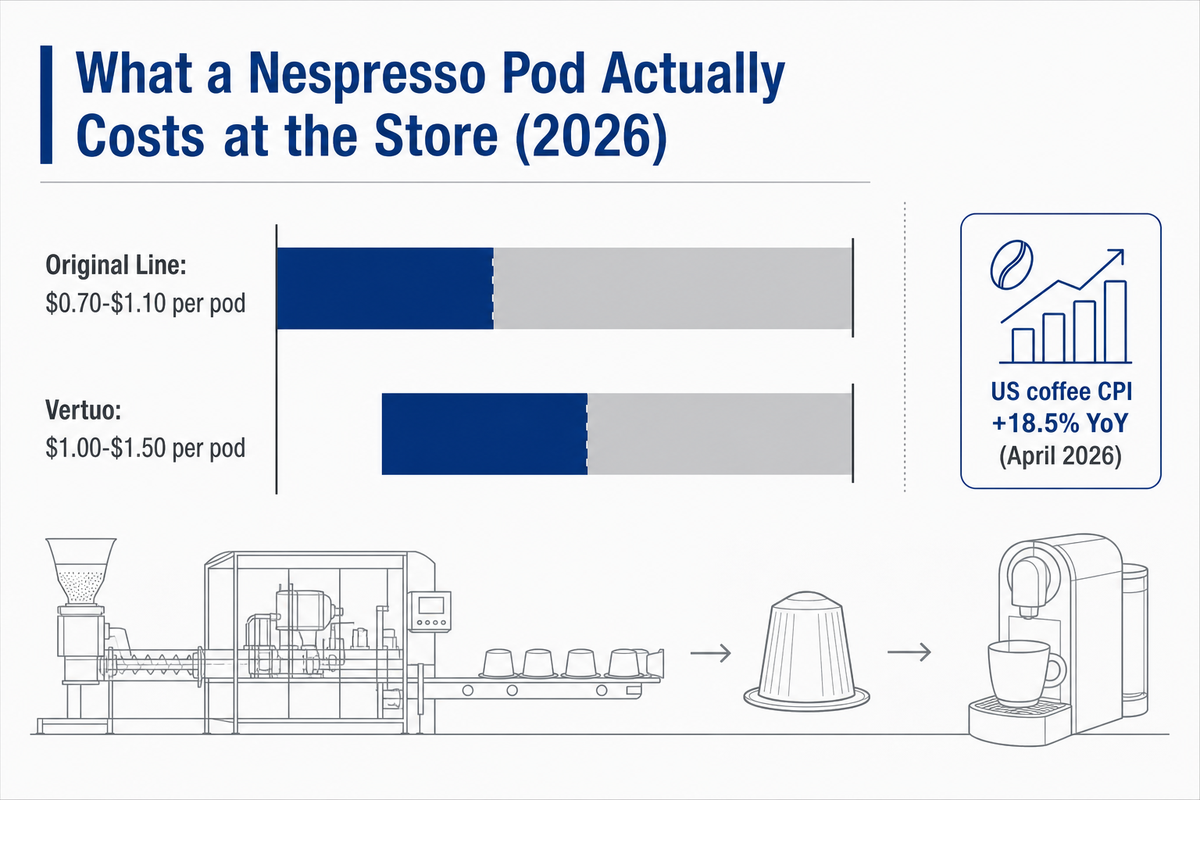
Em 2026, um pod Original Line - seja café expresso, ristretto ou lungo - será vendido entre $0.70 e $1.10, com pacotes de dez vendidos no varejo entre $7 e $11. Essa cápsula do mesmo tamanho no Vertuo funciona de $1.00 a $1.50, refletindo seu tamanho de dosagem maior e prêmio de sistema fechado Esses números não são difíceis: a Nespresso aumentou os preços nos EUA duas vezes em 2025, 2 a 15 centavos por cápsula em janeiro e um valor não anunciado em junho, ambas as vezes citando altos custos de café e envio.
Nenhum desses fatores é exclusivo da Nespresso Por exemplo, o café torrado moído no varejo atingiu $9,72 por libra nos EUA em abril, e até mesmo o próprio governo Índice de Preços ao Consumidor para o café foi até 18.5% ano a ano durante esse mesmo período Um estudo amplamente citado de 2007 do Departamento de Agricultura dos EUA sobre o repasse de preços sugere um aumento de 10 centavos no custo de uma libra de grãos de café verde se traduz em apenas um aumento de dois centavos no varejo e no nível do fabricante no mesmo trimestre - aproximadamente uma taxa de repasse de 20% - e é por isso que as oscilações em uma commodity nem sempre traduzem dólar por dólar no registro.
As cápsulas de café são mais caras do que a alternativa? por uma grande quantidade, sim: o hábito médio de Nespresso soma entre $50 e $80 por libra equivalente, já que cada Cápsula de café contém cerca de 5-6 gramas de café, em comparação com a média de $9 a $22 por libra custo para uma libra de varejo de feijão integral, café gotejante ou café pré-moído fabricado como café de filtro em casa Essa troca, e se uma Cápsula de café pode ter um sabor tão aromático quanto o café especial fresco, é frequentemente debatida em fóruns de entusiastas do café como Home-Barista.com, e é o assunto preciso da próxima seção (que não é apenas um prêmio de conveniência em cápsulas de café expresso.
Por que Vertuo custa mais do que a linha original (a verdadeira razão)
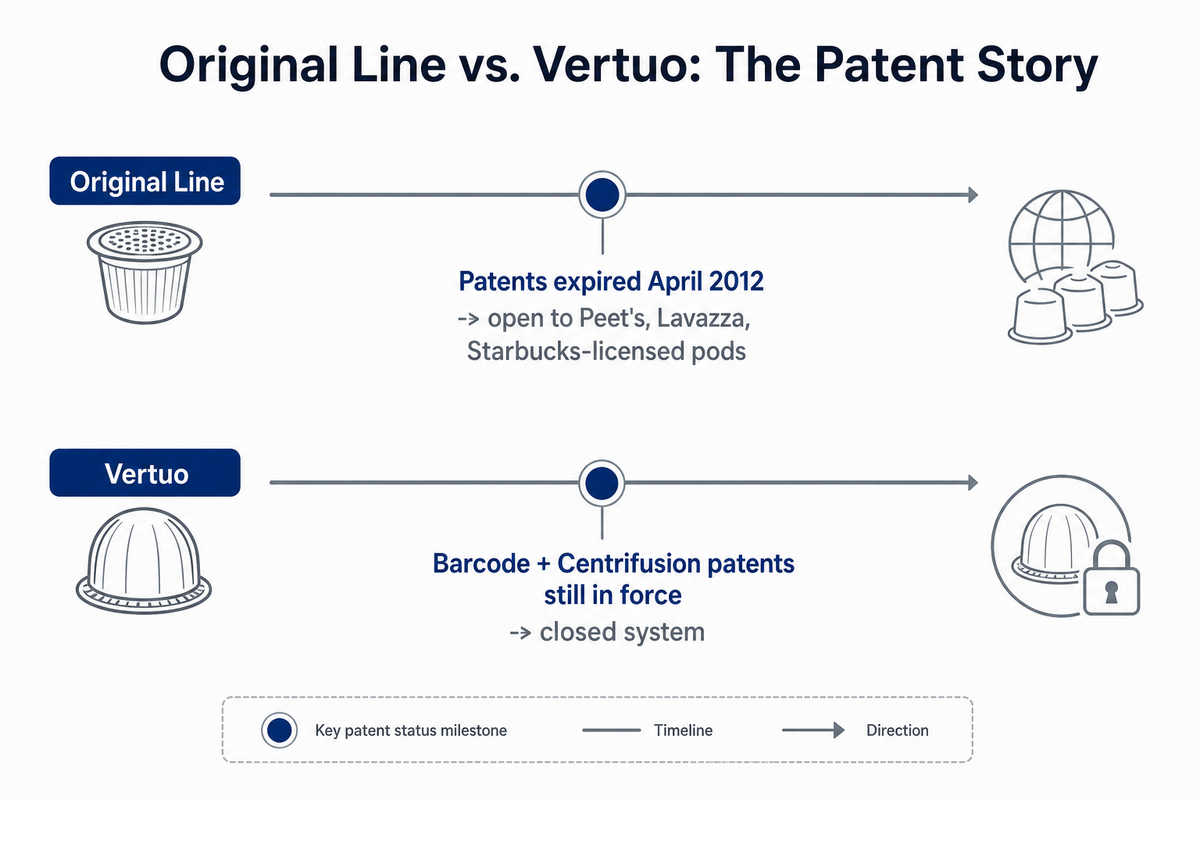
A razão para o aumento do prêmio da Vertuo sobre a Linha Original é uma questão de proteção de patentes e litígios relacionados, não de qualidade de feijão Cada cápsula Vertuo apresenta um código de barras cinco vezes repetido impresso no aro, que um sensor óptico lê para regular a taxa de rotação da cápsula (até 7.000 rpm para a fabricação patenteada de cerveja Centrifusion da Nespresso), temperatura de extração e volume.
As cápsulas da Linha Original não apresentam um código de barras, e suas patentes originais da era s de 1990 expiraram em abril de 2012 - a data que abriu as comportas para pods Starbucks licenciados, Lavazza, Peet's e outros pods compatíveis para as máquinas originais da Vertuo Cafe Capsulas (comercializadas há anos como VertuoLine) carregam seu próprio código de barras separado e patentes de cápsulas que ainda estão em vigor.
Não é um fosso estabelecido e incontestado: a K-fee System GmbH realmente processou a Nestlé em 2021 alegando que o código de barras da Vertuo havia infringido três de suas próprias patentes Esse caso dos EUA foi descartado em junho de 2022, alegando que o código da Vertuo era um “bit-code” não um “barcode” - mas o paralelo Tribunal Federal de Patentes da Suíça realmente chegou à conclusão oposta tecnicamente (as cápsulas Vertuo carregam um código de barras) enquanto invalidavam separadamente as patentes da técnica anterior Essas patentes são reais e litigadas, não teatralidade de marketing, elas simplesmente não eram perfeitas.
“O ciclo completo de fabricação-preenchimento-embalagem para um pedido de cápsula de marca própria dura de 30 a 60 dias de ponta a ponta, refletindo a barreira técnica da moagem ultrafina e do café em cápsula com sensibilidade à descarga de nitrogênio requer versus outros formatos.
Yuval Weinshtock, CEO, Novocapsule, citado em Perfect Daily Grind
Há um ponto de dados mais hardcore que suporta tudo isso: a autoridade de concorrência da França descobriu em 2014 que a Nespresso havia alterado as máquinas da Original Line - selos reposicionados, adicionado nervuras, ajustado as gaiolas de extração (extraction cages) para tornar as cápsulas de outras marcas fisicamente incompatíveis e também limitar a garantia apenas às cápsulas da marca Nespresso A Nespresso acabou assumindo um compromisso de sete anos com mudanças comportamentais Acadêmicos que estudaram o espaço mais amplo de serviço único (mais amplo)INSEAD estudou o mercado português 2005-2013 cobrindo 93% de quota de mercado nas suas quatro marcas dominantes) identificou o mecanismo genérico: a máquina é vendida abaixo do custo, e as cápsulas compõem uma margem de 20-30%, dinâmica clássica de lâminas de barbear, e aqui em Portugal, um aumento de preço de pod de 1% resultou em mais de um declínio de 5% nas vendas de máquinas.
O preço Premium Vertuo é quase sempre atribuído ao “você está pagando pelo” de marketing Na verdade, o mecanismo subjacente parece ser o inverso disso; um sistema genuíno fechado, litigado e protegido por patentes construído sobre a economia de lâminas de barbear e lâminas que sustenta todas as categorias de serviço único. A única diferença são as patentes obtidas na linha de produtos original.
Dentro da pilha de custos do Nespresso: quatro componentes que realmente compõem o custo de um pod
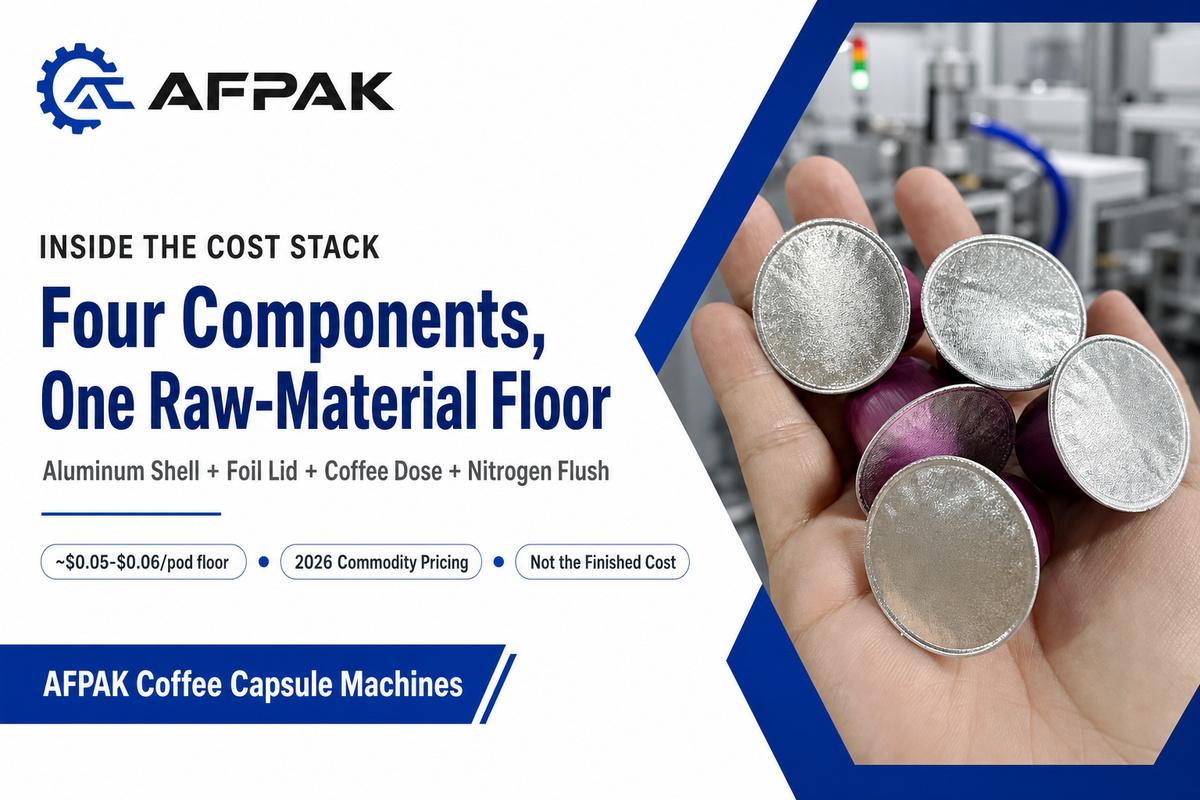
Seja qual for o termo que você use para cápsulas de café e cápsulas ou vagens em geral, as cápsulas de alumínio são feitas de quatro componentes, e as cápsulas da Linha Original contêm a mesma estrutura básica em toda a gama, sejam as vagens acabadas feitas um espresso loiro mais suave assado ou uma mistura de café original mais ousada: a casca de alumínio, a tampa da folha, a dose de café e a descarga protetora de nitrogênio Todas as quatro delas têm um preço real e de fonte de commodities de 2026 por trás delas Para fornecer uma noção do custo de entrada de material sem o preço real dos produtos acabados de um conversor (nenhum conversor divulga tais figuras), vamos triturar os números por componente, com uma ressalva embutida de que essas figuras representam o piso de material, antes de qualquer formação, revestimento, torrefação, mão-de-obra e amortização do investimento de capital em equipamentos:
Uma cápsula vazia e sem conteúdo pesa aproximadamente 3 gramas de alumínio. O alumínio primário na LME foi negociado a $3.600-$3.666 por tonelada métrica entre abril e maio de 2026 — alta de 51% sobre a média de 2024, segundo os dados de commodities do Pink Sheet do Banco Mundial. A esse preço, só o alumínio bruto da casca raspa o fundo do poço, em torno de $0,011 por cápsula. O alumínio nos EUA fica mais caro quando se soma o Midwest Premium — a sobretaxa de entrega —, que brevemente superou $1,00 por libra pela primeira vez em janeiro de 2026, por conta das tarifas da Seção 232 (que subiram de 25% em março de 2026 para 50% em junho) e das rupturas na cadeia de suprimentos, segundo o Resumos de commodities minerais do USGS 2026.
Um ou dois gramas de folha de alumínio da tampa aumentariam novamente em cerca de $0.001 a $0.002 por cápsula; nenhum conversor que verifiquei publica os pesos exatos da tampa.
| Componente | Peso de entrada | Preço das commodities de 2026 | Piso de matéria-prima | Limitações /Não o custo acabado |
|---|---|---|---|---|
| Concha alumínio | ~3g Al | $3,60–$3,67/kg (LME) | ~$0.011 | Exclui estampagem, revestimento (laca 21 CFR 175.300), ferramentas |
| Tampa folha | ~0.30.5 g Al (estimativa de engenharia) | mesma ração de commodities | ~$0,001–$0,002 | Nenhuma fonte publicada de peso da tampa encontrada; tratar como direcional |
| Dose de café (Original) | 5g | $7.30/kg verde Arábica (Banco Mundial, maio de 2026) | ~$0,037$0.044 | Somente piso de feijão verde; torrefação/moagem/logística adicione mais |
| Descarga de nitrogênio | pequeno volume por cápsula, nenhuma fonte por unidade encontrada | $0,11–$0,14/kg de N₂ industrial (2026) | fração de um centavo | O custo do driver é o capex da estação de descarga e o tempo do ciclo do gás em si, consulte a próxima seção |
O café arábica verde que enche cada cápsula tem o mesmo preço se a Cápsula de café acabada acaba assada média ou assada escura, uma vez que o nível de torra é aplicado após esta etapa de matéria-prima Tally tudo para cima e o piso de matéria-prima da Linha Original atinge aproximadamente $0.05-$0.06 por Cápsula de café a muito choro do preço $0.70-$1.10 você encontraria em uma prateleira E isso é apenas o piso de materiais (não incluindo o custo para realmente formar as cápsulas de café, aplicar um revestimento de qualidade alimentar, selá-las hermeticamente, o trabalho para fazê-lo, controle de qualidade, depreciação da máquina e o custo para enviá-lo e colocá-lo em uma prateleira Para comparação: em nosso artigo anterior analisando o custo da K-Cup, dividimos apenas os custos totais de materiais (copo, tampa, filtro, café) em $0.09 a $0.17 (dependendo do tamanho do pedido); O formato de copo único de alumínio (tampa única) da Nespresso usa menos plástico, embora um preço por grama mais pesado em seu alumínio provavelmente o colocaria na mesma faixa depois de tudo feito.
Uma segunda reviravolta regulatória sobre onde os custos vão com a forma da embalagem é que o novo Regulamento de Embalagens e Resíduos de Embalagens da UE isenta as embalagens totalmente em alumínio de seu requisito de conteúdo reciclado do Artigo 7, porque esse regulamento está focado exclusivamente em embalagens que têm mais de 5% de plástico em peso No entanto, uma cápsula de corpo plástico incorreria no custo de 10% PCR até janeiro de 2030 (subindo para 25% até 2040) para evitar a obrigação; o alumínio não incorrerá em custos adicionais de PCR até o final de 2030 Há uma assimetria de custos concreta, datada por data e específica do formulário.
Depreciação da máquina: o que sua linha de enchimento adiciona a cada pod
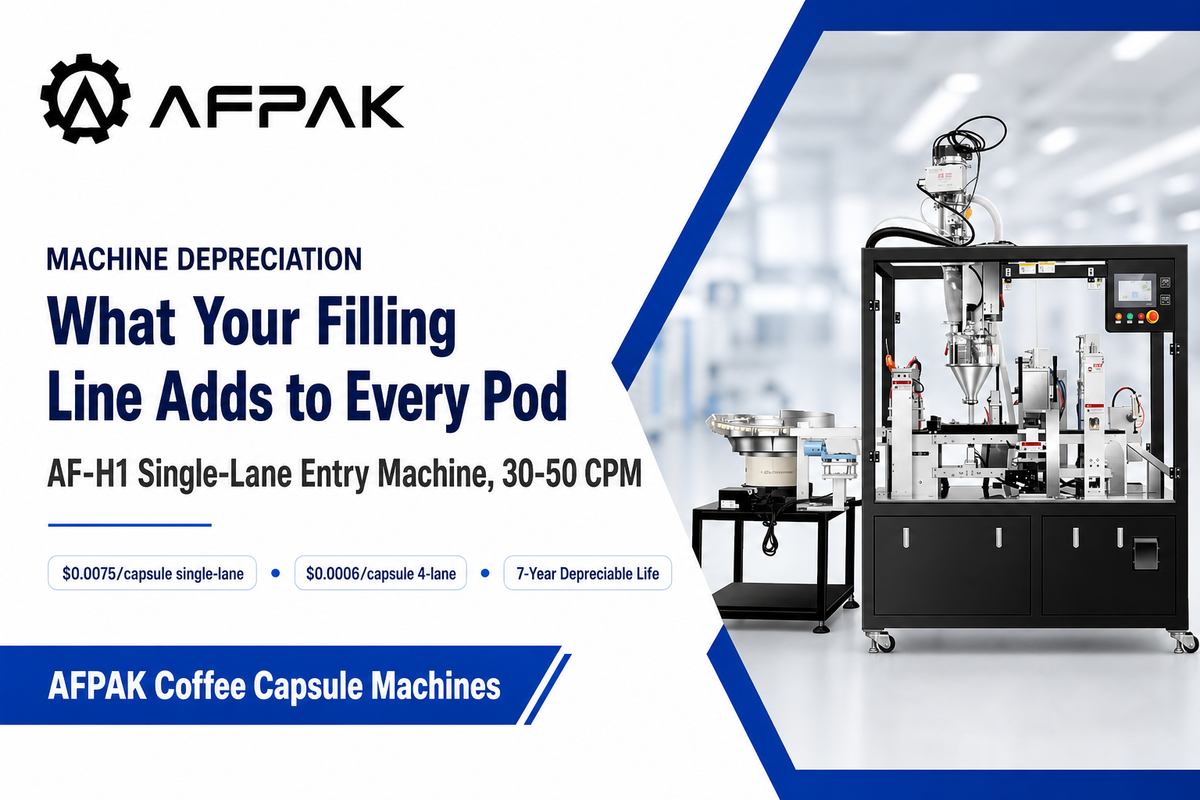
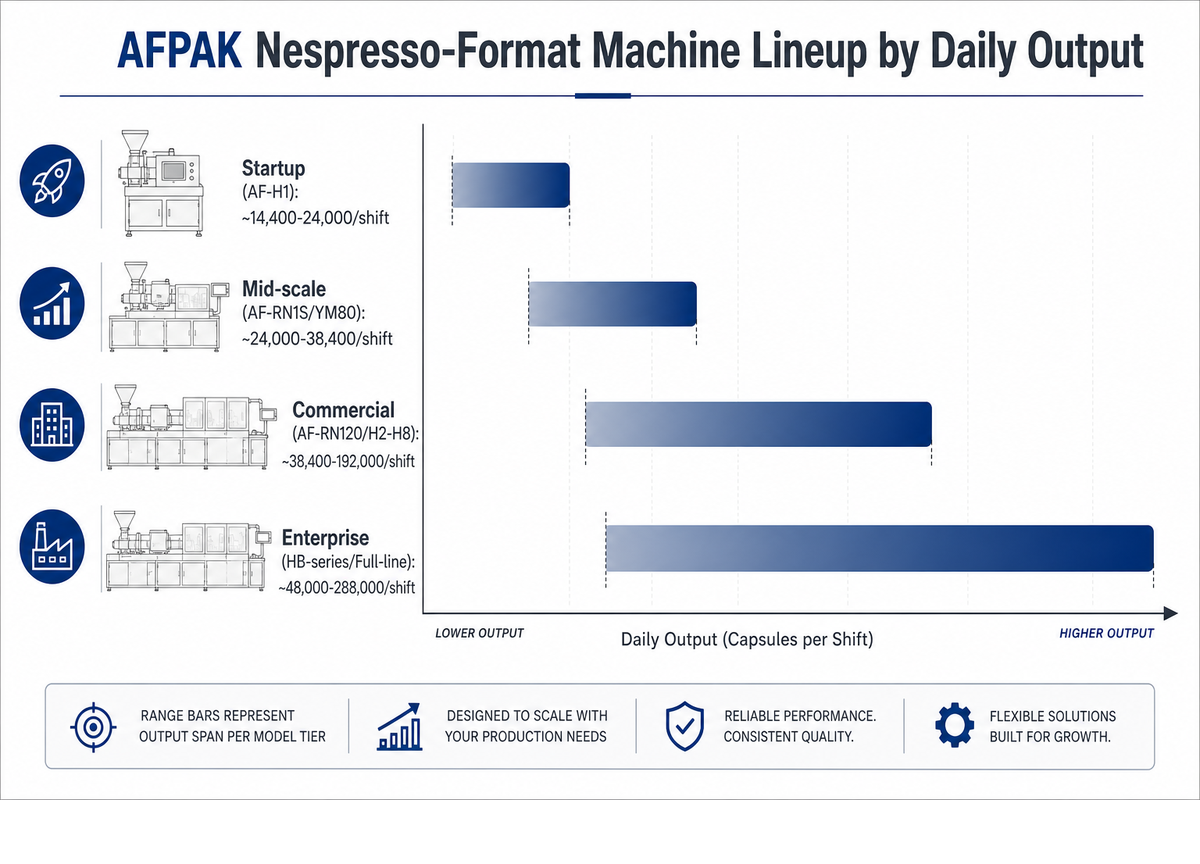
A amortização da máquina é o único elemento de custo em que as comparações de preços de varejo nunca chegam, porque depende totalmente do tipo de máquina enchimento fazendo o trabalho A linha própria de máquinas do estilo Nespresso da AFPAK funciona em qualquer lugar de cerca de 30 a mais de 600 cápsulas por minuto com sete modelos diferentes, desde a máquina básica AF-H1 de pista única (30-50 cpm) até máquinas lineares de várias pistas (H2-H10, 40-50 cpm/pista) para completar máquinas de enchimento-selagem-cartonagem (180-200 cpm).Abaixo, as diferentes velocidades se traduzem em um custo por cápsula para depreciação:
Por exemplo, uma hipotética máquina de pista única custando $45.000, rodando ao longo de uma vida depreciável de 7 anos a 50 cpm durante um ano de 8 horas/250 dias produz: 50 cpm × 480 minutos/dia × 250 dias/ano = 6.000.000 cápsulas em sua vida Dividido pelo custo = $0.0075 por cápsula para depreciação apenas ($45000 /6.000,000).Agora, considere uma máquina de várias pistas $80.000 unidade de 4 pistas a 40 cpm/pista (160 cpm combinadas), com o mesmo cronograma operacional de 8 horas/250 dias (160 cpm) × 480 min/dia × 250 dias/ano × 7 anos = 134.400.000 cápsulas, ou $0.0006 por cápsula em depreciação Isso é uma ordem de magnitude menor por unidade! (Nota: Este é um exemplo de planejamento de cálculo CAPEX, não preços cotados AFPAK Os custos reais da máquina variam de acordo com a configuração. Cite a fórmula CAPEX acima.)
Custo total de propriedade de 5 anos: linha de enchimento de pista única versus linha de enchimento de pista múltipla (capex ilustrativo)
| Artigo de custo | Pista única (50 cpm) | 4 pistas (160 cpm) |
|---|---|---|
| Preço de compra | $45,000 | $80,000 |
| Instalação e comissionamento | $04T004T4T4,000 | $0004T04T8,0000 |
| Energia (5, a 1,5-yrkW) | ~$3,000 | ~$6,000 |
| Manutenção e peças sobressalentes (5 anos) | ~$4,000 | ~$8,000 |
| Risco de inatividade (5 anos) | Ponto de falha mais alto | Redundância inferior |
Exemplo de retorno: a 6.000.000 cápsulas ao longo de 5 anos para a linha de pista única e uma margem bruta all-in $0.03/pod (varejo menos COGS all-in das próximas duas seções), o custo de $45.000$54,000 5 anos da máquina é recuperado bem dentro do primeiro ano de funcionamento em volume total (a restrição real raramente é a própria máquina, está atingindo esse volume de forma consistente.
Trabalho, nitrogênio e despesas gerais para as quais ninguém orçamenta
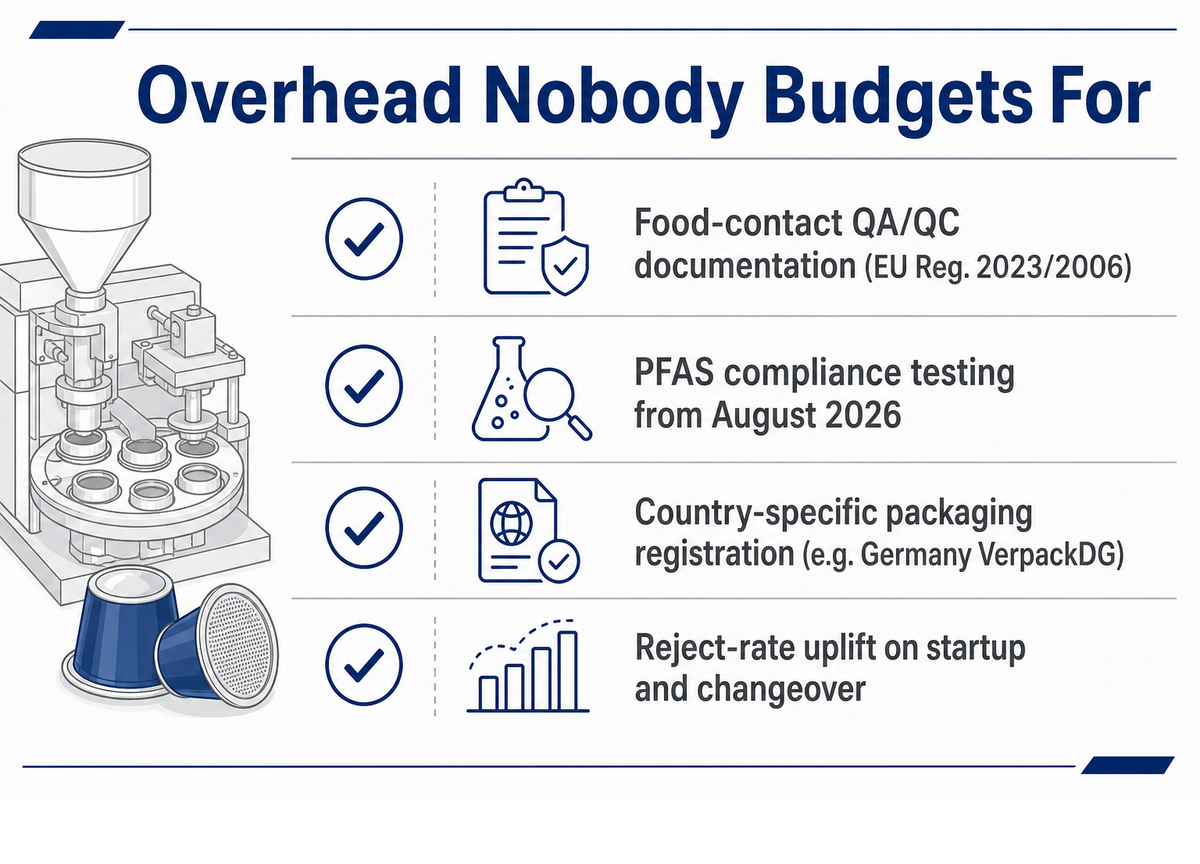
Ficar fora do âmbito dos custos de materiais e da depreciação das máquinas é uma terceira camada real de despesas gerais que muitas dessas folhas de repartição de custos não reconhecem: documentação de conformidade, testes laboratoriais e aumento de mão-de-obra A legislação da UE em matéria de contactos alimentares, o Regulamento 2023/2006, insiste numa garantia de qualidade auditável/sistema de controlo de qualidade dimensionado para o tamanho do negócio (um custo real e contínuo da mão-de-obra, não um item de material por cápsula). Sob o novo PPWR a regulamentação, os testes de conformidade com PFAS, que a partir de agosto de 2026 serão obrigatórios em todas as embalagens de contacto com alimentos da UE, custa várias centenas de euros“ por amostra para uma análise de flúor total até vários milhares para testes de compostos direcionados, e tempo de resposta em laboratório de 4 -8 semanas.
A mão de obra é proporcional ao número de faixas, a quantidade de saída (output) é uma linha de pista única e de operador único e uma linha de várias faixas normalmente semelhante em termos de pessoal em um determinado turno e é isso que leva à depreciação massiva por pod diferença mostrada acima para máquinas de pista única vs multi (o custo da mão de obra por pod comprime da mesma maneira).Cada país terá acréscimos de custos relacionados à conformidade também A Lei de Implementação da Lei de Embalagens da Alemanha, que entra em vigor junto com o PPWR em agosto de 2026, traz a possibilidade de penalidades de 200 k para registro e falha de relatórios ("report") uma linha de risco desagradável para qualquer pessoa que venda no país sem se registrar primeiro.
- Documentação de controle de qualidade/CQ de contato com alimentos (Regulamento UE 2023/2006) mão de obra administrativa contínua
- Testes de conformidade com PFAS de agosto de 202 a centenas de centenas a milhares de euros por SKU
- Registo de embalagens específico do país (por exemplo, VerpackDG) Risco de não conformidade da Alemanha até 200 000 euros
- Aumento da taxa de rejeição Cada linha de enchimento produz uma porcentagem real de sucata quando iniciada ou trocada
Como o volume de produção altera seu custo real por pod
Embora o custo por pod diminua com o volume, ele não diminui suavemente; as folhas de preços reais de co-embalagem, com sua variedade de opções e quantidades mínimas de pedidos, são caracterizadas por reduções graduais correlacionadas a esses mínimos, em vez de uma diminuição linear em toda a gama de tamanhos de pedidos.
Por exemplo, as taxas de co-embalagem de K-Cups ao vivo de 2026 da Peacemaker Coffee para um cliente que fornece seus próprios grãos são de $0,26 por unidade (mínimo de 250 unidades mais uma taxa de moagem de pedágio de $1,00 por libra em pedidos superiores a 20 libras) versus $0,45 por unidade para os próprios grãos do co-embalador (sem mínimo), enquanto as tampas de folha personalizadas estão disponíveis em 5.000 unidades por projeto (tempo de volta de 4-8 semanas). Melhor Copa o co-embalamento de pods compostáveis começa em 2.000 cápsulas (75 libras de café) a $0,95 por unidade, o que se traduz em cerca de $2,00 por cápsula em um canal direto ao consumidor $2,00 por lacuna entre COGS e varejo real. Esses números se aplicam aos volumes K-Cup como um proxy geral, não como um reflexo dos custos do Nespresso.
| Nível de volume | Classe de máquina AFPAK representativa | Produção diária | Motorista de COGS all-in | Limitações /Não adequado para |
|---|---|---|---|---|
| Inicialização | AF-H1 (300 cpm) | ~14.400 24.000/turno | O piso de materiais domina; depreciação/pod mais alta | Não adequado acima de ~50.000 unidades/dia sustentado |
| Escala média | AF-RR (50N1S70 cpm) | ~24.000 3.600/turno | Melhoramento do rácio mão-de-obra/depreciação | A pista única ainda é um único ponto de falha |
| Escala média | AF-YM80, 1 faixa (600 cpm) | ~28.800 8.400/turno | Unidade de came totalmente mecânica, precisão mais apertada de ± 0,15 g na linha | A pista única ainda é um único ponto de falha |
| Comercial | AF-RN1 rotativo (1020 cpm) | ~48.000 57.600/turno | Depreciação/Cápsula de café aproximando-se do chão; escala de trabalho sublinearmente | Requer demanda estável de vários turnos para justificar o capex |
| Comercial | AF-H2, pista (80 100 cpm) | ~38.400 8.000/turno | Depreciação/Cápsula de café aproximando-se do chão; escala de trabalho sublinearmente | Requer demanda estável de vários turnos para justificar o capex |
| Comercial | AF-H4, 4 pistas (1600 cpm) | ~76.800 6.000/turno | Depreciação/Cápsula de café aproximando-se do chão; escala de trabalho sublinearmente | Requer demanda estável de vários turnos para justificar o capex |
| Comercial | AF-H8, 8 pistas (3200 cpm) | ~1.600 1532.000/turno | Depreciação/Cápsula de café aproximando-se do chão; escala de trabalho sublinearmente | Requer demanda estável de vários turnos para justificar o capex |
| Empresa | Série HB (linha integrada 1800+ cpm enchimento+selagem+cartonagem) | ~86.400 6.000+/turno | A menor depreciação por cápsula; sobrecarga (conformidade, controle de qualidade) agora é o item de linha relativa maior | Não é adequado abaixo do volume mensal consistente de 6 dígitos (capex) subutilizado |
| Empresa | Full-autom (100 linha de 600 cpm avaliado, 2 operadores de cpm) | ~48.000288.000/turno | A menor depreciação por cápsula; sobrecarga (conformidade, controle de qualidade) agora é o item de linha relativa maior | Não é adequado abaixo do volume mensal consistente de 6 dígitos (capex) subutilizado |
Outro aspecto do mercado da UE: quaisquer produtores que coloquem 10 toneladas de embalagens por ano num mercado da UE também obtêm relatórios simplificados no âmbito do PPWR, outra vantagem real de conformidade das startups que a maioria das discussões por volume omite.
Margem Real: O Que Resta Depois de Vender o Pod
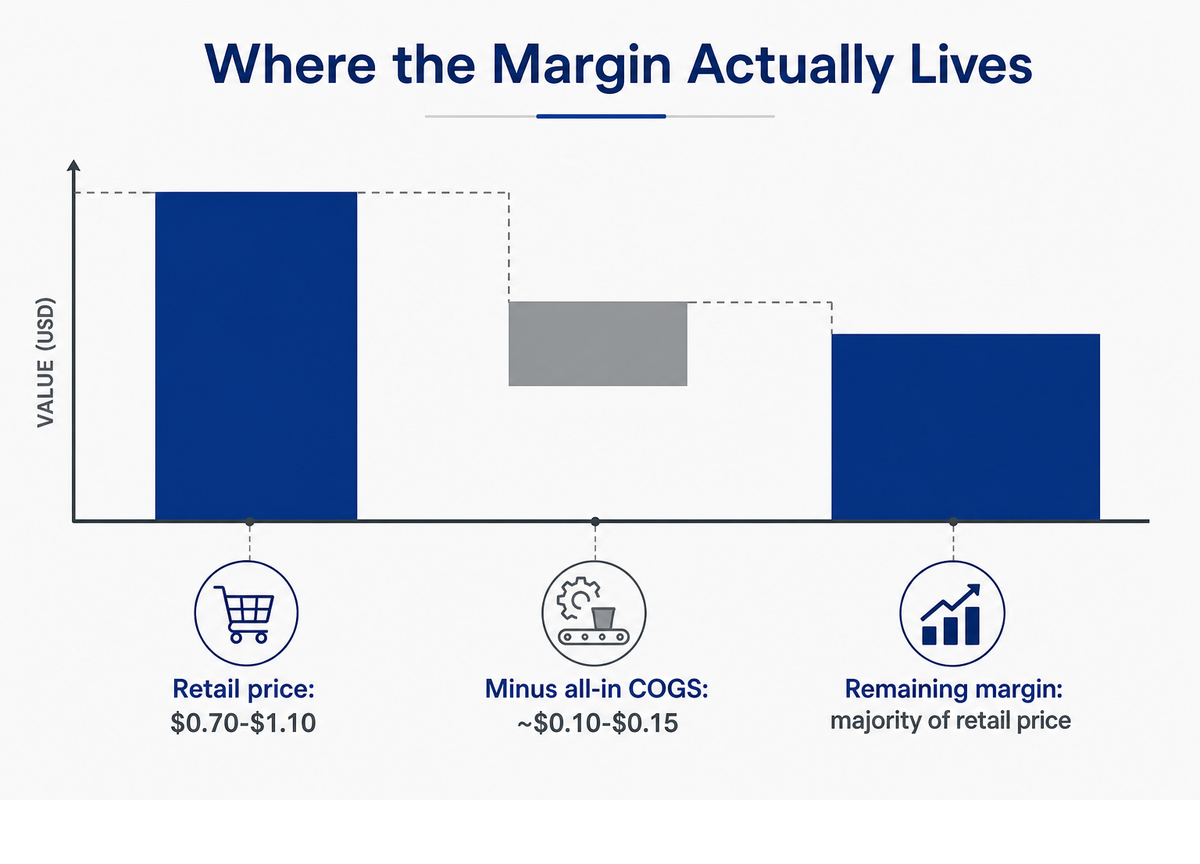
Volte da linha original: varejo em $0.70$1.10, entradas de materiais $0.05$0.6 e depreciação da máquina em escala inferior a um centavo por unidade. Adicione um buffer para contabilizar a conversão/revestimento/mão de obra, entradas de material duplo para 1Todos na escala COGS, aproximadamente $0.10$0.15 por pod. Isso cria uma margem substancial do pod (dezenas de centavos por unidade) além disso, antes de contabilizar as marcações/distribuição/marcações de varejo. É aqui que a economia do razor e das lâminas entra em jogo, o líder de perda é o dispositivo ou pacote inicial, e a margem está no pod.
No entanto, essa margem do pod é suscetível a volatilidade commodities, o que o mercado em 2026 deixou cristalino. O lucro do segmento de Café dos EUA da Keurig Dr Pepper caiu 21,3% na comparação trimestral no Q1 de 2026, por causa dos custos do café verde, das tarifas e da queda de volume. A direção da KDP apontou que o custo do café verde costuma ficar de 6-9 meses atrás do mercado no repasse ao COGS. De forma parecida, a JM Smucker absorveu mais de $75 milhões em custos ligados a tarifas em 2025, em vez de aplicar seu quinto aumento consecutivo de preços. A lição, ao fazer suas próprias contas de COGS por cápsula, é prever um atraso de 6-9 meses nos movimentos de preço de commodities na sua cadeia e desconfiar de repasses rápidos nas faturas de entrada.
O volume no qual a margem de produção interna ultrapassa a co-embalagem ou a recarga DIY não é um número único. É o ponto em que a depreciação da sua máquina por pod (que cai rapidamente com a contagem de faixas, de acordo com a tabela anterior) cai abaixo do que um co-embalador cobraria por unidade no tamanho do seu pedido, geralmente em algum lugar entre os níveis comercial e de escala média acima.
Produção interna vs. Co-embalagem vs. recarga DIY
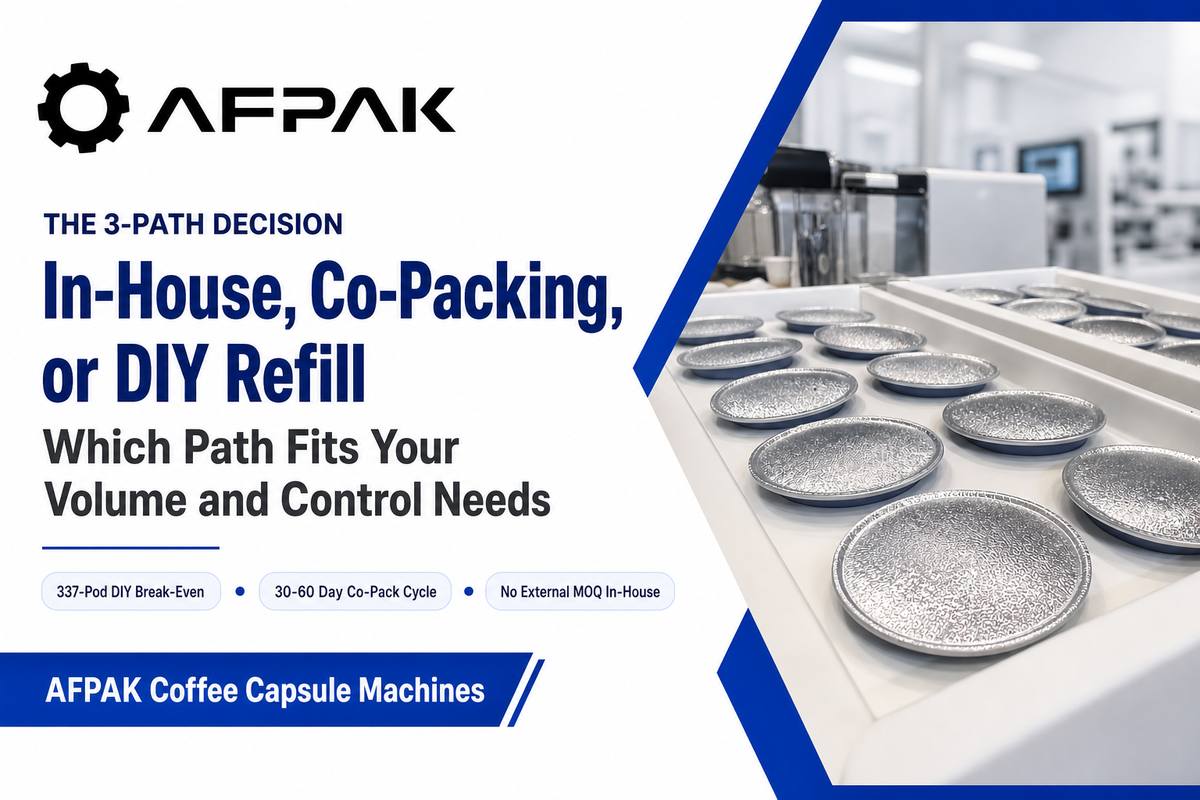
A árvore de decisão Build-vs-Buy de 3 caminhos
A árvore de decisão Build-vs-Buy de 3 caminhos é a escolha de três vias que cada marca de cápsulas enfrenta: construir capacidade de produção interna, comprar capacidade de um co-embalador ou fazer com que os clientes reabasteçam seus próprios pods.
Existem três caminhos reais para as cápsulas no formato Nespresso, e a resposta real para qual é melhor é: “Depende do volume e das necessidades de controle, não de qual é inerentemente ‘mais inteligente’ ” Reabasteça DIY, comprando seus próprios grãos e embalando o café gasto você mesmo, parece mais barato no papel: seu custo por cápsula pode cair para aproximadamente $0.21-$0.43 para cápsula recarregada vs. $1.00 para cápsulas de marca O ponto de equilíbrio no hardware para reabastecer a cápsula, no entanto, é de cerca de 337 cápsulas recarregadas, o que equivale a cerca de 67 semanas de café expresso uma vez por semana A experiência prática? “Dez minutos de preparação complicada, contadores pegajosos, borra de café desperdiçados e o ocasional mau selo” para cada sessão, e cerca de 40% de falha ou fraco ao preencher doses.
DIY raramente é mais barato do que comprar quando você contabiliza o tempo e a taxa de falhas.
A co-embalagem remove problemas de CAPEX e de taxa de falha, mas adiciona obstáculos de prazo de entrega e MOQ: O ciclo de fabricação-preenchimento-embalagem ponta a ponta para cápsulas Nespresso de marca própria é de 30 a 60 dias (de acordo com a entrevista da Novocapsule acima), e geralmente você precisa comprar conjuntos de ferramentas personalizados (tampas, caixas) com mais de 5.000 mínimos.
Sua própria máquina de enchimento interna também eliminará os problemas de qualidade da recarga DIY e os limites MOQ da co-embalagem, ao custo do CAPEX e das considerações de depreciação discutidas acima É uma etapa lógica quando seus volumes ultrapassam um limite.
- Sem capex, sem matemática de depreciação
- 300 dias de ciclo por ordem
- Fricção real de MOQ em ferramentas personalizadas (mais de 5.000 unidades/design)
- O controle de qualidade pertence ao co-packer, não a você
- Capex + depreciação, compensada por volume (ver Limiar de Custo Crossover)
- Sem dependência do ciclo-tempo de terceiros
- Sem teto externo MOQ
- Controle de qualidade e mudança de formato em suas próprias mãos
Os proprietários de marcas que avaliam os méritos de investir em equipamentos compatíveis com Nespresso podem consultar nosso artigo relacionado sobre se o equipamento de produção de cápsulas vale o investimento, & para o porquê DIY Nespresso refills em última análise fazer uma estratégia de marca pobre, leia o nosso artigo sobre por que a recarga DIY Nespresso falha como uma oportunidade de marca.
Requisitos de integração e utilitários antes de comprar
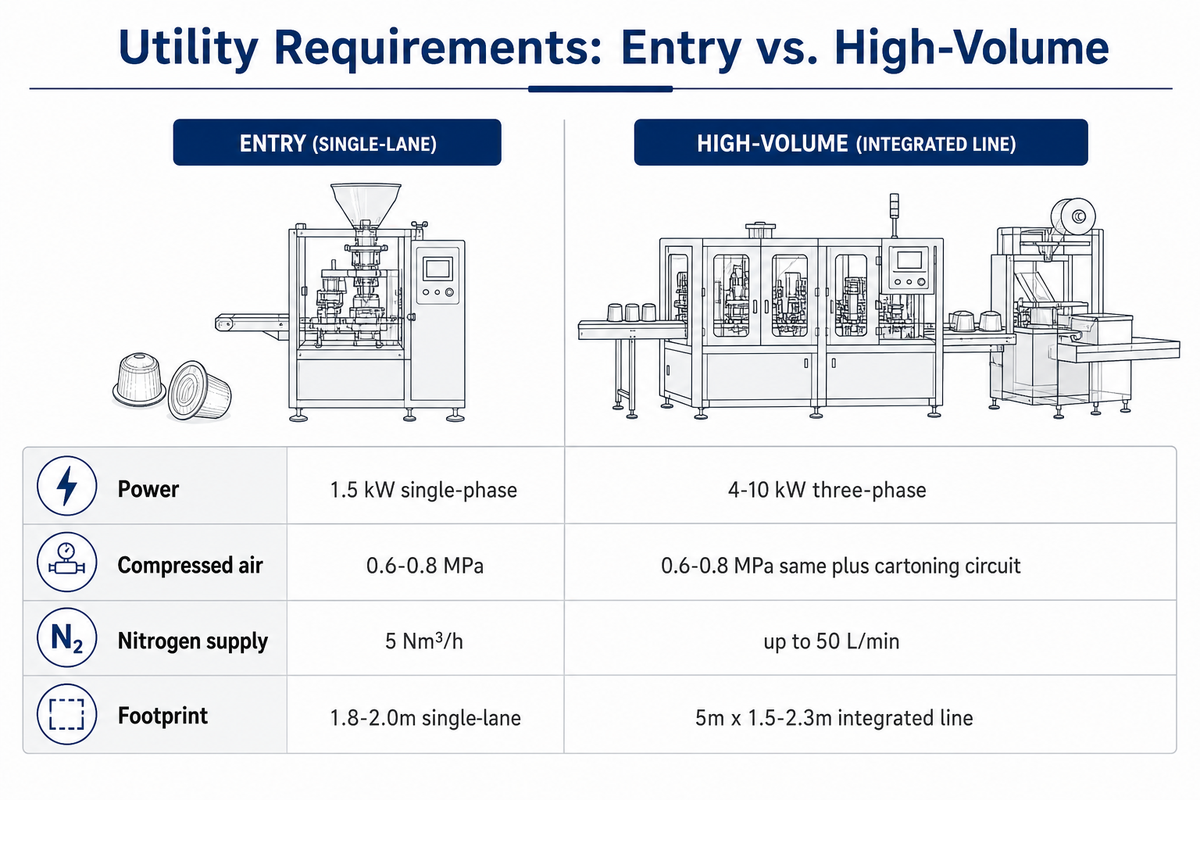
A instalação primeiro tem que ser capaz de realmente executar a máquina, e os requisitos para o nível de entrada da AFPAK versus high-end Equipamento Nespresso alcance amplamente o suficiente para influenciar a seleção do local.
Máquinas de pista única (H1, RN1 S) normalmente requerem apenas 1,5 kW de potência monofásica e 0,6 a 0,8 MPa de ar comprimido Para linhas de enchimento integradas de alto volume, com várias pistas, os requisitos sobem para potência trifásica (4 a 10 kW) mais um circuito adicional para a máquina de encadernação, com fornecimento de ar comprimido, fluxo de nitrogênio e, claro, requisitos de espaço aumentando em paralelo Por exemplo, as máquinas de entrada de pista única precisam de aproximadamente 5 Nm³/h de fornecimento de nitrogênio, enquanto as máquinas de ponta podem funcionar em fluxos mais próximos de 50 L/min.
As necessidades de espaço aumentam juntamente com a produção e o nível de integração Uma unidade de pista única ocupa cerca de 1,8-2,0 m de área útil, enquanto uma máquina integrada de várias pistas da série HB, incluindo cartonagem, mede quase 5 m x 1,5-2,3 m.
Você deve sempre confirmar o ponto de orvalho específico do ar comprimido e as especificações de pureza do nitrogênio com o fabricante da máquina, pois a falha em fornecê-los adequadamente é uma causa comum de atrasos na inicialização de novos equipamentos.
- A depreciação por pod cai rapidamente (consulte a seção de depreciação da máquina)
- A redundância de várias faixas reduz o risco de inatividade em ponto único de falha
- Menor sobrecarga relativa quando o volume limpa o limite de cruzamento
- A energia trifásica e o fornecimento de nitrogênio em vários circuitos exigem atualizações nas instalações que a maioria das startups não possui
- Capex fica ocioso abaixo do volume que o justifica
- A sobrecarga de conformidade (papelada de controle de qualidade, teste PFAS) se aplica por SKU, independentemente do tamanho da máquina
Quando NÃO comprar uma linha de enchimento de formato Nespresso
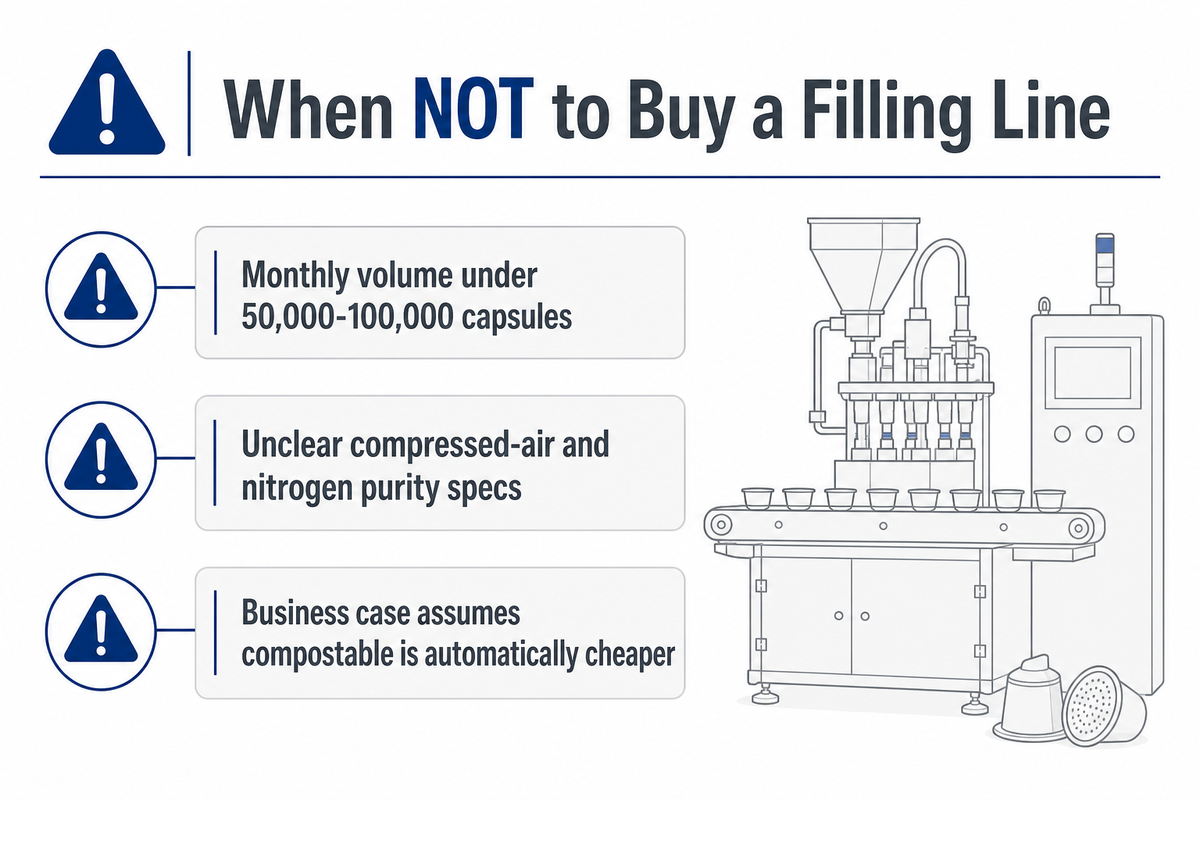
As desvantagens precisam de um lugar ao lado da história de vantagens Sua taxa de execução mensal realista, se abaixo, digamos, de 50 K a 100 K cápsulas, e espera-se que assim permaneça para o próximo ano ou assim, deve resultar em melhor custo unitário geral através de um co-embalador Preço de nível MOQ (veja a discussão sobre o nível de volume acima), mesmo levando em consideração os tempos de entrega de 30 a 60 dias e a depreciação do equipamento.
Se você ainda não esclareceu qual pressão de ponto de orvalho de ar comprimido e quantos “nines” de pureza de nitrogênio sua formulação exige, essa é uma data potencial de comissão que acabou de se tornar um problema.
E se o caso de negócio da sua empresa para usar material de cápsula compostável é que, “compostable significa que EU vou sempre economizar dinheiro, enquanto também salvar a terra, automaticamente,” então o próximo item provavelmente não é leitura opcional.
Compostável Nem Sempre É A Escolha Mais Barata
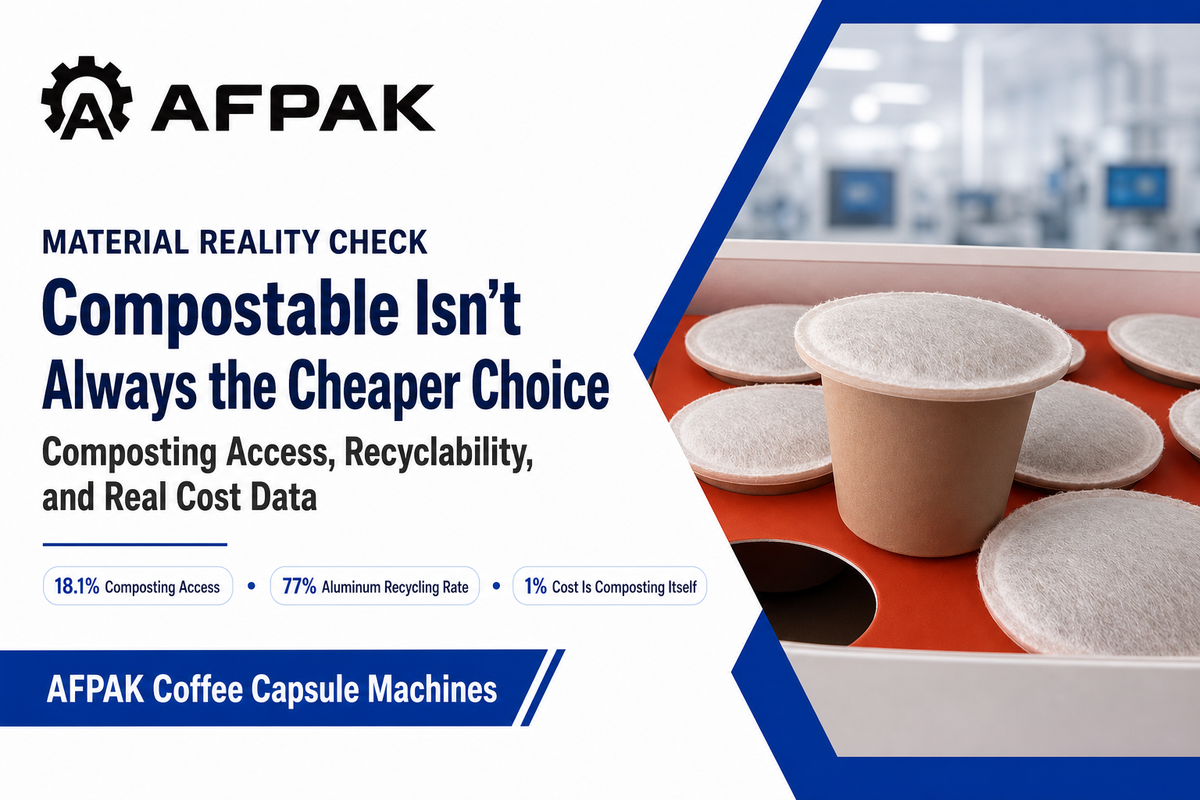
A avaliação do ciclo de vida de 2020 revisada por pares dos pods compostáveis PLA mostraram que a única situação em que o pod compostável era cerca de 21% mais barato que o plástico tradicional, a economia veio de como eles foram comprados - não do processo de compostagem, que foi de 1% do custo total em todas as situações analisadas.
O problema só é amplificado pela falta de infraestrutura: apenas 18,1% da população dos EUA tem acesso a um programa que leva restos de comida e embalagens compostáveis, em comparação com 35,9% com qualquer acesso à compostagem de resíduos alimentares em tudo Outra avaliação comparativa recente (2024) revisada por pares do ciclo de vida até previu que, se descartada como assumido no futuro, a reciclagem de alumínio sobe para 77% enquanto a reciclagem de biopolímeros é estruturalmente complementada no que quer que já seja, porque o material não é tão confiável reciclável na prática e não é realmente capaz de reciclagem verdadeiramente em circuito fechado e, portanto, é propenso a mais aterro e compostagem (em vez de reciclagem) do que suas contrapartes de alumínio Estou apaixonado pela história anedótica de uma torrefadora de tentar estabelecer sua própria cápsula compostável compatível com Nespresso: a qualidade era errática, o desconto de um preço premium de fornecimento de cápsulas (não é o preço premium).
Claro, isso não é um argumento para o alumínio por si só, apenas um argumento de que a escolha dos materiais deve ser guiada pelos seus dados específicos sobre custos de eliminação e acesso, e não por uma ideia geral (e falsa) de que “compostable” é o última palavra.
Perguntas frequentes
P: Os pods Nespresso são muito caros?
As cápsulas Nespresso custam cerca de $50–$80 por libra-equivalente de café, bem acima dos $9–$22 por libra do grão inteiro no varejo — ainda que a comparação não seja exatamente equivalente quando se leva em conta a conveniência e a dosagem constante.
P: Quanto custam os pods Nespresso vs. Keurig K-Cups?
Comparando Nespresso e Keurig diretamente, os pods Nespresso Vertuo rodam aproximadamente $1.00 a $1.50 cada, versus Keurig K-Cups em cerca de $0.40 a $1.10, de acordo com as comparações de mercado de 20252026.
P: É mais barato comprar pods Nespresso na loja ou online?
Sites de rastreamento de negócios comunitários transacionados reais mostram multi-packs da Linha Original se acomodando em torno de $0,5 preços $0.71 por cápsula após a assinatura descontos, significativamente abaixo de $0.70.$1.1 preço de lista a maioria dos guias de compra.
P: Por que as cápsulas Vertuo são mais caras que a Original Line?
A Vertuo executa um sistema fechado patenteado e litigado (extração Centrifusion de leitura de código de barras) que o formato aberto e de patente expirada da Original Line não carrega, que é o verdadeiro mecanismo por trás da diferença de preço, não simplesmente feijões de qualidade superior.
P: Você pode reutilizar pods Nespresso?
Existem cápsulas reutilizáveis para ambas as linhas, mas o ponto de equilíbrio do hardware é de aproximadamente 337 recargas e a precisão da dosagem em nível de fábrica é difícil de replicar em casa.
P: O que realmente custa para uma marca fabricar um pod compatível com Nespresso?
As matérias-primas funcionam aproximadamente $0.0.5$0.06 por pod Original Line; COGS all-in em volume comercial normalmente cai bem abaixo da metade do preço de varejo quando a depreciação da máquina e as despesas gerais são adicionadas.
Por que escrevemos isso
Como construímos as máquinas de enchimento e vedação para uma boa parte das cápsulas Nespresso, K-Cup e Dolce Gusto feitas em todo o mundo, estamos abordando esse tópico do lado “supply” do negócio, não do lado varejo “demand” Os preços das commodities, especificações de máquinas e prazos regulatórios nesta peça vêm de fontes primárias (dados comerciais do governo, registros de patentes, estudos de ciclo de vida revisados por pares) e nossa própria linha de equipamentos, não uma postagem no blog de um concorrente.
Referências e fontes
- Índice de Preços ao Consumidor: 2025 em análise Bureau de Estatísticas do Trabalho dos EUA
- Preço do Indicador Composto (I-CIP) Organização Internacional do Café
- Perspectiva dos Mercados de Commodities, Folha Rosa, junho de 2026 Banco Mundial
- Resumos de commodities minerais 2026, alumínio Serviço Geológico dos EUA
- Decisão Máquinas Café Espresso Autorité de la concurrence (Autoridade da Concorrência francesa)
- Vagens de café, produtos vinculados e busca de lucro Conhecimento INSEAD
- Avaliação do Ciclo de Vida de Vagens de Café Compostáveis Relatórios Científicos (Nature Portfolio), via PubMed Central
- Nova pesquisa do SPC mostra aumento no acesso à compostagem nos EUA Coalizão de Embalagens Sustentáveis
- Avaliação Comparativa do Ciclo de Vida das Cápsulas de Café Produção e Consumo Sustentáveis (ScienceDirect)
- Resumo do Regulamento Europeu sobre Embalagens e Resíduos de Embalagens Latham e Watkins
- Os preços do café nos EUA disparam no supermercado Notícias diárias sobre café da Roast Magazine
- Como as cápsulas de café são fabricadas e preenchidas? Moagem Diária Perfeita
- Vertuo Pods da Nespresso: códigos de barras que não são códigos de barras Revisão FPC
Artigos Relacionados
- Custo de produção da K-Cup por Copa: números reais a mesma metodologia de custo-componente aplicada ao formato K-Cup
- Vagens originais da linha Nespresso: alumínio vs compostável vs plástico a comparação material-escolha atrás da linha de custo do shell acima
- Por que o refil DIY Nespresso falha como uma oportunidade de marca a desmontagem completa atrás da seção DIY acima
- O equipamento de produção de cápsulas de café vale o investimento?
- Máquinas de enchimento e vedação de cápsulas de café Nespresso Linha completa de equipamentos em formato Nespresso da AFPAK
Revisado pela equipe técnica da AFPAK.