
Coffee capsule incoming material qualification ties a supplier’s material specification to the lot you receive and the filling line that will use it. A clean-looking capsule and a lid that sticks to it are just the beginning. Food-contact suitability, lot consistency and performance at the agreed production speed still need evidence.
Coffee capsule incoming material qualification means approving the material identity, checking the delivered lot and proving the intended body-and-lid combination on the selected machine. Keep separate records for each decision.
Before releasing a shipment
- A strong peel result doesn’t establish a leak-free package.
- A supplier certificate must match the material, manufacturer and intended use.
- Incoming inspection and a machine trial answer different questions.
- Agree the sampling plan and disposition rules before testing the lot.
What Coffee Capsule Incoming Material Qualification Covers
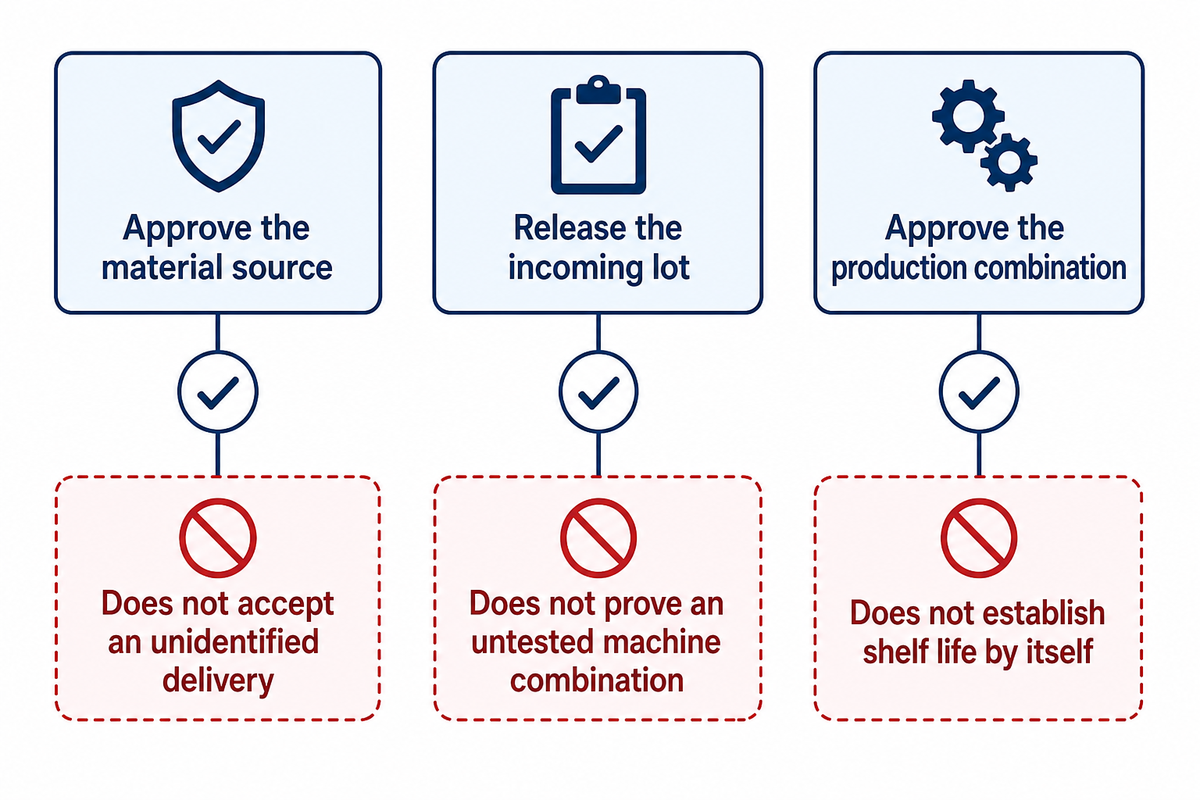
When an approved capsule body and sealing lid and other components in an approved pack structure arrive, the buyer must check what lot was delivered, whether it meets the agreed specification and whether it works on the intended equipment. Treat these as separate approvals, with named owners.
Use the 3-Release Evidence Map below when purchasing a new capsule format or changing a supplier. The map is a practical quality management record, not an industry certification. It’s critical to keep a successful demonstration from becoming blanket approval to use all subsequent shipments.
| Decision | Evidence to connect | Owner and next action | Limitations |
|---|---|---|---|
| Approve the material source | Manufacturer, construction, drawing revision and intended food-contact use | Quality and procurement approve the specified source | Does not accept an unidentified delivery |
| Release the incoming lot | Receipt, lot identity, chosen sampling plan and inspection results | Quality signs the lot disposition | Does not prove an untested machine combination |
| Approve the production combination | Body lot, lid lot, tooling, process settings and agreed trial results | Production and quality sign the trial scope | Does not establish shelf life by itself |
What evidence should a buyer request before approving a new line?
A buyer should request identified material samples, agreed acceptance criteria and a trial record linking those samples to the machine setup. Specifications of body and sealing lid, the product to be filled, the fill speed, and the method to evaluate the filled capsule are some of the criteria to be included in the record. A demonstration video can’t replace the record.
This is important when considering coffee capsule production lines. One line may be able to handle one approved material combination, but a different lid coating or flange shape may require a different setup to work well with the other approved material combination. Supplier approval must be kept available for audit, but the release signature must be specific to the decision being supported.
Build a Lot-Specific Evidence Pack
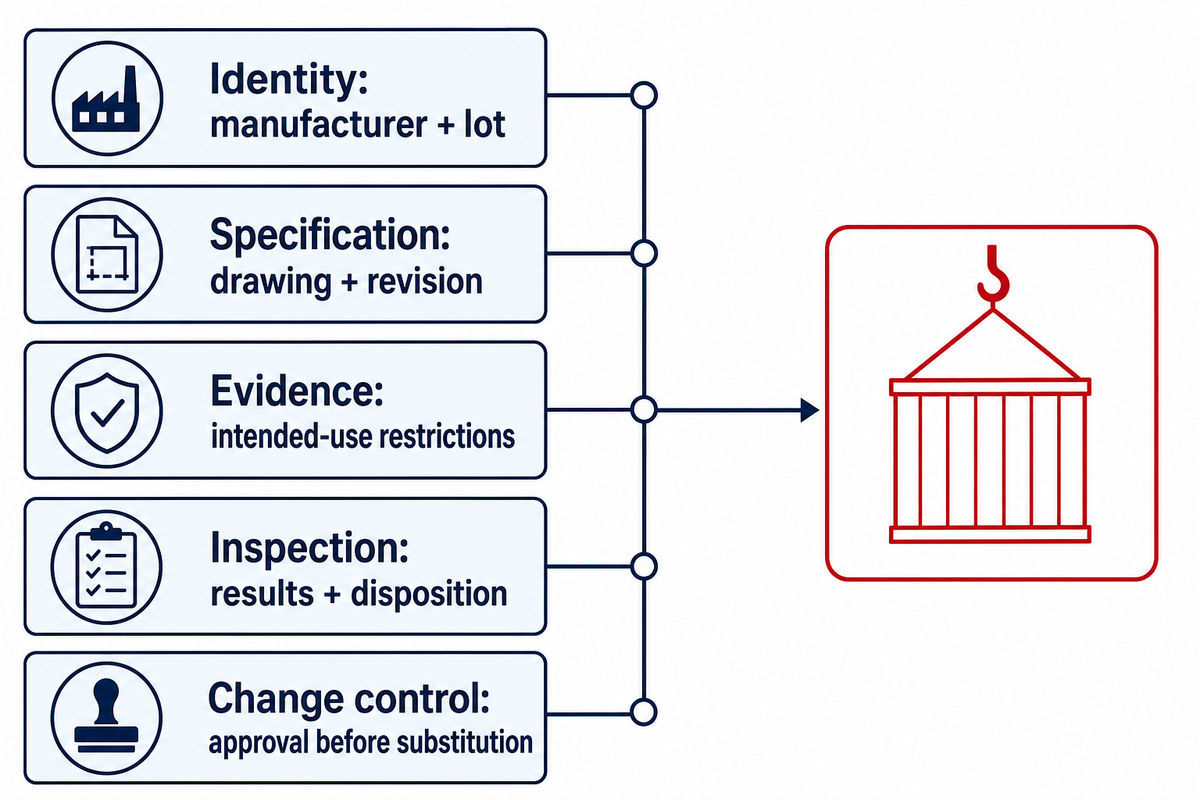
A lot-specific evidence pack connects the purchase order, supplier identity, material revision, and inspection results to the same shipment. Start with the approved drawing and material construction. Then confirm that the delivered labels and supporting records refer to those versions, rather than a similar capsule sold under the same trade name.
The FDA’s guidance for food-contact materials for the U.S. project states why the identity and intended use of a plastic food contact material matter. An effective Food Contact Substance Notification is tied to the identified manufacturer, substance and conditions of use. Determine if dry coffee storage and the contact with hot water are the functions for which the food contact material is intended. A statement that a plastic is “food grade” does not establish that connection.
For plastic food contact materials within its scope, the European Commission’s legislation overview describes a Declaration of Compliance and accompanying evidence. Make inquiries as to what the intended use covers. Hot brewing is not the same process as hot-fill packaging, and a room-temperature use statement should not be silently extended to every beverage application.
- Identity: supplier, actual manufacturer, material code, lot or batch number and receipt date.
- Specification: controlled drawing, material formulation or construction identifier, sealing layer and approved revision.
- Evidence: applicable food-contact statement, certificate or test report, with the relevant use restrictions.
- Inspection: method, sample identity, equipment used, results, inspector and disposition.
- Change control: contact person, notification agreement and approval required before substitution.
What information do batch numbers typically include?
A batch number identifies a defined production group; its characters may encode a date, line, or other supplier information, but there’s no universal format. Confirm the records the supplier retrieves and ask them to explain the code. The receiving record should retain the original identifier, even if the buyer assigns an internal stock code.
Body and lid batches can differ. Record them, and then link them to the final-product batch. Different SKUs can share a capsule body and use different lids. Preserve that distinction. Later, during a recall, affected materials can be identified. A quality system loses traceability if an original identifier is replaced with a single product description like “compatible aluminum capsule.”
Standardize the receiving form before trying to automate its entries. Quality control still requires someone to make the decision. A database that copies a mistaken material code more quickly doesn’t fix an identity crisis.
Check Capsule Bodies, Lids and Handling Before Filling
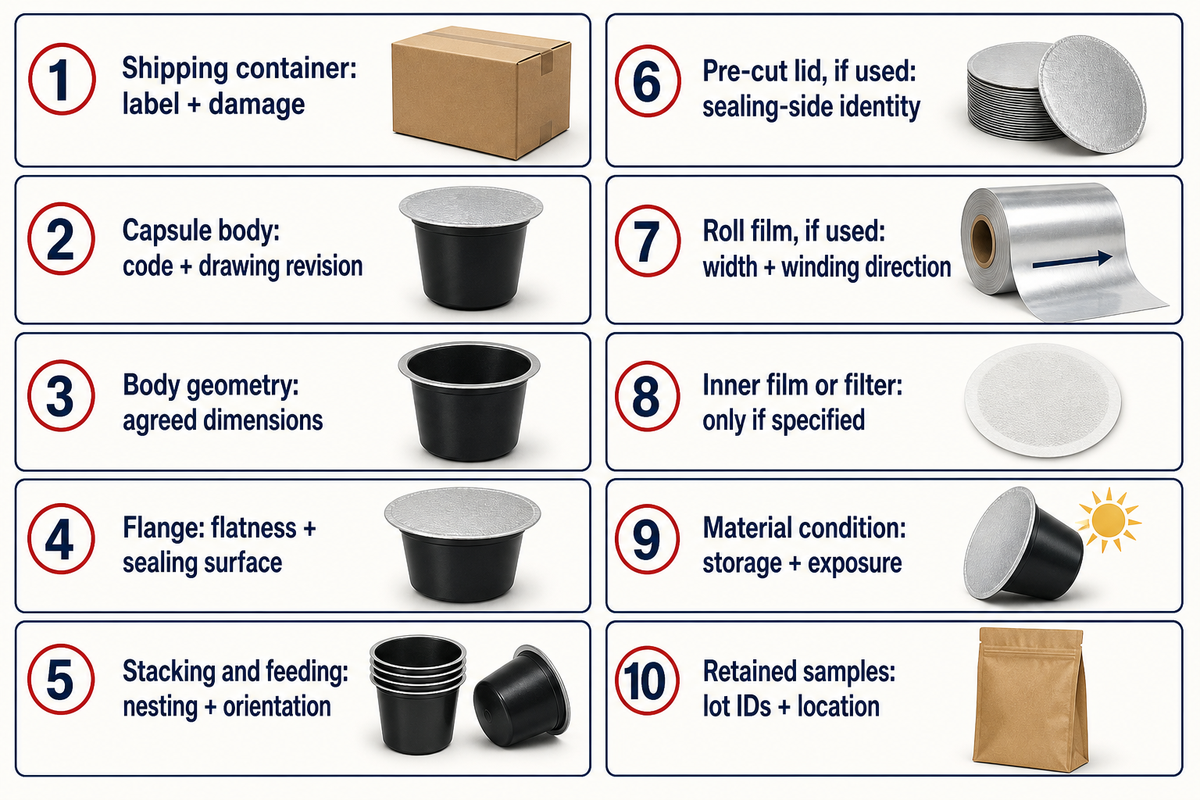
Incoming checks should follow the approved capsule structure and machine interfaces that can stop a process or damage a seal. Check dimensions with the controlled drawing. Inspect the sealing surface and check feeding behavior. Record the outcome and the method. A tick by “appearance acceptable” leaves too much unexplained in case of a failed trial.
Build the receiving sheet around applicable parts. According to AFPAK’s Nespresso-compatible filling machine page, samples of customers’ capsules and lids, as well as coffee, are to be tested prior to confirming the setup. The Dolce Gusto-compatible equipment by AFPAK also uses inner- and top-film arrangements where the pack structure requires them. In a top-only design, don’t add an inner-film requirement.
| Item | What to record | Why production needs it | Limitations / hold condition |
|---|---|---|---|
| Shipping container | Label, lot, damage, contamination and storage history available | Preserves identity before unpacking | Unidentified mixed stock stays on hold |
| Capsule body | Material code and drawing revision | Links the sample to the approved design | Trade name alone cannot confirm construction |
| Body geometry | Drawing-controlled dimensions in mm and measuring method | Checks seating and tooling interfaces | Use agreed tolerances; no universal capsule tolerance |
| Flange | Flatness, damage and usable sealing surface | Identifies a possible sealing mismatch | Appearance does not prove seal integrity |
| Stacking and feeding | Sticking, nesting, orientation and observed handling problems | Separates a feeding fault from a filling fault | Hand feeding does not qualify automatic feeding |
| Pre-cut lid | Diameter, shape, orientation and sealing-side identity | Checks placement and contact with the flange | Correct diameter does not prove coating compatibility |
| Roll film | Width, winding direction, splice identity and approved artwork | Checks the actual unwind and cutting arrangement | Not applicable to a pre-cut-only line |
| Inner film or filter | Part code, orientation and specified construction | Prevents substitution within a multi-part pack | Include only when the approved design needs it |
| Material condition | Supplier storage instructions, damage and suspect exposure | Allows investigation before sealing trials | A clean outer carton does not prove inner material condition |
| Retained samples | Body/lid lot IDs, storage location and retention rule | Supports investigation of later deviation | Retention does not replace representative sampling |
An illustrative receiving example: A replacement lid is delivered that has the correct diameter and artwork, but its sealing layer revision is missing from the delivery record. Production wants to use it as the next job is scheduled. The correct response is to quarantine that lot, ask procurement to obtain the revision and to let quality compare it to the approved sample. Turning up the sealing temperature first would obscure whether the problem came from material identity or process adjustment.
A packaging redesign requires the same level of detail. Depending on which body, lid, filter or outer wrapper is changed, the checks may vary. If the approved pack uses a printed sleeve, list its identity in the receiving record without considering it a sealing component. Keep the checklist specific enough so an inspector can mark a row “not applicable” with a reason instead of treating every capsule format as the same.
Separate Seal Strength, Leakage and Barrier Evidence
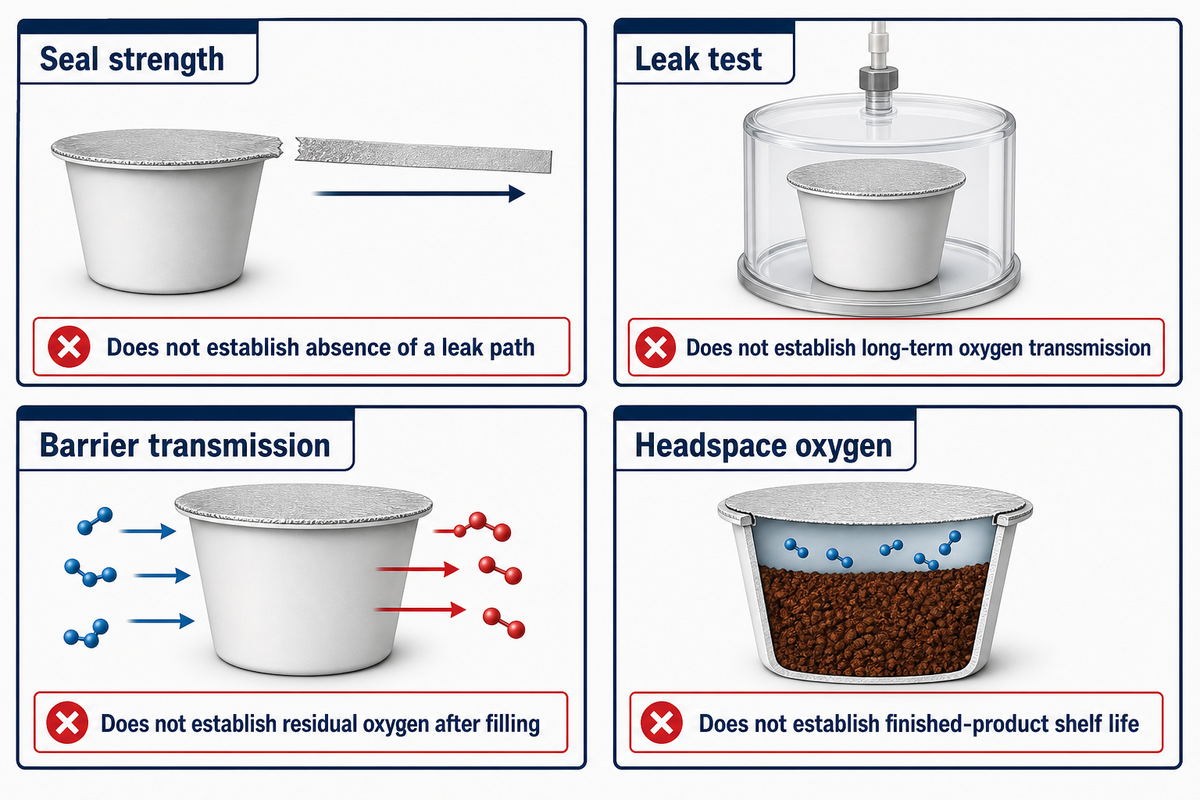
Seal strength, package leakage, barrier transmission and residual headspace oxygen address different questions. Select the method that addresses the property being evaluated and maintain the test conditions. A peel-force result describes mechanical separation; it cannot substitute for a leak measurement or establish how the packaged coffee will age during storage.
ASTM F88/F88M-23 measures the force needed to separate a strip containing the seal and records its failure mode. It can test seals between flexible material and flexible, rigid or semi-rigid materials. ASTM F2824-10(2025) on the other hand describes the removal of an entire peelable lid from a rigid or semi-rigid round container. Select by geometry and purpose and not by the standard number appearing in a supplier brochure.
| Question | Evidence to request | Essential report context | What it does not establish |
|---|---|---|---|
| How does the seal separate? | Suitable peel/strength method and failure mode | Strip or whole lid, fixture, pull angle, force units | Absence of a leak path |
| Does the package leak under the test conditions? | Validated leak method suited to the pack | Test settings, conditioning and demonstrated detection capability | Long-term oxygen transmission through intact material |
| How much gas or vapor passes through the barrier? | Oxygen or water-vapor transmission report | Film/body/whole pack, area basis, temperature and humidity | Residual oxygen left after filling |
| What oxygen remains in the filled capsule? | Headspace oxygen result at an agreed time | Sampling method, elapsed time and reported concentration | The finished product’s shelf life |
An example: a force reported in N for a complete lid should not be compared directly to a strip result, for example, per unit width. Ask the lab to resolve the method difference before reaching a conclusion that a supplier’s seal is stronger. ASTM F2824 describes a 45° pull angle; other angles require the documented procedure be validated. The angle described is a test detail; not the setting of the sealing machine.
Record if a transmission result is for flat film, an empty body or a completely sealed package. Keep units and conditions as stated. A number without a specimen description can’t be compared to other numbers and offers.
The commercial concern is straightforward: a lower material cost can lose its advantage when evidence can’t be compared; a statement that a capsule can withstand brewing conditions requires a defined test, not a general durability statement. Quality should agree to the report format with the supplier and test service provider before procurement treats different results as equivalent.
Set Sampling and Release Rules Before the Shipment
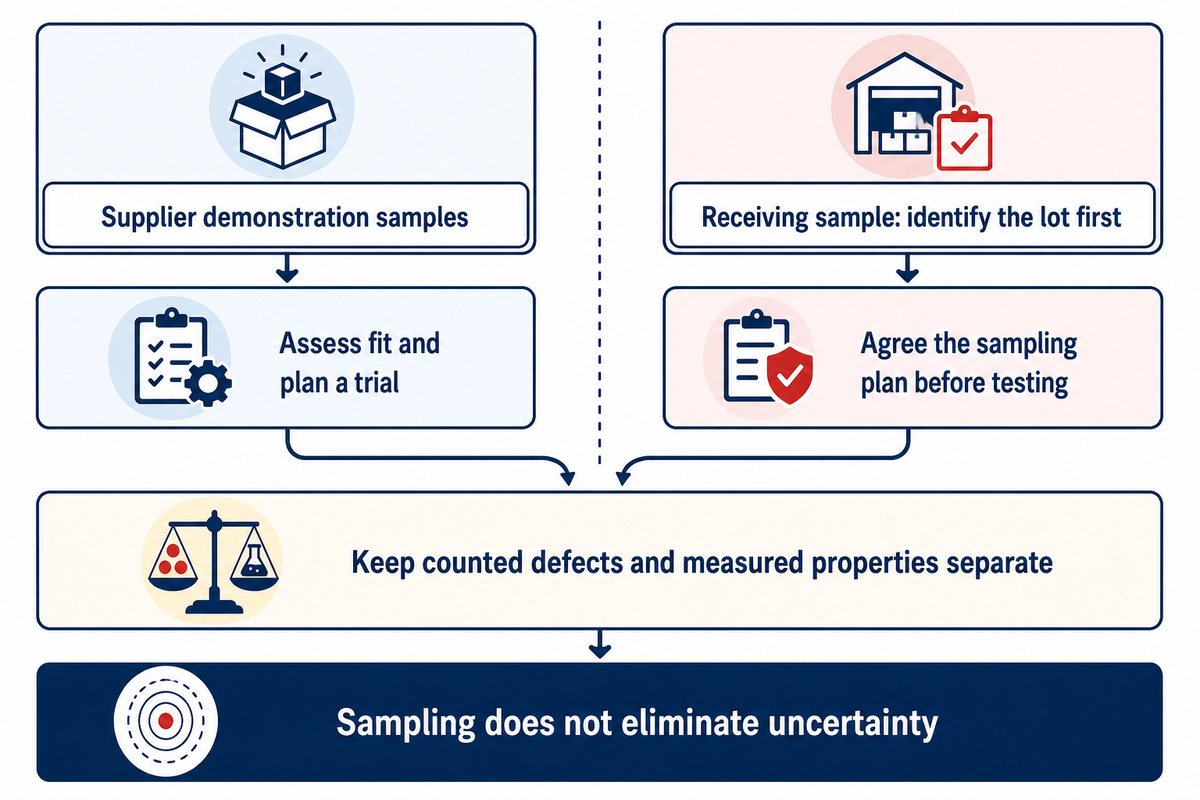
A receiving sampling plan describes the lot and specifies inspection characteristics, sampling method, and defines the acceptance level, before samples are taken. Counted defects and measured properties must be separated. The plan must also fit the supply history: continuing deliveries and an isolated first order do not automatically justify the same sampling arrangement.
ASQ describes Z1.4 and Z1.9 as different acceptance-sampling systems. Z1.4 deals with attributes and assumes a specified Acceptance Quality Limit and switching rules for subsequent lots. Z1.9, on the other hand, deals with variables and assumes a normally distributed measurement. Neither overview determines the appropriate sample size for your shipment.
For an isolated order or a short series where switching rules cannot apply, the scope of ISO 2859-2:2020 is relevant to discuss with the quality lead. NIST’s acceptance-sampling guidance also distinguishes supplier and buyer risk. An agreed Quality Limit does not guarantee that all lots accepted against that limit will have less than that percentage of defective units.
- Define what counts as a lot and prevent mixing during inspection.
- Classify defects by their consequence for the actual product and process.
- Choose and document the sampling basis, including destructive tests.
- Set acceptance, rejection and escalation rules before seeing results.
- Specify retained samples, retest authority and the release signature.
For a first-order sample, procurement may receive a small packet of samples from the supplier before the production shipment exists. These samples may be used to assess fit and plan a trial. These samples are not automatically a random receiving sample from the later lot, and the trial should be viewed provisionally. The samples shouldn’t be viewed as lot approval until the lot has been identified, inspected and given a recorded acceptance decision.
Agree who pays for the investigation, replacement material and another trial if the results exceed a limit or fall outside the signed spec. Clear rejection and escalation rules help reduce risk without claiming to eliminate sampling uncertainty.
Run a Controlled Material-to-Machine Trial
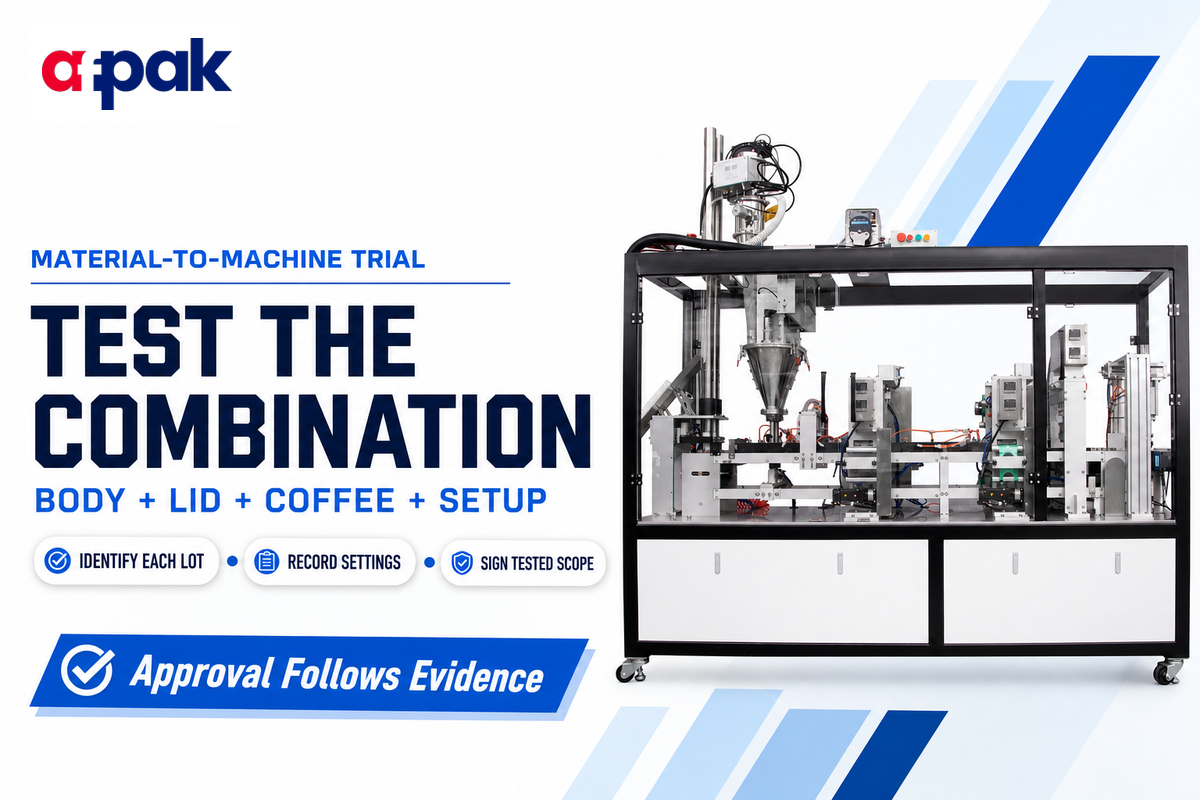
A controlled material-to-machine trial evaluates the combination of body and lid under an agreed production condition. Keep the coffee, tooling, settings and test methods traceable to each result. First, consider the supplier evidence and then verify performance on the specified equipment, rather than treating a laboratory sealing curve as finished production approval.
ASTM F2029-16(2021) mentions that laboratory and manufacturing sealers may vary in sealing area, scale, and speed. The heat-seal study serves as a production condition baseline.
“It does not cover the required validation procedures for the production equipment.”
Use the actual ground coffee and specified pack components. A description of the coffee beans alone doesn’t define the actual product being used in the trial. List the target fill weight in g, and the agreed speed in capsules/min. Seal settings are to be described with their units. For settings, distinguish what was measured from what the controller is set to. If a setting is changed, indicate this and separate the results before and after the setting change.
List the product variants proposed for testing. If flavoring or ingredients associated with food allergens are present, have the food safety lead determine the requirements for safe handling. Don’t think that a material qualification form replaces those requirements. An on-site trial and a supplier demonstration should use the same agreed upon identifiers and report fields.
AFPAK’s production-line page lists HB210, HB410 and HB610 arrangements with 2, 4 and 6 filling lanes and 4, 8 and 12 sealing heads, respectively. Those published arrangements show why a trial record needs lane and sealing station identities. They aren’t evidence that every lane passed your material trial. Confirm the exact purchased machine arrangement before drafting the test sheet.
- Check feeding and seating before attributing a stop to dosing.
- Record filling consistency and the condition of the flange before sealing.
- Apply the agreed strength, leak and gas checks to identified trial samples.
- Evaluate the required brewing/extraction behavior separately from storage evidence.
- Record start-up, restart and any planned operating conditions in the signed trial scope.
In the case of switching from pre-cut lids to roll film, the trial must cover unwind, registration and cut, as well. AFPAK’s guide to foil, roll film and pre-cut sealing may be of assistance with the equipment discussion. The approval should identify the combination that was tested, rather than say “all compatible lids approved.”
Quarantine Failures and Control Material Changes
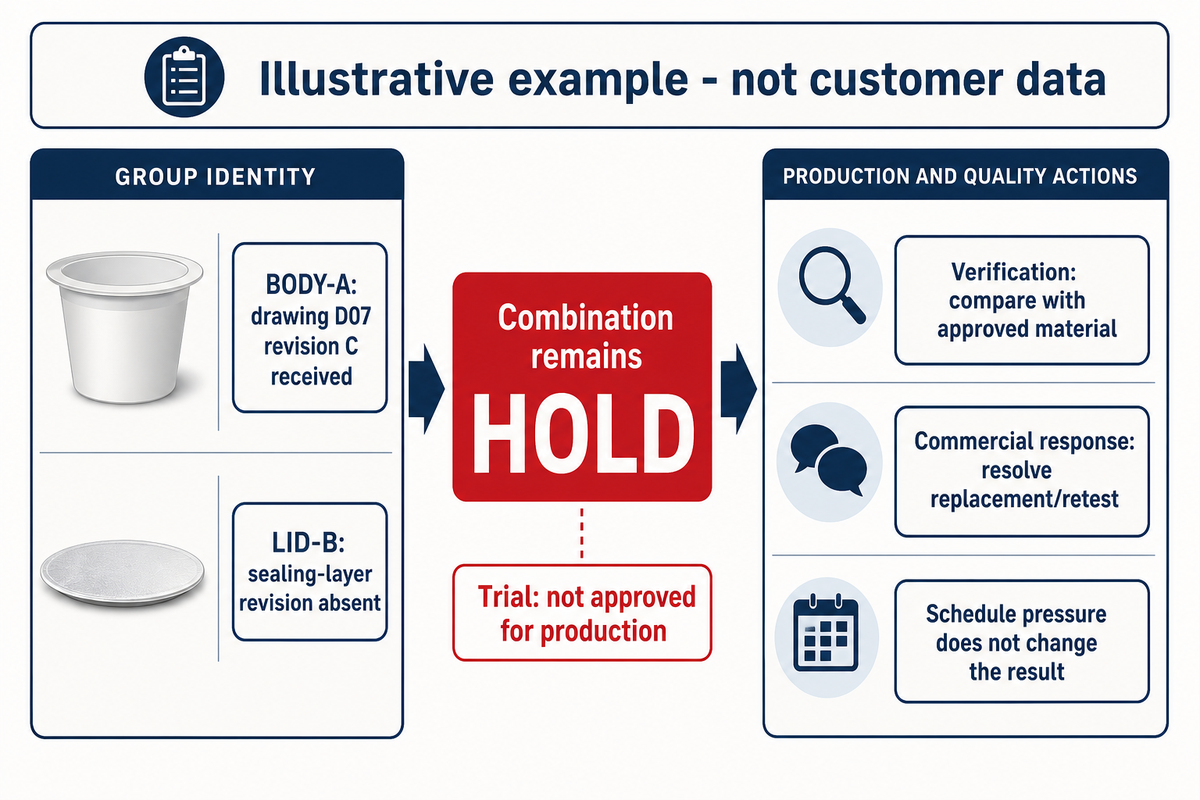
A failed or incomplete incoming record requires a hold decision, marked sample, and an investigation. Separate missing evidence from measured nonconformances. Both may prevent release, but they require different corrective actions. Don’t delete that distinction by retesting until a favorable result is shown.
The illustration that follows uses fictitious identifiers BODY-A and LID-B, not AFPAK customer data. The body drawing is available; however, the revision of the lid’s sealing layer isn’t available. The correct result is a hold on the combination, even if a few samples that were sealed manually look acceptable.
| Record field | Example entry | Responsible next action | Release boundary |
|---|---|---|---|
| Body identity | BODY-A; drawing D07 revision C received | Quality confirms match to received labels | Does not identify the lid |
| Lid identity | LID-B; sealing-layer revision absent | Procurement obtains the controlled construction record | Combination remains HOLD |
| Trial status | Not approved for scheduled production | Production preserves proposed setup and sample IDs | Appearance-only trial is insufficient |
| Verification | Pending comparison with approved material | Quality defines whether additional testing is needed | No automatic release after an email arrives |
| Commercial response | Replacement/retest responsibility to be resolved | Buyer and supplier apply the purchase agreement | Schedule pressure does not change the result |
A material change warrants a new review, even if the outer dimensions stay the same. In its July 2025 Metropolis Coffee report, Packaging World mentions a compostable body and a lid with separate sealing, barrier and filtering functions. This is a third party (packaging) case, and not related to AFPAK. This illustrates that replacing “just the lid” can include more than one performance requirement.
When should a material lot stay on hold?
A material lot should remain on hold when its identity is undetermined, required evidence is lacking, or an agreed acceptance criterion isn’t met. Identify which of the three is the case. For a suspected sealing problem, retained samples of body and lid should be held as well as measured results and set machine parameters before the process is changed or the shipment is returned.
Useful lines of investigation include change to wrong material, damaged flange, contamination present at the interface and a test method that doesn’t match the claimed result. With respect to a brewing complaint, determine if water escaped during extraction, or if a drip was seen after opening the machine. These observations aren’t interchangeable. Assign each branch to the supplier, quality team or production team. AFPAK’s article on coffee capsule seal failures covers the troubleshooting topic separately; incoming qualification should keep the evidence needed to investigate it.
A new approach to sustainability can involve different raw materials and a different sealing layer. Put that change through the agreed review even if the supplier retains the same product name. Environmental positioning doesn’t answer the mechanical or food-contact questions.
Prepare the Supplier Trial Request
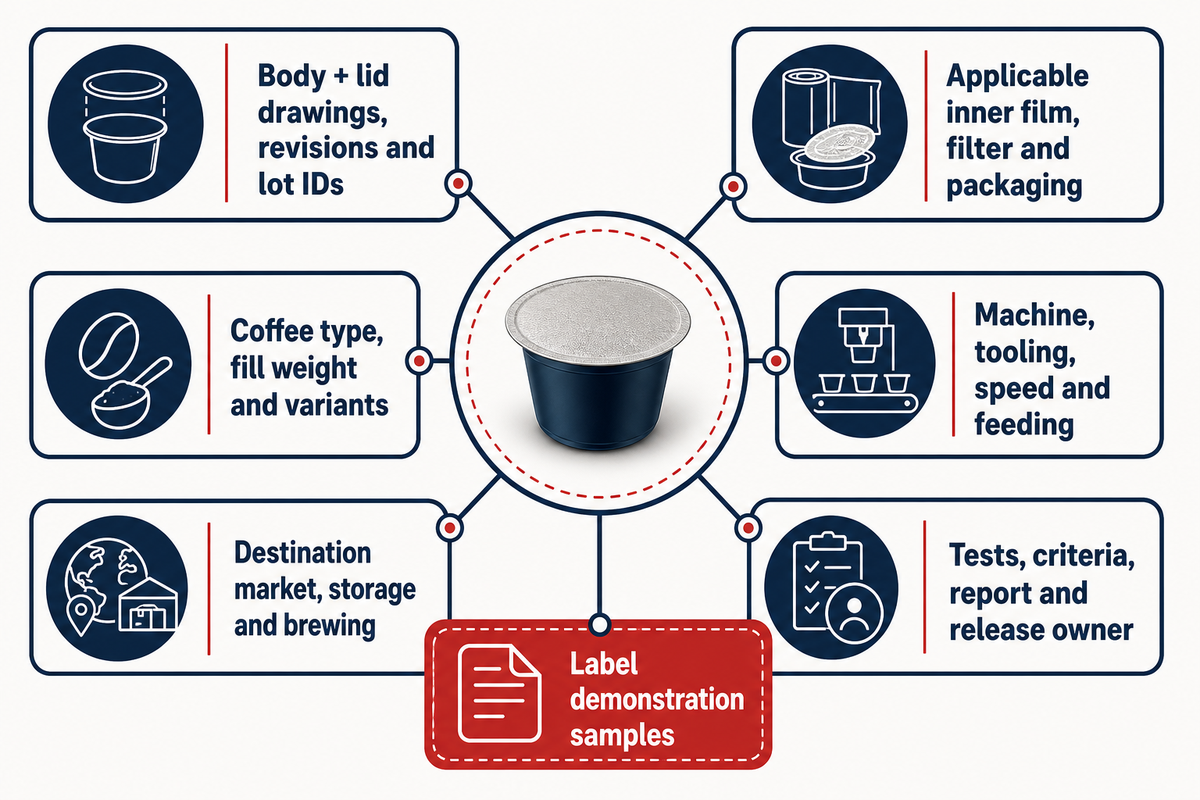
The ideal supplier trial request specifies the material and proposed use, and identifies the decision the trial must help clarify. Label demonstration samples as demonstration samples. This gives the supplier the opportunity to scope the test appropriately. Sample size is determined after the scope of testing and destruction, repetition, and retained samples are agreed to; a defensible, universal sample size for every case doesn’t exist.
NIST distinguishes lot acceptance from estimating lot quality. Separately, FDA’s food-contact chemistry recommendations tie test specimens and exposure conditions to the intended use; those recommendations do not suggest a machine trial.
Trial request checklist
- Body and lid drawings, construction/revision and lot identifiers.
- Applicable inner film, filter and packaging components.
- Coffee type, target fill weight and any relevant product variation.
- Selected machine, tooling, target speed and automatic feeding arrangement.
- Destination market, storage and brewing conditions.
- Agreed tests, decision criteria, report format and release owner.
The pack is sent to AFPAK with the proposed production requirements. AFPAK is instructed to confirm the material samples and the scope of the trial prior to finalization of the machine set-up. Maintain the decisions to release the material, approve the trial, and set the shelf life of the finished coffee as separate signed documents.
Frequently Asked Questions
What is the difference between a batch number and a lot number?
Both identify a defined group, but the supplier’s coding rules determine the exact meaning.
A batch commonly describes a production run, while a lot may describe a group controlled for production or shipment. Suppliers can use the terms interchangeably. Ask what the identifier retrieves and whether different manufacturing runs can share a shipment. Keep body and lid identifiers separate in receiving records, then link both to the finished coffee batch so an investigation can trace the correct materials.
What is the difference between a batch number and a serial number?
A batch number identifies a group; a serial number identifies an individual item.
The distinction is useful in a machine trial. The equipment serial number identifies the machine, while the capsule and lid batch numbers identify the materials used. Neither replaces the other. Record the tooling or station identifier where relevant, too. A later auditor should be able to connect the physical machine, material lots and test report without relying on someone’s memory of the demonstration.
Can third-party compatible capsules run on the same filling machine?
Possibly, but compatibility requires checking the actual capsule, lid and machine arrangement.
A claim that a capsule works in a particular consumer brewer doesn’t prove that it will feed, seat, fill and seal on a specific production line. Compare the drawings and material construction, then test representative samples with the proposed tooling and settings. AFPAK asks for actual capsule, lid and coffee samples before confirming a setup. Keep the approval limited to the combination tested.
Is a supplier certificate enough to release an incoming lot?
A certificate is one part of the evidence pack, not automatic permission to release.
Check its product identity, manufacturer, revision, scope and intended use. Then apply the agreed receiving inspection and release rules to the actual shipment. A certificate for another material or use can’t close the gap.
How many capsules should be sampled from each delivery?
The sample count must come from the agreed plan and the lot being evaluated.
Define the lot, defect classes, inspection method and acceptance rules first. Consider whether the supply is a continuing series or an isolated order and whether testing destroys the samples. The quality lead should choose the plan with the supplier and test provider. A number copied from another factory may produce a different buyer risk and may not cover the same material or failure mode.
Does a strong seal mean the capsule has no leaks?
No. Peel strength and leak integrity are different properties.
A strong portion of a seal can coexist with a defect elsewhere. Use the agreed leak test for the actual package and keep its conditions with the result.
Can incoming inspection establish the coffee’s shelf life?
No. Incoming inspection alone cannot establish finished-product shelf life.
Incoming results help confirm the materials entering production. Shelf-life evaluation concerns the filled product and its actual pack, process, storage and distribution conditions. Keep barrier evidence, residual oxygen, seal integrity and product-quality observations distinct. A capsule that meets a drawing or passes a peel test hasn’t, by that result alone, demonstrated that its coffee will remain acceptable throughout the proposed storage period.
Discuss the material combination before choosing the line
Prepare your capsule and lid specifications, coffee details and trial objectives. Review AFPAK’s production-line options with that evidence pack so the machine discussion starts with the materials you intend to run.
The guide has used public technical sources and AFPAK’s published product information. Illustrative examples of the filled hold records are provided. Acceptance limits, test selection and requirements of the market must be set for the actual material and product of interest to the project.
References & Sources
- Determining the Regulatory Status of Components of a Food Contact Material U.S. Food and Drug Administration.
- Food Contact Materials: Legislation European Commission.
- F88/F88M-23: Seal Strength of Flexible Barrier Materials ASTM International, public scope.
- F2824-10(2025): Mechanical Seal Strength Testing for Round Cups and Bowl Containers with Flexible Peelable Lids ASTM International, public scope.
- ASQ/ANSI Quality Standards Z1.4 & Z1.9 American Society for Quality.
- ISO 2859-2:2020: Sampling Plans for Isolated Lot Inspection International Organization for Standardization, public abstract.
- What Kinds of Lot Acceptance Sampling Plans Are There? National Institute of Standards and Technology, section 6.2.2.
- F2029-16(2021): Making Laboratory Heat Seals ASTM International, public scope and significance.
- Compostable Capsules for Nespresso Original Line Systems Pat Reynolds, Packaging World, July 11, 2025.
- What Is Acceptance Sampling? National Institute of Standards and Technology, section 6.2.1.
- Preparation of Premarket Submissions for Food Contact Substances: Chemistry Recommendations U.S. Food and Drug Administration.