
Atualizado em agosto de 2026
O café expira? a expiração do café é principalmente uma questão de sabor, não um ponto de corte de segurança: o café seco perde gradualmente aroma e sabor através da oxidação, em vez de estragar a maneira como o leite ou a carne fazem Um saco meio usado na parte de trás da despensa geralmente desperta esse pensamento, sempre que um comprador avista um “melhor por data de” além de sua expiração Na realidade, a resposta é mais complicada do que um simples sim ou não (o café não necessariamente vai mal como leite ou carne, ainda assim muda, e entender como ele muda é o que distingue entre uma xícara amarga de café velho e com sabor de papelão e quando jogá-lo oficialmente no lixo.
Este guia desembala todos os tipos de café, explica o que as datas “best by” significam do ponto de vista jurídico (e uma mudança na lei da Califórnia em 2026) e separa os dois tipos de perguntas: o que há de melhor no café velho e o que há de seguro nele?
Bebedores de café especializados frequentemente fazem duas perguntas ligeiramente diferentes: o café fica obsoleto, e o café realmente expira? café de meses não significa automaticamente que não é mais consumível, mas quanto tempo dura o café, e quanto tempo o café permanece fresco, depende muito de como o café permanece bom quando você o mantém em embalagens seladas e secas, mas pode ir de saboroso a sem brilho muito mais rápido do que o esperado quando você abre o saco Este guia examina cada variedade de café, descreve como cada um contribui para diferentes durações de vida útil e identifica qual deles tem a vida útil mais longa de todos Em última análise, o objetivo é ajudá-lo a desfrutar do seu café o maior tempo possível, se isso significa que ele permanece fresco por duas semanas ou dois anos Os leitores geralmente fazem várias versões da mesma pergunta: o café fica ruim, quanto tempo dura o café uma vez aberto, o café preparado fica ruim na manhã seguinte e como você pode dizer se o café realmente ficou ruim apenas pelo cheiro.
Especificações rápidas: resumo da vida útil da prateleira de café
| Feijão inteiro, fechado | 3-9 meses para o pico de sabor, seguro bem além disso se selado |
| Café moído, aberto | 1-2 semanas para o sabor de pico |
| Café instantâneo, fechado | 1-2 anos |
| Cápsula/saco com descarga de azoto | 6-12 meses ou mais, selado |
O café expira? Resposta rápida
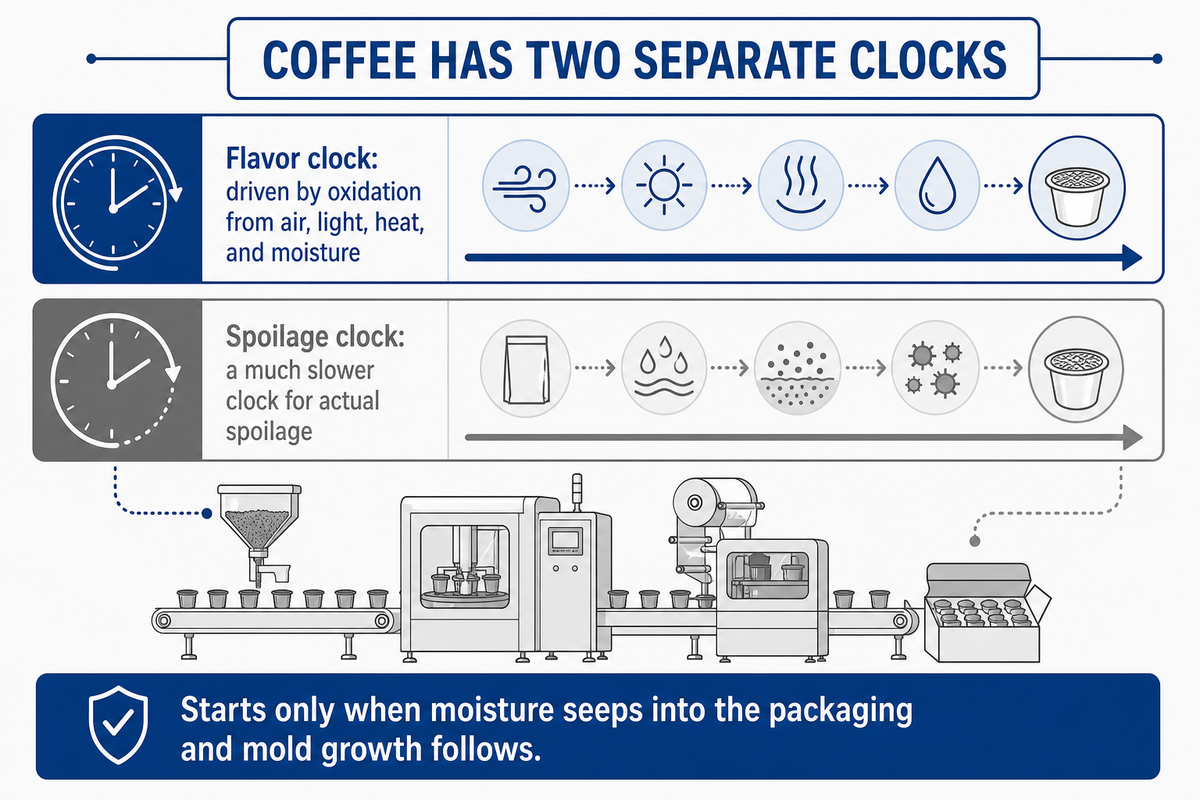
O café expira de uma forma que o torna inseguro para consumir? não como o leite estragado tornando-se coalhado ou carne expirada apodrecendo em poucos dias O café é um bem seco com teor de umidade muito limitado, e não tem risco de deterioração associado ao seu “best se usado por data de” por o Serviço de Inspeção e Segurança Alimentar do USDA; em suma, a data “best by” em um produto armazenado de café destaca quando ele está em seu perfil de sabor ideal, não quando expira Em vez disso, o que ocorre ao café ao longo do tempo é que seu aroma (os compostos voláteis do aroma) gradualmente se degrada através da oxidação (um processo lento e inevitável que o retira de seu aroma e sabor, tornando o produto plano, não perigoso.
“A ‘Melhor se Usado Por’ data indica quando um produto será de melhor sabor ou qualidade Não é uma data de compra ou segurança, exceto quando usado em fórmula infantil.”
• Departamento de Agricultura, Segurança Alimentar e Serviço de Inspeção
Duas linhas de tempo coexistem no relógio mundial do café chamá-lo de Modelo Two-C. Conflating um relógio com o outro é geralmente a fonte de toda a confusão, o relógio de sabor marca para baixo de oxidação causada pelo ar, luz, calor, e umidade os principais impulsionadores de perda para os óleos e compostos de aroma liberados durante a torrefação (o processo que libera CO2 e aumenta o aroma) Segundo, o relógio de deterioração é um relógio muito mais lento para deterioração real; ele só marca para baixo, no entanto, quando a umidade se infiltra na embalagem e crescimento do molde segue, o que indica armazenamento defeituoso.
O mito melhor por
Existem duas falsidades concorrentes em relação ao café e ambas estão erradas Há a de como o café “expira” como qualquer outro alimento perecível que leva as pessoas a despejar grãos perfeitamente bons na semana após a data impressa Uma segunda falsidade é prevalente dentro do espaço café-entusiasta: que o café seco é efetivamente imortal e nunca pode realmente ficar ruim O comportamento real do café pousa em algum lugar no meio desses dois extremos: o café seco não adoecerá uma pessoa saudável meramente com base na idade, mas pode e irá estragar se ficar molhado, mofado ou infestado por pragas Pesquisas revisadas por pares sobre como o café é melhor armazenado respaldam o lado de decaimento de sabor disso mais diretamente Um dos numerosos estudos de armazenamento revisados por pares publicados em Banco de dados online do PMC do National Institutes of Health rastreia o café torrado ao longo de nove meses de armazenamento e encontra um declínio quantificável na qualidade do sabor devido a um processo impulsionado pela oxidação, não pela biologia.
| Formato | Inaugurado/Selado | Aberto | Primary Spoilage Driver | Ideal Storage |
|---|---|---|---|---|
| Whole bean | 3-9 months past roast for peak flavor | 2-4 weeks peak flavor, 3+ months still usable | Surface-oil oxidation | Airtight, dark, cool |
| Café moído | 3-5 months peak flavor, up to 2 years still usable if sealed | 1-2 weeks peak flavor, up to 1 month still usable | Oxidation, larger surface area | Airtight, dark, cool |
| Café instantâneo | 1-2 anos | 2-6 months | Moisture absorption, clumping | Airtight, dry |
| Cápsula/saco com descarga de azoto | 6-12 months or longer | Single-serve, N/A | Seal/barrier-film integrity | Cool, dry, unopened |
| Standard (non-flushed) pod | Varies with film quality, typically shorter than N2-flushed | Single-serve, N/A | Oxygen permeation through film | Cool, dry |
| Green (unroasted) beans | 12-15+ months | N/A | Slow moisture/quality drift | Cool, dry, breathable bag |
| Brewed coffee, room temperature | N/A | 12-24 hours, best in first 30 min | Oxidation and bacterial growth | Refrigerate promptly |
| Brewed coffee, refrigerated | N/A | 3-4 days | Flavor oxidation | Airtight container, fridge |
| Cold brew concentrate, refrigerated | N/A | 5-7 days homemade, up to 1-2 weeks commercial sealed | Bacterial/pathogen risk if not kept cold | Refrigerate continuously, never room temp for long |
O que realmente significa o encontro na bolsa
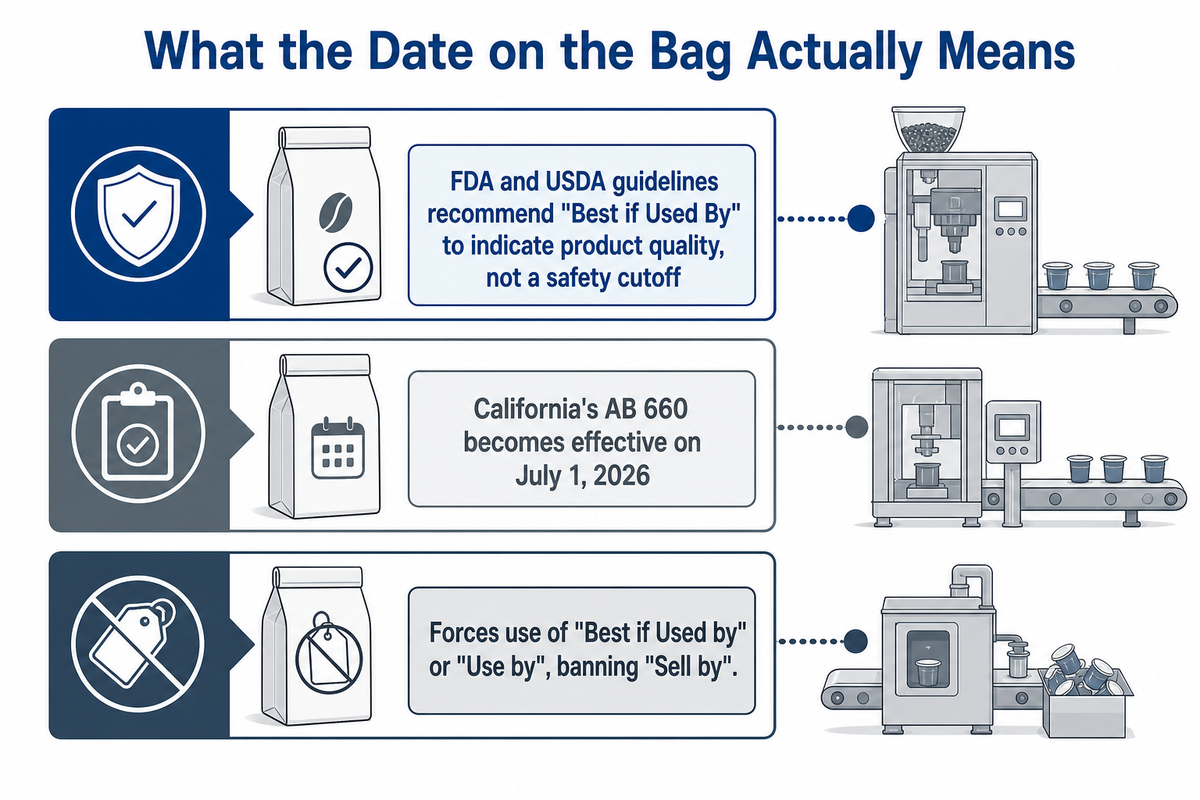
In the United States, dates on food are optional, and only some items are required to carry a date label. Federal FDA and USDA guidelines jointly recommend manufacturers use labeling such as “Best if Used By” to indicate product quality, not a safety cutoff. Most shelf-stable products, including coffee, don’t even require a printed date at all. When a roaster does print one, it’s intended as a quality marker, not a kill-date countdown.
That said, state-level changes are coming, and the ambiguity over who exactly must comply only adds to the confusion shoppers already feel about date labels. California’s AB 660, passed by the state legislature, becomes effective on July 1, 2026 and is worth dissecting since it’s easy to over estimate exactly what it mandates. AB 660 doesn’t mandate that roasters must date all coffee bags. Instead it only requires that any of these entities label with a date when they’re producing, packaging, or selling a product labeled with a quality or safety date, or when it’s required by other statutes. Once that date passes, it forces any entity to use either ‘Best if Used by’ (for quality) or ‘Use by’ (for safety), banning’ Sell by’. Both the California Department of Food and Agriculture and a study on the matter published by the National Agricultural Law Center support this more precise reading: the statute standardized labels; it didn’t mandate that dates be on all products.
For coffee in particular, this means a little is changing. What matters more than a ‘best by’ date on the bag is the roast date. Roasters usually calculate a coffee “best-by” date as a fixed window (often 12 to 24 months) after roasting, regardless of how the bag has been stored. The clock starts the moment coffee roasts, not the day it’s packaged or sold.
Café de feijão inteiro: quanto tempo realmente dura
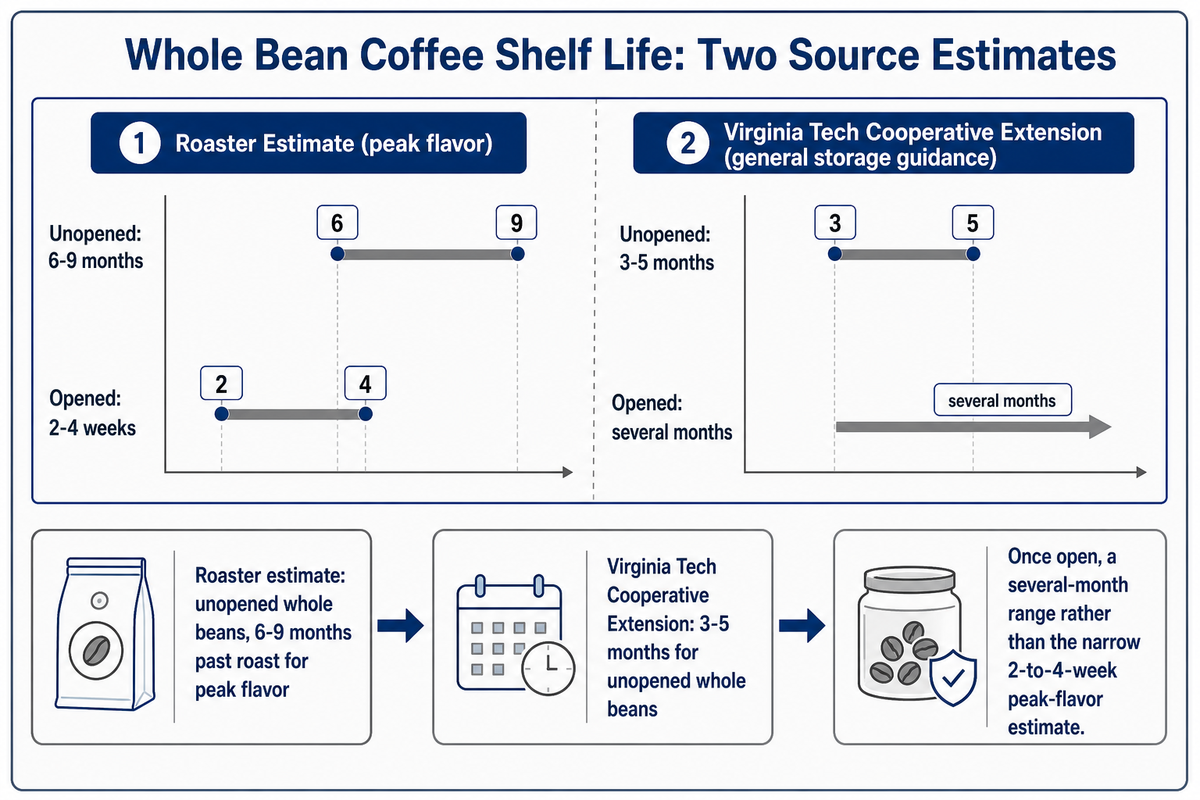
Whole bean coffee retains flavor longer than any other format because the exposed surface area is smallest. Roaster-sourced guides frequently place unopened, properly stored whole beans at 6-9 months past their roast date for peak flavor; a 2025-revised food storage guide from Virginia Tech’s Cooperative Extension recommends a more conservative 3-5 months for unopened whole beans, and once open, allows a several-month range rather than the narrow 2-to-4-week peak-flavor estimates roasters tend to provide. These two figures are by no means contradictory: the shorter, roaster-sourced ranges describe when whole beans are at their absolute freshest, while the longer, extension-sourced guidance describes when they’re still reasonably good, with both figures pointing to safety well past those limits as long as the bag has never gotten wet.
It boils down to a process called degassing. Newly roasted beans release carbon dioxide for weeks following the roasting – this is the reason some roasters advise “resting” beans, and the cause of those slightly puffy vacuum-sealed roasted bags. It’s in this escape of carbon dioxide that the majority of those volatile, aromatic-smelling molecules in a fresh brew escape as well, and the Institute of Food Technologists’ own peer-reviewed research confirms how post-roast storage affects the process.
Coffee enthusiasts use the “15-15-15 rule” to manage their freshness expectations, though the rule gets applied in more than one way. According to some, it means 15 days from roast to brew, 15 minutes from grind to brew, and 15 minutes to consume; a few others take 15-15-15 to mean 15 months of shelf life for unopened, unroasted beans, 15 days of post-roast flavor peaking, and a third, more elastic “15” for ground coffee. Either way, the core lesson is the same: coffee is at its best close to its roast date, and not for very long.
Café moído: por que fica obsoleto mais rápido
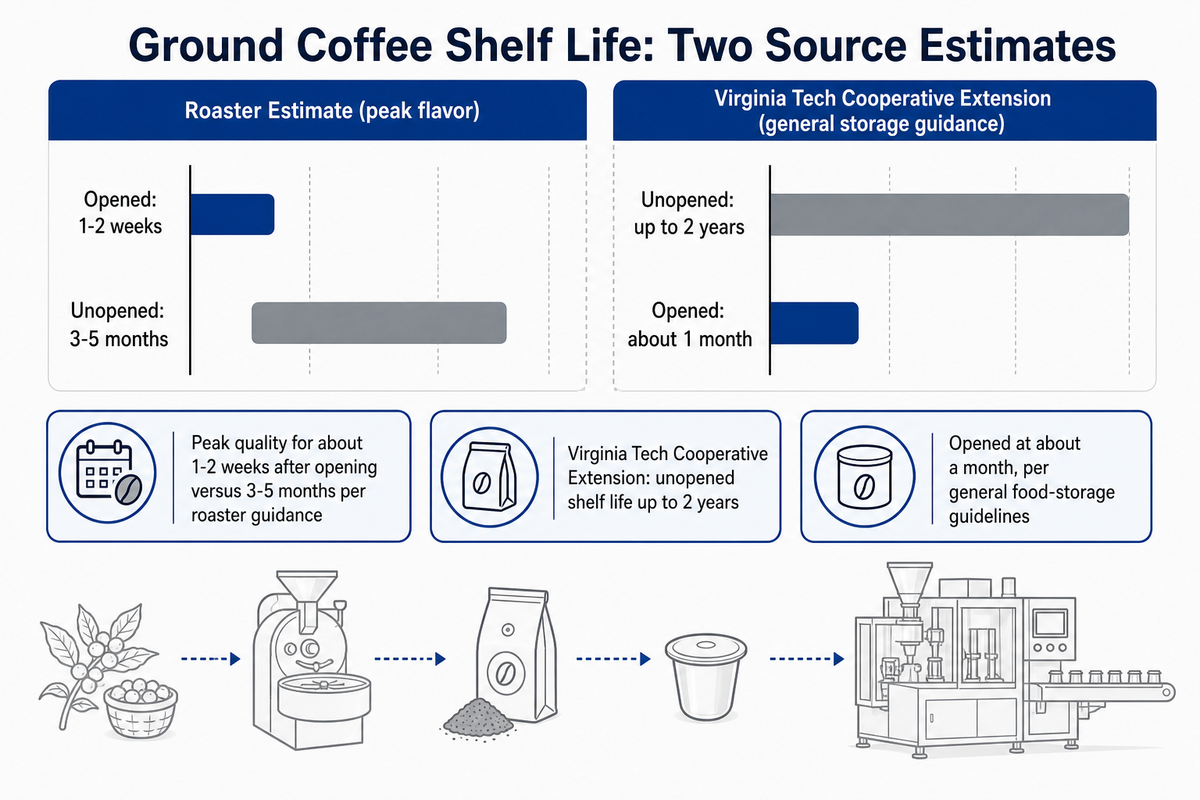
Ground coffee loses its fresh flavor faster than whole beans, usually holding peak quality for about 1-2 weeks after opening versus 3-5 months according to roaster guidance (Virginia Tech Cooperative Extension puts unopened shelf life at up to 2 years and opened at about a month, though that reflects general food-storage guidelines rather than a coffee-specific peak-flavor window). Once ground, the bean’s surface area increases dramatically, which accelerates the same oxidation process whole beans undergo, just far faster.
This is the real reason serious coffee drinkers take the time to grind just prior to brewing, versus purchasing pre-ground beans in bulk. Buying pre-ground beans for convenience will always come at the expense of longevity in flavor quality. Should pre-ground options be unavoidable, opt for the smallest available package size and invest in a top quality, truly airtight container to extend the enjoyment window.
Ground coffee behaves very differently from whole coffee beans, and coffee can go stale within days once ground and exposed to air. Coffee loses its aroma fastest right after grinding, since grinding multiplies the surface area exposed to oxygen; coffee grounds may also pick up odors from the refrigerator or pantry around them if left uncovered. This is why people who store coffee as whole beans and only grind down what they need get more consistent results from cup to cup – how you use coffee grounds right after opening the bag affects how fast the rest of it stales. Coffee stays fresher for much longer sealed as whole beans than it does ground. How coffee tastes a week after opening depends heavily on how it was stored in between, and however you want your coffee to taste, the taste of coffee is far more forgiving when it is still whole bean.
Café Instantâneo: O Formato Mais Duradouro
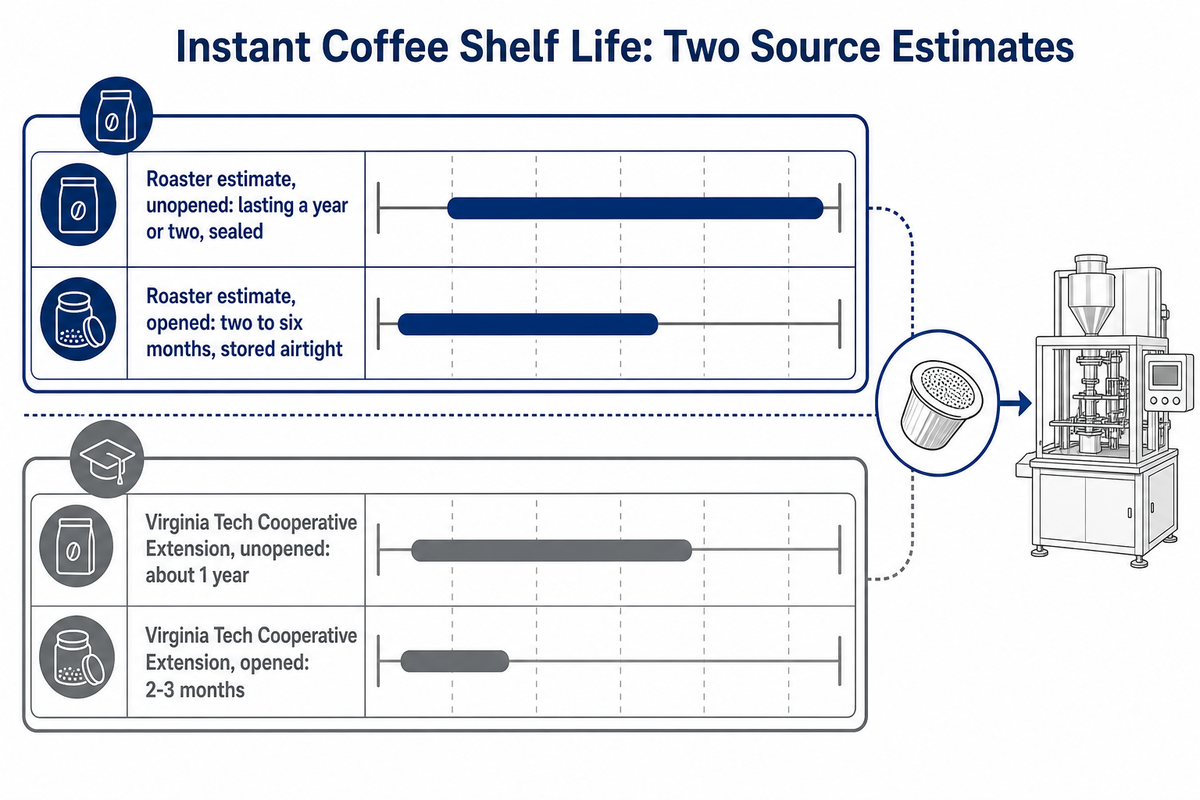
Instant coffee is the most shelf-stable format of all, lasting a year or two according to some sources (unopened and sealed) or two to six months once opened and stored airtight as the texture and flavor begins to fall off; opened instant coffee still outlasts opened ground coffee by a wide margin. Virginia Tech’s Cooperative Extension offers a more conservative estimate of about 1 year unopened and 2-3 months opened, which reflects general food-storage guidance rather than a peak-flavor window. That’s because brewed instant coffee is then freeze-dried or spray-dried to remove nearly all its moisture content, making oxidation and water work to less and less purpose.
Freeze-dried granules hold the only real storage edge over spray-dried ones, since the lower-heat drying process causes less damage to the volatile aroma compounds. Both formats share the exact same failure mode, though: moisture. An opened jar of instant coffee, once exposed to humidity, will quickly start clumping and hardening, which is the clearest sign it needs replacing.
Os K-Cups e as Cápsulas de Café Expiram?
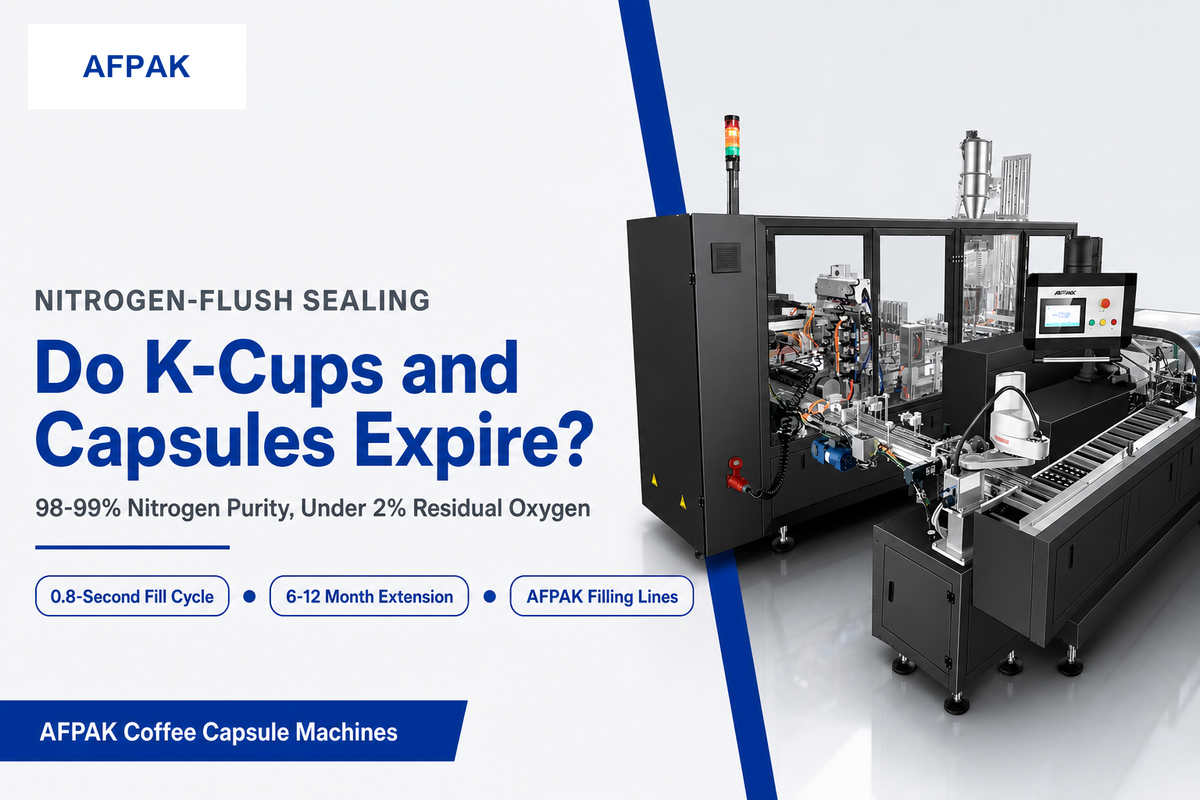
Yes, K-Cups and Nespresso-format capsules do have a shelf life, but single-use capsule shelf life is determined less by the coffee inside than by the packaging-system around it. A sealed capsule of coffee stays fresh for a long time based on the type of gas inside the capsule, the barrier-film material used, and the storage temperature.
This is why technologies like nitrogen-flushing exist. On AFPAK’s own coffee capsule filling and sealing lines, an optimized vacuum-nitrogen 3-phase pulsation cycle floods each capsule with 98-99% pure nitrogen gas, displacing the capsule’s air content, including oxygen, and reducing residual oxygen inside the sealed capsule to under 2% within about 0.8 seconds during the fill-and-seal cycle. This process preserves the coffee and can extend a sealed coffee capsule’s shelf life anywhere from 6 to 12 months or longer, a figure that lines up with one commercial coffee roaster’s own consumer-facing claim that “vacuum-sealed or nitrogen-flushed bags containing roasted, ground, or instant” coffee can last 6 to 12 months or longer when kept sealed in a cool, dark place — arrived at completely independently of any capsule-manufacturing context. It is also consistent with a peer-reviewed packaging-film study in Molecules that directly measured how standard aluminum-foil barrier-film packaging compares to a recyclable alternative for capsule coffee freshness over time.
In practice, the real issue isn’t “how long do coffee capsules last” in the abstract, it’s what capsule packaging system is being used. For a single-serve product, a coffee brand needing to know the right package for its product, or a buyer wondering how a given brand’s single-serve coffee stays fresh months after production, the real question is “which gas and barrier film combination is this specific capsule using?” Brands evaluating K-Cup filling and sealing equipment or a Nespresso-format capsule line are, in effect, choosing a shelf-life outcome as much as a production line. AFPAK’s own technical breakdown of how nitrogen protection extends coffee capsule freshness covers the gas-flush process in more production-level detail, and the companion guide on increasing coffee capsule shelf life walks through the grinding, packaging, and storage variables that compound with gas-flushing to determine a capsule’s real-world freshness window.
For anyone with a single Nespresso or K-Cup pod at home: a tightly sealed, unopened pod from a commercial brand is usually still fine well past its published use-by date, because its individual airtight packaging only has to keep oxygen out until the moment it’s steeped in the machine – an advantage large coffee bags don’t have once they’ve been opened.
Café preparado e frio: um relógio diferente
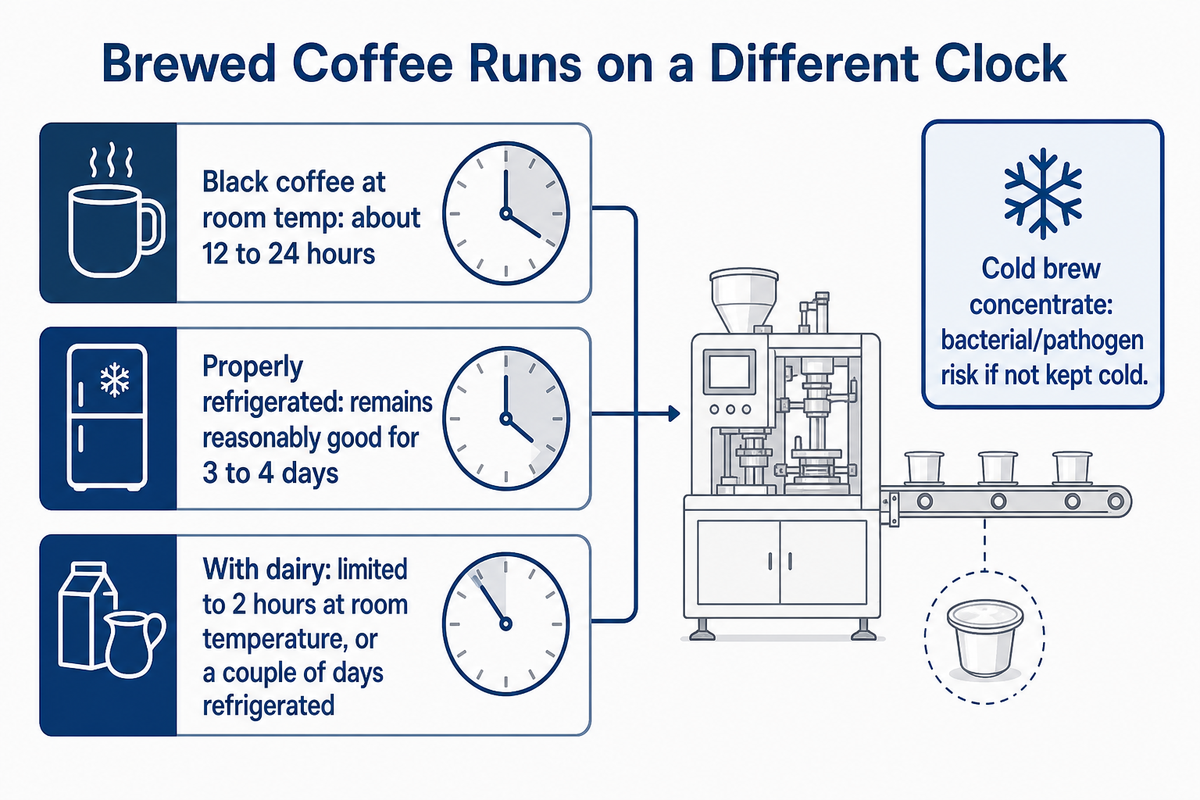
After it’s finished, the storage conversation changes altogether: Because brewed coffee is a moist (not a dry good), low-acid liquid, it operates on a radically faster clock than beans or grounds. FDA’s “two-hour rule” generally applies to foods that the agency considers perishable, like meat, poultry, seafood, eggs, and produce, and black coffee isn’t on that list, which is why plain black coffee has more quality-focused (not safety-focused) leeway than a two-hour cutoff, translating into a longer shelf-life driven by quality rather than safety. Black coffee stored outside its airtight container at room-temperature can typically be drunk for about 12 to 24 hours, though flavor quality degrades significantly much earlier (around the first 30 minutes post-heat).
Properly refrigerated within the airtight container it will remain reasonably good for 3 to 4 days. Once creamer or milk comes into contact with the coffee, its shelf life dramatically shrinks: Add dairy and coffee now follows normal dairy storage protocol, limited to 2 hours at room temperature, or a couple of days refrigerated.
Is brewed coffee the same as drinking dry coffee? Not even. Fresh brewed coffee is best within the first hour, and freshly brewed coffee that sits on the warming plate in the carafe of a coffee machine goes off more quickly than coffee stored in a sealed cup left out at room temperature. Iced coffee is no different than regular refrigerated brewed coffee once the ice has melted into it.
Cold brew needs its own discussion – for obvious reasons, this is “brewed coffee, but cold.” Unlike hot-brewed coffee, which includes a heat-kill step, cold brew steeps for many hours at room or even refrigeration temperature with no hot-brew step to affect its safety. Homemade cold brew concentrate, kept continuously refrigerated, is good used within 5-7 days. Commercially produced and sealed cold brew has a longer suggested shelf life (sometimes a week or two refrigerated), though. It comes down to more than just staleness in this case. Cold brew doesn’t have the near-boiling heat kill step of hot brewing, and if left un-refrigerated, or produced in large quantities without temperature control it presents a genuine food-safety issue in addition to flavor, not just a cosmetic one. Don’t be lulled into a false sense of security from dry coffee being very low risk – cold brew once wet and unheated, must be treated with the same refrigeration discipline as any other drink.
Sinais de que seu café realmente estragou
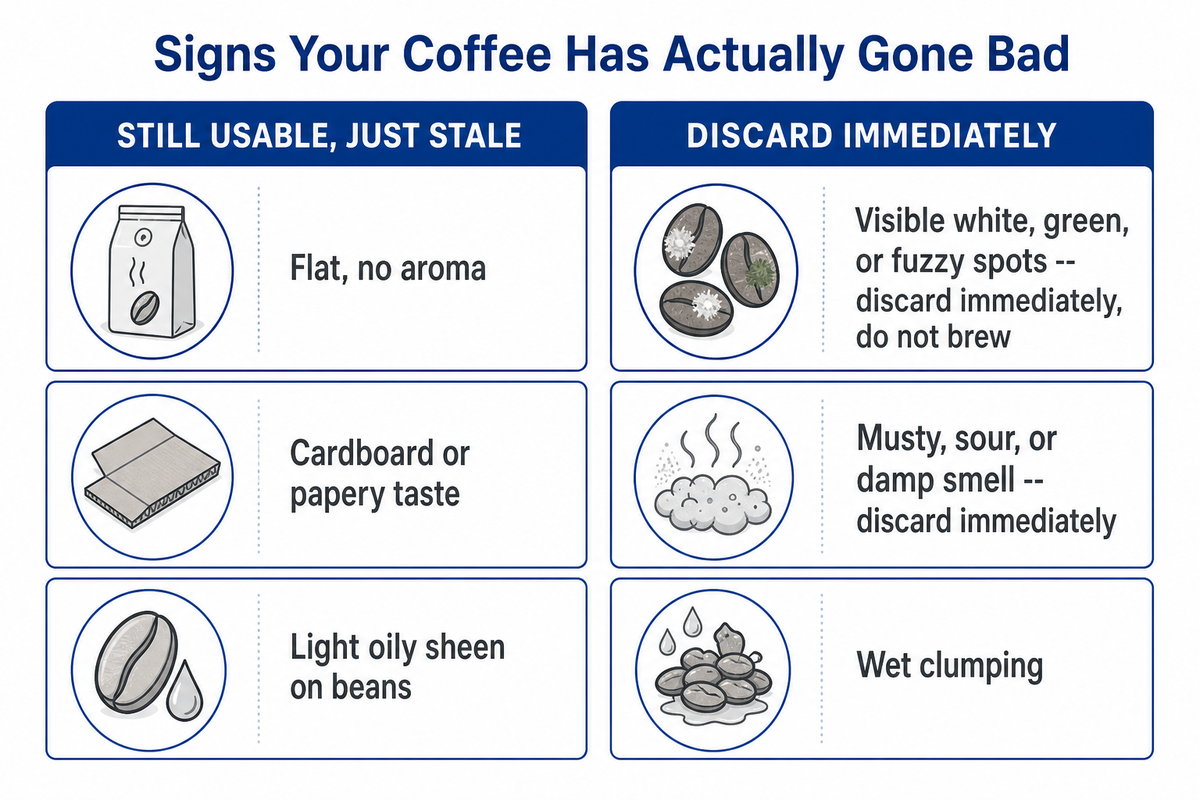
Much of what consumers recognize as “expired coffee” really comes down to little more than stale coffee. There are subtle but significant differences in the appearance and behavior of the two formats that allow for a quick distinction. Learning how to distinguish stale coffee from genuinely “ruined” coffee is far more important than paying close attention to a bag of beans. These tables distinguish quality-only, merely aesthetic indicators from outright discard-level warning signs that mean it’s genuinely time to toss the coffee.
| Signal Type | Likely Cause | Still Usable? | Recommended Action |
|---|---|---|---|
| Flat, no aroma | Oxidation, CO2 has off-gassed | Yes, just stale | Use for cold brew, or replace |
| Cardboard or papery taste | Extended oxidation | Sim | Brew stronger, or replace soon |
| Light oily sheen on beans | Normal roast oils, or beans past their prime | Usually yes | Check smell before brewing |
| Visible white, green, or fuzzy spots | Mold from moisture intrusion | Não | Discard immediately, do not brew |
| Musty, sour, or damp smell | Moisture contamination | Não | Discard immediately |
| Wet clumping (instant or ground) | Moisture absorption | Não | Discard, do not rehydrate or use |
| Ice crystals on frozen beans | Freeze-thaw cycling, condensation | Yes, quality-reduced | Use soon, avoid re-freezing |
| Pantry moths or insects present | Pest contamination | Não | Discard, inspect storage area |
| Gray or greenish discoloration | Oxidation, or possible contamination | Depends | Discard if paired with smell or mold |
It bears emphasis that the sensory clues for judging quality and staleness – appearance, smell, taste – are remarkably reliable for dry coffee because the moisture levels are so low that pathogen proliferation is difficult. These checks do not provide adequate protection for wet foods, like brewed coffee or cold brew. According to the FDA’s own consumer guidance on food storage, food can cause illness even if it looks, smells, and tastes normal, which is particularly true for wet coffee products compared to the dry kind resting in a pantry.
É seguro beber café expirado?
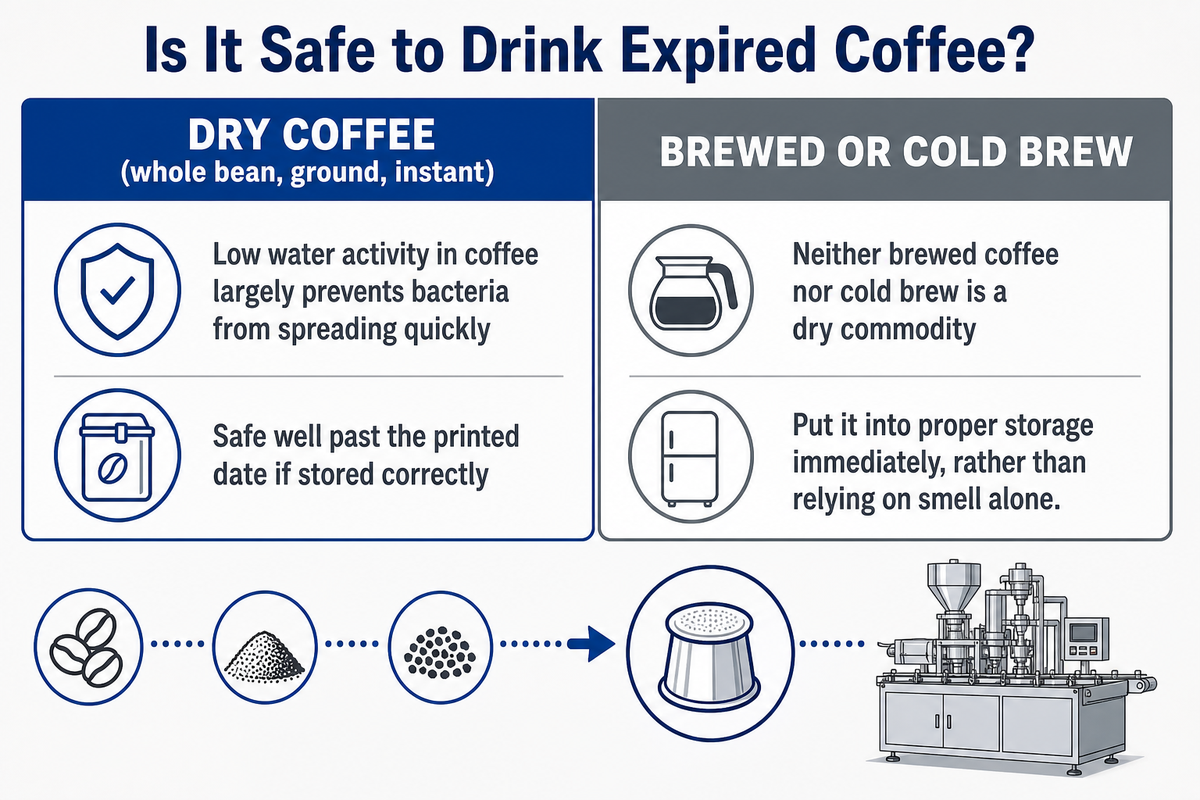
For whole beans, ground, or instant dry coffee, the answer is an emphatic yes, assuming you stored the coffee correctly and it displays none of the discard-level signs listed above that call for disposal. Low water activity in coffee largely prevents bacteria from spreading quickly, which is why the USDA’s Food Safety and Inspection Service considers the date printed on a coffee bag to be a quality indicator as opposed to a definitive date for disposal.
But that figure is altered when coffee is wet. Neither brewed coffee nor cold brew is a dry commodity, and “it smells fine” as a quality check is a much less reliable metric – this is especially true for cold brew if it’s spent time non-refrigerated or was batch-fermented at uncontrolled temperatures. Real-world accounts from coffee drinkers communities often seem to align more with the dry end of coffee: one long-running forum discussion on older ground coffee concluded it “doesn’t necessarily expire but it does go stale… it should be ok for consumption if it was sealed,” which is spot-on for the general findings.
Elsewhere, there’s confusion between expired and best before, with one coffee drinker describing the difference as, expired can mean it’s unsafe or soon to be unsafe but best before means it’s still safe but no longer tastes good; for beverages in general this is fairly accurate, though as we’ve seen neither the words expired nor “best before” on coffee signify an actual safety threshold.
Use this as a general rule of thumb: for dry-coffee products, go by smell. But once it’s brewed, and especially once it becomes cold brew, put it into proper storage immediately like any other drink, rather than relying on smell alone.
Como armazenar café para desacelerar o relógio
The simplest advice for keeping your coffee from losing its flavor hinges on how coffee is stored – even a little pantry or cupboard away from your stove is better than a bag sitting openly on the counter. Keep coffee away from excessive heat and light in a cool, dark place, and once you tear open the package, it will both lose its flavor and aroma with every moment of exposure to the air. Buyers who buy coffee in bulk should split large bags into smaller airtight portions instead of continually opening and closing one bag; the goal, always, is flavorful coffee whenever you actually brew it.
Most guides agree on how best to store coffee beans and store your coffee overall: an airtight container, kept cool and dark, keeps coffee fresh far longer than a bag clipped shut and left on the counter. These tips to keep your coffee fresh apply across whole bean, ground, and instant formats, and a few simple steps applied to coffee to extend its shelf life go a long way. Stored this way, coffee remains safe and reasonably flavorful well past its printed date, whether you buy coffee by the bag or rely on a coffee subscription for a better overall coffee experience. Properly sealed, coffee can last well beyond its printed date without becoming unsafe.
No matter the method of storage you choose, staling isn’t something that can be put to a full stop, but it significantly postpones it. By mastering some simple rules, weeks or months of the lifespan of your dry freshness in any dry format can be reclaimed. According to the NCA (National Coffee Association) as well as academia (coffee-science research programs like the UC Davis Coffee Center), three elements threaten fresh coffee in all dry formats: light, air, and moisture, all of which warmth makes worse.
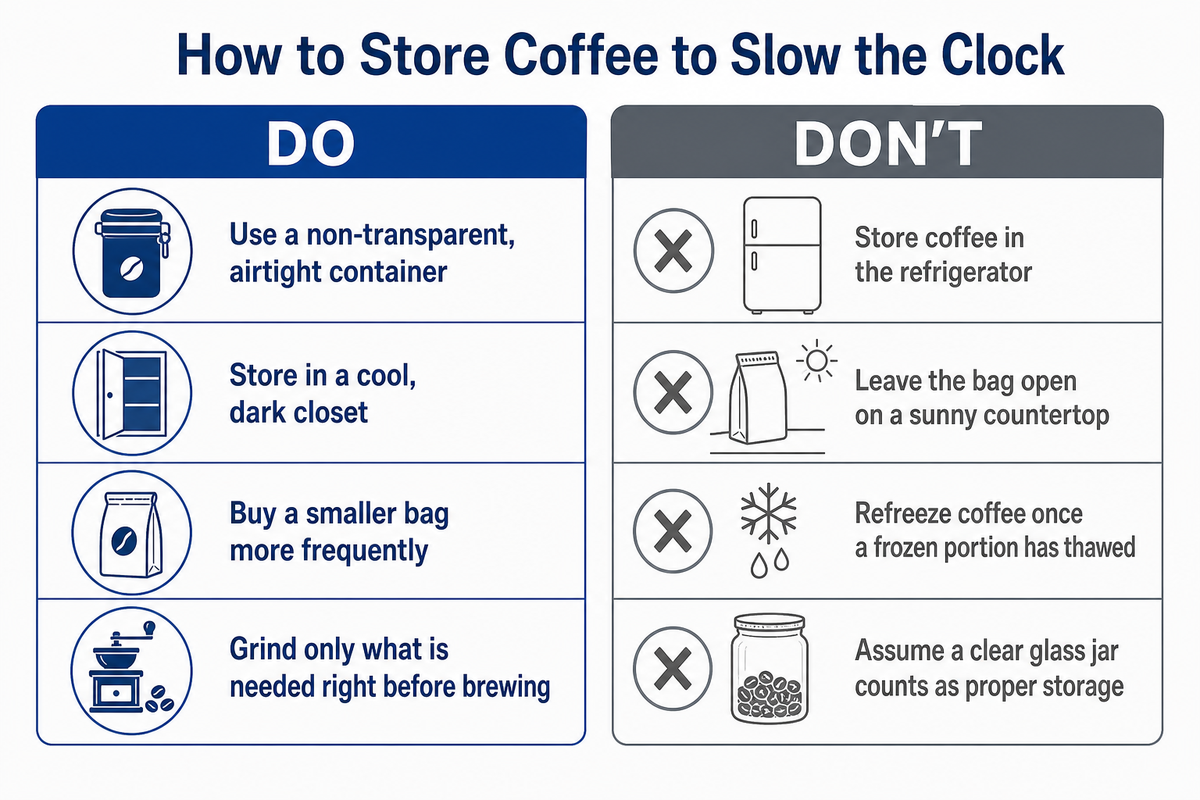
- Use a non-transparent, airtight container, do not use the clip originally supplied to close the bag
- Store in a cool, dark closet and out of reach of the oven or stove
- Buy a smaller bag more frequently than one big bag that would be left open for many months
- Grind only what is needed right before brewing
- Store coffee in the refrigerator
- Leave the bag open on a sunny countertop
- Refreeze coffee once a frozen portion has thawed
- Assume a clear glass jar counts as proper storage
Refrigeration deserves special mention. This is an all-too-common, but counterproductive habit. As a cold container rises to room temperature, condensation forms on its surface, and that moisture works against our efforts to keep coffee dry.
Though coffee may seem simple to store, any discussion among home coffee drinkers of how best to store their precious dry coffee long-term always ends up back at this single point-refrigeration only adds moisture exposure relative to keeping coffee in a simple, sealed container in a dry cabinet. Freezing in smaller portions is the exception. Break it down before you freeze it, and pull out one or two small amounts to thaw at a time rather than opening and closing a larger bag or container multiple times.
Veredicto Sniff-Look-Taste
Whether your goal for your coffee each and every morning is peak freshness, or you’re relying on a monthly subscription of coffee that lands on your doorstep as part of your regular coffee ritual, the best habits remain. There are surprisingly simple things you can do to prolong the useful life of your coffee – airtight, dark, cool, and consumed when it’s at its peak is the golden rule for keeping good coffee good and for enjoying all the nuanced flavors you originally selected that coffee for. By these methods, good dry coffee can remain safe and at least minimally palatable for extended periods beyond its printed “best by” date.
If a bag has been lingering for some time, there are three quick tests to resolve most doubts in a minute or so. First, give it a sniff: fresh, well-preserved coffee is rich and unique, while stale coffee is flat or dusty, potentially smelling like old cardboard. If coffee smells musty or sour, toss it immediately, since moldy coffee is a hazard. Second, examine it for appearance: good, dry coffee should be loose and free of clumping, significant discoloration, or signs of mold, and anything wet, clumpy, or mold-covered should be discarded. Third, if the above checks pass, take a small sip: stale coffee will taste flat and potentially watery but will usually be safe to drink, while anything that tastes “off,” beyond simple staleness, isn’t worth the risk, and calls for a fresh pot instead. These checks-smell, sight, and taste-are for judging dry coffee; they aren’t a substitute for good storage habits in the case of brewed or cold-brew coffee.
Sobre Esta Análise
This guide draws on USDA and FDA food-labeling guidance, peer-reviewed coffee storage research, and AFPAK’s own production-floor data on nitrogen-flush capsule sealing, gathered across the coffee capsule filling and sealing machines our engineering team designs for capsule producers worldwide. The nitrogen-flushing figures cited for K-Cup and Nespresso-format capsules come directly from the gas-flush parameters used on AFPAK’s own filling and sealing lines, confirmed by AFPAK’s technical team.
Perguntas frequentes
P: Você pode beber café 2 anos desatualizado?
Yes, unopened dry coffee that is 2 years past its printed date is usually still safe to drink if it was stored sealed, cool, and dry, though the flavor will be noticeably duller than fresh coffee.
P: O café ainda é bom depois de 4 anos?
Four-year-old coffee is very likely safe to drink if it stayed sealed and dry the entire time, but expect a flat, muted cup rather than anything resembling fresh coffee.
P: O café de 10 anos ainda é bom?
Ten-year-old sealed, dry coffee is generally still safe to drink, but by this point it will taste almost entirely of its container rather than of coffee, and most people will find it not worth brewing.
P: Qual é a regra 15-15-15 para o café?
One popular shorthand, the 15-15-15 rule, is a rough freshness guideline for coffee, but it is not applied consistently: some sources define it as 15 days from roast to use, 15 minutes from grind to brew, and 15 minutes to drink, while others use it to describe roughly 15 months of green-bean shelf life and 15 days of peak flavor after roasting.
P: O café expira se não for aberto?
Unopened coffee does not truly expire, but it does gradually lose flavor even sealed, typically staying near peak quality for 6-9 months (whole bean) or 3-5 months (ground) past the roast date.
P: O café expira na geladeira?
Storing dry coffee in the refrigerator does not directly cause it to expire, but it introduces condensation every time the container is removed and re-chilled, which speeds up staleness rather than slowing it.
Q: Que é a vida útil das vagens do café?
Coffee pod and capsule shelf life depends on how the individual pod was sealed rather than one fixed number; nitrogen-flushed capsules with a strong barrier film commonly hold flavor for 6-12 months or longer, while pods sealed without a gas flush typically last a shorter, more variable window.
Referências e fontes
- Food Product Dating Serviço de Inspeção e Segurança Alimentar do USDA
- USDA-FDA Seek Information About Food Date Labeling Administração de Alimentos e Medicamentos dos EUA
- Are You Storing Food Safely? Administração de Alimentos e Medicamentos dos EUA
- Food Date Labeling (AB 660) California Department of Food and Agriculture
- Date Labels and the New California Law National Agricultural Law Center
- Changes in Sensory Quality Characteristics of Coffee During Storage National Institutes of Health, PMC
- Relationship Between Coffee Quality and Storage Conditions Institute of Food Technologists (Wiley Online Library, peer-reviewed)
- Storage and Shelf Life Associação Nacional do Café
- Coffee Research UC Davis Coffee Center
- Food Storage Guidelines for Consumers Virginia Tech Cooperative Extension
- Coffee Pod Packaging Film Study Molecules (MDPI, peer-reviewed)
- Pathogen Survival in Cold Brew Coffee Study PubMed (peer-reviewed)
Artigos Relacionados
- Como a proteção contra nitrogênio revoluciona a frescura da cápsula de café? The production-side technical breakdown of the gas-flush process referenced above
- Como aumentar a vida útil da cápsula de café grinding, packaging, and storage factors for capsule producers
- Nespresso vs Dolce Gusto: Qual cápsula de café você deseja produzir?
- Powder-in-Cap Packaging: Viability Analysis