
Aktualisiert im August 2026
Verfällt Kaffee? Kaffeeverfall ist meist eine Geschmacksfrage, kein Sicherheits-Cutoff: Trockener Kaffee verliert durch Oxidation allmählich Aroma und Geschmack, anstatt zu verderben, wie Milch oder Fleisch es tun Ein halb benutzter Beutel auf der Rückseite der Speisekammer löst diesen Gedanken normalerweise aus, jederzeit entdeckt ein Käufer ein “Best-by” - Datum über sein Verfallsdatum hinaus In Wirklichkeit ist die Antwort komplizierter als ein einfaches Ja oder Nein (Kaffee wird nicht unbedingt schlecht wie Milch oder Fleisch, dennoch ändert er sich, und zu verstehen, wie er sich verändert, ist das, was zwischen einer bitteren Tasse abgestandenem, pappend schmeckendem Kaffee und dem offiziellen Einwerfen in den Müll unterscheidet.
Dieser Ratgeber packt jede Kaffeesorte aus, erklärt, was die “best by” - Datteln rechtlich bedeuten (und eine Änderung des kalifornischen Gesetzes im Jahr 2026), und trennt die beiden Arten von Fragen: Was ist das Beste an altem Kaffee und was ist daran sicher?
Spezialkaffeetrinker stellen häufig zwei leicht unterschiedliche Fragen: Wird Kaffee schal, und verfällt Kaffee wirklich? einmonatiger Kaffee bedeutet nicht automatisch, dass er nicht mehr verzehrbar ist, aber wie lange Kaffee haltbar ist, und wie lange Kaffee frisch bleibt, hängt weitgehend davon ab, wie er gelagert wird Kaffee bleibt gut, wenn man ihn in versiegelter, trockener Verpackung aufbewahrt, aber er kann viel schneller als erwartet von aromatisch zu glanzlos werden, sobald man die Tüte öffnet Dieser Leitfaden untersucht jede Kaffeesorte, beschreibt, wie jeder einzelne zu unterschiedlichen Haltbarkeitsdauern beiträgt Kaffee, und identifiziert anhand der Frage, welche die längste Haltbarkeit von allen hat. Letztendlich geht es darum, dass Sie Ihren Kaffee so lange wie frisch für zwei Wochen geöffnet haben.
Schnelle Spezifikationen: Kaffeegitterlebensdauer auf einen Blick
| Ganze Bohne, ungeöffnet | 3-9 Monate für Spitzengeschmack, weit darüber hinaus sicher, wenn es versiegelt ist |
| Gemahlener Kaffee, geöffnet | 1-2 Wochen für Spitzengeschmack |
| Instantkaffee, ungeöffnet | 1-2 Jahre |
| Stickstoffgespülte Kapsel/Beutel | 6-12 Monate oder länger, versiegelt |
Läuft Kaffee ab? Schnelle Antwort
Verfällt Kaffee in einer Weise, die es unsicher macht, ihn zu konsumieren? nicht wie verdorbene Milch geronnenes oder abgelaufenes Fleisch innerhalb von Tagen verrottet Kaffee ist ein trockenes Gut mit sehr begrenztem Feuchtigkeitsgehalt, und es hat kein Verderb Risiko mit seinem “besten, wenn verwendet bis” Datum pro der USDA-Dienst für Lebensmittelsicherheit und -inspektion; Kurz gesagt, das “best by” - Datum auf einem gelagerten Produkt von Kaffee hebt hervor, wenn es sein optimales Geschmacksprofil hat, nicht wenn es abläuft Stattdessen tritt bei Kaffee im Laufe der Zeit auf, dass sein Aroma (die flüchtigen Aromastoffe) allmählich durch Oxidation abgebaut wird – ein langsamer und unvermeidlicher Prozess, der ihm sein Aroma und seinen Geschmack entzieht und das Produkt flach und nicht gefährlich macht.
“Ein ‘Best if Used By’ Datum gibt an, wann ein Produkt den besten Geschmack oder die beste Qualität haben wird Es ist kein Kauf - oder Sicherheitsdatum, außer wenn es auf Säuglingsnahrung verwendet wird.”
„U.S. Ministerium für Landwirtschaft, Lebensmittelsicherheit und Inspektion
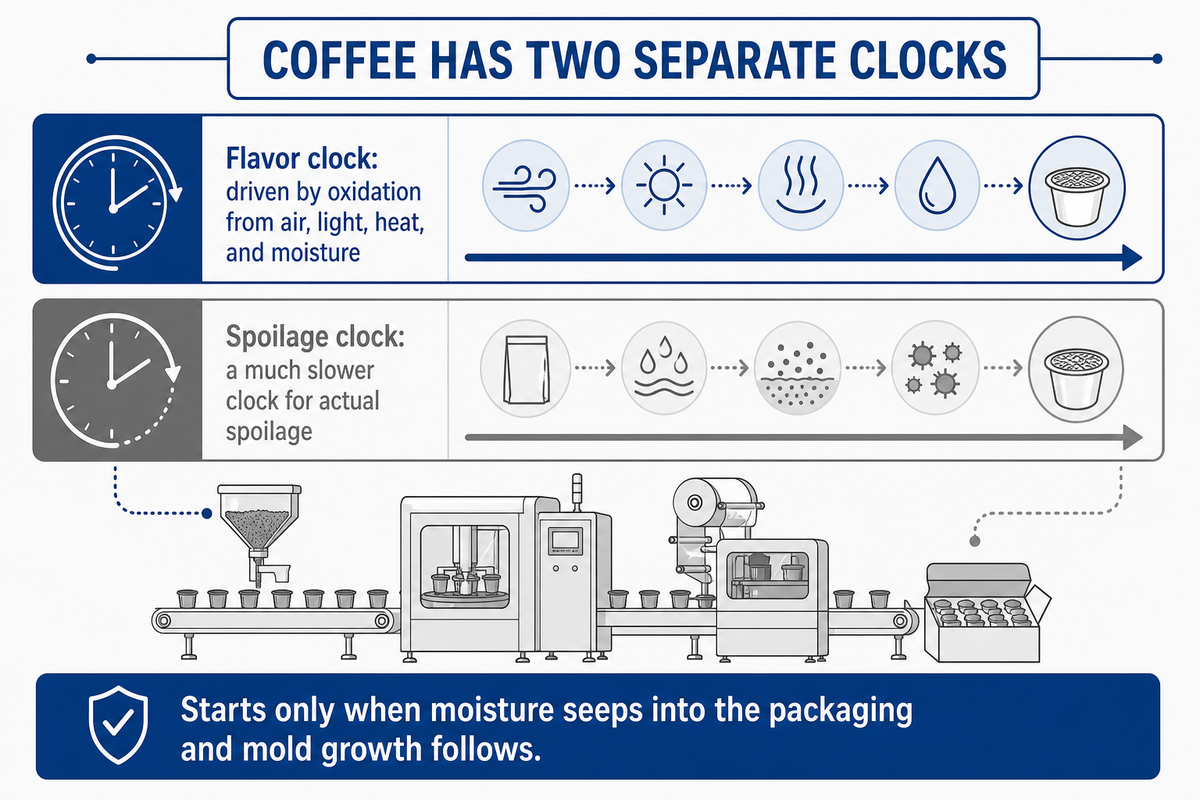
Zwei Zeitlinien koexistieren im Weltmodell des Kaffees als Zwei-Block-Modell, die Verwechslung einer Uhr mit der anderen ist meist die Quelle der ganzen Verwirrung, Erstens tickt die Geschmacksuhr durch Oxidation durch Luft, Licht, Hitze, Feuchtigkeit nach unten & Haupttreiber des Verlustes für die beim Rösten freigesetzten Öle und Aromastoffe (der Prozess, der CO2 freisetzt und das Aroma verstärkt) Zweitens ist die Verderbuhr eine viel langsamere Uhr für den tatsächlichen Verderb; sie kocht jedoch erst ab, wenn Feuchtigkeit in die Verpackung eindringt und ein Schimmelwachstum folgt, was auf eine fehlerhafte Lagerung hinweist.
Der Best-By-Mythos
Es gibt zwei konkurrierende Unwahrheiten in Bezug auf Kaffee und beide liegen falsch. Es gibt die Frage, wie Kaffee wie jedes andere verderbliche Lebensmittel “abläuft”, was die Menschen dazu veranlasst, in der Woche nach dem gedruckten Datum vollkommen gute Bohnen wegzuwerfen. Eine zweite Unwahrheit ist im Kaffee-Enthusiasten-Raum vorherrschend: dass trockener Kaffee effektiv unsterblich ist und niemals wirklich schlecht werden kann. Das tatsächliche Verhalten von Kaffee landet irgendwo in der Mitte dieser beiden Extreme: Trockenkaffee wird einen gesunden Menschen nicht nur aufgrund seines Alters krank machen, sondern es kann und wird verderben, wenn er nass wird, schimmelig oder von Schädlingen befallen wird. Peer-Reviewte Forschung darüber, wie Kaffee am besten gelagert wird, wird die Geschmack-Dekundierte Seite dieser mehr direkt in einer Peer-Studie veröffentlicht. PMC-Onlinedatenbank der National Institutes of Health Verfolgt gerösteten Kaffee während der neunmonatigen Lagerung und stellt einen quantifizierbaren Rückgang der Geschmacksqualität aufgrund eines oxidationsgetriebenen Prozesses und nicht der Biologie fest.
| Format | Ungeöffnet / Versiegelt | Eröffnet | Primärer Verderbfahrer | Ideale Lagerung |
|---|---|---|---|---|
| Ganze Bohne | Nach 3-9 Monaten rösten, um den höchsten Geschmack zu erzielen | 2-4 Wochen Spitzengeschmack, 3+ Monate noch verwendbar | Oberflächenöloxidation | Luftdicht, dunkel, kühl |
| Gemahlener Kaffee | 3-5 Monate Spitzengeschmack, bis zu 2 Jahre noch verwendbar, wenn versiegelt | 1-2 Wochen Spitzengeschmack, bis zu 1 Monat noch verwendbar | Oxidation, größere Oberfläche | Luftdicht, dunkel, kühl |
| Instantkaffee | 1-2 Jahre | 2-6 Monate | Feuchtigkeitsaufnahme, Verklumpung | Luftdicht, trocken |
| Stickstoffgespülte Kapsel/Beutel | 6-12 Monate oder länger | Einzelservice, N/A | Integrität des Siegel-/Barrierefilms | Kühl, trocken, ungeöffnet |
| Standard-Pod (nicht gespült) | Variiert mit der Filmqualität, typischerweise kürzer als N2-gespült | Einzelservice, N/A | Sauerstoffpermeation durch Film | Kühlen, trocknen |
| Grüne (ungeröstete) Bohnen | 12-15+ Monate | N/A | Langsame Feuchtigkeit/Qualitätsdrift | Kühle, trockene, atmungsaktive Tasche |
| Gebrühter Kaffee, Raumtemperatur | N/A | 12-24 Stunden, am besten in den ersten 30 Minuten | Oxidation und Bakterienwachstum | Pünktlich kühlen |
| Gebrühter Kaffee, gekühlt | N/A | 3-4 Tage | Geschmacksoxidation | Luftdichter Behälter, Kühlschrank |
| Kaltgebrühkonzentrat, gekühlt | N/A | 5-7 Tage hausgemacht, bis zu 1-2 Wochen handelsüblich versiegelt | Bakterien-/Erregerrisiko bei Nichtkälte | Kontinuierlich kühlen, nie lange temp räumen |
Was das Datum auf der Tasche eigentlich bedeutet
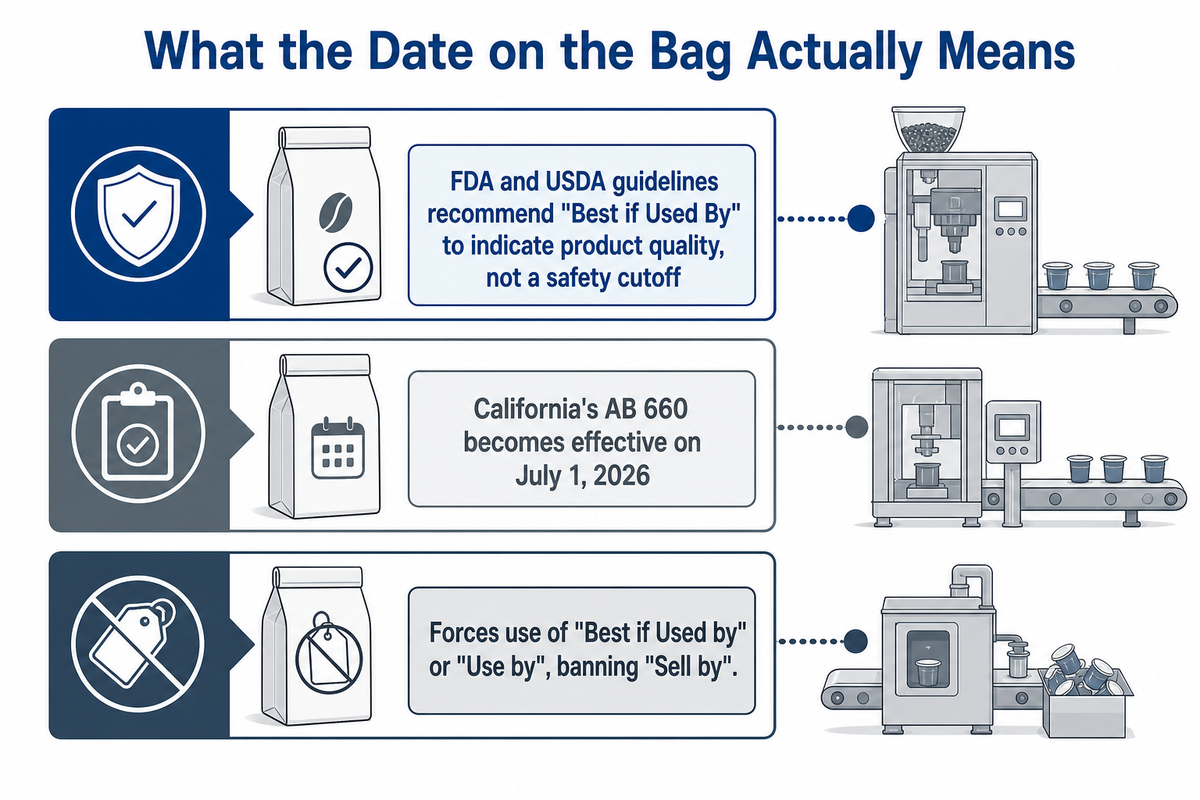
In den Vereinigten Staaten sind Datteln auf Lebensmitteln optional und nur einige Artikel müssen mit einem Datumsschild versehen sein. Bundes FDA- und USDA-Richtlinien Empfehlen Sie gemeinsam den Herstellern, eine Kennzeichnung wie “Best if Used By” zu verwenden, um die Produktqualität anzuzeigen, nicht einen Sicherheitsabstand. Die meisten lagerstabilen Produkte, einschließlich Kaffee, benötigen überhaupt kein gedrucktes Datum. Wenn ein Röster eines druckt, ist es als Qualitätsmarkierung gedacht, nicht als Kill-Date-Countdown.
Allerdings kommen Änderungen auf Landesebene, und die Unklarheit darüber, wer genau die Vorschriften einhalten muss, trägt nur zu der Verwirrung bei, die Käufer bereits über Datumsbeschriftungen empfinden. Kaliforniens AB 660, verabschiedet vom Landtag, tritt am 1. Juli 2026 in Kraft und lohnt sich zu sezieren, da es leicht ist, genau abzuschätzen, was es vorschreibt. AB 660 schreibt nicht vor, dass Röster alle Kaffeetüten datieren müssen. Stattdessen verlangt es nur, dass eine dieser Unternehmen mit einem Datum gekennzeichnet, an dem sie produzieren, verpacken oder verkaufen ein Produkt, das mit einem Qualitäts- oder Sicherheitsdatum gekennzeichnet ist. Sobald dieses Datum verstrichen ist, zwingt es jede Organisation dazu, entweder ‘Best for quality by’‘’, by the Use by used by’). Kalifornisches Ministerium für Ernährung und Landwirtschaft und eine Studie zu diesem Thema, die von der veröffentlicht wurde Nationales Agrarrechtszentrum Unterstützen Sie diese präzisere Lesart: die gesetzlich standardisierten Etiketten; Es wurde nicht vorgeschrieben, dass Daten auf allen Produkten angegeben werden müssen.
Gerade beim Kaffee bedeutet das, dass sich ein wenig ändert, mehr zählt als ein ‘best by’-Datum auf der Tüte ist das Röstdatum, meist berechnen Röster nach dem Rösten ein Kaffee “best-by” - Datum als festes Fenster (oft 12 bis 24 Monate), egal wie die Tüte gelagert wurdeDie Uhr startet in dem Moment, in dem Kaffee geröstet wird, nicht an dem Tag, an dem sie verpackt oder verkauft wird.
Vollbohnenkaffee: Wie lange er tatsächlich hält
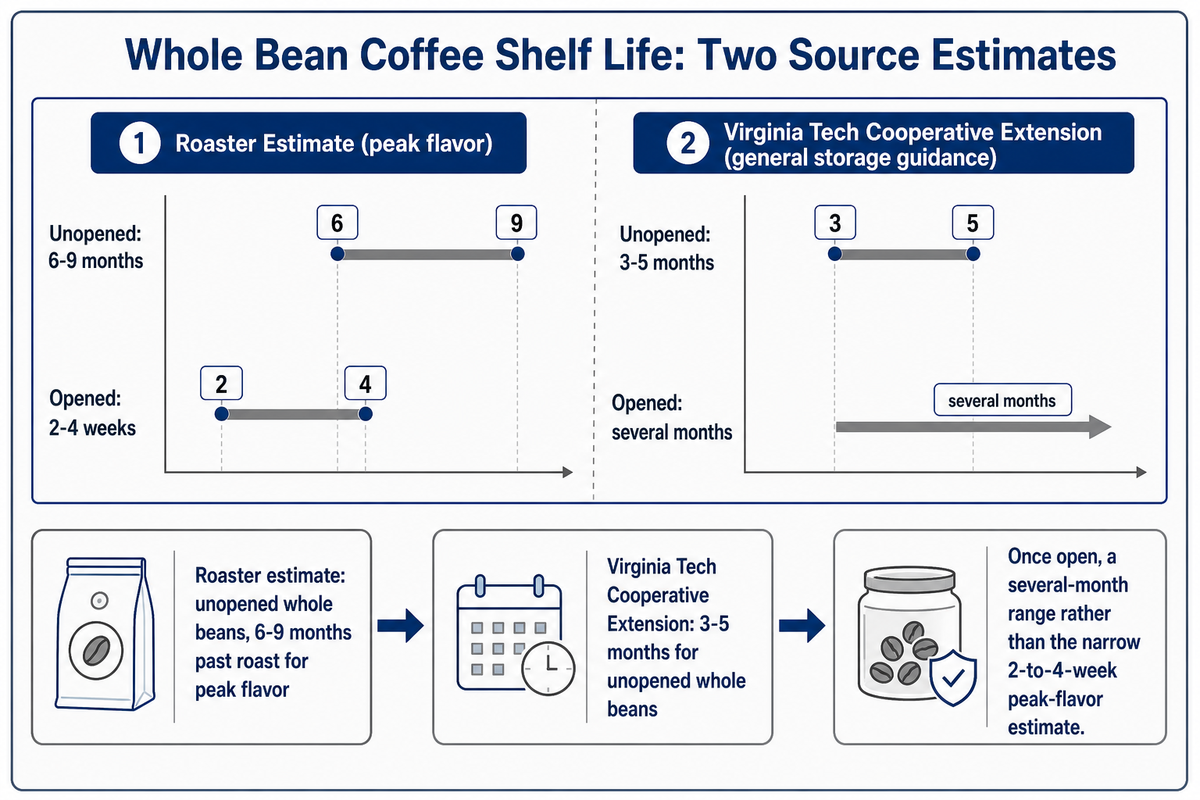
Vollbohnenkaffee behält den Geschmack länger als jedes andere Format, da die freiliegende Oberfläche am kleinsten ist. Führungen aus Röstern platzieren ungeöffnete, ordnungsgemäß gelagerte ganze Bohnen häufig 6-9 Monate nach ihrem Röstdatum, um den höchsten Geschmack zu erreichen; ein 2025 überarbeiteter Leitfaden zur Lebensmittellagerung von Genossenschaftliche Erweiterung von Virginia Tech Empfiehlt konservativere 3-5 Monate für ungeöffnete ganze Bohnen und ermöglicht nach dem Öffnen einen mehrmonatigen Bereich anstelle der engen 2- bis 4-wöchigen Spitzengeschmacksschätzungen, die Röster liefern. Diese beiden Zahlen sind keineswegs widersprüchlich: Die kürzeren Sortimente aus Rösterei beschreiben, wann ganze Bohnen am absolut frischesten sind, während die längeren, durch Extension bezogenen Leitlinien beschreiben, wann sie noch einigermaßen gut sind, wobei beide Zahlen darauf hinweisen, dass die Sicherheit diese Grenzwerte weit überschritten hat, solange die Die Tasche ist nie nass geworden.
Es läuft auf einen Prozess namens Entgasung hinaus. Neu geröstete Bohnen setzen nach dem Rösten wochenlang Kohlendioxid frei. Dies ist der Grund, warum einige Röster “ruhende”Bohnen raten, und die Ursache für diese leicht aufgeblasenen, vakuumversiegelten gerösteten Beutel. Bei diesem Austritt von Kohlendioxid entweichen auch die meisten dieser flüchtigen, aromatisch riechenden Moleküle in einem frischen Sud, und die Institute of Food Technologists’ own peer-reviewed research confirms how post-roast storage affects the process.
Coffee enthusiasts use the “15-15-15 rule” to manage their freshness expectations, though the rule gets applied in more than one way. According to some, it means 15 days from roast to brew, 15 minutes from grind to brew, and 15 minutes to consume; a few others take 15-15-15 to mean 15 months of shelf life for unopened, unroasted beans, 15 days of post-roast flavor peaking, and a third, more elastic “15” for ground coffee. Either way, the core lesson is the same: coffee is at its best close to its roast date, and not for very long.
Gemahlener Kaffee: Warum er schneller altbacken wird
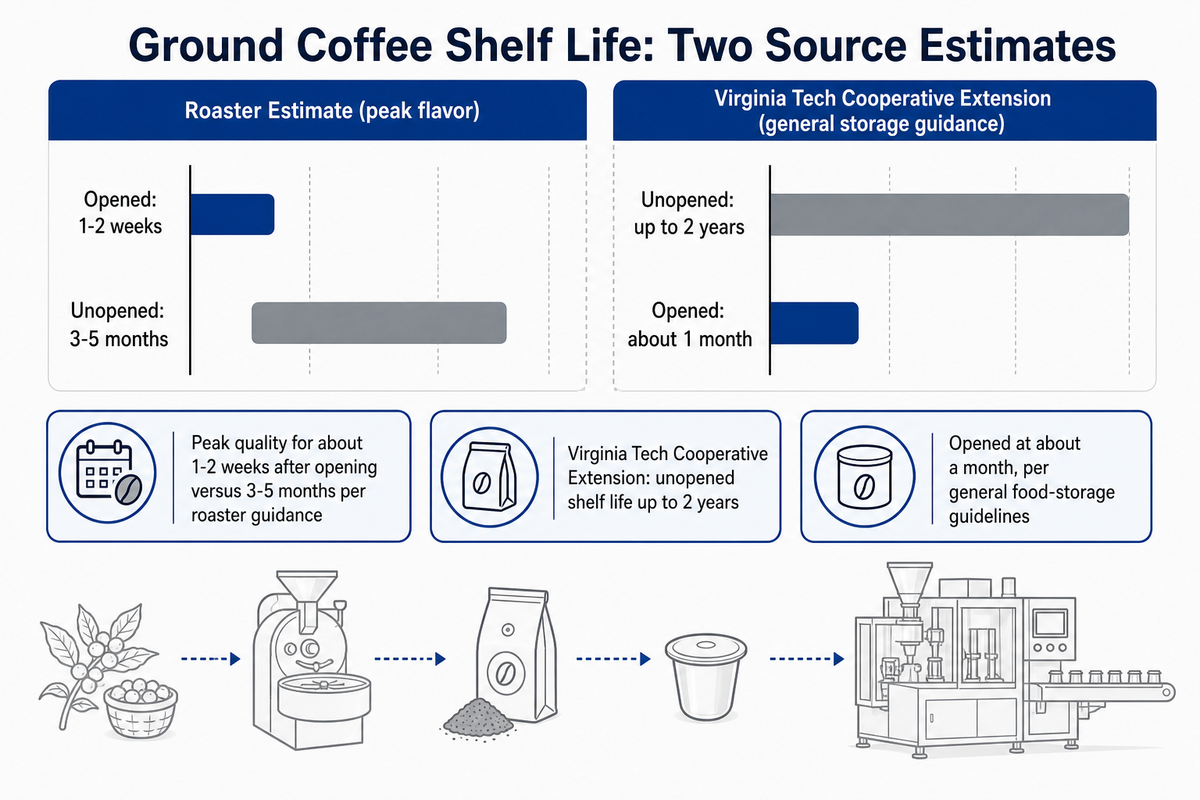
Ground coffee loses its fresh flavor faster than whole beans, usually holding peak quality for about 1-2 weeks after opening versus 3-5 months according to roaster guidance (Virginia Tech Cooperative Extension puts unopened shelf life at up to 2 years and opened at about a month, though that reflects general food-storage guidelines rather than a coffee-specific peak-flavor window). Once ground, the bean’s surface area increases dramatically, which accelerates the same oxidation process whole beans undergo, just far faster.
This is the real reason serious coffee drinkers take the time to grind just prior to brewing, versus purchasing pre-ground beans in bulk. Buying pre-ground beans for convenience will always come at the expense of longevity in flavor quality. Should pre-ground options be unavoidable, opt for the smallest available package size and invest in a top quality, truly airtight container to extend the enjoyment window.
Ground coffee behaves very differently from whole coffee beans, and coffee can go stale within days once ground and exposed to air. Coffee loses its aroma fastest right after grinding, since grinding multiplies the surface area exposed to oxygen; coffee grounds may also pick up odors from the refrigerator or pantry around them if left uncovered. This is why people who store coffee as whole beans and only grind down what they need get more consistent results from cup to cup – how you use coffee grounds right after opening the bag affects how fast the rest of it stales. Coffee stays fresher for much longer sealed as whole beans than it does ground. How coffee tastes a week after opening depends heavily on how it was stored in between, and however you want your coffee to taste, the taste of coffee is far more forgiving when it is still whole bean.
Instantkaffee: Das langlebigste Format
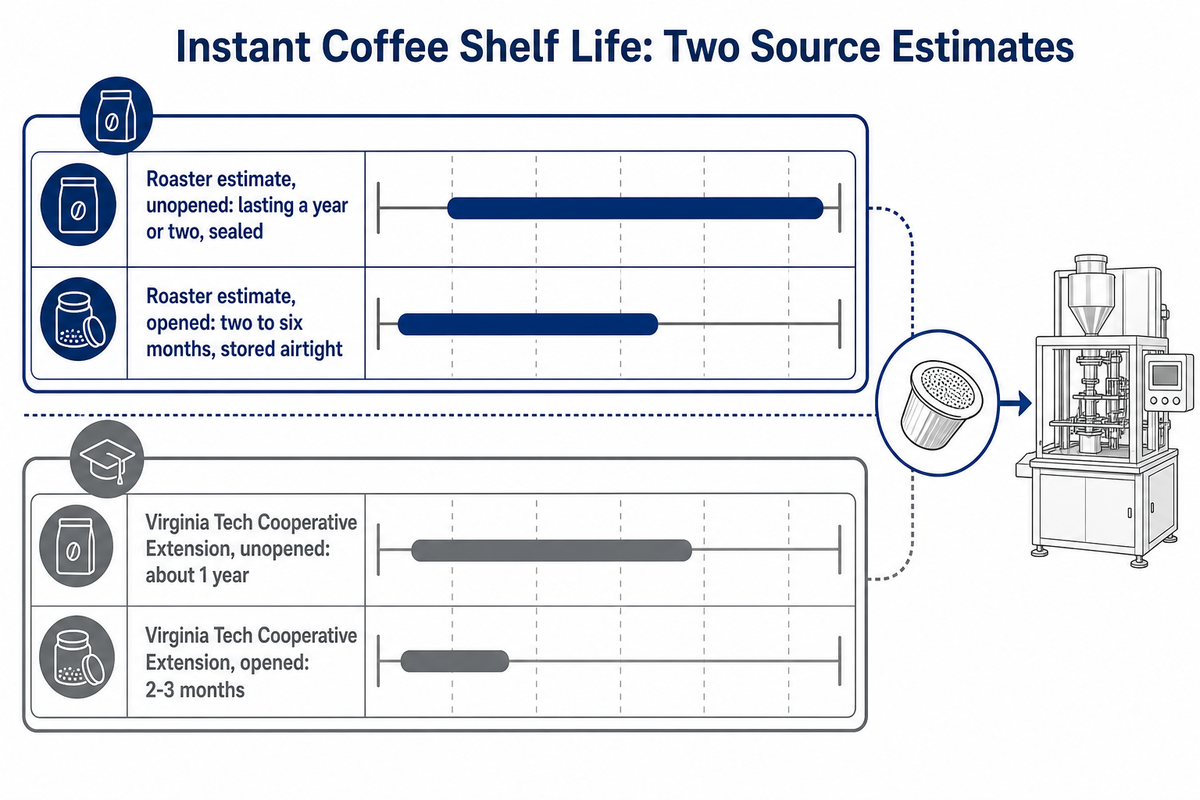
Instant coffee is the most shelf-stable format of all, lasting a year or two according to some sources (unopened and sealed) or two to six months once opened and stored airtight as the texture and flavor begins to fall off; opened instant coffee still outlasts opened ground coffee by a wide margin. Genossenschaftliche Erweiterung von Virginia Tech offers a more conservative estimate of about 1 year unopened and 2-3 months opened, which reflects general food-storage guidance rather than a peak-flavor window. That’s because brewed instant coffee is then freeze-dried or spray-dried to remove nearly all its moisture content, making oxidation and water work to less and less purpose.
Freeze-dried granules hold the only real storage edge over spray-dried ones, since the lower-heat drying process causes less damage to the volatile aroma compounds. Both formats share the exact same failure mode, though: moisture. An opened jar of instant coffee, once exposed to humidity, will quickly start clumping and hardening, which is the clearest sign it needs replacing.
Verfallen K-Cups und Kaffeekapseln?
Yes, K-Cups and Nespresso-format capsules do have a shelf life, but single-use capsule shelf life is determined less by the coffee inside than by the packaging-system around it. A sealed capsule of coffee stays fresh for a long time based on the type of gas inside the capsule, the barrier-film material used, and the storage temperature.
This is why technologies like nitrogen-flushing exist. On AFPAK’s own coffee capsule filling and sealing lines, an optimized vacuum-nitrogen 3-phase pulsation cycle floods each capsule with 98-99% pure nitrogen gas, displacing the capsule’s air content, including oxygen, and reducing residual oxygen inside the sealed capsule to under 2% within about 0.8 seconds during the fill-and-seal cycle. This process preserves the coffee and can extend a sealed coffee capsule’s shelf life anywhere from 6 to 12 months or longer, a figure that lines up with one commercial coffee roaster’s own consumer-facing claim that “vacuum-sealed or nitrogen-flushed bags containing roasted, ground, or instant” coffee can last 6 to 12 months or longer when kept sealed in a cool, dark place — arrived at completely independently of any capsule-manufacturing context. It is also consistent with a peer-reviewed packaging-film study in Molecules that directly measured how standard aluminum-foil barrier-film packaging compares to a recyclable alternative for capsule coffee freshness over time.
In practice, the real issue isn’t “how long do coffee capsules last” in the abstract, it’s what capsule packaging system is being used. For a single-serve product, a coffee brand needing to know the right package for its product, or a buyer wondering how a given brand’s single-serve coffee stays fresh months after production, the real question is “which gas and barrier film combination is this specific capsule using?” Brands evaluating K-Cup filling and sealing equipment or a Nespresso-format capsule line are, in effect, choosing a shelf-life outcome as much as a production line. AFPAK’s own technical breakdown of how nitrogen protection extends coffee capsule freshness covers the gas-flush process in more production-level detail, and the companion guide on increasing coffee capsule shelf life walks through the grinding, packaging, and storage variables that compound with gas-flushing to determine a capsule’s real-world freshness window.
For anyone with a single Nespresso or K-Cup pod at home: a tightly sealed, unopened pod from a commercial brand is usually still fine well past its published use-by date, because its individual airtight packaging only has to keep oxygen out until the moment it’s steeped in the machine – an advantage large coffee bags don’t have once they’ve been opened.
Gebrauter und kalter Brühkaffee: Eine andere Uhr
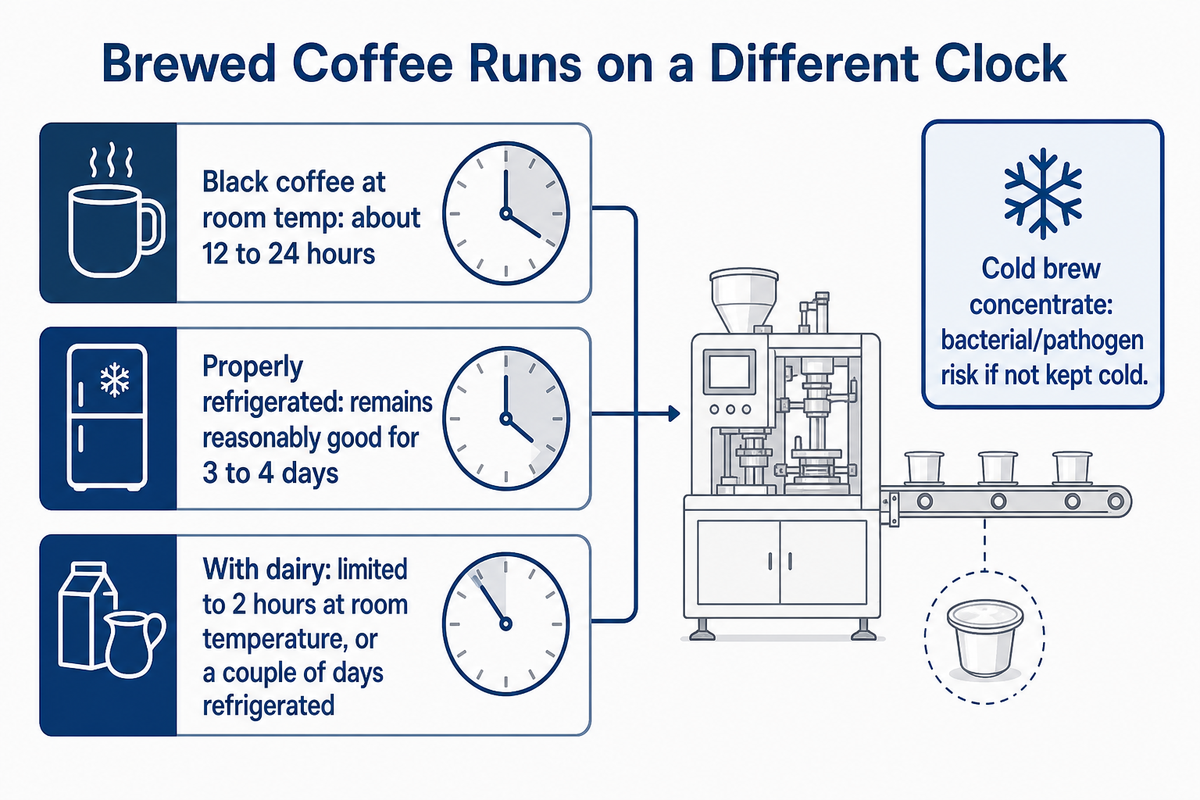
After it’s finished, the storage conversation changes altogether: Because brewed coffee is a moist (not a dry good), low-acid liquid, it operates on a radically faster clock than beans or grounds. FDA’s “two-hour rule” generally applies to foods that the agency considers perishable, like meat, poultry, seafood, eggs, and produce, and black coffee isn’t on that list, which is why plain black coffee has more quality-focused (not safety-focused) leeway than a two-hour cutoff, translating into a longer shelf-life driven by quality rather than safety. Black coffee stored outside its airtight container at room-temperature can typically be drunk for about 12 to 24 hours, though flavor quality degrades significantly much earlier (around the first 30 minutes post-heat).
Properly refrigerated within the airtight container it will remain reasonably good for 3 to 4 days. Once creamer or milk comes into contact with the coffee, its shelf life dramatically shrinks: Add dairy and coffee now follows normal dairy storage protocol, limited to 2 hours at room temperature, or a couple of days refrigerated.
Is brewed coffee the same as drinking dry coffee? Not even. Fresh brewed coffee is best within the first hour, and freshly brewed coffee that sits on the warming plate in the carafe of a coffee machine goes off more quickly than coffee stored in a sealed cup left out at room temperature. Iced coffee is no different than regular refrigerated brewed coffee once the ice has melted into it.
Cold brew needs its own discussion – for obvious reasons, this is “brewed coffee, but cold.” Unlike hot-brewed coffee, which includes a heat-kill step, cold brew steeps for many hours at room or even refrigeration temperature with no hot-brew step to affect its safety. Homemade cold brew concentrate, kept continuously refrigerated, is good used within 5-7 days. Commercially produced and sealed cold brew has a longer suggested shelf life (sometimes a week or two refrigerated), though. It comes down to more than just staleness in this case. Cold brew doesn’t have the near-boiling heat kill step of hot brewing, and if left un-refrigerated, or produced in large quantities without temperature control it presents a genuine food-safety issue in addition to flavor, not just a cosmetic one. Don’t be lulled into a false sense of security from dry coffee being very low risk – cold brew once wet and unheated, must be treated with the same refrigeration discipline as any other drink.
Anzeichen dafür, dass Ihr Kaffee tatsächlich schlecht geworden ist
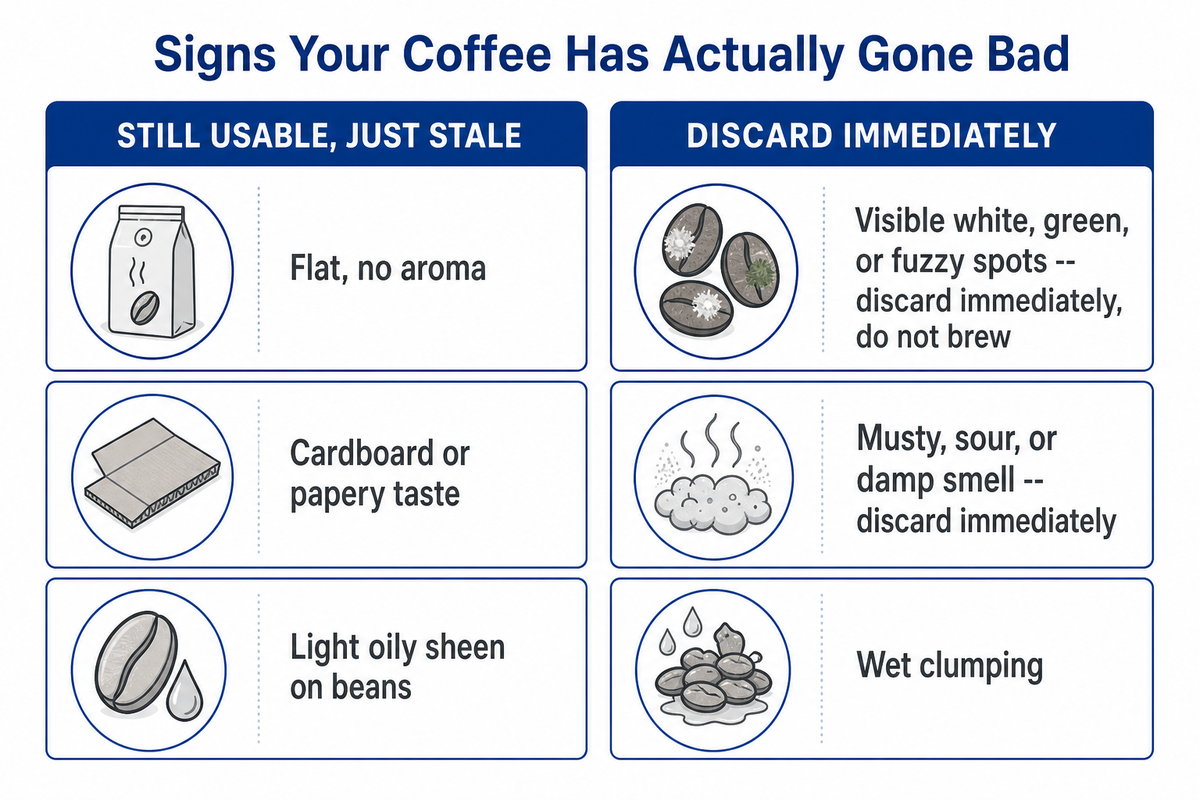
Much of what consumers recognize as “expired coffee” really comes down to little more than stale coffee. There are subtle but significant differences in the appearance and behavior of the two formats that allow for a quick distinction. Learning how to distinguish stale coffee from genuinely “ruined” coffee is far more important than paying close attention to a bag of beans. These tables distinguish quality-only, merely aesthetic indicators from outright discard-level warning signs that mean it’s genuinely time to toss the coffee.
| Signal Type | Likely Cause | Still Usable? | Recommended Action |
|---|---|---|---|
| Flat, no aroma | Oxidation, CO2 has off-gassed | Yes, just stale | Use for cold brew, or replace |
| Cardboard or papery taste | Extended oxidation | Ja | Brew stronger, or replace soon |
| Light oily sheen on beans | Normal roast oils, or beans past their prime | Usually yes | Check smell before brewing |
| Visible white, green, or fuzzy spots | Mold from moisture intrusion | Nein | Discard immediately, do not brew |
| Musty, sour, or damp smell | Moisture contamination | Nein | Discard immediately |
| Wet clumping (instant or ground) | Moisture absorption | Nein | Discard, do not rehydrate or use |
| Ice crystals on frozen beans | Freeze-thaw cycling, condensation | Yes, quality-reduced | Use soon, avoid re-freezing |
| Pantry moths or insects present | Pest contamination | Nein | Discard, inspect storage area |
| Gray or greenish discoloration | Oxidation, or possible contamination | Depends | Discard if paired with smell or mold |
It bears emphasis that the sensory clues for judging quality and staleness – appearance, smell, taste – are remarkably reliable for dry coffee because the moisture levels are so low that pathogen proliferation is difficult. These checks do not provide adequate protection for wet foods, like brewed coffee or cold brew. According to the FDA’s own consumer guidance on food storage, food can cause illness even if it looks, smells, and tastes normal, which is particularly true for wet coffee products compared to the dry kind resting in a pantry.
Ist es sicher, abgelaufenen Kaffee zu trinken?
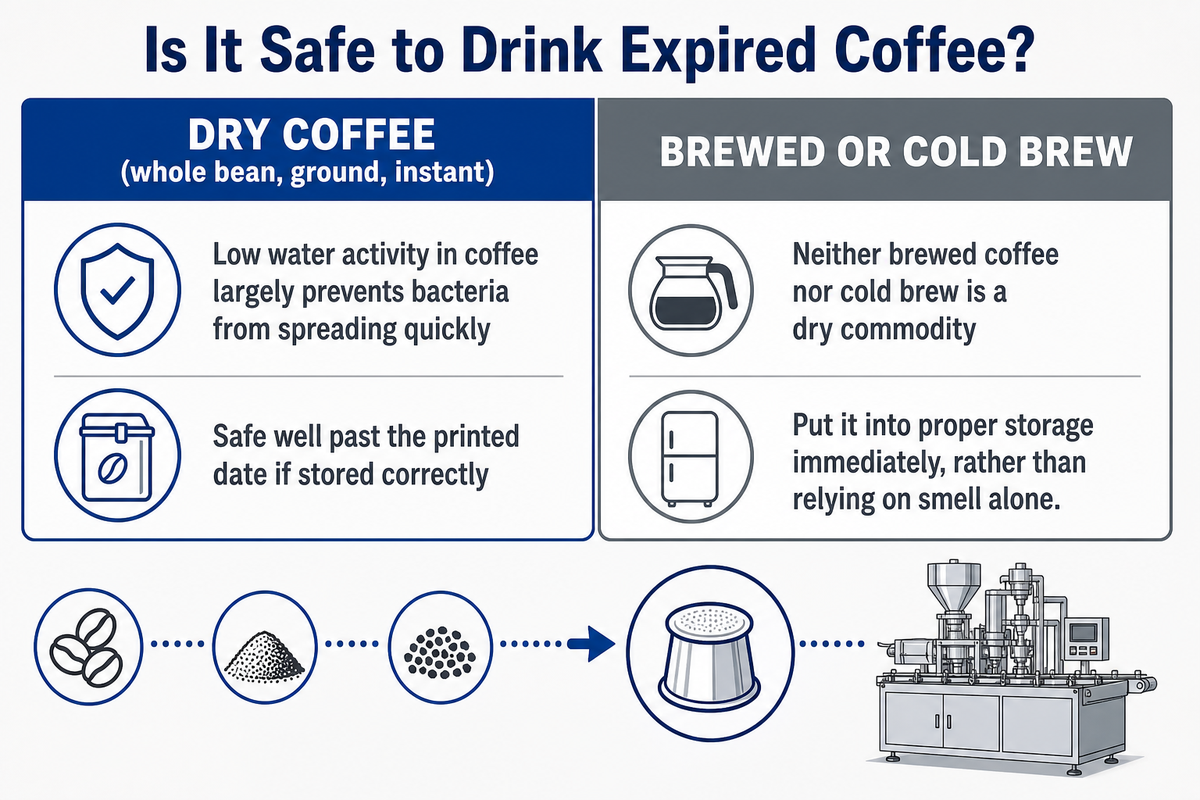
For whole beans, ground, or instant dry coffee, the answer is an emphatic yes, assuming you stored the coffee correctly and it displays none of the discard-level signs listed above that call for disposal. Low water activity in coffee largely prevents bacteria from spreading quickly, which is why the USDA’s Food Safety and Inspection Service considers the date printed on a coffee bag to be a quality indicator as opposed to a definitive date for disposal.
But that figure is altered when coffee is wet. Neither brewed coffee nor cold brew is a dry commodity, and “it smells fine” as a quality check is a much less reliable metric – this is especially true for cold brew if it’s spent time non-refrigerated or was batch-fermented at uncontrolled temperatures. Real-world accounts from coffee drinkers communities often seem to align more with the dry end of coffee: one long-running forum discussion on older ground coffee concluded it “doesn’t necessarily expire but it does go stale… it should be ok for consumption if it was sealed,” which is spot-on for the general findings.
Elsewhere, there’s confusion between expired and best before, with one coffee drinker describing the difference as, expired can mean it’s unsafe or soon to be unsafe but best before means it’s still safe but no longer tastes good; for beverages in general this is fairly accurate, though as we’ve seen neither the words expired nor “best before” on coffee signify an actual safety threshold.
Use this as a general rule of thumb: for dry-coffee products, go by smell. But once it’s brewed, and especially once it becomes cold brew, put it into proper storage immediately like any other drink, rather than relying on smell alone.
So lagern Sie Kaffee, um die Uhr zu verlangsamen
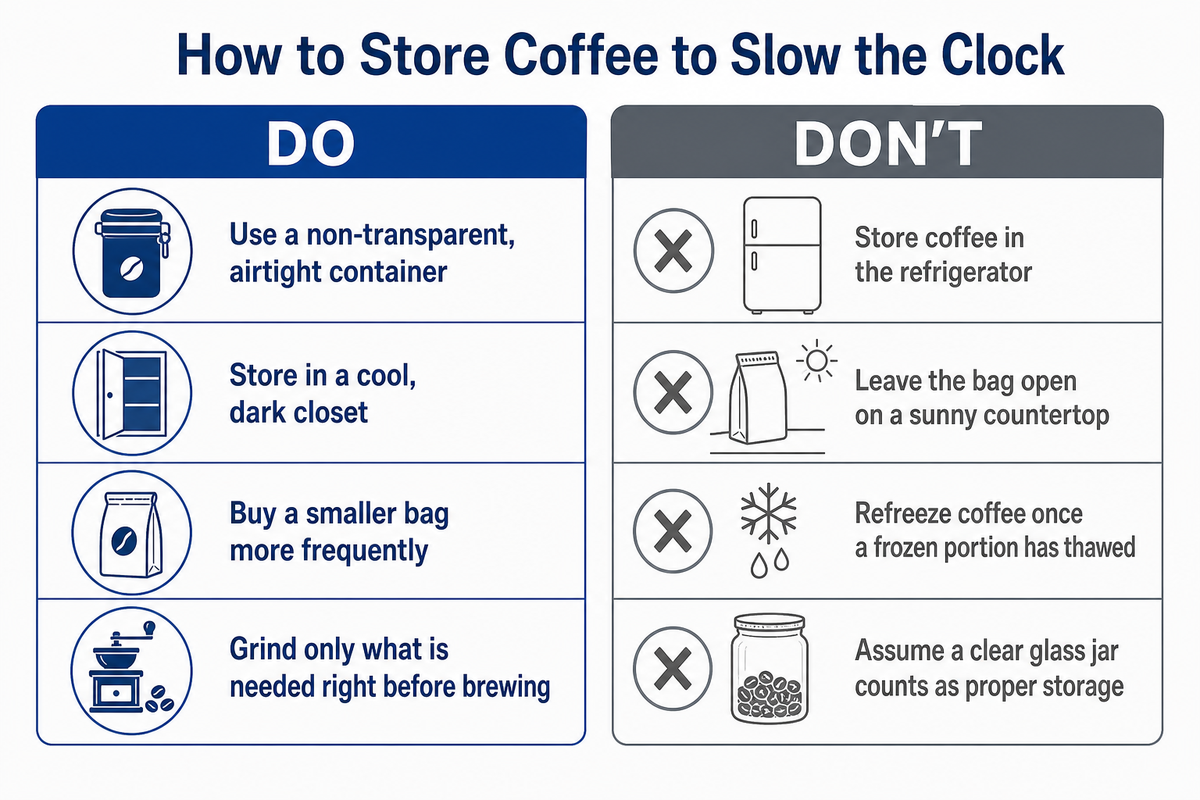
The simplest advice for keeping your coffee from losing its flavor hinges on how coffee is stored – even a little pantry or cupboard away from your stove is better than a bag sitting openly on the counter. Keep coffee away from excessive heat and light in a cool, dark place, and once you tear open the package, it will both lose its flavor and aroma with every moment of exposure to the air. Buyers who buy coffee in bulk should split large bags into smaller airtight portions instead of continually opening and closing one bag; the goal, always, is flavorful coffee whenever you actually brew it.
Most guides agree on how best to store coffee beans and store your coffee overall: an airtight container, kept cool and dark, keeps coffee fresh far longer than a bag clipped shut and left on the counter. These tips to keep your coffee fresh apply across whole bean, ground, and instant formats, and a few simple steps applied to coffee to extend its shelf life go a long way. Stored this way, coffee remains safe and reasonably flavorful well past its printed date, whether you buy coffee by the bag or rely on a coffee subscription for a better overall coffee experience. Properly sealed, coffee can last well beyond its printed date without becoming unsafe.
No matter the method of storage you choose, staling isn’t something that can be put to a full stop, but it significantly postpones it. By mastering some simple rules, weeks or months of the lifespan of your dry freshness in any dry format can be reclaimed. According to the NCA (National Coffee Association) as well as academia (coffee-science research programs like the UC Davis Coffee Center), three elements threaten fresh coffee in all dry formats: light, air, and moisture, all of which warmth makes worse.
- Use a non-transparent, airtight container, do not use the clip originally supplied to close the bag
- Store in a cool, dark closet and out of reach of the oven or stove
- Buy a smaller bag more frequently than one big bag that would be left open for many months
- Grind only what is needed right before brewing
- Store coffee in the refrigerator
- Leave the bag open on a sunny countertop
- Refreeze coffee once a frozen portion has thawed
- Assume a clear glass jar counts as proper storage
Refrigeration deserves special mention. This is an all-too-common, but counterproductive habit. As a cold container rises to room temperature, condensation forms on its surface, and that moisture works against our efforts to keep coffee dry.
Though coffee may seem simple to store, any discussion among home coffee drinkers of how best to store their precious dry coffee long-term always ends up back at this single point-refrigeration only adds moisture exposure relative to keeping coffee in a simple, sealed container in a dry cabinet. Freezing in smaller portions is the exception. Break it down before you freeze it, and pull out one or two small amounts to thaw at a time rather than opening and closing a larger bag or container multiple times.
Schnüffel-Schau-Geschmack-Urteil
Whether your goal for your coffee each and every morning is peak freshness, or you’re relying on a monthly subscription of coffee that lands on your doorstep as part of your regular coffee ritual, the best habits remain. There are surprisingly simple things you can do to prolong the useful life of your coffee – airtight, dark, cool, and consumed when it’s at its peak is the golden rule for keeping good coffee good and for enjoying all the nuanced flavors you originally selected that coffee for. By these methods, good dry coffee can remain safe and at least minimally palatable for extended periods beyond its printed “best by” date.
If a bag has been lingering for some time, there are three quick tests to resolve most doubts in a minute or so. First, give it a sniff: fresh, well-preserved coffee is rich and unique, while stale coffee is flat or dusty, potentially smelling like old cardboard. If coffee smells musty or sour, toss it immediately, since moldy coffee is a hazard. Second, examine it for appearance: good, dry coffee should be loose and free of clumping, significant discoloration, or signs of mold, and anything wet, clumpy, or mold-covered should be discarded. Third, if the above checks pass, take a small sip: stale coffee will taste flat and potentially watery but will usually be safe to drink, while anything that tastes “off,” beyond simple staleness, isn’t worth the risk, and calls for a fresh pot instead. These checks-smell, sight, and taste-are for judging dry coffee; they aren’t a substitute for good storage habits in the case of brewed or cold-brew coffee.
Über diese Analyse
This guide draws on USDA and FDA food-labeling guidance, peer-reviewed coffee storage research, and AFPAK’s own production-floor data on nitrogen-flush capsule sealing, gathered across the coffee capsule filling and sealing machines our engineering team designs for capsule producers worldwide. The nitrogen-flushing figures cited for K-Cup and Nespresso-format capsules come directly from the gas-flush parameters used on AFPAK’s own filling and sealing lines, confirmed by AFPAK’s technical team.
Häufig gestellte Fragen
F: Kann man Kaffee trinken 2 Jahre veraltet?
Yes, unopened dry coffee that is 2 years past its printed date is usually still safe to drink if it was stored sealed, cool, and dry, though the flavor will be noticeably duller than fresh coffee.
F: Ist Kaffee nach 4 Jahren noch gut?
Four-year-old coffee is very likely safe to drink if it stayed sealed and dry the entire time, but expect a flat, muted cup rather than anything resembling fresh coffee.
F: Ist 10 Jahre alter Kaffee noch gut?
Ten-year-old sealed, dry coffee is generally still safe to drink, but by this point it will taste almost entirely of its container rather than of coffee, and most people will find it not worth brewing.
F: Was ist die 15-15-15-Regel für Kaffee?
One popular shorthand, the 15-15-15 rule, is a rough freshness guideline for coffee, but it is not applied consistently: some sources define it as 15 days from roast to use, 15 minutes from grind to brew, and 15 minutes to drink, while others use it to describe roughly 15 months of green-bean shelf life and 15 days of peak flavor after roasting.
F: Verfällt Kaffee, wenn er ungeöffnet ist?
Unopened coffee does not truly expire, but it does gradually lose flavor even sealed, typically staying near peak quality for 6-9 months (whole bean) or 3-5 months (ground) past the roast date.
F: Läuft Kaffee im Kühlschrank ab?
Storing dry coffee in the refrigerator does not directly cause it to expire, but it introduces condensation every time the container is removed and re-chilled, which speeds up staleness rather than slowing it.
F: Wie lange sind Kaffeepads haltbar?
Coffee pod and capsule shelf life depends on how the individual pod was sealed rather than one fixed number; nitrogen-flushed capsules with a strong barrier film commonly hold flavor for 6-12 months or longer, while pods sealed without a gas flush typically last a shorter, more variable window.
Referenzen und Quellen
- Food Product Dating USDA-Dienst für Lebensmittelsicherheit und -inspektion
- USDA-FDA Seek Information About Food Date Labeling US-amerikanische Lebensmittel- und Arzneimittelbehörde
- Are You Storing Food Safely? US-amerikanische Lebensmittel- und Arzneimittelbehörde
- Food Date Labeling (AB 660) Kalifornisches Ministerium für Ernährung und Landwirtschaft
- Date Labels and the New California Law Nationales Agrarrechtszentrum
- Changes in Sensory Quality Characteristics of Coffee During Storage National Institutes of Health, PMC
- Relationship Between Coffee Quality and Storage Conditions Institute of Food Technologists (Wiley Online Library, peer-reviewed)
- Storage and Shelf Life Nationaler Kaffeeverband
- Coffee Research UC Davis Coffee Center
- Food Storage Guidelines for Consumers Virginia Tech Cooperative Extension
- Coffee Pod Packaging Film Study Molecules (MDPI, peer-reviewed)
- Pathogen Survival in Cold Brew Coffee Study PubMed (peer-reviewed)
Verwandte Artikel
- Wie revolutioniert der Stickstoffschutz die Frische von Kaffeekapseln? The production-side technical breakdown of the gas-flush process referenced above
- So erhöhen Sie die Haltbarkeit von Kaffeekapseln grinding, packaging, and storage factors for capsule producers
- Nespresso vs. Dolce Gusto: Welche Kaffeekapsel möchten Sie produzieren?
- Powder-in-Cap Packaging: Viability Analysis