
From a 2-Lane Pilot to a Dual-Line Dolce Gusto Facility
How a Spanish coffee producer scaled Dolce Gusto capsule production with AFPAK — twice.
Explore AFPAK’s complete range of Dolce Gusto filling and packaging machines, from compact rotary systems to multi-lane filling and cartoning lines.
Client Snapshot
- Location: Spain
- Specialization: A specialized single-serve coffee capsule producer — the client’s entire production focus is on capsules, with no bagged, canned, or other packaging formats on-site
- Business model: Manufactures under its own brand and also produces as a contract manufacturer (OEM) for major coffee brands
- Existing production capability: Already operating 4 European-brand filling & sealing lines covering Lavazza Espresso Point, Lavazza Blue cups, Nespresso biodegradable capsules, and Nespresso aluminum capsules — before adding Dolce Gusto capacity with AFPAK
- Product on the new lines: Dolce Gusto–compatible capsules (pure coffee, instant coffee, and flavored coffee)
- Relationship with AFPAK: Repeat customer — first order 3 years ago, second (expansion) order 2026
Planning to expand an existing capsule line?
Tell us your current equipment, target output and final carton format.
The Challenge
This client is not a general-purpose packaging operation — it is a dedicated single-serve capsule specialist, running four European-brand filling and sealing lines across multiple capsule formats (Lavazza Espresso Point, Lavazza Blue, Nespresso biodegradable, Nespresso aluminum), serving both its own brand and OEM contracts for major coffee brands. With its entire business built around capsule production, and no other packaging categories to fall back on, equipment reliability wasn’t just a preference — it was core to daily operations. Any new supplier had to prove it could match the stability the client already expected from its European equipment, while expanding into the Dolce Gusto format.
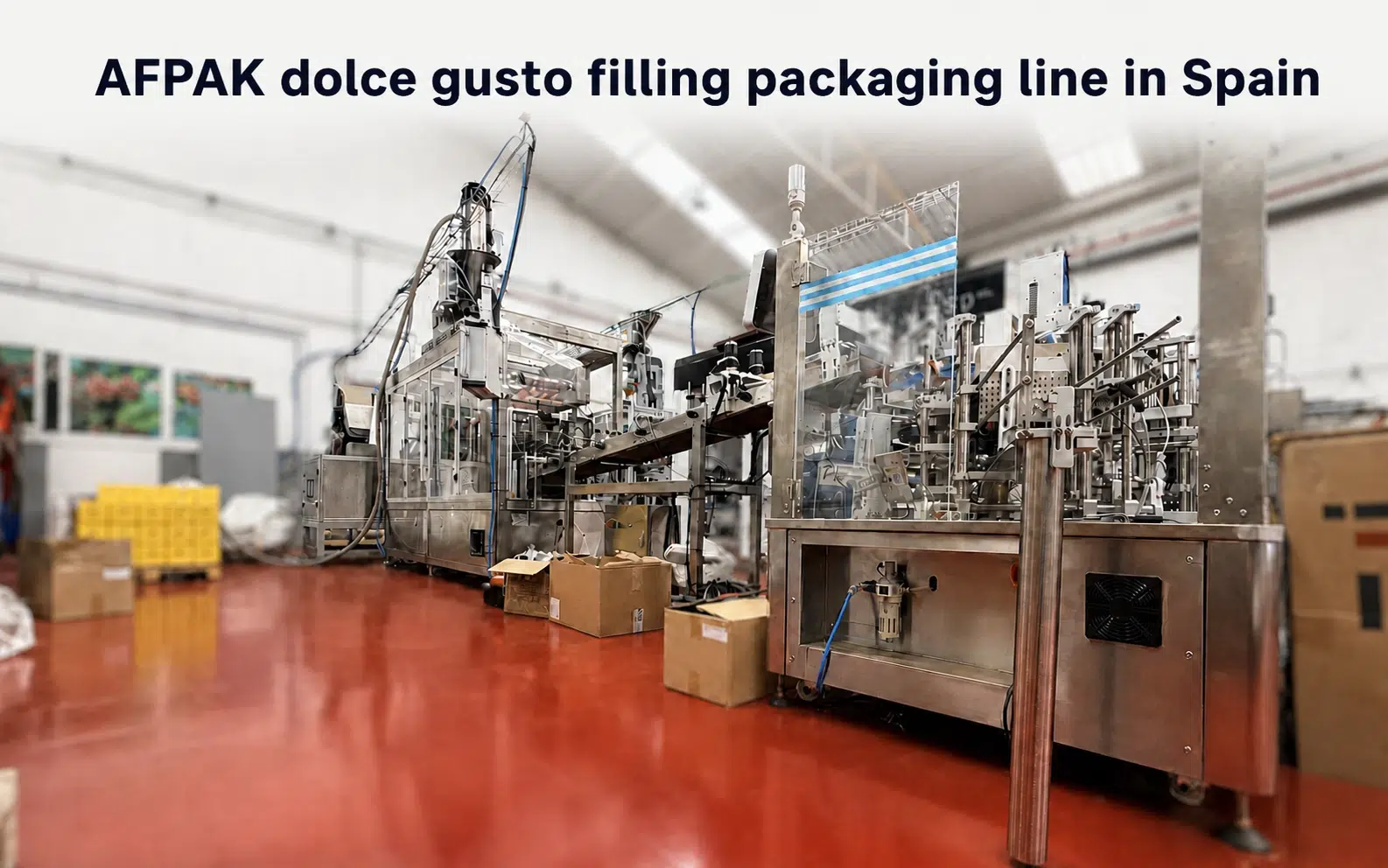
Phase 1 — Building the Foundation (2023)
The client started with an AFPAK H2 Dolce Gusto filling & sealing machine (2-lane). AFPAK sent an engineer to the client’s facility in Spain for two weeks to complete installation and commissioning on-site, ensuring the line was fully validated and running to the client’s standards before handover — the same standard of stability the client was already used to from its European equipment.
Technical & service highlights of the original H2 line:
- Rated capacity of up to 80 capsules/min
- Dual-mode operation: manual mode for individual function control, and automatic mode for streamlined full-cycle production
- Bilingual (Spanish/English) touchscreen interface for local operators
- Versatile filling capability: ground coffee as well as soluble/instant powder products (milk powder, cocoa, chocolate powder), with filling weight and sealing parameters adjustable directly on the touchscreen
- On-site training covered daily operation checkpoints, maintenance schedules (lubrication, cleaning, part replacement), and common troubleshooting scenarios
- Backed by AFPAK’s 2-year warranty and lifetime after-sales support, including online video-call support with an 8-hour response commitment
Phase 2 — Scaling Up (2026)
Two years after the first line proved itself in daily production, the client returned to AFPAK to expand its Dolce Gusto capacity — a clear signal of trust built over the first partnership. The expansion order included:
- 1 × 4-lane Dolce Gusto filling & sealing machine
- 1 × cartoning machine (16-count box configuration), paired with the new 4-lane line
- 1 × matching cartoning machine (same 16-count configuration) added to the original 2-lane line, upgrading it from a standalone filler into a fully integrated filling-to-carton line
AFPAK supported this expansion with two dedicated site visits:
- A technician stayed on-site for one month to install all the equipment and carry out initial commissioning
- AFPAK’s chief engineer then made a second visit — accompanied on-site for 7 days by AFPAK’s own leadership — to complete final commissioning, trial runs, and fine-tuning together with the client’s verification process
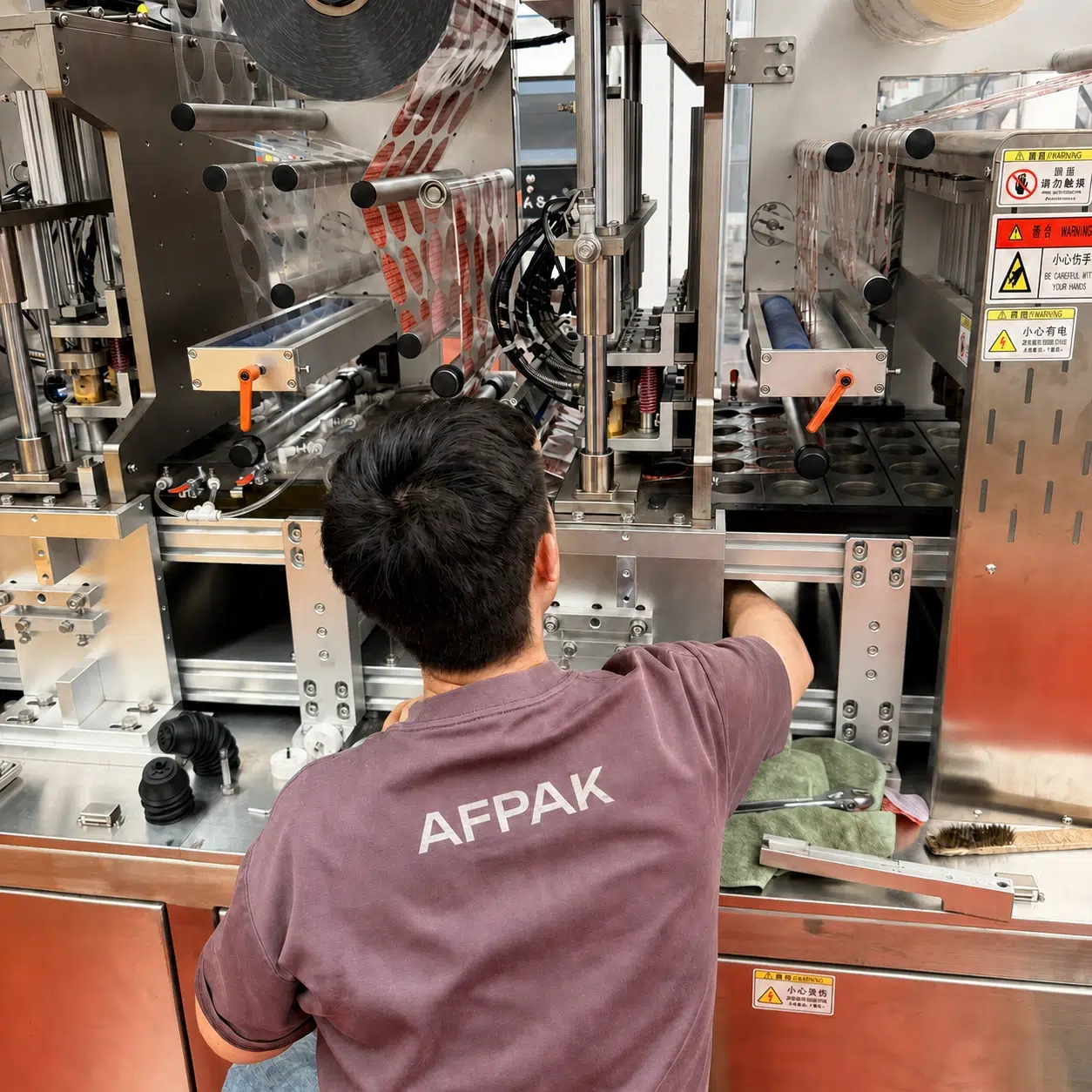
By the time the AFPAK team departed, the new line had already run 1 continuous hour without stopping — the run wasn’t extended further only because the coffee powder hopper capacity was reached, not due to any equipment issue, an early sign of the line’s stability under real operating conditions.
Final on-site installation, commissioning, and client inspection/acceptance were completed in early July 2026, with the client signing off on both lines after on-site testing. Notably, the entire installation and commissioning process — across two full production lines — was handled by just 1–2 AFPAK technicians on-site at a time, reflecting both the equipment’s engineering maturity and AFPAK’s field service efficiency.
Have a production problem your current line cannot solve?
Send AFPAK your capsule, film and production details for an engineering review.
Engineering & Customization — Solving the Client’s Real Production Problems
As a specialist producer that had already run European equipment for years, this client came to the expansion project with specific, well-informed technical requirements. AFPAK’s team addressed each one directly:
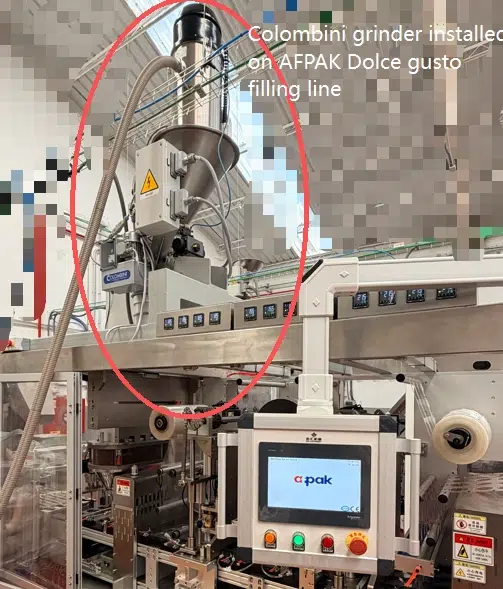
1. Grinder integration (Colombini)
The client needed the new line to interlock with their large-capacity Colombini grinder. AFPAK’s machines come standard with a vacuum feeding system to support the filling process, but this project required a dedicated interlock between the grinder and the filling line. AFPAK reserved the necessary interface and control program before shipment, and the connection was fully implemented and working by the time the first technician was on-site — no additional trip required for this integration.
2. Sealing quality — solving film edge curling
The client’s sealing film is notably thin, which made it prone to slight edge curling when heated. The client’s concern was that under nitrogen flushing, a curled film edge could shift out of position, resulting in an incomplete or loose seal. AFPAK’s chief engineer redesigned the heat-sealing head with a new structure, then disassembled and re-adjusted the sealing/cutting assembly on-site — successfully eliminating the film edge curling issue.
3. Sealing spring durability — from a recurring failure point to a redesigned, validated component
On the client’s original 2-lane machine, the sealing spring had been the most frequent point of failure — in some months requiring replacement as often as once a month. For this project, AFPAK’s engineering team studied the sealing/cutting structures used in leading international equipment, then combined that benchmarking with their own engineering insight to design a new sealing/cutting structure. Before ever installing it on the client’s line, AFPAK ran the new design continuously in its own factory for one full month to validate reliability. Only after confirming it performed correctly across every metric was it installed on the client’s new line — and retrofitted onto the original 2-lane line at the same time.
4. Reducing manual cup loading
To minimize manual intervention during production, AFPAK equipped the new line with a large-capacity cup storage hopper, designed so operators would not need to repeatedly reload cups by hand within a given run — targeting at least 30 minutes of continuous operation between manual reloads.
Verified Output — And Proof the Spring Redesign Worked
When AFPAK’s technician was on-site installing the new 4-lane line, they also retrofitted the original 2-lane line with the newly redesigned sealing springs — and reset the machine’s touchscreen production counter to zero at that point, creating a clean baseline to track performance going forward.
By the time AFPAK’s chief engineer arrived for the second visit (final commissioning of the 4-lane line), the touchscreen showed the 2-lane line had produced 1.3 million capsules over that one-month period — confirmed directly from the machine’s production data. Just as importantly, during that month, the client reported no spring-related failures. This first month of production provided encouraging early evidence that the redesigned sealing assembly had addressed the recurring issue. AFPAK continues to monitor its long-term performance with the customer.
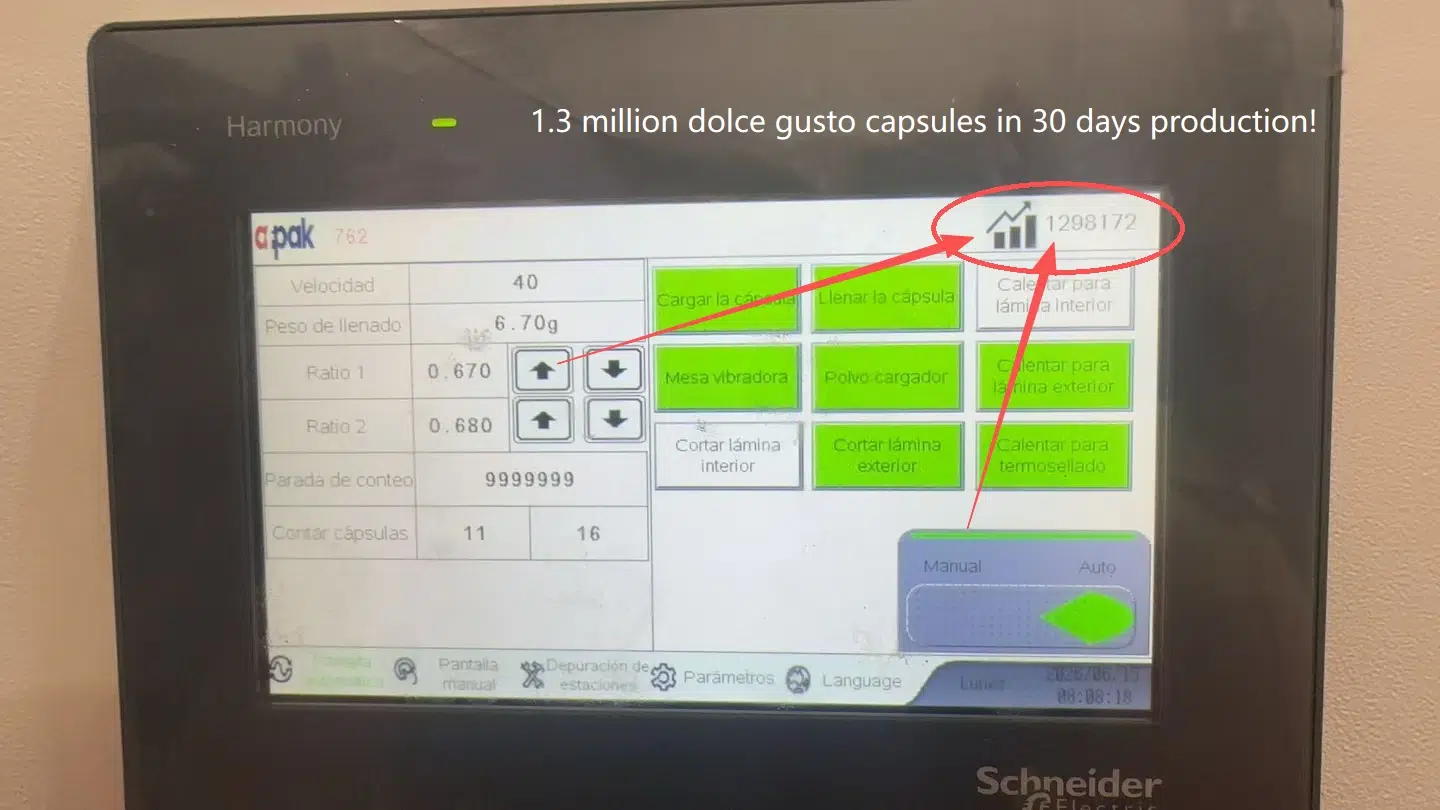
Under the client’s normal operating schedule, the two-lane machine ran at approximately 40–45 cycles per minute, equivalent to a total output of 80–90 capsules per minute across both lanes. This is real, verified output under actual production conditions — not a rated/theoretical spec.
Production Strategy Post-Expansion
With both lines now operational, the client has structured their Dolce Gusto production by product type:
- 4-lane line → primarily dedicated to pure coffee capsules
- 2-lane line → dedicated to instant coffee and flavored coffee capsules
This dual-line setup gives the client the flexibility to run different product categories in parallel without cross-contamination or frequent changeovers — a common requirement for producers running both pure and flavored/instant SKUs.
Why AFPAK
- Selected by an experienced capsule producer: The customer already operated multiple European filling lines before selecting AFPAK for its Dolce Gusto expansion
- Proven reliability, proven by repeat business: the original 2-lane line performed well enough in daily production to justify a return, expansion order two years later
- Real R&D responsiveness, not just customization: from grinder interlock integration to a redesigned sealing head and a newly engineered, factory-validated sealing/cutting structure, AFPAK solved the client’s specific recurring pain points — including a spring failure issue the client had lived with on their original line
- Leadership on the ground: AFPAK’s own leadership personally accompanied the final commissioning visit for 7 days, working alongside the client through final adjustments and verification
- Lean, efficient field service: full installation and commissioning across two production lines was completed with just 1–2 AFPAK technicians on-site at a time — from a two-week single-line commissioning to a two-visit, multi-line expansion project
- Backed by real service commitments: 2-year warranty, lifetime after-sales support, and an 8-hour response commitment for video-call technical support
- Scalable, modular approach: the client grew from a single filling line into a fully integrated dual-line filling-to-carton facility, with cartoning capability added to both the new and the original line
Planning your own Dolce Gusto production line expansion?


