
Flexible Capsule Production. Easier Daily Operation.
RN1S Coffee Capsule Filling and Sealing Machine
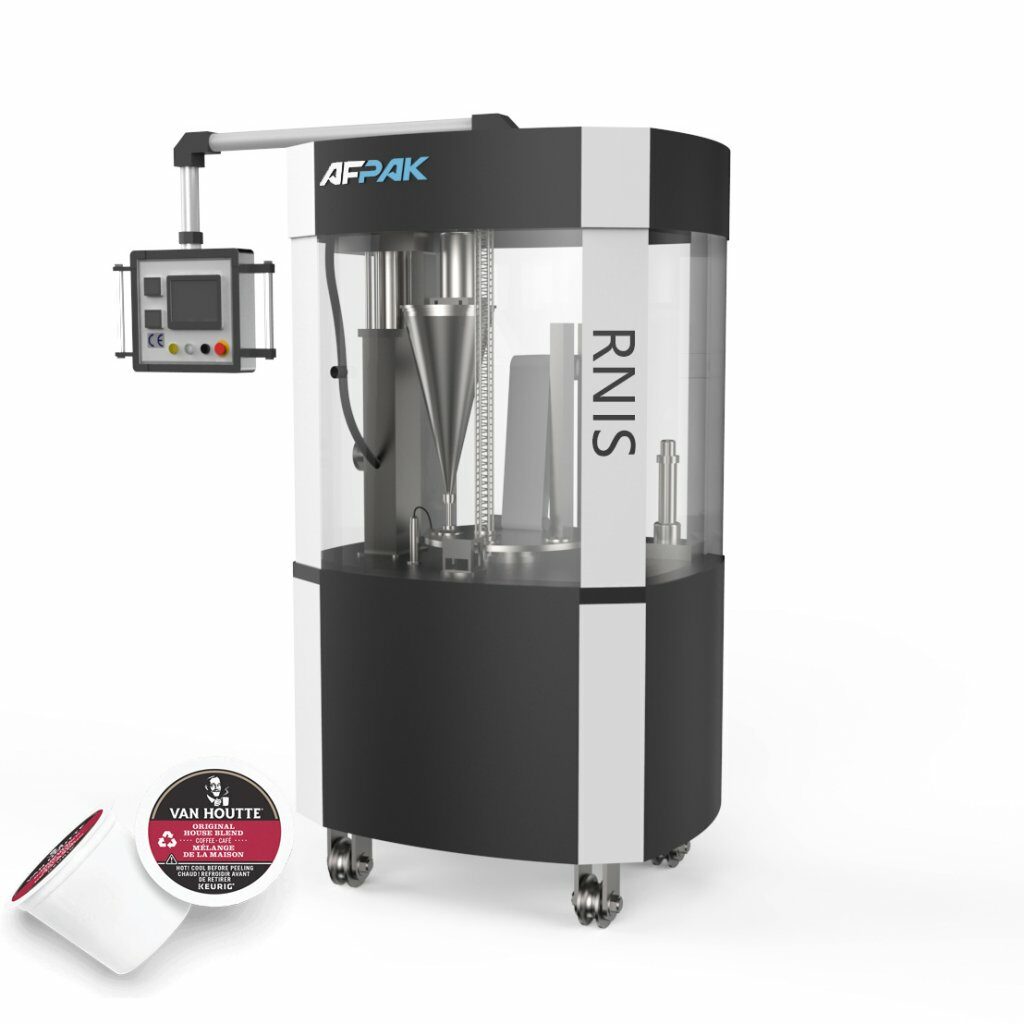
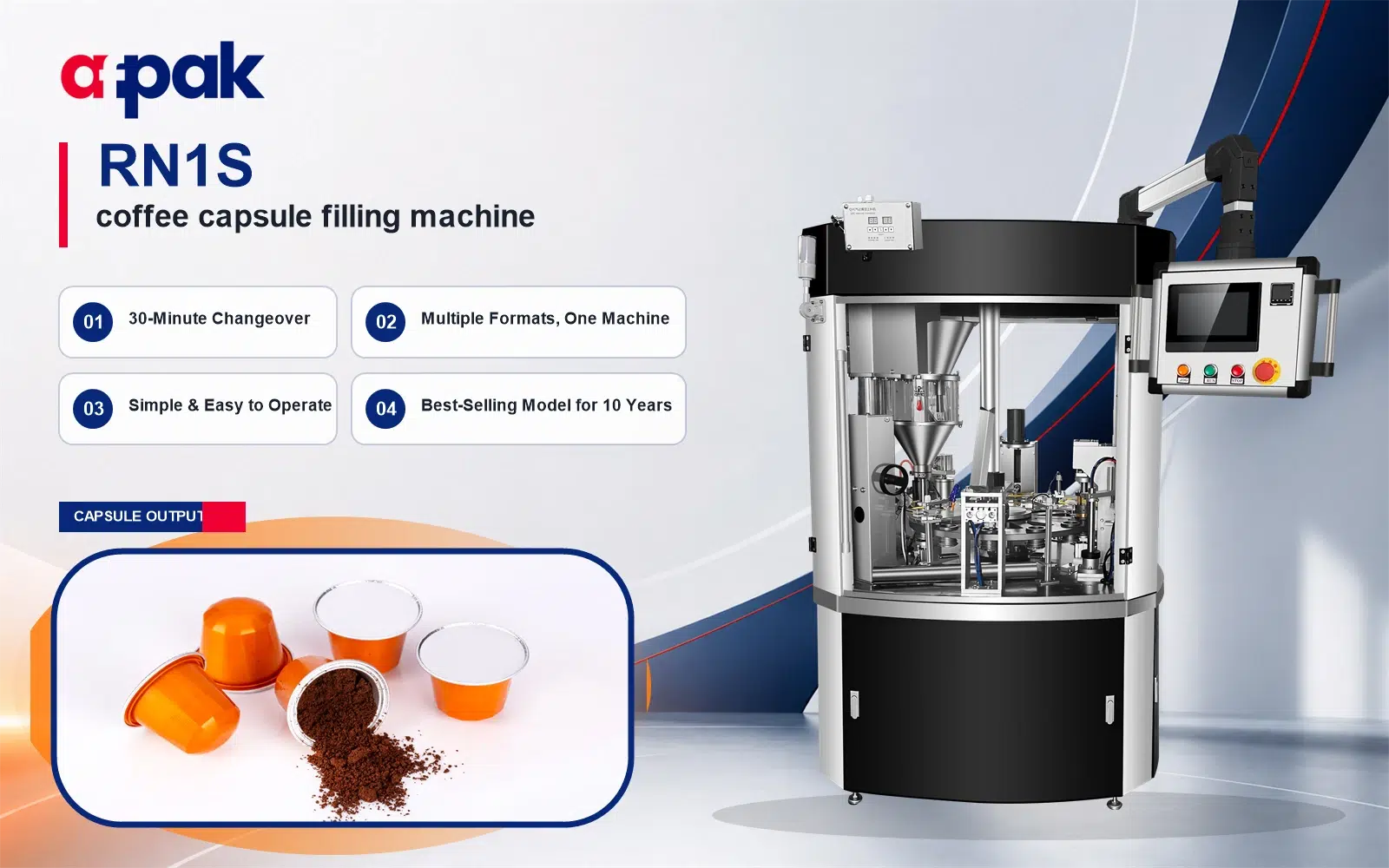
The AFPAK RN1S is a single-lane, 12-station rotary coffee capsule filling and sealing machine for roasters, coffee brands and contract manufacturers. It combines automatic capsule feeding, servo-auger dosing, rim cleaning, nitrogen protection and sealing in one compact system.
Configure RN1S for your capsule format, coffee and lid material—with approximately 50 capsules per minute as the reference production speed and dedicated tooling for approved format changes.
About 50 capsules/min | 1–20 g filling range | Approx. 30-minute format changeover
Since 2010 · Suzhou Manufacturing + Wenzhou R&D · Response Within 8 Hours
Output and filling performance depend on the capsule, product, lid material and selected configuration.
AFPAK / RN1S
Key Performance Data
| Item | Reference specification |
|---|---|
| Machine platform | Single-lane rotary platform with space for 12 working stations |
| Production speed | Approximately 50 capsules/min |
| With optional inline checkweighing | Approximately 40–45 capsules/min |
| Filling range | 1–20 g for the powder configuration, with suitable product and tooling |
| Standard filling accuracy | ±0.2 g under agreed production conditions |
| Format changeover | Approximately 30 minutes with the corresponding change parts |
| Routine cleaning | Approximately 10 minutes for the defined routine cleaning task |
AFPAK / RN1S
Engineering That Supports Daily Production
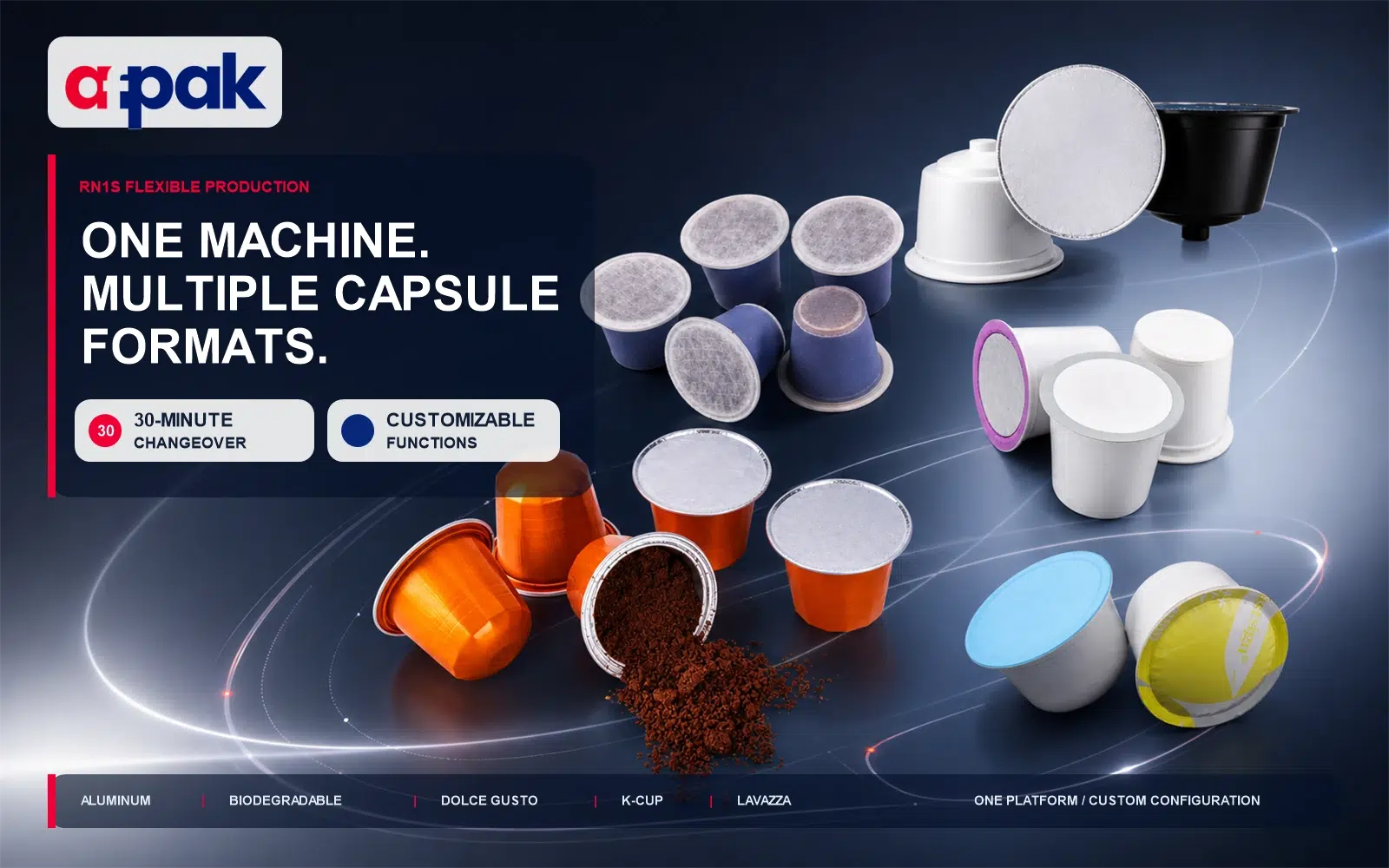
Change Capsule Formats With Dedicated Tooling
Produce different approved capsule formats on the same base machine by changing the relevant tooling. Depending on the format, this can include rotary mold inserts, the capsule dropper, dosing components, rim-cleaning head, cutter and sealing head.
A typical format change takes approximately 30 minutes. AFPAK confirms the required change parts before the machine configuration is finalized.
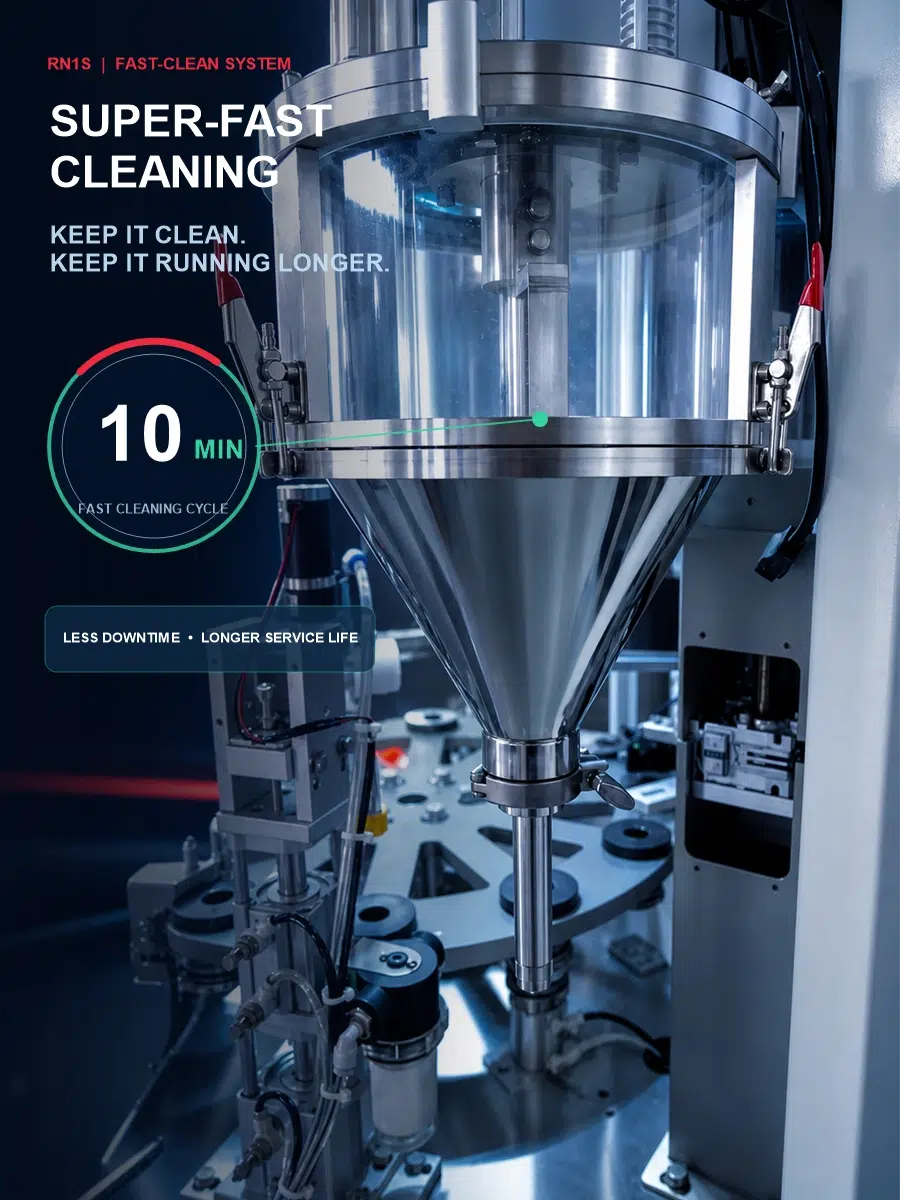
Access the Hopper and Auger for Cleaning
Removable product-contact components make routine cleaning easier between production runs. The hopper and auger can be removed without tools, helping operators reach the surfaces that contact the product.
Allow approximately 10 minutes for the defined routine cleaning task. Product changes requiring deeper cleaning need additional time and an appropriate cleaning procedure.
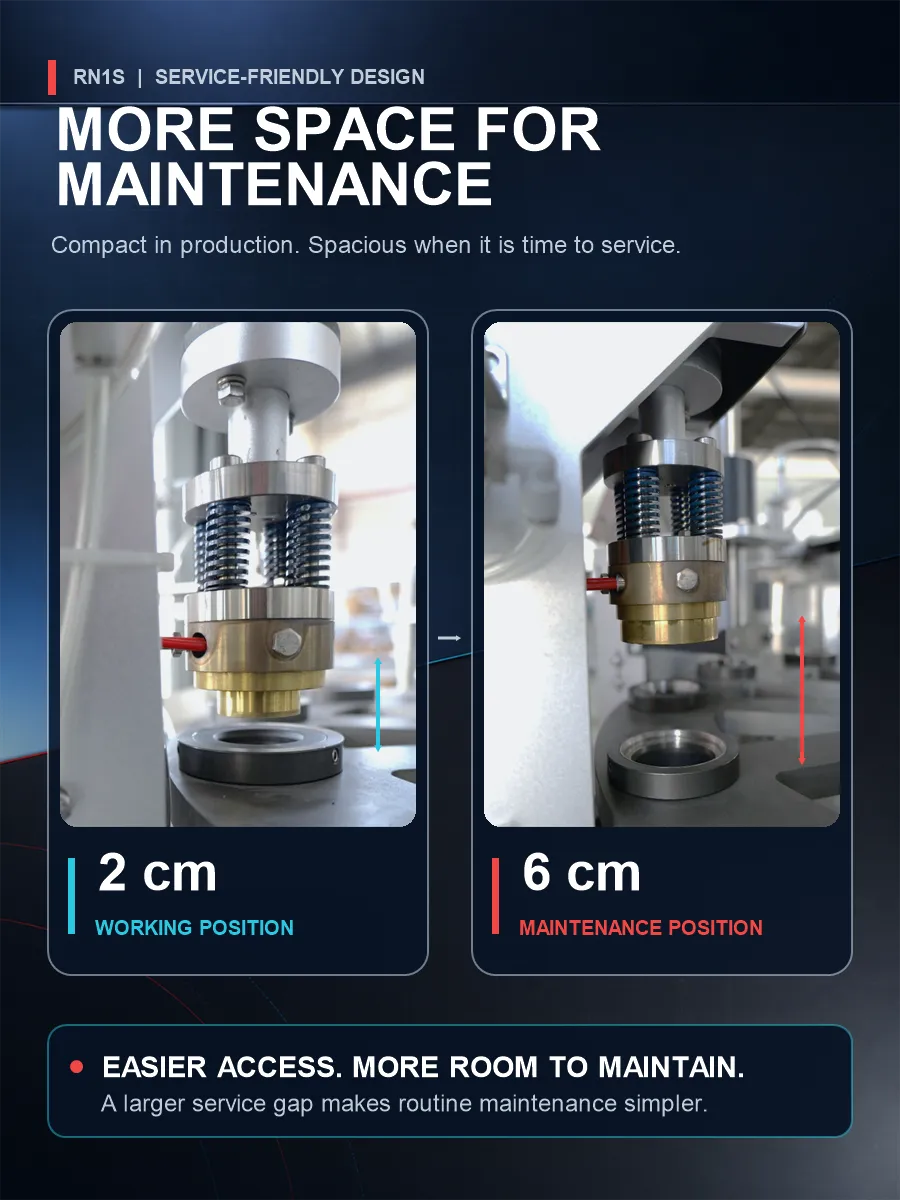
Create More Room for Sealing-Head Maintenance
The upgraded RN1S provides separate production and maintenance modes. With the machine stopped and the prescribed safety procedure followed, maintenance mode opens additional clearance around the sealing area for cleaning, inspection and component replacement.
Control Dosing and Check Finished Capsule Weight
Servo-auger filling meters the product to the selected dose. Standard filling accuracy is ±0.2 g under agreed conditions; ±0.1 g may be achievable with suitable coffee and operating settings.
An optional inline checkweigher checks each capsule and rejects products outside the selected limits. It monitors finished weight; it does not automatically correct the filler setting.
under agreed conditions
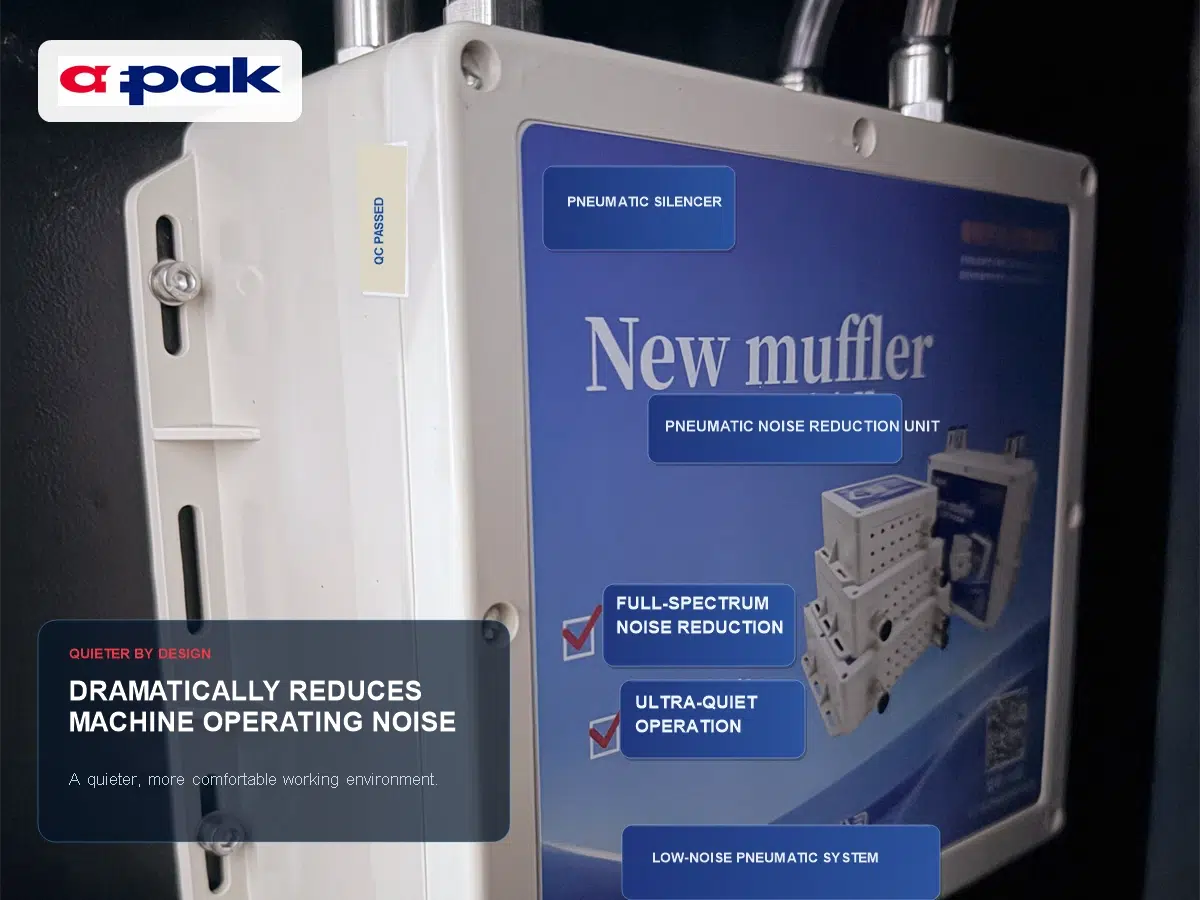
Reduce Noise at the Source
The upgraded sound-reduction structure addresses noise around the machine and capsule-feeding area. Ask to see the current configuration operating with a capsule format comparable to yours.
RN1S DESIGN DETAILS
Explore the Machine.
See the Details.
Move through the RN1S from the complete machine to its internal working stations, sealing area and powder filling system.
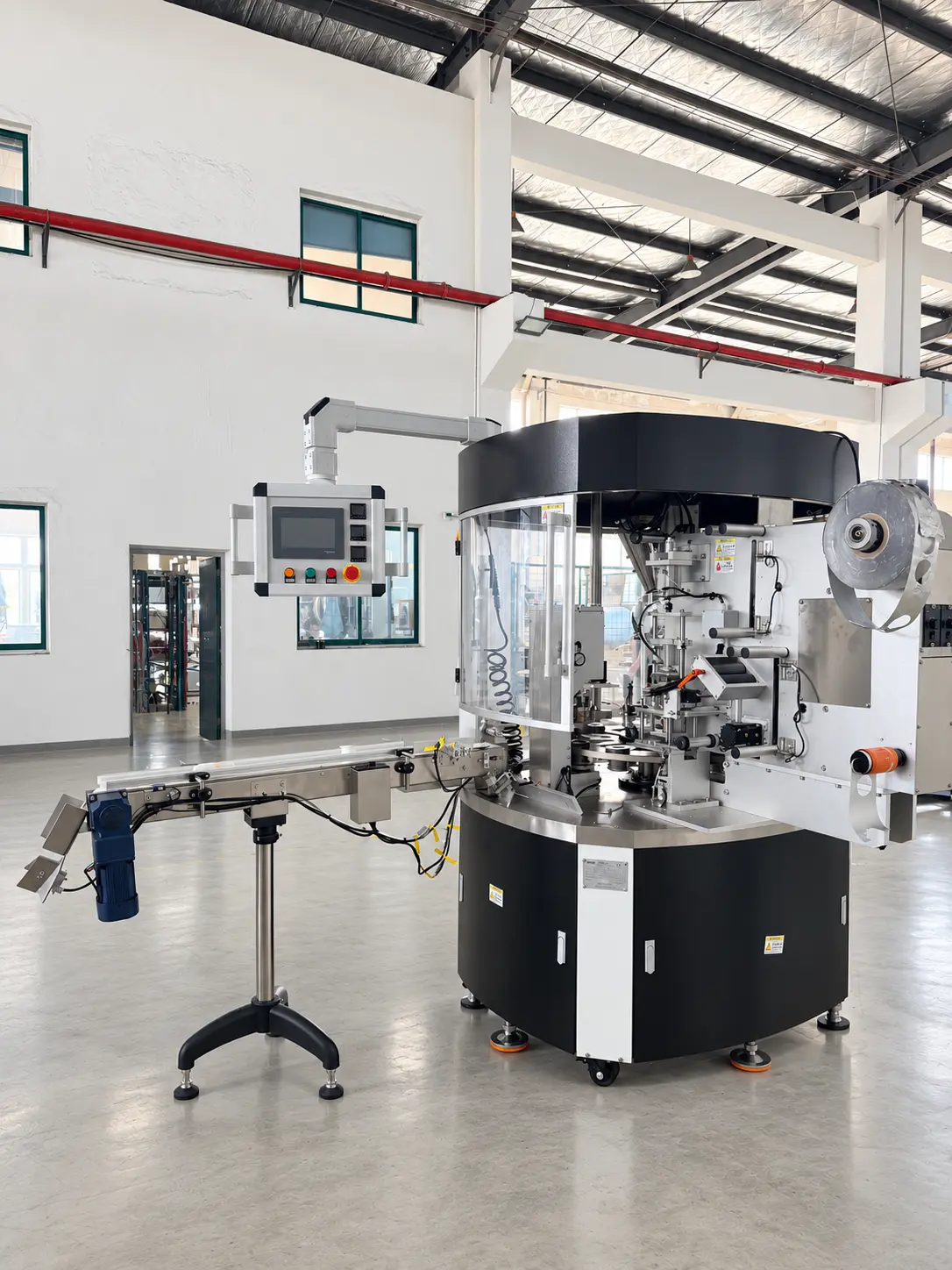
Rear Machine View
Enclosed rotary machine from the rear.
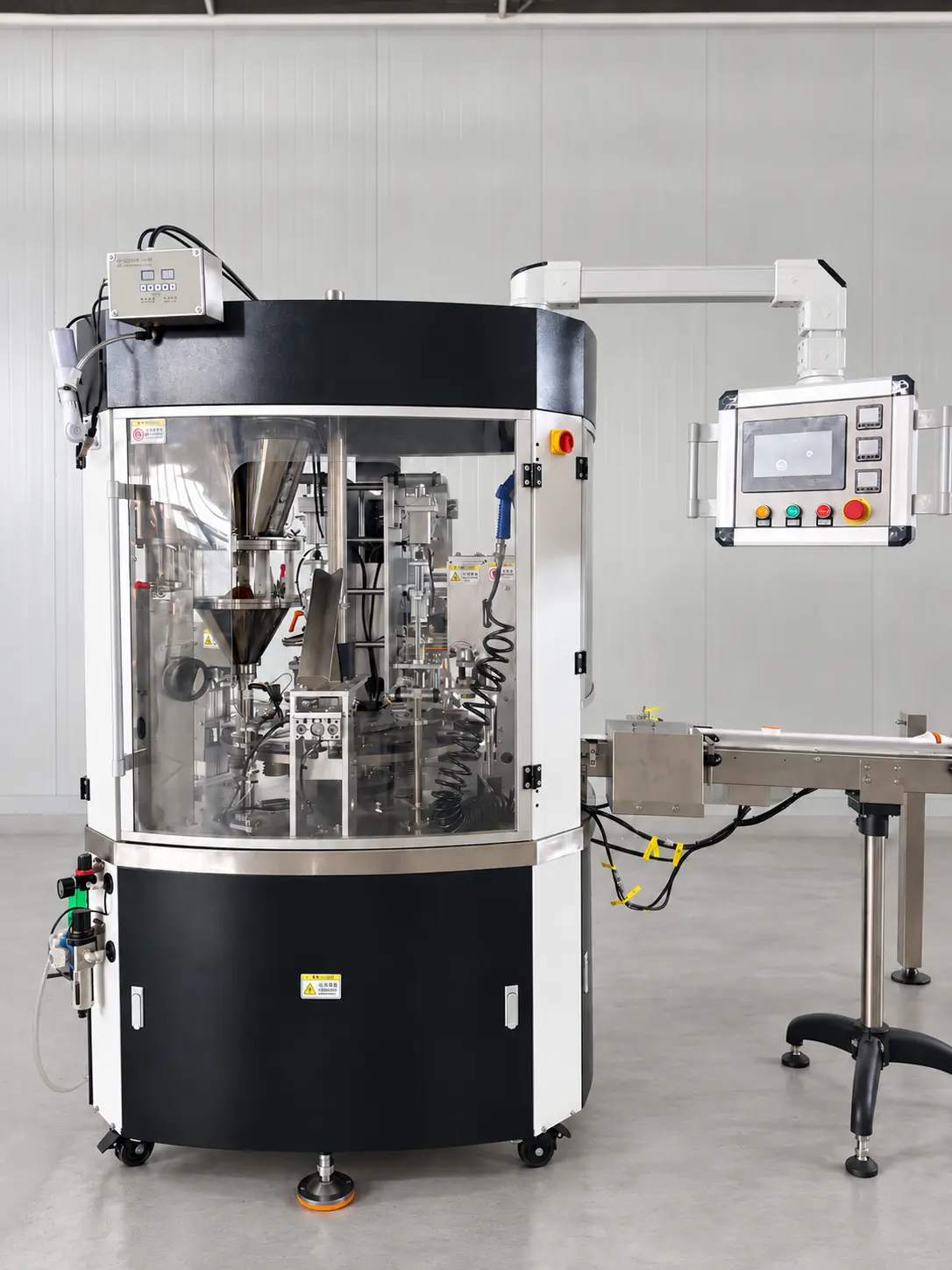
Complete Machine
RN1S on the workshop floor.
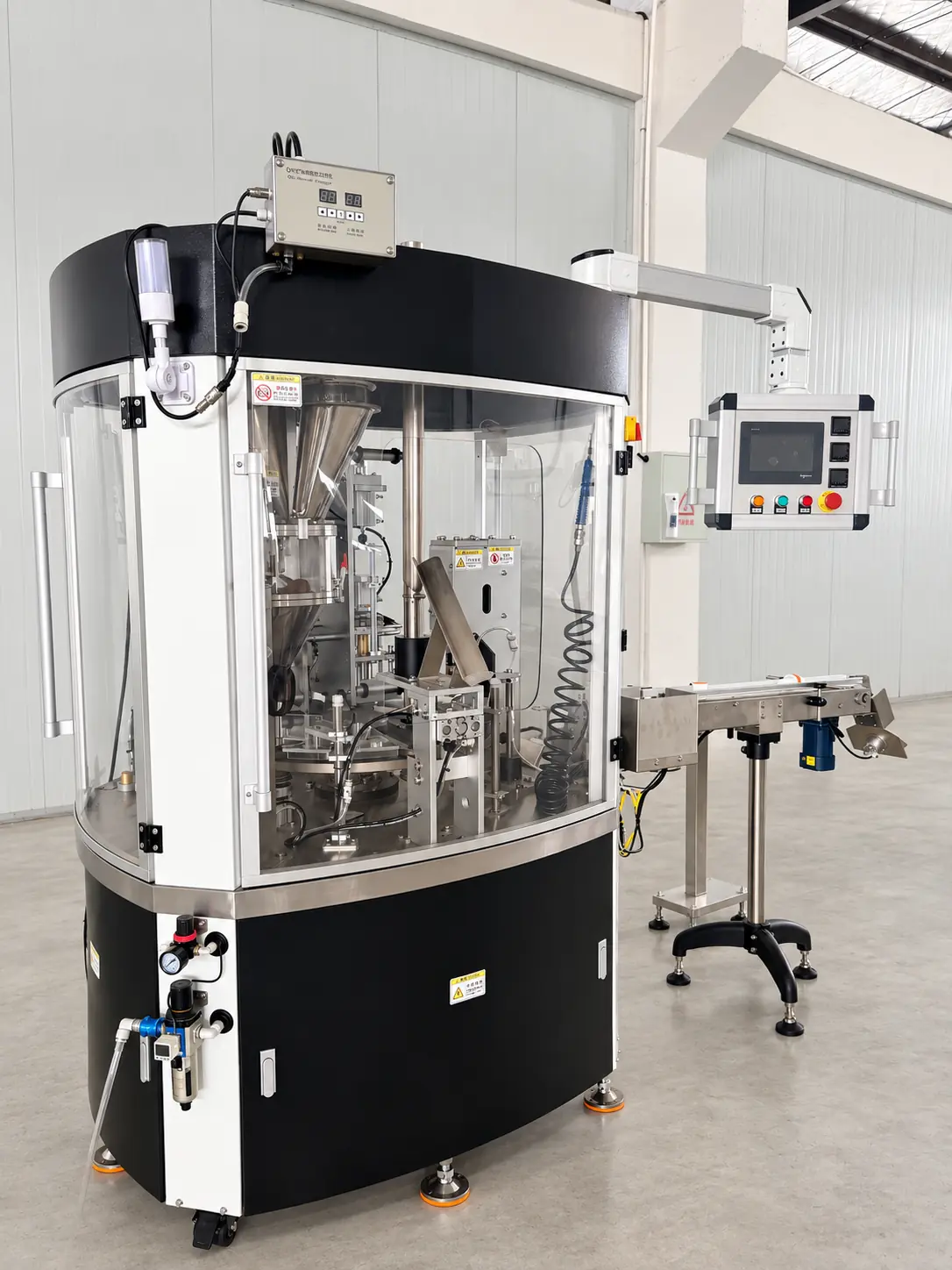
Side View
Machine profile and working-area access.
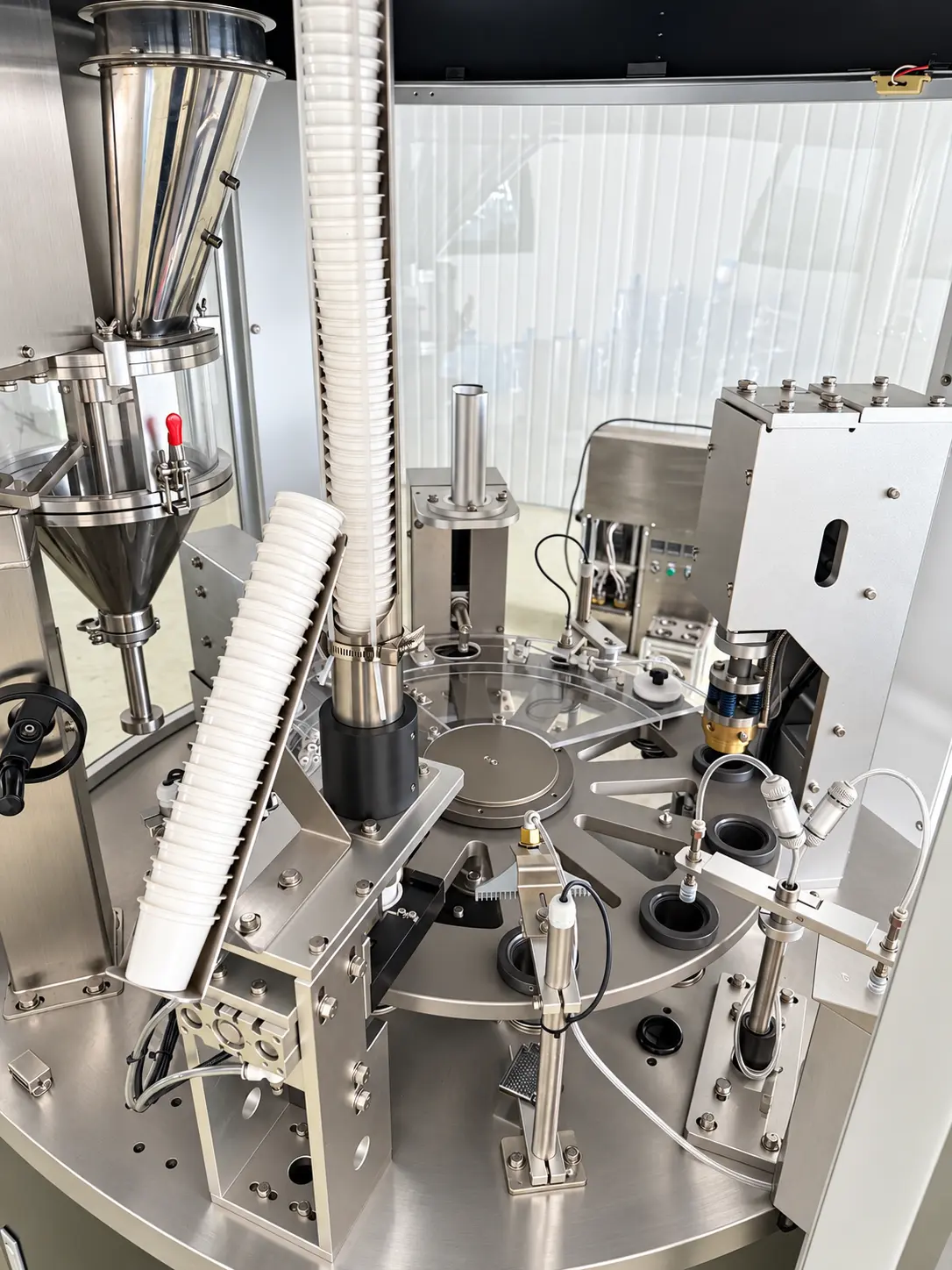
Internal Working Stations
A closer look inside the rotary platform.
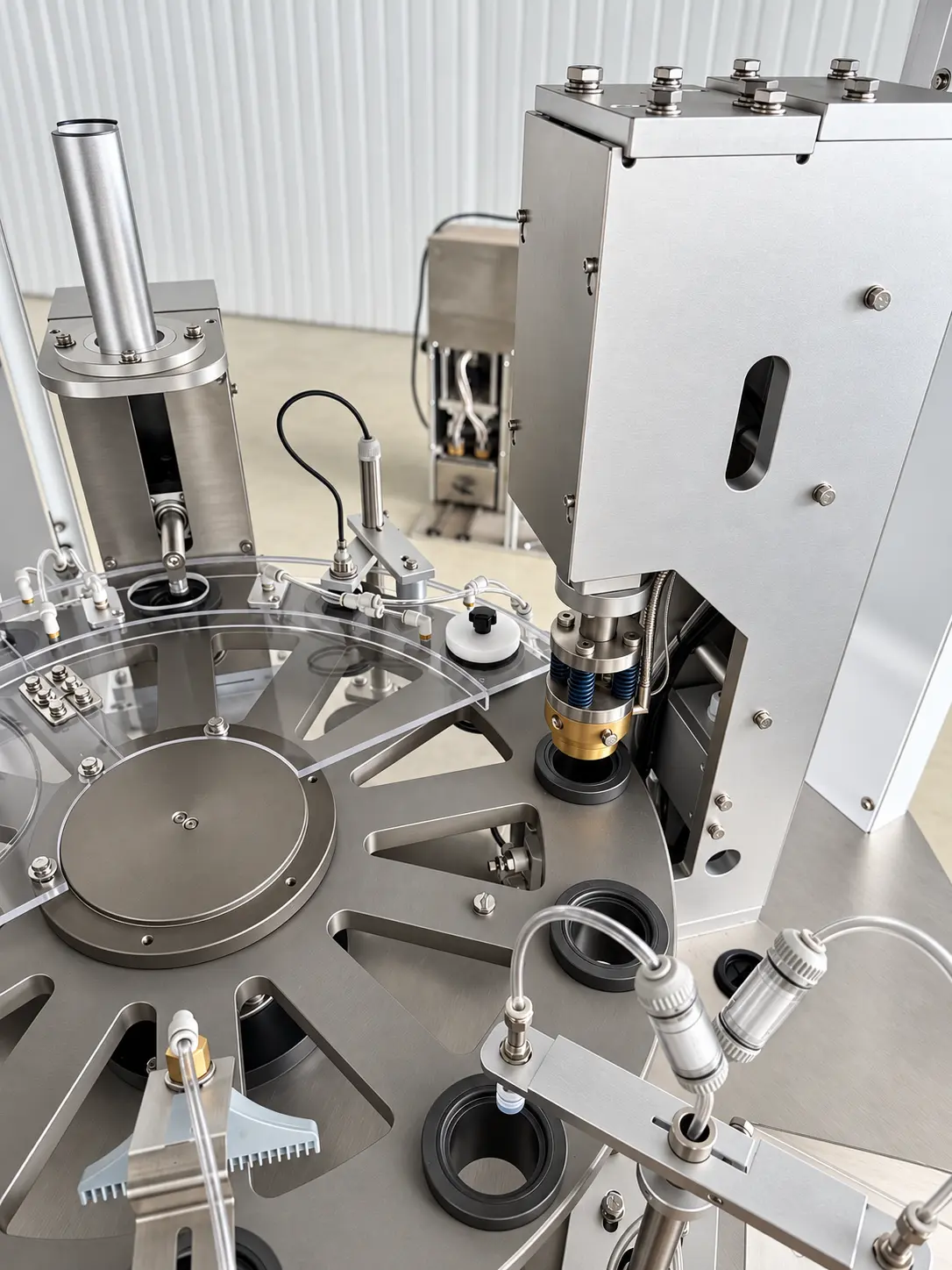
Capsule Sealing Station
Sealing components and capsule positioning.
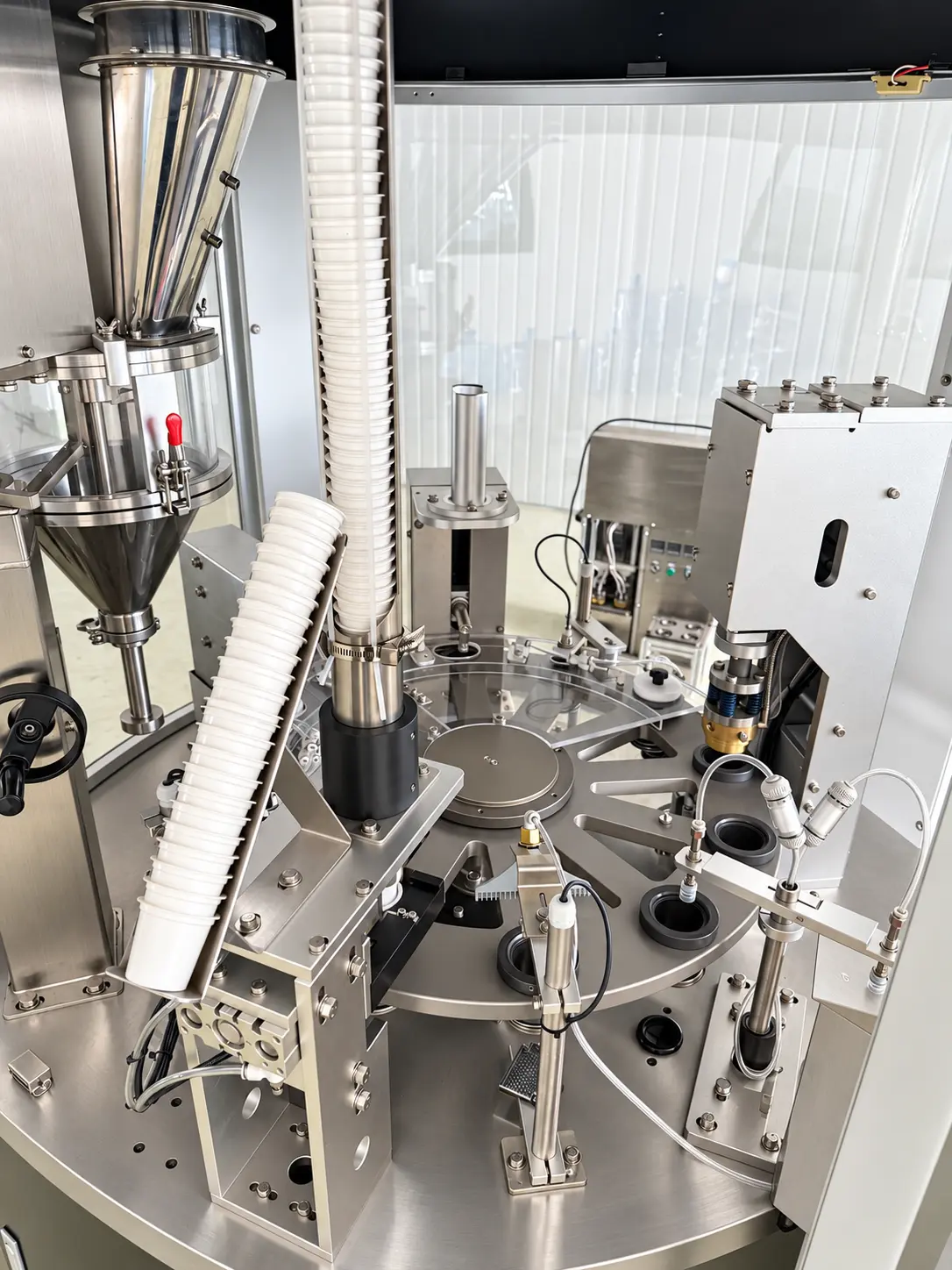
Rotary Station Layout
Working stations arranged around the rotary table.
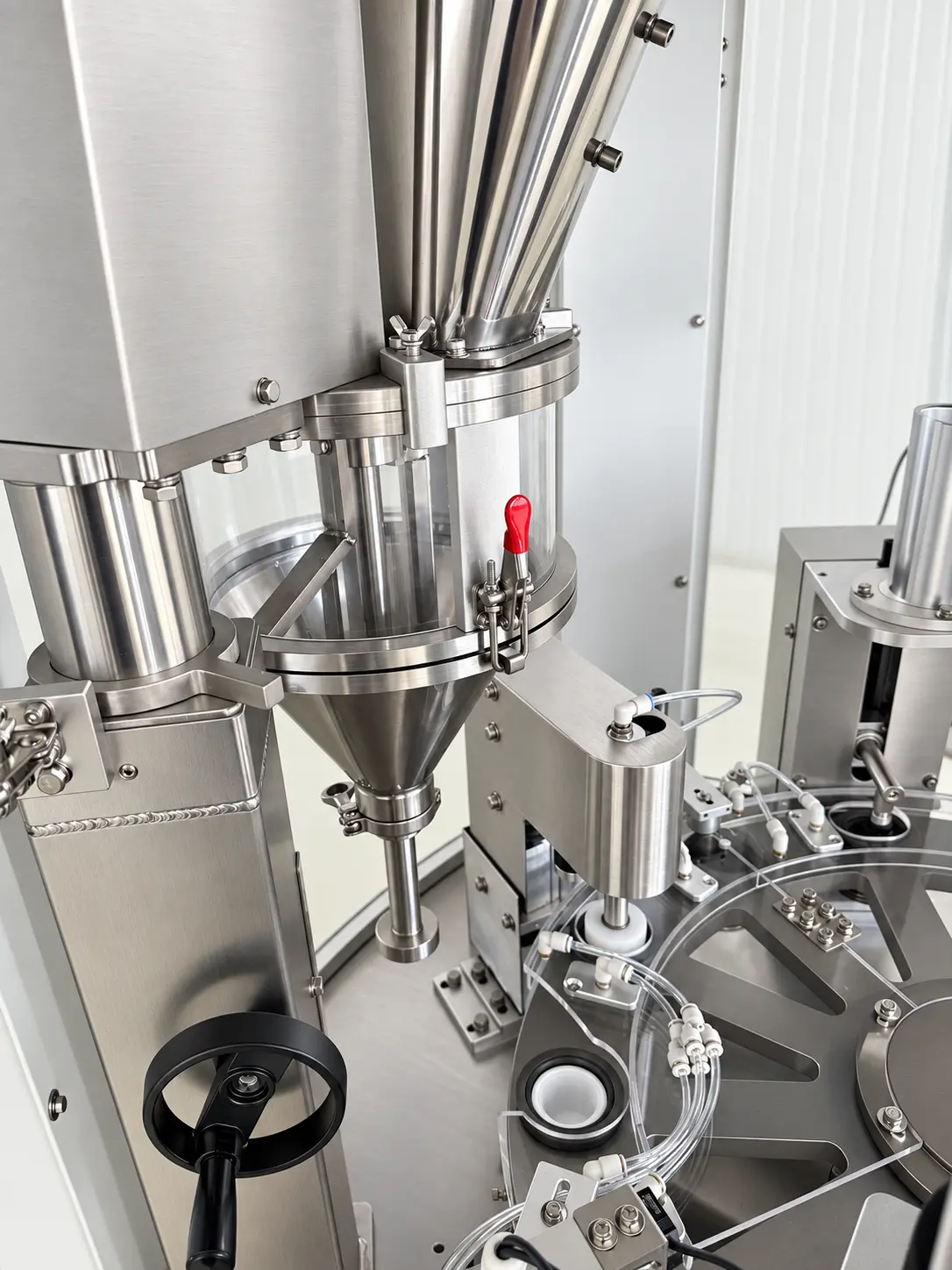
Powder Filling System
A closer view of the capsule dosing area.
Image 1 of 7
AFPAK / RN1S
Is RN1S the Right Fit for Your Production Plan?
RN1S is a practical choice when capsule-format flexibility, cleaning access and a compact layout are priorities, and your required output fits a single-lane system.
When planning capacity, include cleaning, material replenishment, format changes, quality checks and planned stops. Use the agreed production rate and your operating schedule to estimate daily saleable output.
For higher output or automated retail packing, AFPAK can evaluate a multi-lane system and a complete packaging line around your capsule, carton and factory layout.
Discuss Your Production Plan · Explore Complete Capsule Packaging Lines
CHOOSE YOUR PLATFORM
RN1S vs. YM80: Which Machine Fits Your Priorities?
Both platforms serve producers who care about capsule quality. The key difference is how the working components move—and the level of mechanical construction you want to invest in.
| What matters to you | RN1S | YM80 |
|---|---|---|
| Vertical component movement | Pneumatic actuation controls the up-and-down movement of working components. | Cam-driven mechanical transmission coordinates the movement of working components. |
| Mechanical design | A practical balance of production quality, operating convenience and investment. | Greater mechanical precision and closer coordination between mechanically linked components, with a more substantial machine build. |
| Investment priority | For companies seeking high-quality capsule production and convenient operation within a limited equipment budget. | For companies with a larger equipment budget that prioritize a more robust mechanical platform and long-term use. |
| Which should you choose? | Choose RN1S when ease of use, flexible applications and budget control are central to your purchase. | Choose YM80 when mechanical construction, coordinated motion and durability are your main investment priorities. |
Drive design is one part of machine selection. Final filling and sealing performance depends on the product, capsule, tooling and operating conditions. Service life also depends on operating hours, maintenance and the production environment.
RN1S: Quality and Convenience Within Your Budget
For buyers who want high-quality capsule production without stretching the equipment budget, RN1S combines convenient operation with a versatile 12-station platform.
YM80: Invest in a More Substantial Mechanical Platform
For buyers who can invest more upfront, YM80 offers cam-driven mechanical coordination and a more robust build for users who place greater emphasis on long-term durability.
AFPAK / RN1S
Confirm the Process With Your Materials
- Share your requirements. Provide the capsule format, product, target dose, lid specification and required output.
- Confirm the tooling and configuration. Review capsule handling, dosing, sealing and optional inspection functions.
- Evaluate production samples. Check filling results, capsule appearance and seal quality using the agreed materials and test conditions.
- Agree the acceptance criteria. Confirm the operating rate, tolerances, utilities, training and delivery scope in the technical proposal.
AFPAK / RN1S
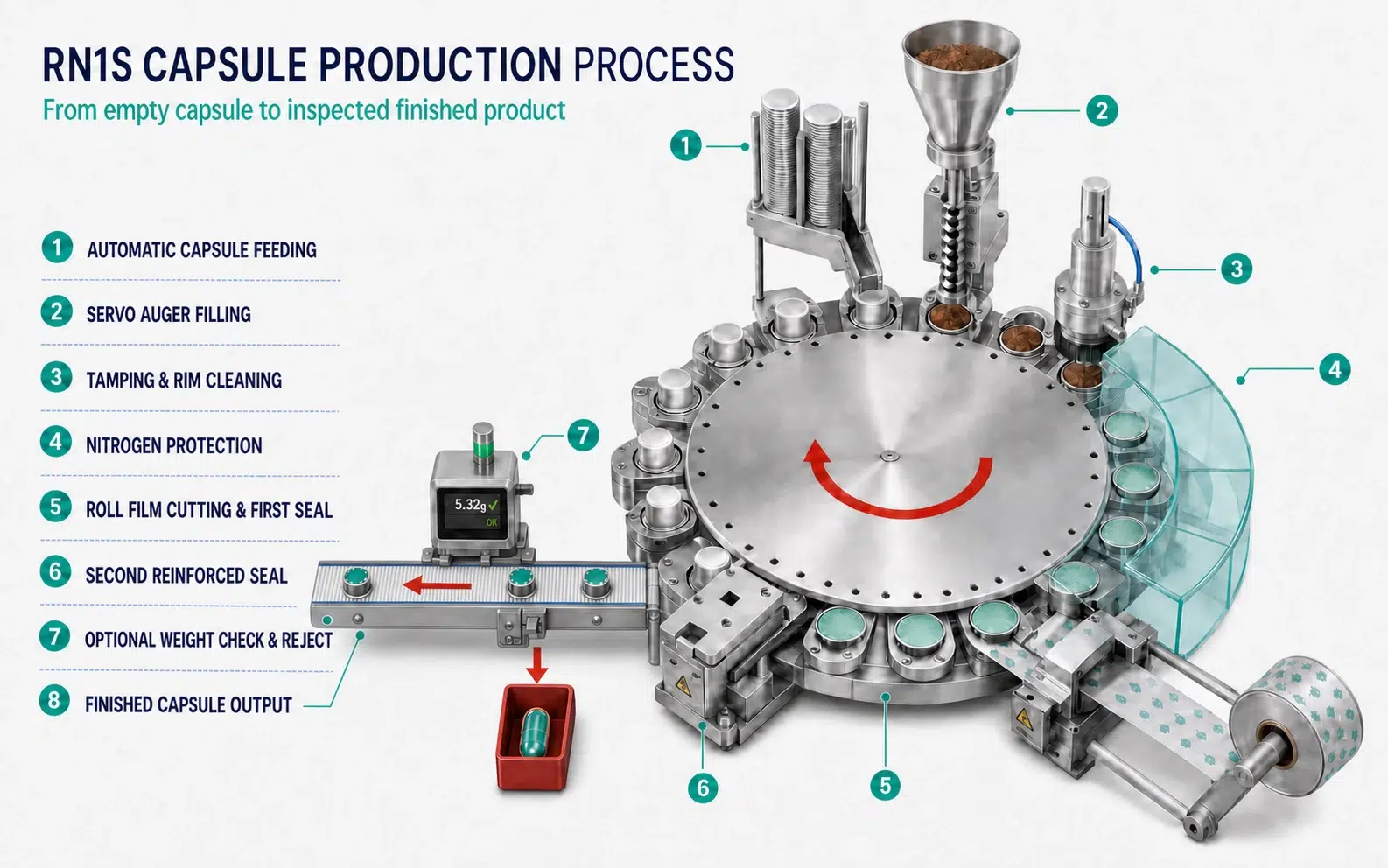
From Empty Capsule to Sealed Product
| Process | Function |
|---|---|
| Capsule feeding and detection | Position the empty capsule and check its presence before processing |
| Nitrogen protection and filling | Protect the product path and meter the selected dose with the servo auger |
| Tamping and rim cleaning | Prepare the filled capsule and remove loose powder from the sealing surface |
| Lid handling | Feed pre-cut lids or handle roll film according to the selected configuration |
| Heat sealing | Apply the sealing process matched to the capsule and lid material |
| Inspection and discharge | Add optional weight inspection and rejection, then discharge finished capsules |
This is a process overview, not a numbered physical-station drawing. The station arrangement depends on the selected configuration.
PRODUCTS / FORMATS / FILLING SYSTEMS
One 12-Station Platform. More Capsule Applications.
RN1S provides space for 12 working stations, allowing the process to be configured for a broad range of coffee capsule formats and filling applications. Station functions are arranged around the product, capsule, lid material and selected inspection requirements.
From ground coffee and tea to instant powders and cocoa, AFPAK selects the filling structure for the material. Liquid, paste and granular products can also be evaluated with their corresponding filling systems.
Match the Filling System to Your Product
| Product application | Filling configuration |
|---|---|
| Ground coffee, instant powders and cocoa powder | Powder filling structure, with dosing components selected for flowability, bulk density and target weight. |
| Tea | Filling structure selected for the tea form, from tea powders to suitable leaf or granular products, subject to sample evaluation. |
| Liquids | Dedicated liquid filling structure matched to the product and required dose. |
| Pastes | Dedicated paste filling structure matched to viscosity and dispensing requirements. |
| Granular products | Dedicated granular filling structure selected for particle size, flow and target dose. |
These are application-specific configurations, not functions included in one standard powder filler. Moving between powders, liquids, pastes and granules requires evaluation and the appropriate filling structure. The stated powder filling range and accuracy do not automatically apply to other filling systems.
Capsule Formats Available for Configuration
Each capsule system requires its own approved tooling and sealing setup. The available station space supports the process arrangement; it does not make different capsule formats interchangeable without change parts.
For Nespresso-compatible coffee capsules, a typical dose is approximately 5–6 g. Actual fill weight depends on the product and usable capsule volume. Send your capsule, lid and filling material so AFPAK can confirm compatibility and the final station layout.
AFPAK / RN1S
Nitrogen Protection and Sealing
Protect the Product Through Filling and Sealing
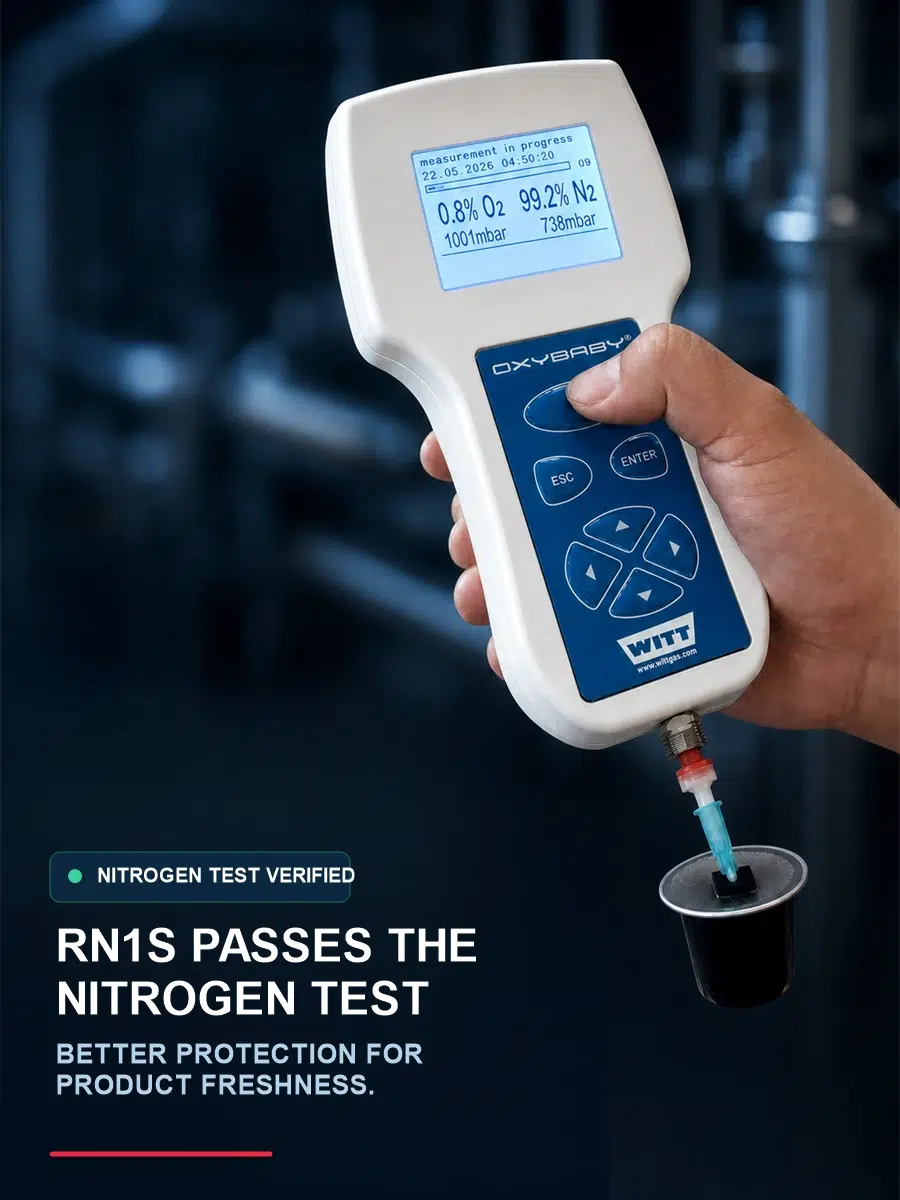
RN1S uses nitrogen protection around the critical filling and sealing stages. Residual oxygen results depend on capsule geometry, packaging materials, gas purity, machine settings and production speed.
If residual oxygen is part of your acceptance criteria, specify the target and test method before the production trial. Nitrogen flushing alone does not establish a finished product's shelf life.
Match the Seal to Your Capsule and Lid
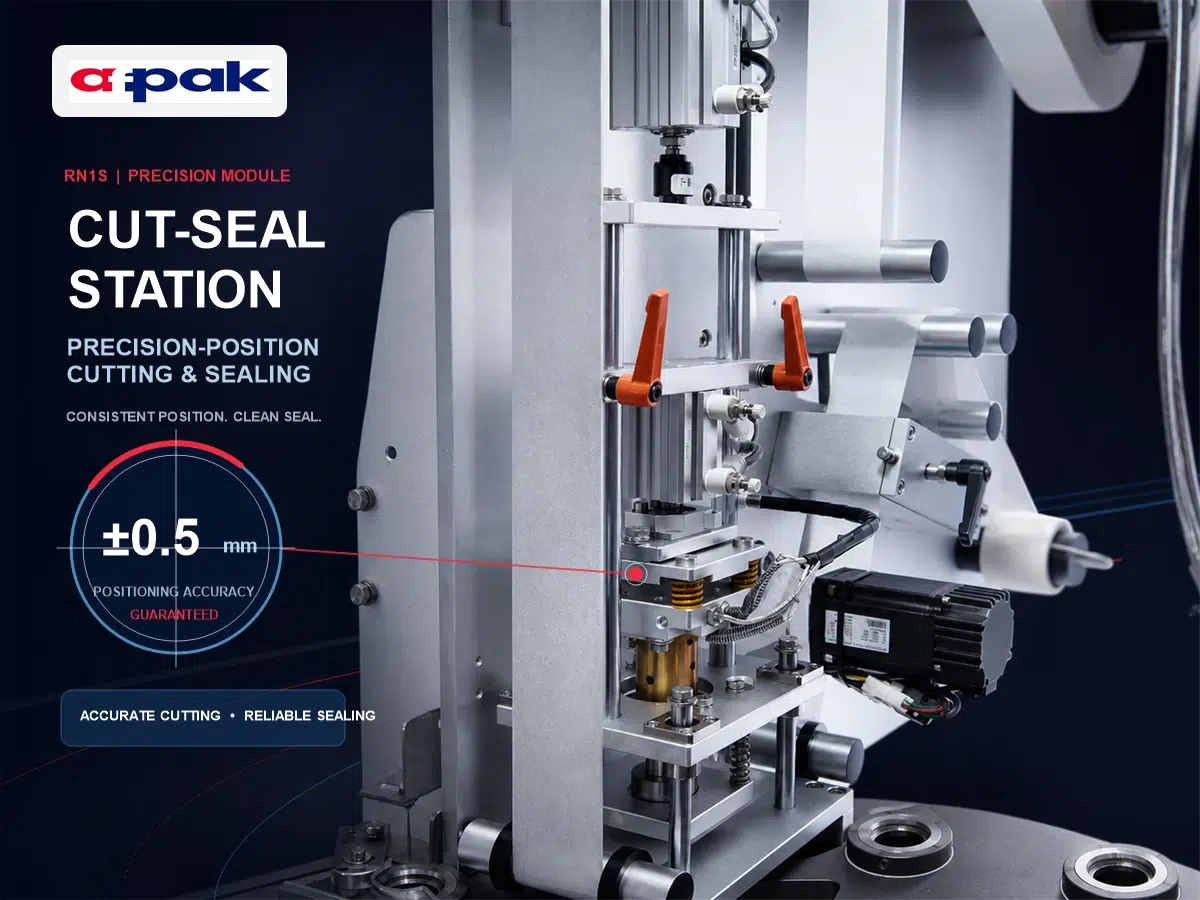
For the described roll-film configuration, cutting and initial sealing are followed by a second sealing operation. Pre-cut-lid configurations use the corresponding lid-placement and sealing arrangement.
AFPAK evaluates sealing settings with the selected capsule and lid material. Confirm temperature, pressure and operating conditions as part of the project setup.
AFPAK / RN1S
Watch RN1S Run Your Capsule Format
See capsule feeding, dosing, rim cleaning, sealing and discharge in one production sequence. For a more relevant evaluation, request a demonstration using a comparable capsule format and fill weight.
AFPAK / RN1S
Configuration and Optional Functions
| Core process scope* | Available options* |
|---|---|
| Automatic capsule feeding and presence detection | Inline checkweigher and rejection |
| Servo-auger filling | Vision-based sealing inspection |
| Tamping and rim cleaning | Laser coding |
| Nitrogen protection | Liquid flavor dosing |
| Selected lid-feeding and sealing system | Additional capsule-format tooling |
| Finished-capsule discharge | Remote diagnostics module |
| Operating controls and safety interlocks | SUS316 product-contact components |
| Powder filling structure for the agreed product | Dedicated liquid, paste or granular filling structures, subject to project evaluation |
The final quotation identifies included equipment, selected options and customer-supplied utilities. Pre-cut-lid and roll-film arrangements must be specified for the project.
AFPAK / RN1S
Technical Specifications
| Parameter | RN1S |
|---|---|
| Type | Single-lane, 12-station rotary coffee capsule filling and sealing machine |
| Reference production speed | Approximately 50 capsules/min |
| Output with inline checkweigher | Approximately 40–45 capsules/min |
| Filling range | 1–20 g for the powder configuration; other filling systems evaluated separately |
| Standard filling accuracy | ±0.2 g under agreed conditions |
| Format changeover | Approximately 30 minutes |
| Routine cleaning | Approximately 10 minutes for the defined task |
| Product-contact material | SUS304; SUS316 available as an option |
| Electrical supply | Confirmed for the destination and machine configuration |
| Dimensions and installation space | Confirmed in the approved project layout |
| Compressed air and nitrogen | Requirements confirmed in the technical proposal |
AFPAK / RN1S
Installation, Training and Support
Before shipment, confirm the machine layout, electrical supply, compressed air, nitrogen supply and material-handling arrangements with AFPAK. Include access for operators, cleaning and service in your installation plan.
Online installation guidance, operating documentation and training support help your team understand setup and daily operation. Remote diagnostics can be added with the appropriate module and customer authorization. Warranty and on-site service terms are stated in the final proposal.
AFPAK has focused on coffee packaging machinery since 2010, with manufacturing in Suzhou and R&D in Wenzhou. Send your capsule and production requirements to receive a configuration recommendation and project-specific delivery schedule.
AFPAK / RN1S
Frequently Asked Questions
Can one RN1S produce different capsule formats?
Yes, with the corresponding tooling and an approved machine configuration. A typical changeover takes approximately 30 minutes. Confirm each intended capsule format before ordering so the required change parts can be included.
What production speed should I use for planning?
Use approximately 50 capsules per minute as the reference before product testing. The described inline-checkweigher configuration operates at approximately 40–45 capsules per minute. Final output is agreed for your capsule, coffee, lid material and inspection requirements.
Is ±0.1 g filling accuracy guaranteed for every coffee?
No. The standard reference is ±0.2 g under agreed production conditions. ±0.1 g may be achievable with suitable coffee and settings. Coffee flowability, particle size, oil content, hopper level and speed affect the result.
Can RN1S use both pre-cut lids and roll film?
RN1S can be configured for the appropriate lid system. Tell AFPAK which materials you intend to use; running both systems must be specifically evaluated and included in the configuration.
Does the checkweigher automatically adjust the filler?
No. The described option checks capsule weight and rejects products outside the selected limits. It does not provide automatic feedback correction to the filling system.
How long does cleaning take?
The reference for routine cleaning is approximately 10 minutes. The actual procedure and time depend on the product, residue and required cleaning standard. Allow additional time for deeper cleaning between products.
What if I need higher output or automatic cartoning?
Share your target output and carton format. AFPAK can compare RN1S with higher-output equipment and evaluate a complete capsule packaging line. Downstream integration is engineered for the project and is not assumed to be included with RN1S.
What information is needed for a quotation?
Send your capsule drawing or samples, filling product, target dose, lid specification, required output, destination and available factory space. Include inspection and downstream packing requirements if applicable.
How does RN1S differ from YM80?
RN1S uses pneumatic actuation for vertical component movement and suits buyers who prioritize high-quality capsule production, convenient use and budget control. YM80 uses cam-driven mechanical transmission with greater mechanical precision and coordination, and suits buyers who can invest more in a substantial platform for long-term use. Explore the YM80 machine.
Can RN1S fill liquids, pastes or granules?
Yes, RN1S can be configured with dedicated liquid, paste or granular filling structures. These differ from the powder filling system and must be specified for the product. Dosing performance and cleaning requirements are confirmed separately for each configuration.
What does the 12-station layout support?
The platform provides space to arrange the required filling, capsule handling, sealing and selected inspection functions. RN1S can be configured for Nespresso-compatible, K-Cup-compatible, Dolce Gusto-compatible, Lavazza Espresso Point-compatible, Lavazza Blue-compatible and Lavazza A Modo Mio-compatible capsules with the appropriate tooling. The final station arrangement is confirmed for the project.
Configure RN1S Around Your Capsule and Coffee
Get a proposal covering the machine configuration, format tooling, inspection options, utility requirements and delivery schedule.
Send your capsule format, target dose and required output to help us recommend a suitable setup.
Third-party trademarks belong to their respective owners. AFPAK is not affiliated with or endorsed by these trademark owners.