
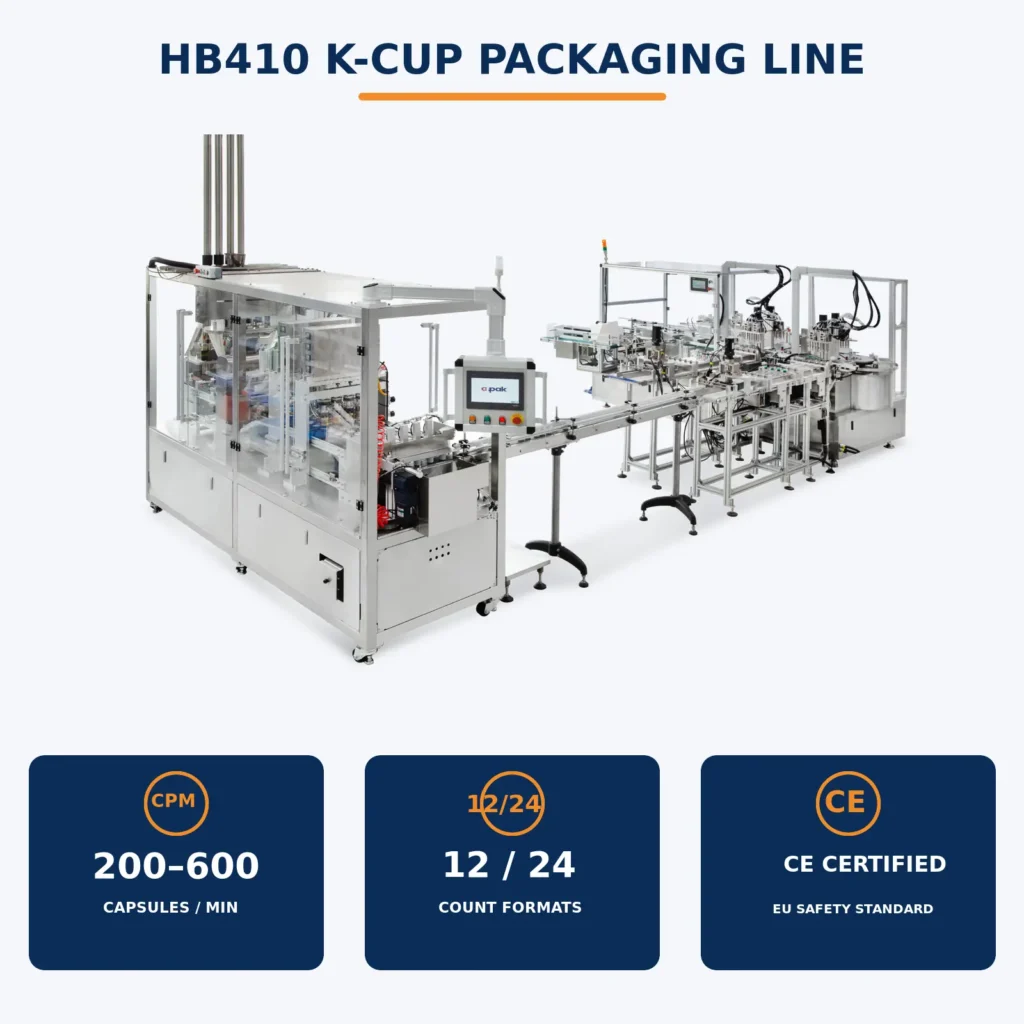
Automatic K-Cup Filling, Sealing & Cartoning Line
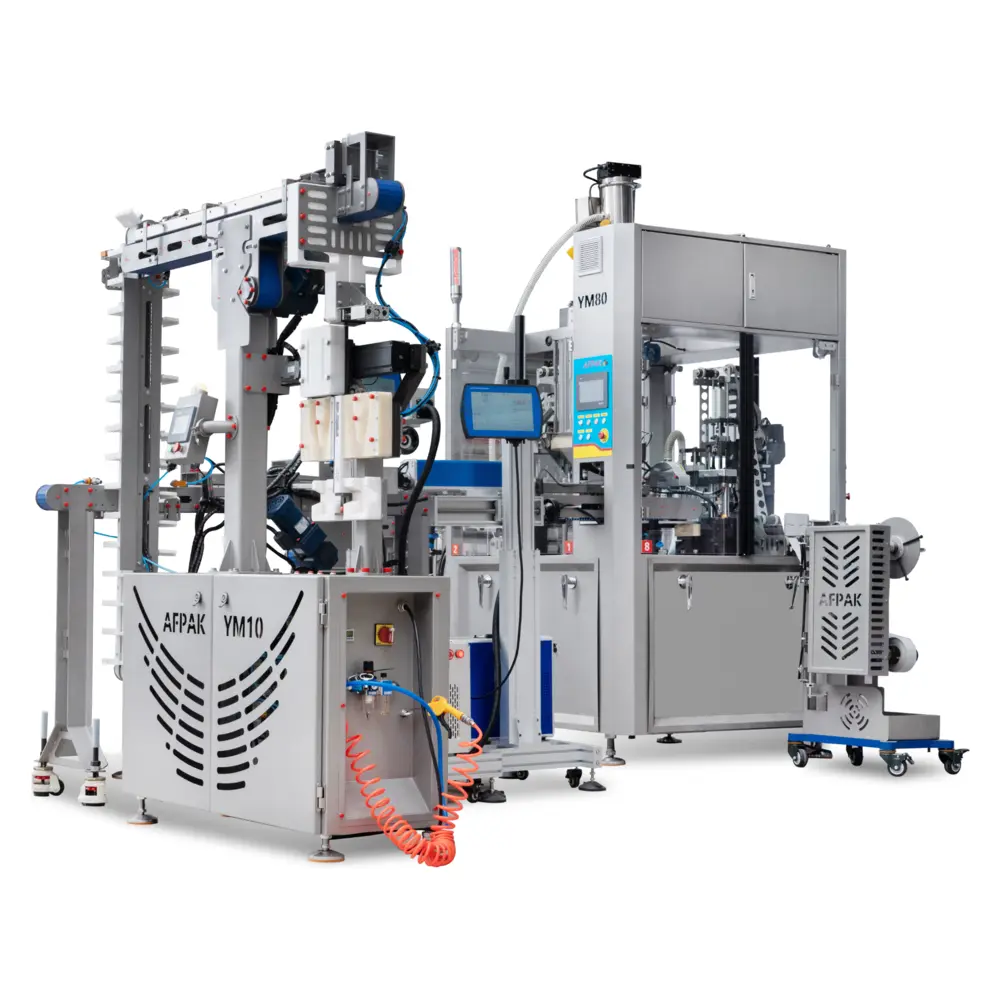
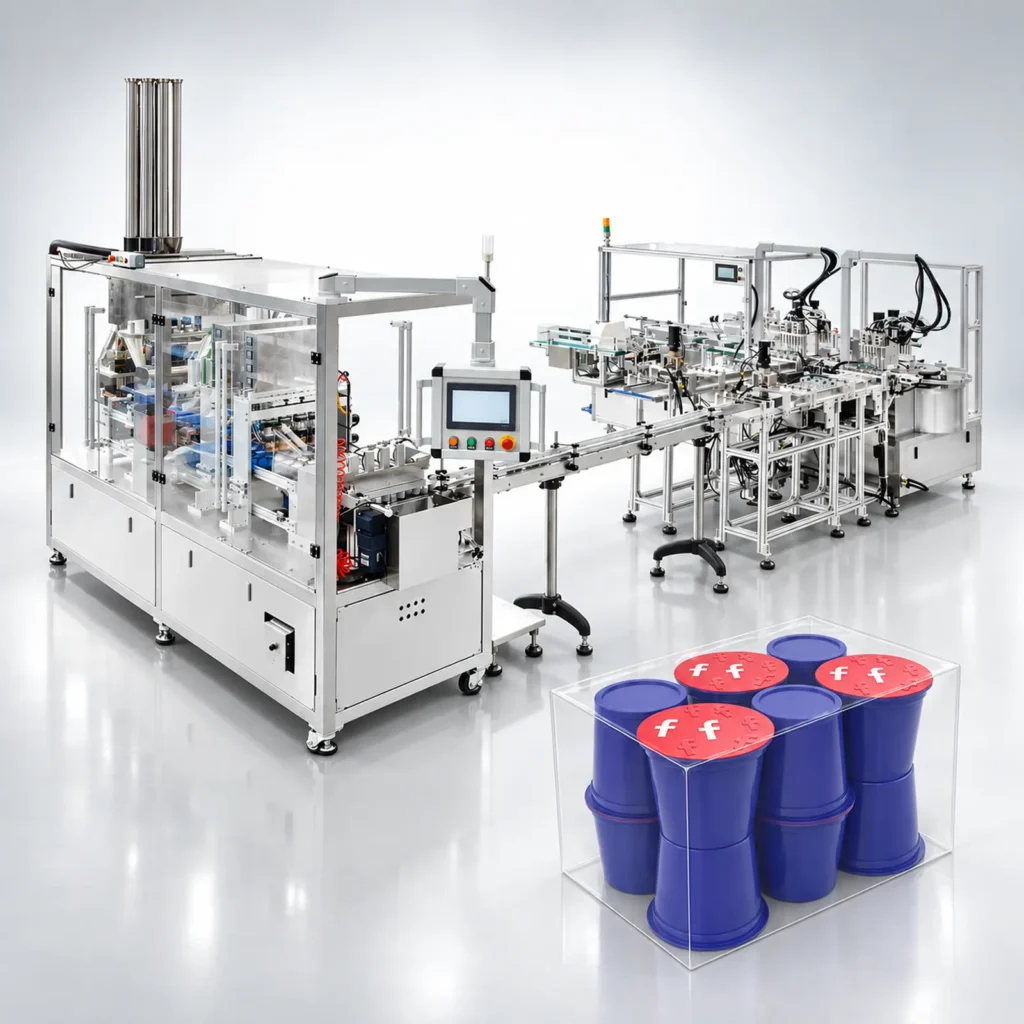
From ground coffee to finished retail cartons. Configure the HB410 from one 50-cup/min channel to a 12-channel line with output up to 600 cups/min, then connect filling, sealing and cartoning in one coordinated workflow.
Designed for coffee brands, roasters and contract packers expanding K-Cup production. Configure the line around your coffee, cups, lids, cartons and factory layout.
Watch the filling, sealing, transfer and cartoning workflow. Final equipment layout is configured for your project.
Key Production Data
| Item | Reference specification |
|---|---|
| Filling configuration | Single-channel to 12-channel K-Cup filling and sealing; standard reference configuration is 4 channels |
| Reference filling output | Approximately 50 cups/min per channel; approximately 200 cups/min in the 4-channel configuration |
| Higher-output configurations | Approximately 300 cups/min with 6 channels, 400 cups/min with 8 channels, 500 cups/min with 10 channels and 600 cups/min with 12 channels |
| Filling range | 5–20 g, subject to product density and cup capacity |
| Standard filling accuracy | ±0.2 g under agreed production conditions |
| With optional inline checkweighing | Approximately 35–40 machine cycles/min; finished cups/min depends on the selected number of channels |
| Standard carton formats | 12 and 24 cups per carton |
| Maximum 12-count cartoning speed | Up to 20 cartons/min with sufficient cup supply |
| Carton format changeover | Approximately 30 minutes, including required change parts |
| Typical staffing | 2–3 trained operators |
Finished-line output is confirmed for your coffee, packaging materials, carton format and inspection requirements. Include replenishment, cleaning, quality checks and planned stops when estimating daily output.
Engineering That Supports Daily Production
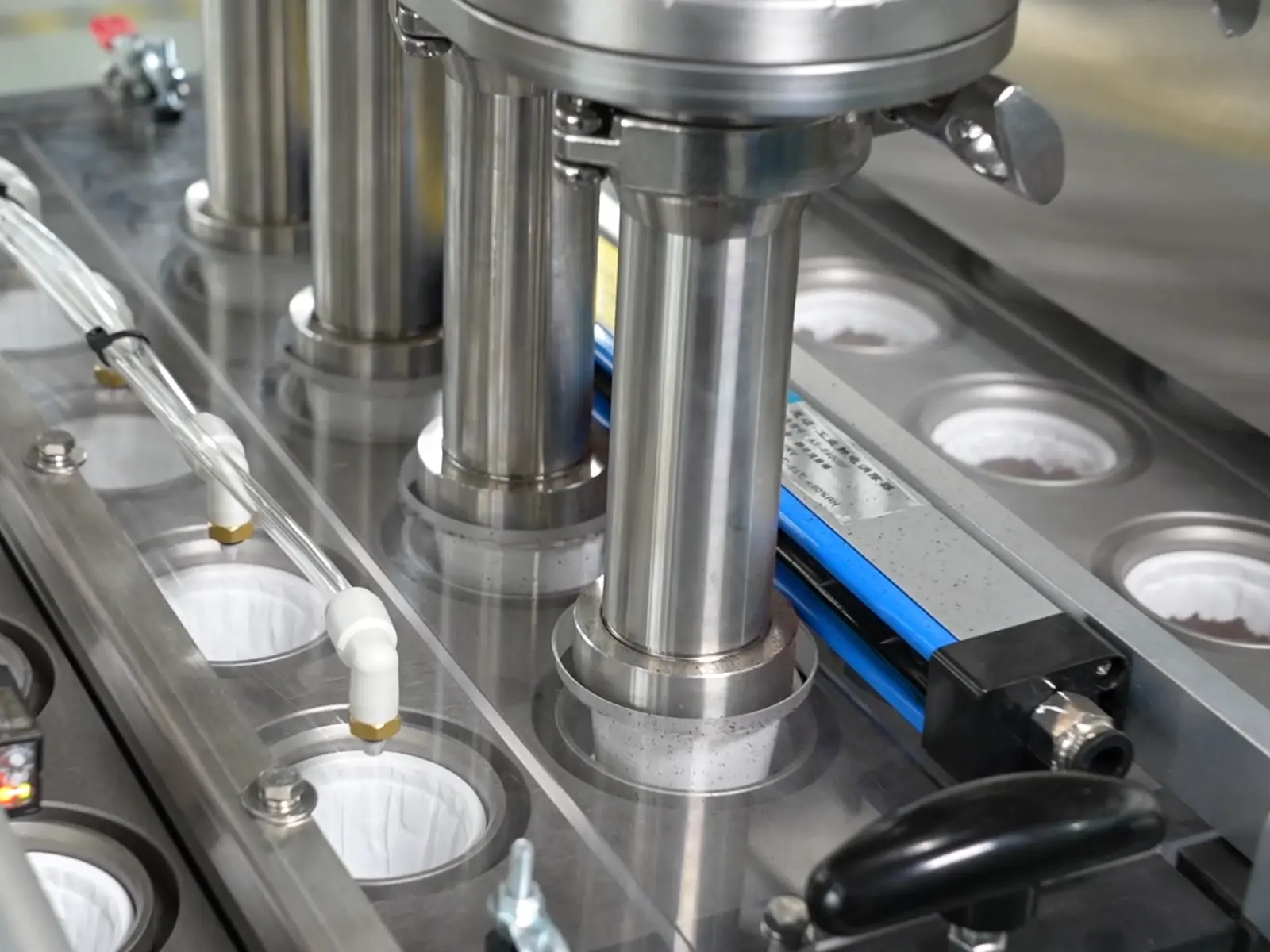
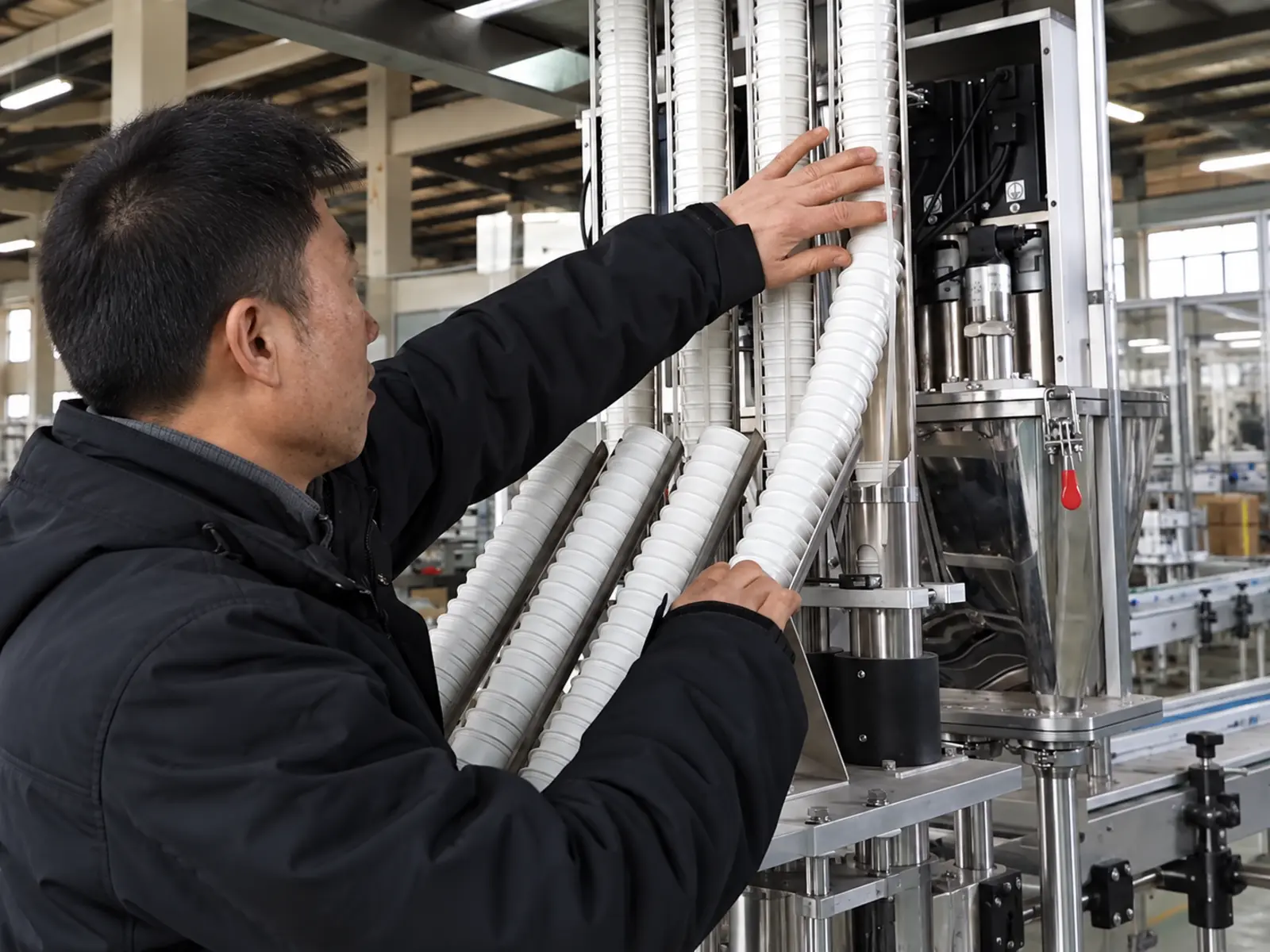
Automatic Coffee Supply
The vacuum feeding system transfers ground coffee from the product supply container to the filling hopper, reducing manual refilling at the machine.
Stable material supply supports consistent dosing. Operators monitor product availability and hopper level throughout production.
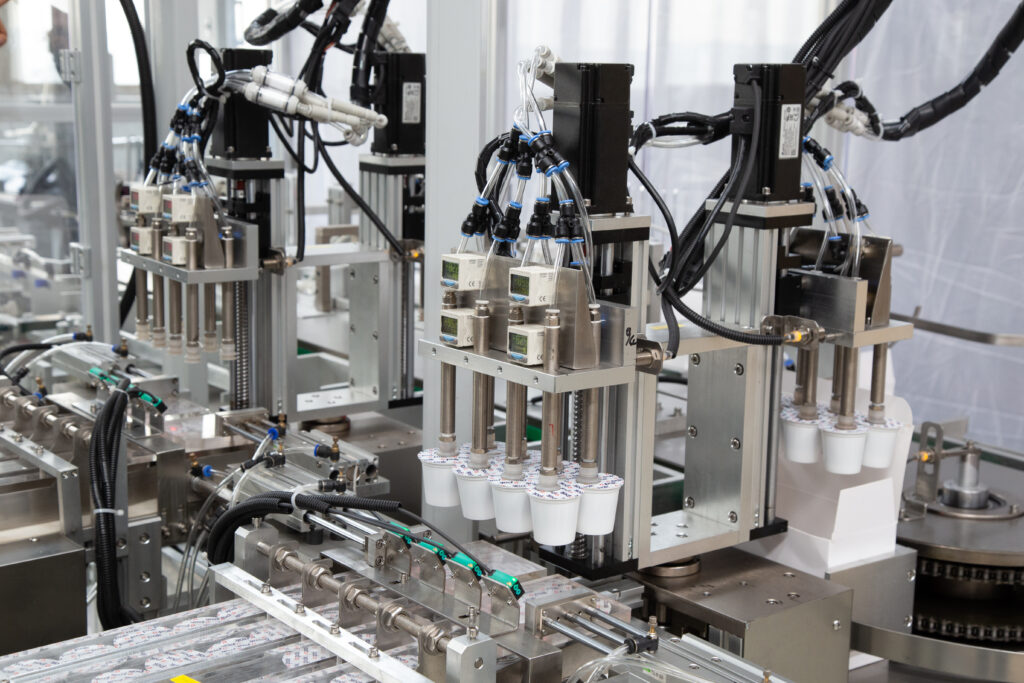
Individually Adjustable Servo-Auger Filling
Each channel has its own servo-driven filling auger, allowing dosing settings to be adjusted for the selected channel configuration. The adjustable filling range is 5–20 g, subject to coffee characteristics and cup capacity.
Standard accuracy is ±0.2 g under agreed conditions. With suitable coffee and settings, and a stable hopper level maintained at approximately 50–70% full, ±0.1 g may be achievable. Results are verified with your product.
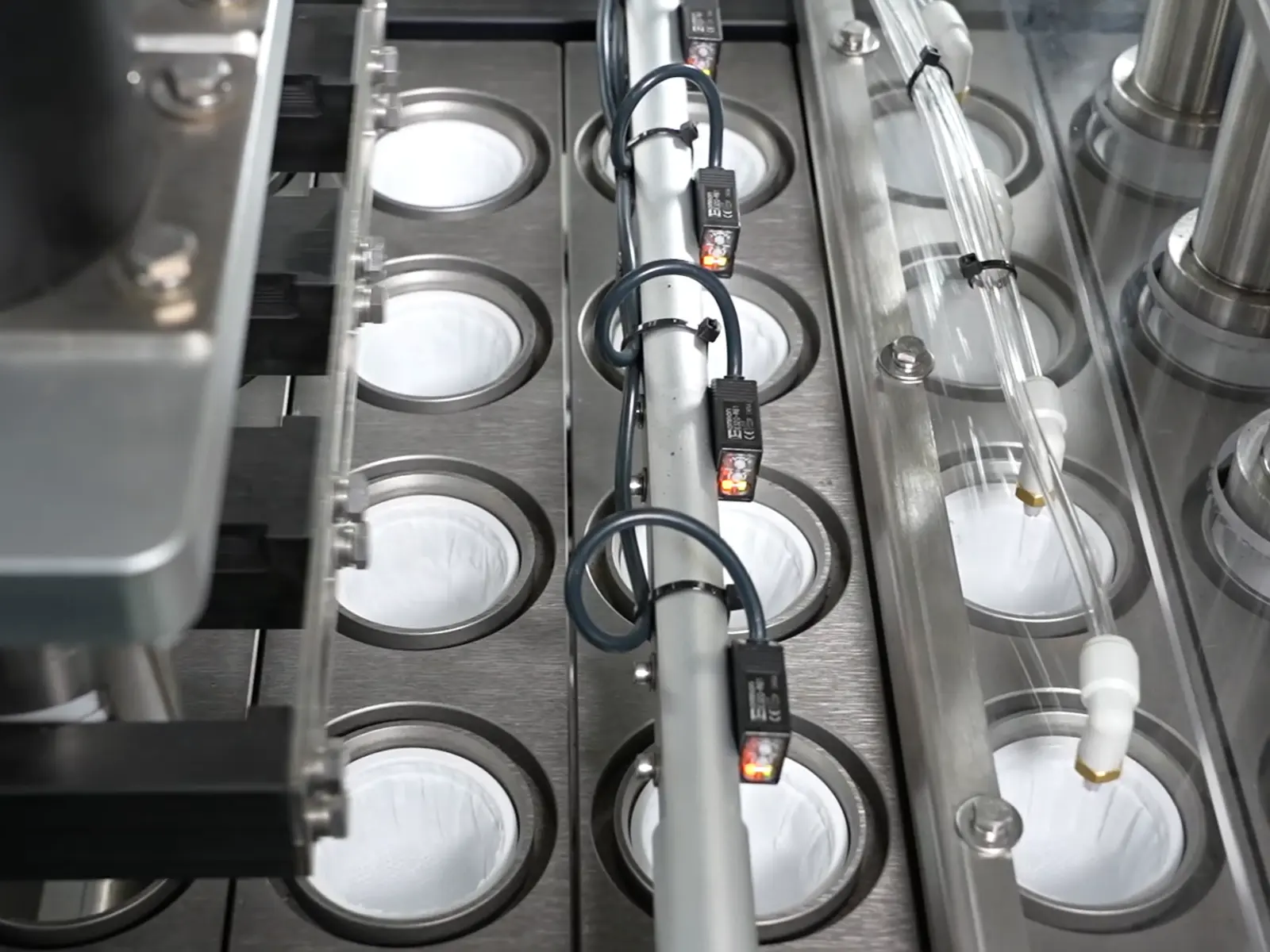
Cup Detection and Nitrogen Purging
Cup-presence detection prevents filling when a cup is missing. Nitrogen purging displaces air before filling and supports product protection through the process.
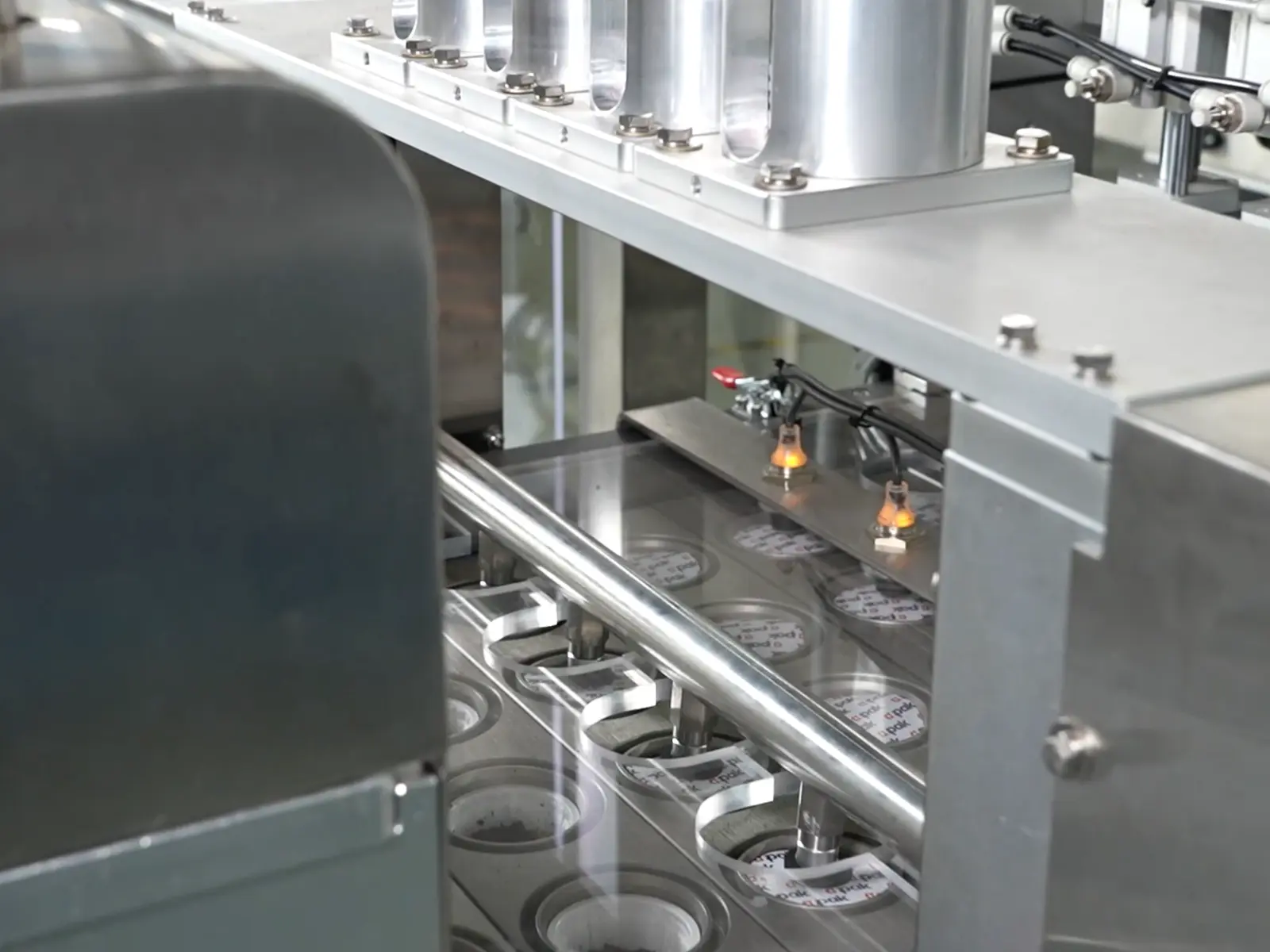
Pre-Cut Lid Placement
The standard K-Cup configuration places pre-cut lids before the two heat-sealing operations. Lid handling is matched to the selected cup and lid materials.
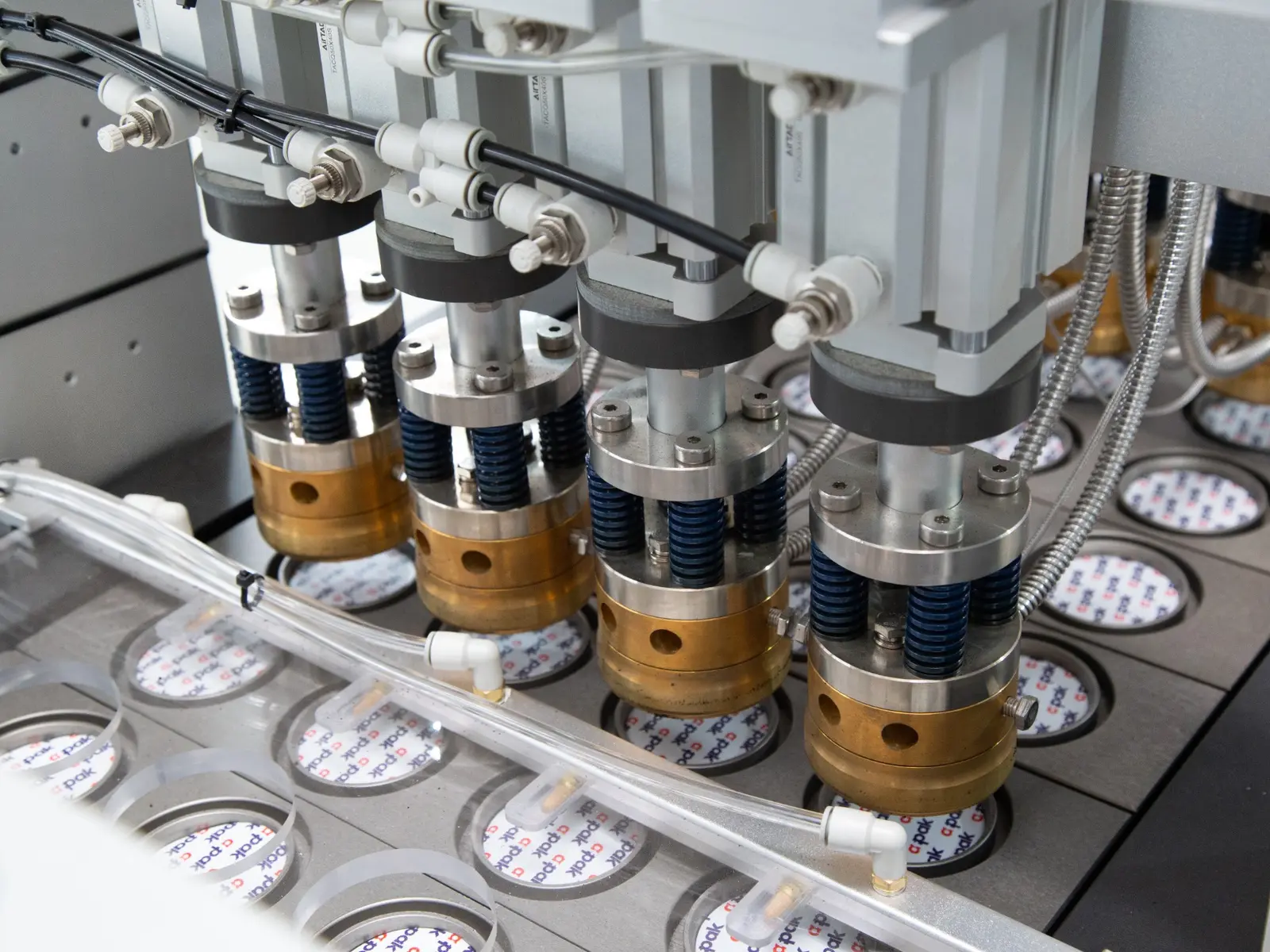
Two Heat-Sealing Operations
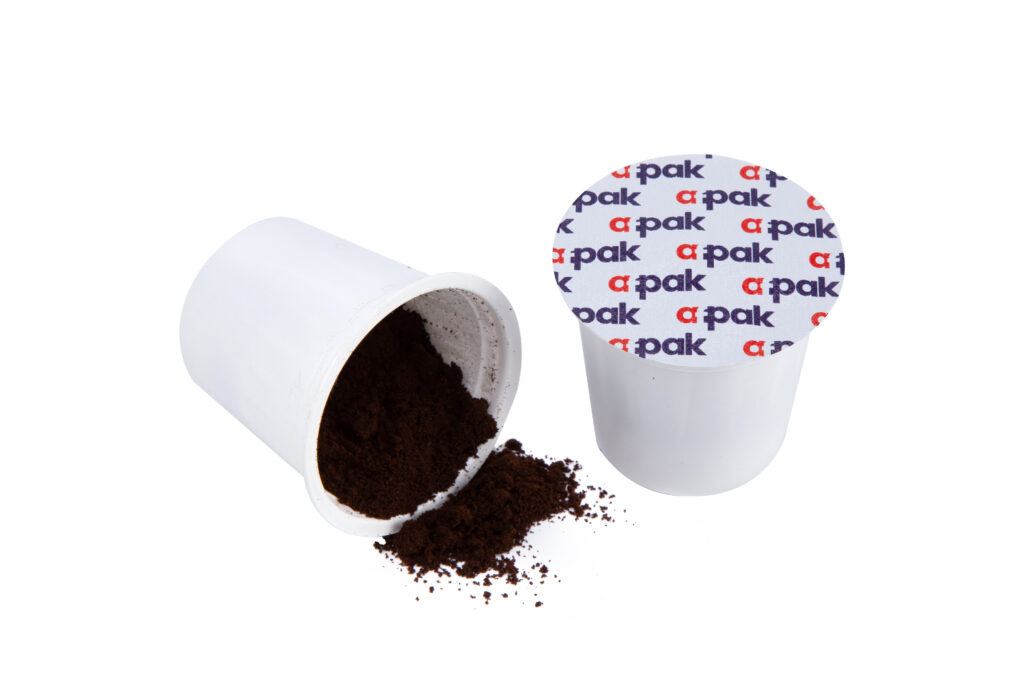
Two sealing operations create the finished K-Cup seal. Sealing settings are evaluated using your actual cup, lid and product.
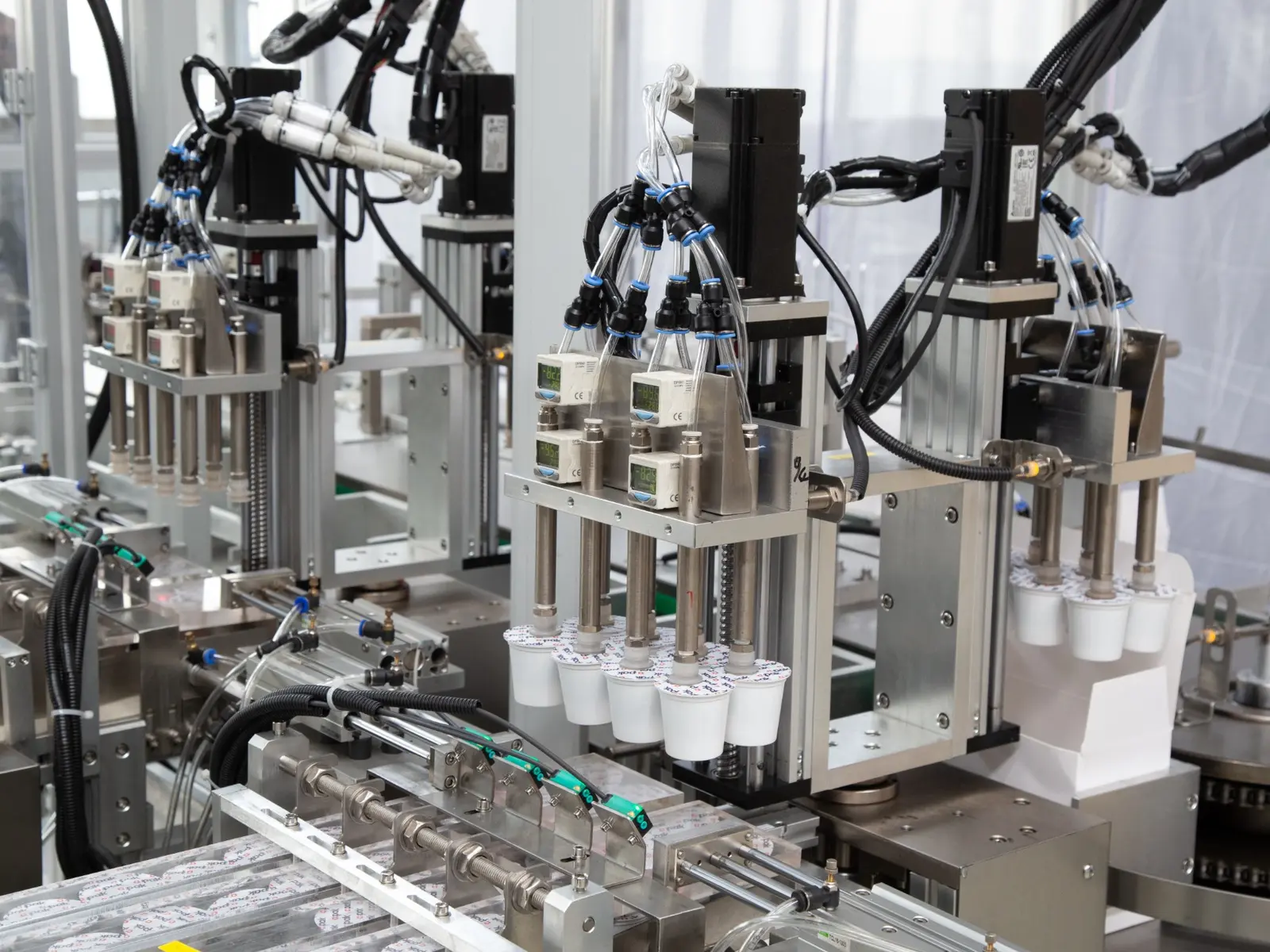
Connected Cup Transfer and Cartoning
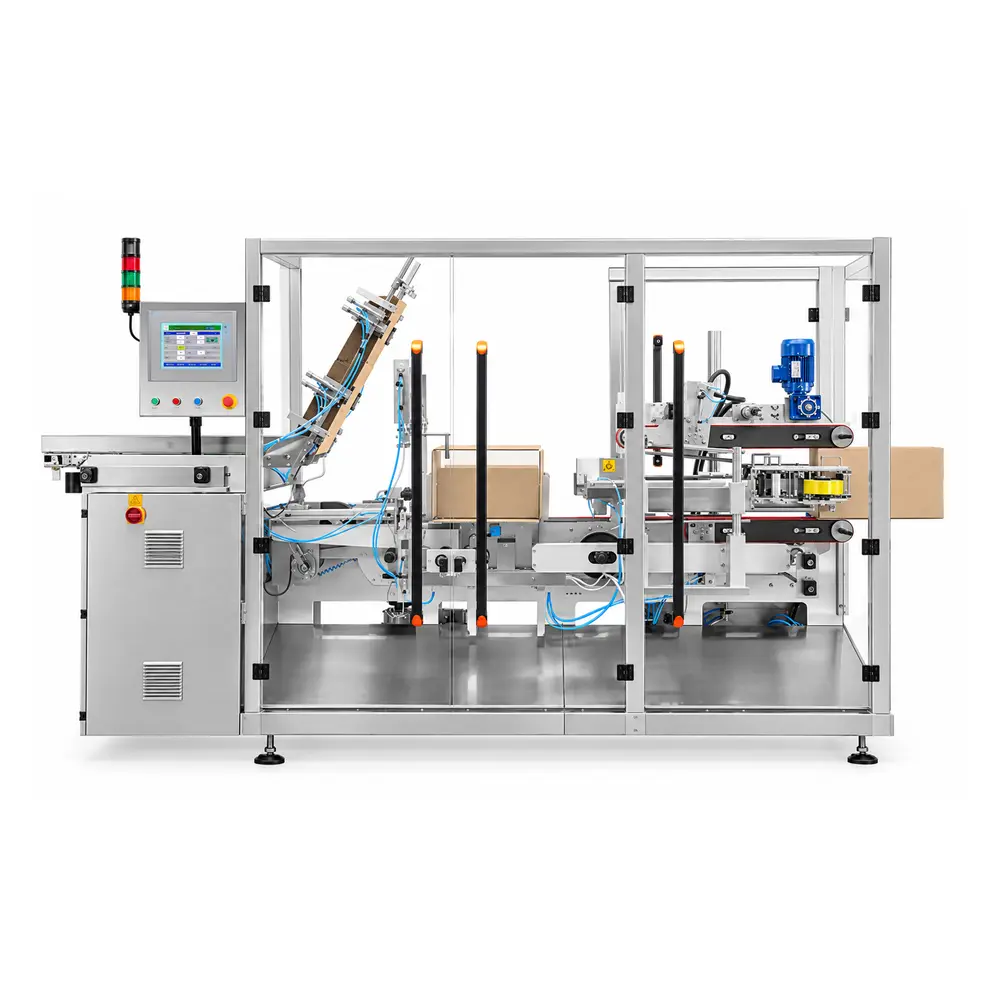
The conveyor connects filling and sealing to cup arrangement and automatic carton loading. The cartoning system opens folding cartons, loads cups and closes cartons with hot-melt glue.
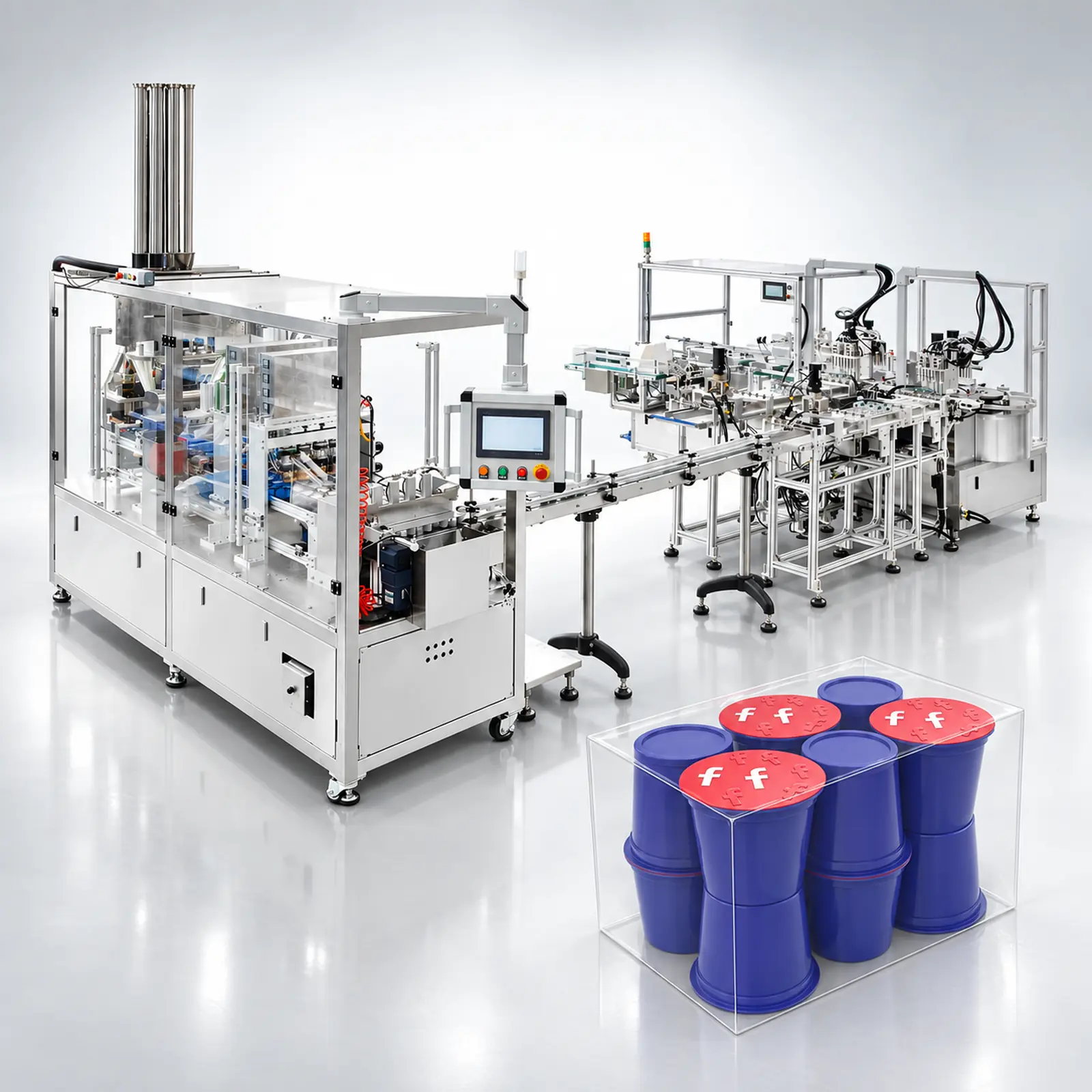
From Empty Cups to Retail Cartons
- Cup Feeding and DetectionPosition cups and check their presence before processing.
- Nitrogen Flushing and FillingIntroduce nitrogen before filling and meter the selected coffee dose.
- Tamping and Rim CleaningPrepare the coffee and remove loose powder from the sealing surface.
- Lid Placement and Double SealingPlace pre-cut lids and complete two heat-sealing operations.
- Optional Inspection and TransferCheck weight and/or leaks, reject defects and convey accepted cups to cartoning.
- Carton Loading and ClosingOpen cartons, load cups, apply hot-melt glue and discharge finished packs.
This is a process overview. The physical station arrangement depends on the selected configuration.
Standard Carton Formats. Custom Packaging Options.
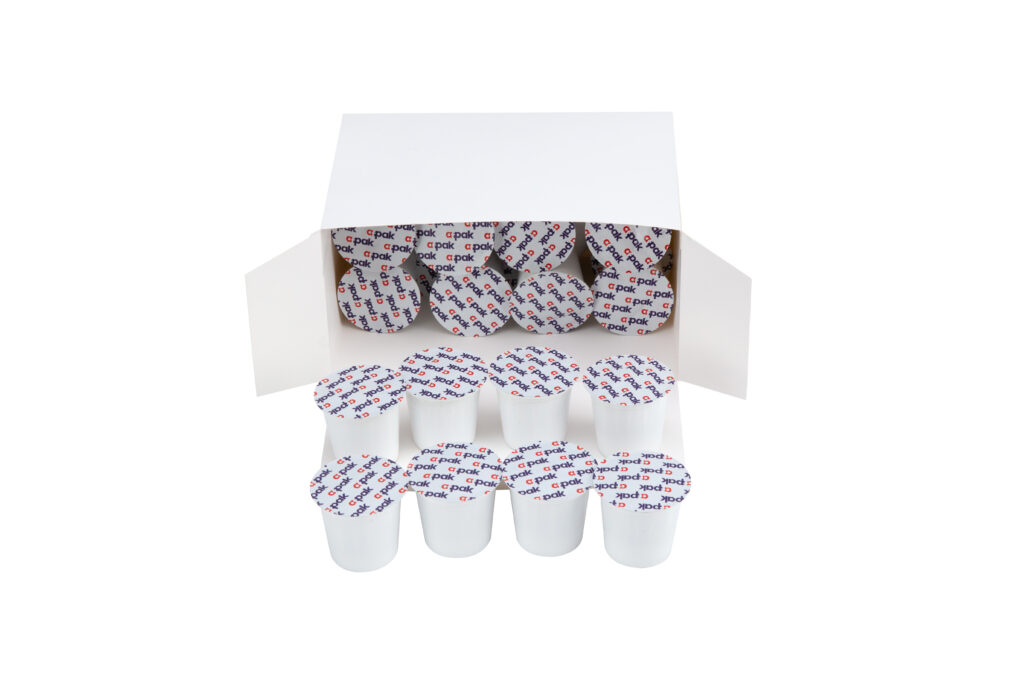
2 × 3 × 2 Arrangement
Six cups per layer across two layers. The approved 12-count cartoning configuration can achieve up to 20 cartons/min when sufficient cups are supplied.
2 × 3 × 4 Arrangement
Six cups per layer across four layers. Output is confirmed for the selected carton, cup-handling arrangement and available filling capacity.
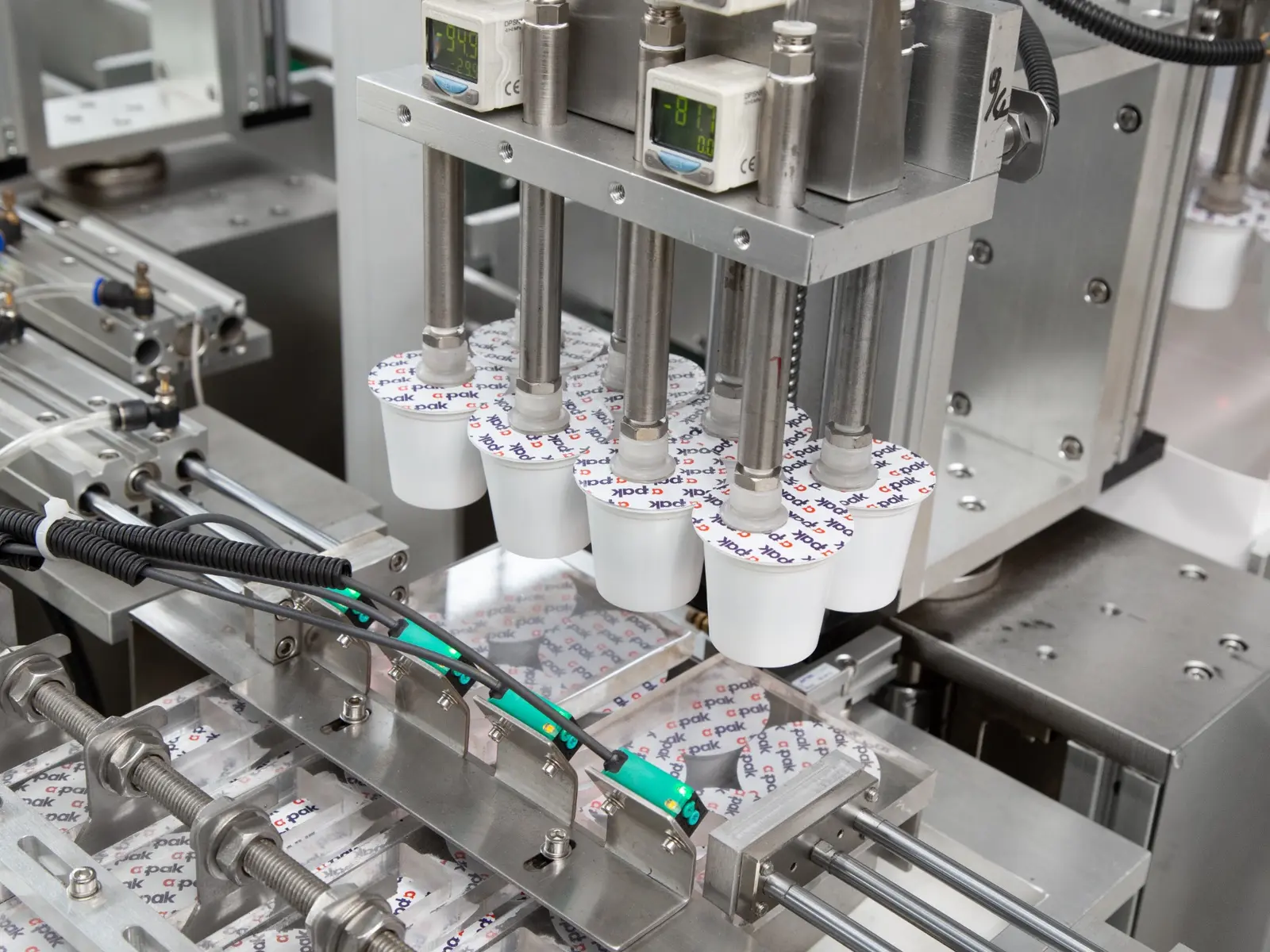
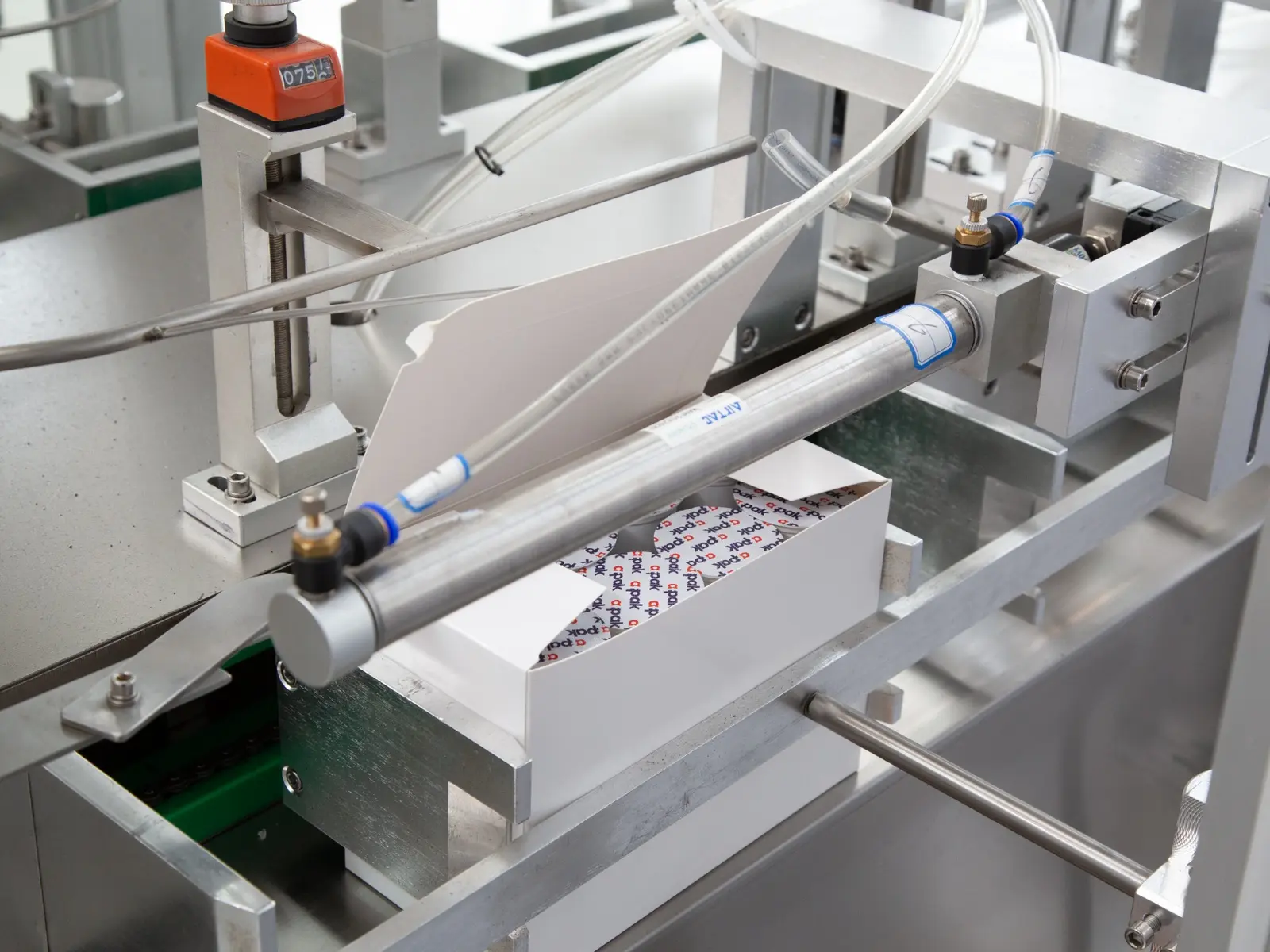
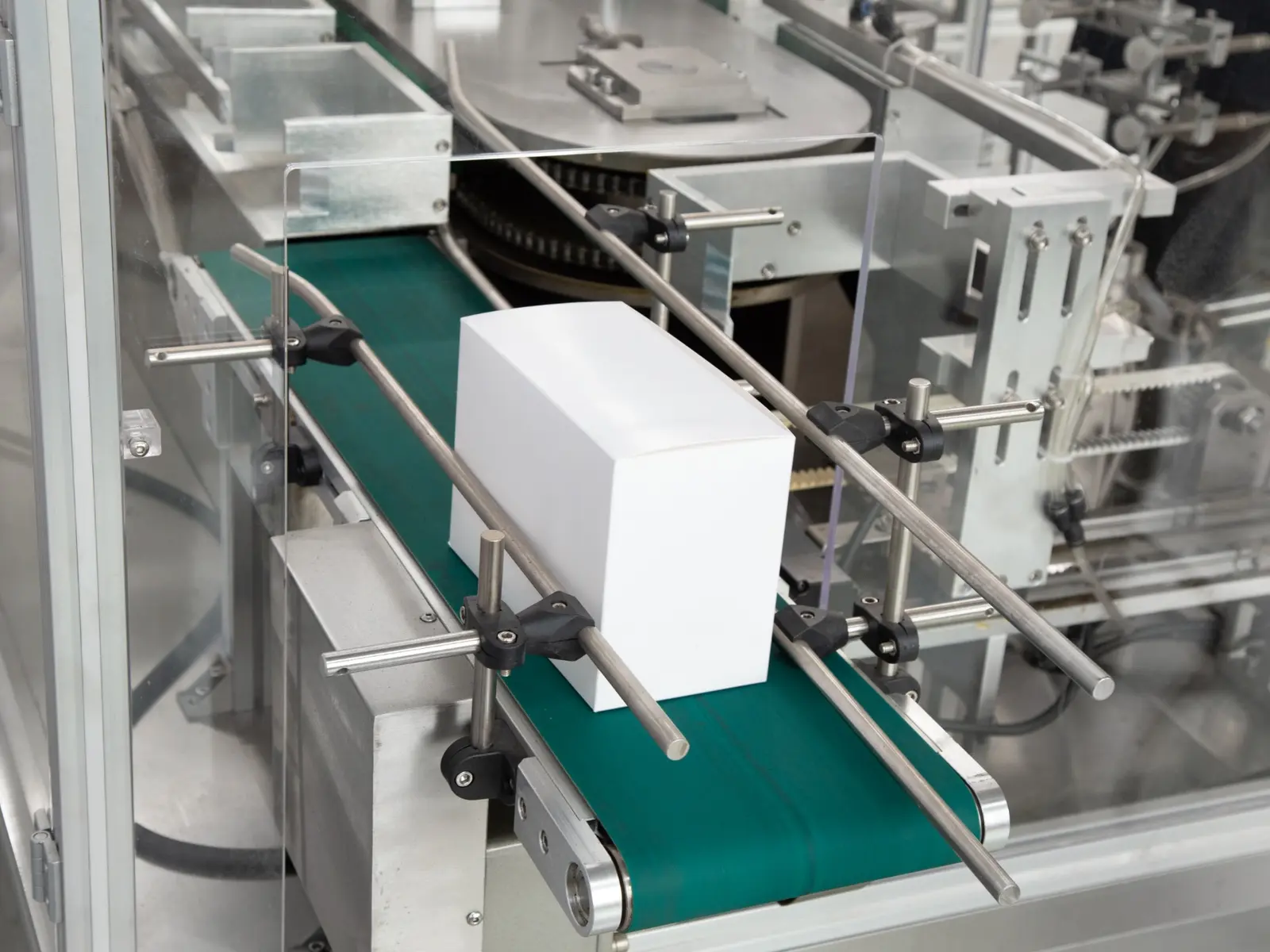
The standard system uses folding cartons with hot-melt glue closing. AFPAK can evaluate custom carton designs and cup arrangements using your drawings and samples. Switching between approved formats requires the corresponding change parts and typically takes approximately 30 minutes.
Match Filling Output to Cartoning Capacity
Plan around both cups per minute and cups per carton. Each channel is designed for approximately 50 cups/min, so the line can be configured from one channel to a maximum of 12 channels.
The standard four-channel configuration provides approximately 200 cups/min. Higher-output configurations are available at approximately 300, 400, 500 and 600 cups/min with 6, 8, 10 and 12 channels respectively.
For example, 20 finished 12-count cartons per minute require 240 cups per minute. A configuration with at least 5 active channels is needed to supply that theoretical cup volume; the nearest listed higher-output configuration is 6 channels at approximately 300 cups/min. AFPAK confirms filling capacity, transfer arrangements and expected finished-carton output together in the technical proposal.
Growing From RN1S to a Four-Lane K-Cup Line
A Production Partnership That Grew With the Business
This customer started K-Cup production with an AFPAK RN1S filling and sealing machine. After approximately one year of operation, continued sales growth led them to invest in an AFPAK four-lane K-Cup production line to expand capacity.
They later added another RN1S machine configured for Nespresso-compatible capsules, extending production to a second capsule format.
Their equipment investment followed the needs of their growing business, from initial production to higher output and a broader product range.
Nitrogen Protection Through Filling and Sealing
Before filling, nitrogen is introduced into the empty cup to displace air. Two nitrogen injection points are provided in the hopper, and nitrogen continues to be supplied around subsequent processing stages through sealing.
The described configuration uses more than 10 nitrogen injection points across the product and cup-processing path. Reference nitrogen consumption is approximately 200 L/min, subject to machine settings and operating conditions.
Residual oxygen and product shelf life must be evaluated using your actual coffee, cups, lids and operating conditions. No residual-oxygen or shelf-life figure is specified without testing.
Inspect Finished Cups Before Cartoning
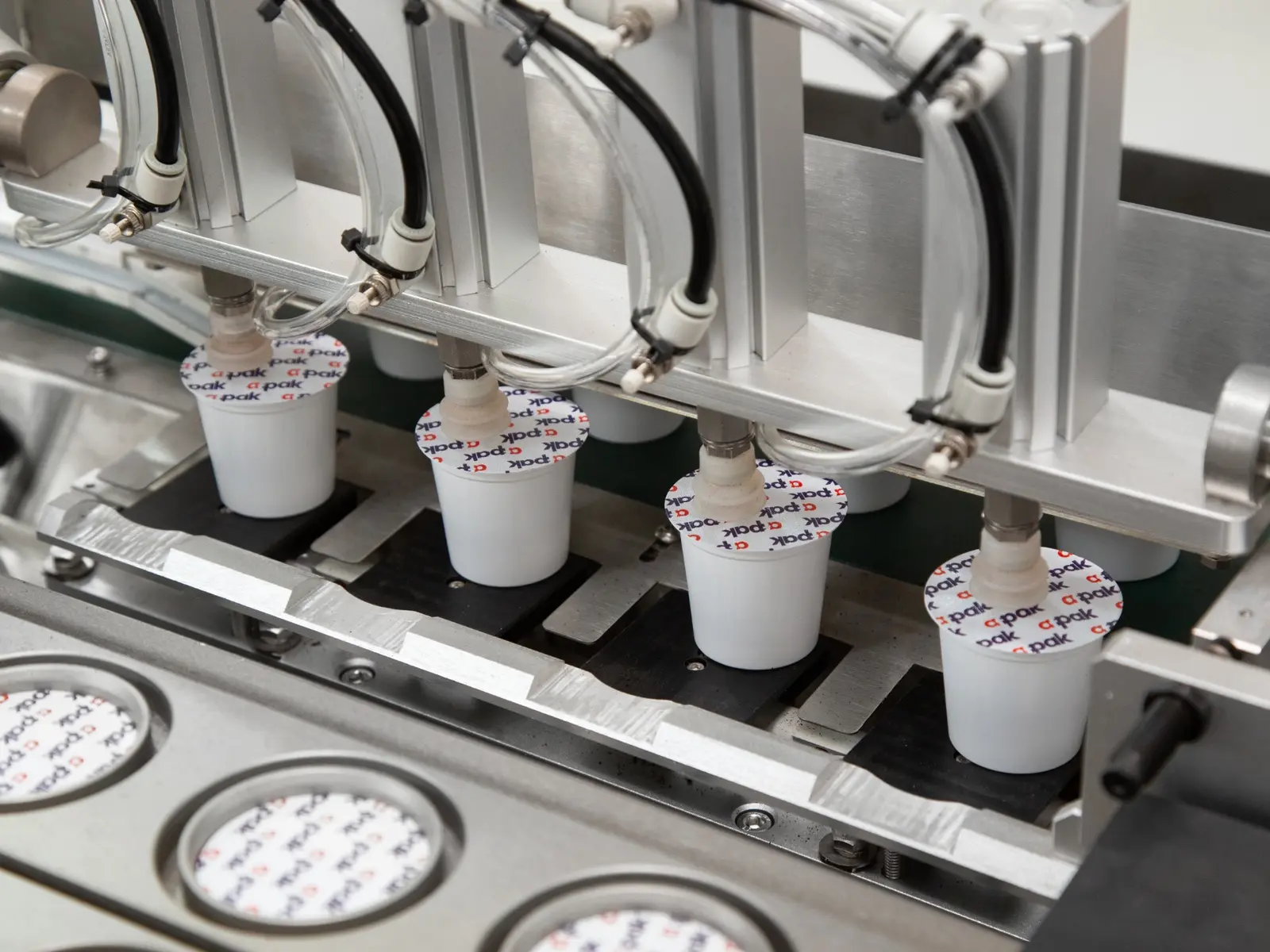
Inline Checkweighing and Rejection
An optional inline checkweigher checks finished cup weight and rejects cups outside the selected limits.
To allow time for the weighing response, the machine typically operates at approximately 35–40 cycles/min with this option. Finished cups/min depends on the selected number of channels; for example, a four-channel line produces approximately 140–160 cups/min at this cycle rate.
Compression-Based Leak Detection
An optional leak-detection system uses two mechanical compression stages to apply pressure to sealed cups. Sensors monitor the pressure response to identify cups that lose pressure.
Cups identified as leaking are rejected before cartoning. Detection settings and performance are confirmed with your cup, lid and product.
Line Scope and Available Options
| Described line scope | Available options |
|---|---|
| Vacuum coffee feeding system | Inline checkweighing and weight-based rejection |
| Filling and sealing module, configurable from 1 to 12 channels | Compression-based leak detection and rejection |
| Nitrogen injection arrangement | Additional carton-format change parts |
| Pre-cut lid handling and two heat-sealing operations | Custom carton formats and cup arrangements |
| Conveyor connecting filling to cartoning | Project-specific line configuration |
| Folding-carton loading and closing system | — |
| Nordson or equivalent hot-melt glue equipment | — |
The final proposal identifies included equipment, selected options, change parts and customer-supplied utilities.
Technical Specifications
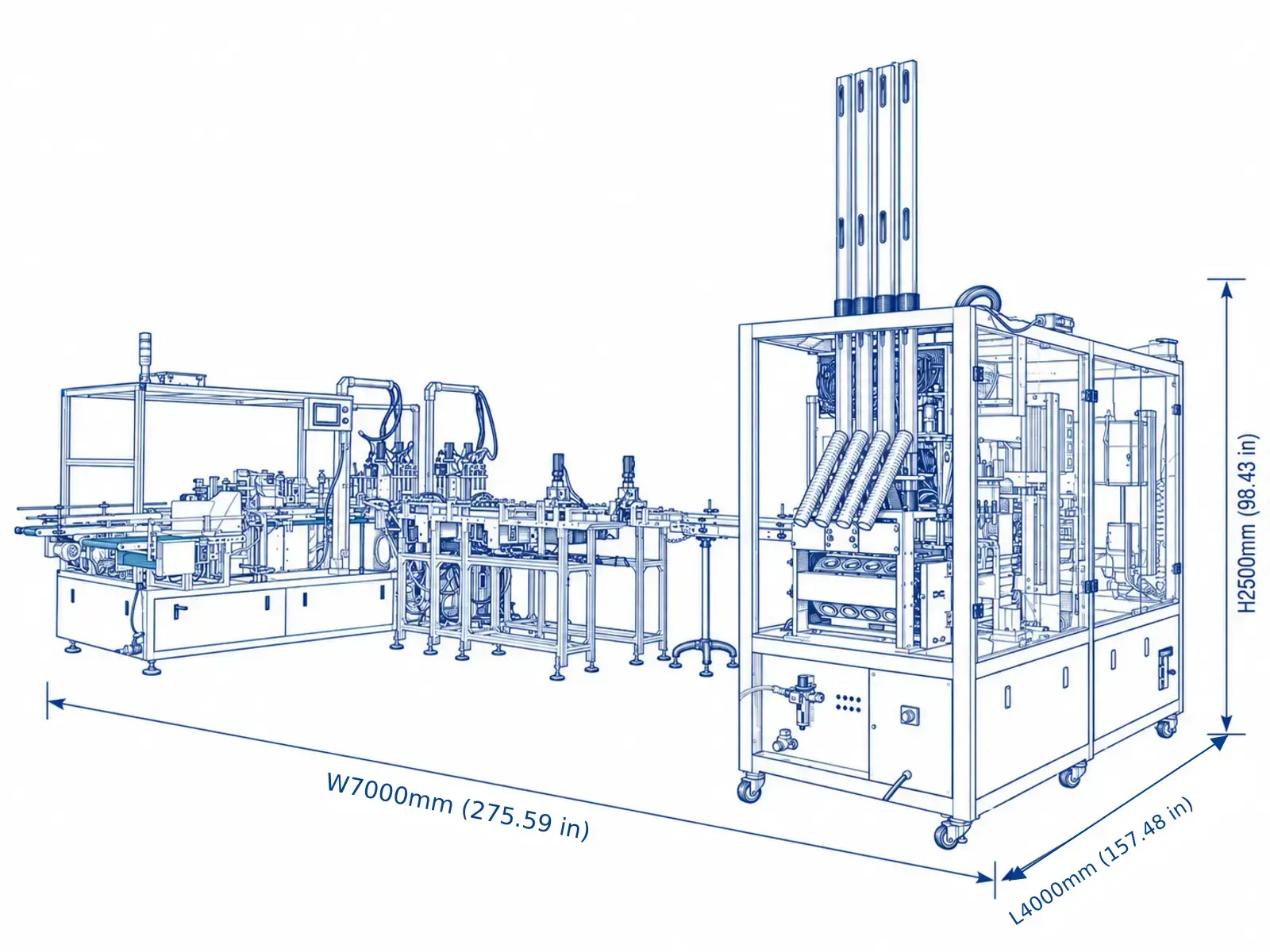
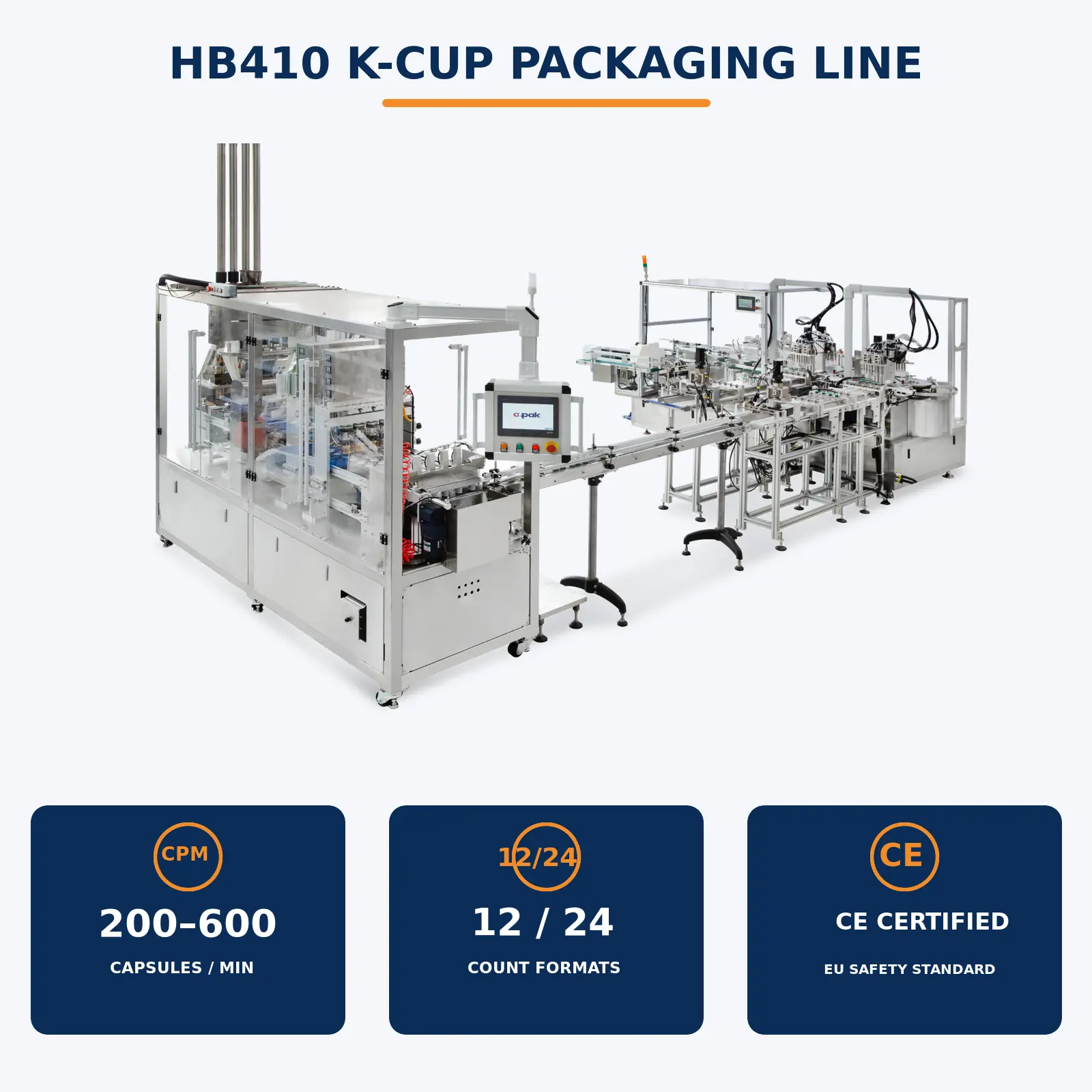
| Parameter | HB410 reference specification |
|---|---|
| Application | Ground coffee in K-Cup-compatible cups |
| Filling channels | 1–12 channels; standard reference configuration is 4 channels |
| Channel output | Approximately 50 cups/min per channel |
| Reference line output | Approximately 200 cups/min with 4 channels; 300–600 cups/min with 6–12 channels |
| Filling system | Servo-driven auger dosing |
| Filling range | 5–20 g, subject to product density and cup capacity |
| Standard filling accuracy | ±0.2 g under agreed conditions |
| Lid and sealing configuration | Pre-cut lids; two heat-sealing operations |
| Standard carton counts | 12 and 24 cups |
| Carton closing | Hot-melt glue |
| Product-contact material | SUS304 |
| Electrical supply | Three-phase 240 V, 50–60 Hz |
| Approximate total power | 12 kW; final rating confirmed in the technical proposal |
| Reference compressed-air consumption | 800 L/min; required supply pressure confirmed for the project |
| Reference nitrogen consumption | 200 L/min; supply requirements confirmed for the project |
| Main component brands | Schneider Electric, Omron, Airtac and other approved brands |
| Hot-melt glue equipment | Nordson or equivalent |
| Typical staffing | 2–3 trained operators |
| Installation dimensions | Provided in the project-specific complete line layout |
| Reference lead time | Approximately 12 weeks from receipt of deposit and required samples |
| Warranty | Two years from machine shipment, subject to contractual terms |
Specifications are finalized for the selected configuration and destination. The approved layout identifies equipment positions and required access for operation, cleaning and maintenance.
Confirm the Line With Your Materials
- Share your requirements. Provide target output, coffee dose, cup and lid specifications, carton count and factory layout.
- Send representative samples. Supply coffee, cups, lids and cartons for compatibility evaluation.
- Review test results. Check dosing, sealing, selected inspection functions and finished-carton presentation.
- Agree acceptance criteria. Confirm operating rate, tolerances, utilities, equipment scope and training arrangements.
Installation, Training and Support
AFPAK provides operating documentation, video guidance and training support to help your team prepare for installation and daily production.
U.S. local support includes remote troubleshooting, live video troubleshooting and local spare-parts coordination. Paid on-site installation and maintenance services are available, with scope and charges confirmed for the project.
The warranty period is two years from machine shipment. Coverage, exclusions and replacement-part arrangements are defined in the sales contract.
Frequently Asked Questions
Can HB410 pack both 12-count and 24-count cartons?
Yes. The standard arrangements are 2 × 3 × 2 for 12 cups and 2 × 3 × 4 for 24 cups. Changing between approved formats requires the corresponding change parts.
What filling capacities are available?
Each channel is designed for approximately 50 cups/min. HB410 can be configured from one channel to a maximum of 12 channels. The standard four-channel line is approximately 200 cups/min; 6, 8, 10 and 12 channels provide approximately 300, 400, 500 and 600 cups/min respectively, subject to product and configuration testing.
Can we use a custom carton design?
Yes. Send carton drawings, samples and your preferred cup arrangement so AFPAK can evaluate loading, handling and closing requirements.
How long does carton changeover take?
Approximately 30 minutes for the defined format change, including replacement of the required change parts.
Is ±0.1 g filling accuracy guaranteed?
The standard reference is ±0.2 g under agreed conditions. With suitable coffee and settings, and a stable hopper level maintained at approximately 50–70% full, ±0.1 g may be achievable. Results are verified through product testing.
Is inline weighing included as standard?
No. Inline checkweighing is optional. With this option, the machine typically operates at approximately 35–40 cycles/min. Finished cups/min depends on the selected number of channels; a four-channel line produces approximately 140–160 cups/min at this cycle rate.
Can the line detect leaking cups?
Yes, with the optional compression-based leak-detection system. It monitors the pressure response of sealed cups and rejects those identified as leaking.
Does 20 cartons/min apply to every configuration?
No. Up to 20 cartons/min is the maximum for the approved 12-count cartoning configuration with sufficient cup supply. Sustaining that rate requires 240 cups/min. Finished-line output is confirmed for the filling capacity, carton format and selected inspection functions.
How many operators are needed?
Typically 2–3 trained operators. Staffing depends on replenishment, quality-control procedures and the factory workflow.
When does the 12-week lead time begin?
The reference lead time begins after AFPAK receives the deposit and required samples. The delivery schedule is confirmed in the project proposal.
What U.S. local support is available?
Remote troubleshooting, live video troubleshooting and local spare-parts coordination are available. Paid on-site installation and maintenance can be arranged, with service scope and charges confirmed for the project.
What information is needed for a proposal?
Send your target output, filling product and dose, cup and lid samples or drawings, carton count and drawing, electrical requirements, factory layout and inspection requirements.
Configure HB410 Around Your Coffee and Cartons
Receive a proposal covering filling capacity, carton format, inspection options, line layout, utilities and service arrangements.
Send your cup and lid specifications, target dose, carton drawing, required output and factory layout.